


The Sixteenth Sunday of Ordinary Time (Year C)
Genesis 18:1-10a
Psalm 15:2-3, 3-4, 5
Colossians 1:24-28
Luke 10:38-42
Some men in a Bible study group were discussing who would make the better wife: Martha or Mary. One said, “I think Martha would make the better wife. The way to a man’s heart is through his stomach. It sounds like Martha knew how to cook. I’d love to be married to a woman like that!” Another man said, “I think Mary would make the better wife. She was thoughtful, sweet and loving. I could be very happy, married to a woman like Mary!” Finally, another fellow settled the argument when he said, “Well, I would like to be married to both of them. I would like Martha before supper and Mary after supper.” Today’s Gospel invites us to integrate the listening spirit of Mary with the dynamic spirit of Martha in our Christian lives.
Many times, this story in our Gospel is explained by saying that Martha was wrong to be so busy and active, and Jesus wants us to be like Mary, contemplative and peaceful. Or that we need to balance the activity of Martha with the contemplation of Mary. That’s closer to the mark. If we read the story carefully (maybe prayerful Lectio Divina on this reading), we might notice that Jesus doesn’t criticize Martha for being busy or active. He corrects her for being anxious and distracted. Not her physical activity, but her spiritual activity. She’s worried about a great many things. Jesus isn’t telling her to stop being active. And he doesn’t necessarily praise Mary for being a better person; just that she’s made the better choice in that moment.
In the Old Testament, there are many words that get translated into English as sin. But in the New Testament, there’s pretty much only one word: hamartía (ἁμαρτία). It means “missing the mark,” like shooting at a target and missing. God gives us principles and circumstances to guide us in virtue and truth, and we can go wrong on either side of the target. The virtue is like Goldilocks: not too much, not too little, but just right.
Martha and Mary are a wonderful illustration of the extremes (missing the target to one side or the other). Mary is contemplative and inactive; Martha is active and anxious. We’re called to be contemplative and active. Jesus says we must be hearers and doers of the Word. He says it in that order, and not the other way around.
In this scene in our Gospel reading, Jesus, the Word of God, Wisdom Incarnate, is there in Martha’s house. Now hospitality was very important. And Jesus didn’t usually travel alone, so maybe there’s a small crowd in the house. But some things take priority over other things. It says Martha was burdened with much serving. Perhaps she had planned to serve a great feast to her visitors. Jesus is calming her down. Martha didn’t have to go all out, when her attention should be on what’s really important… the better portion, the one thing necessary.
Sometimes, many times, we get all worked up about what’s not that important, and then we’re too anxious and worked up to pay attention to the most important thing. If we’re not planning things out and being organized in our thinking and priorities, we’re just going to be putting out fires, taking care of the urgent problems, and not letting some of the less important fires just burn out so that we can be attentive to what’s getting neglected. Children’s sports and activities and jobs are important, sure. But on Sunday mornings, they’re not as important as Church. Teaching responsibility is good. Teaching holiness is better.
We don’t want to be so worried and anxious about what we’re doing that we’ve forgotten why we’re doing it. Martha was so fixated on hospitality that she was missing out on who she was showing hospitality to. She could have fixed a tray of bologna, cheese, and crackers (and maybe some olives or pickles), and then joined her sister at Jesus’ feet.
On the other end, Mary might have provided some support to Martha before Jesus got there, made sure that they had everything ready (of course, we don’t know that she didn’t). The other end of the problem is more like Mary’s end of the spectrum: to be so interior, academic, theoretical, and wrapped up in your thoughts, that you don’t do much of anything. Sometimes it’s called “analysis paralysis”: Getting so locked up in the theoretical that it gets in the way of the practical. Sometimes it’s good to be quiet and still, sometimes it’s good to be active and busy, but only when those are the correct responses to the situation. In this situation, Mary had the right response.
Also, of course, as I kind of hinted at a moment ago, we don’t just want to balance out our action and our contemplation. We want to make sure that our action flows from our contemplation. Our external activity should be the outward fruit of the internal activity of our relationship with God (how sacramental!). We can be doing a lot of things. But if we’re just doing and not praying, then how sure are we that we’re doing the right things? Is what we’re worried about really worth the anguish, or is it really unimportant? Are we focused on the storm we’re going through instead of the Lord who can calm the storm? Are we putting first things first, and everything in its proper priority? Or are we just choosing as we want, or worse, letting circumstances (the urgent fires to be put out) choose for us?
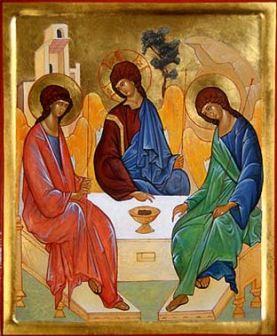
In our first reading, Abraham understood that his guests were more than just three men.  It’s a strange little section of the Old Testament. It says that the Lord visited Abraham, then it presents three men. It keeps shifting between singular pronouns and plural pronouns for the three. Many Christian commentators have said that this could be one of the earliest revelations of the mystery of the Holy Trinity: the Lord as one and three at the same time. But Abraham understood this because of his relationship with the Lord. His prayer life, his relationship with God, gave him the insight into the situation, and allowed him to perceive the truth he needed to respond to. Because he was spiritually attuned, his hospitality was rewarded with a great blessing from God. (This icon is popularly known as “Rublev’s Trinity”, by the 13th c. Russian Andrei Rublev. It is also called “The Hospitality of Abraham.” You can read more about it here). It’s interesting that our readings both have themes of hospitality to the Lord. Moreover, in our gospel reading, St. Luke, who usually calls Jesus by his name, here calls him, “the Lord,” as he’s often referred to in our first reading. Perhaps Luke is deliberately making a connection to our first reading.
Unless we’re dedicated to our prayer life, we’re often missing the big picture, and so we react the wrong way. Martha was distracted about many things, and was so caught up in her momentary concerns that she was missing the big picture. The religious leaders of Jesus’ time were big into the Temple Sacrifices, but they weren’t reading the situation right when the Messiah they had been waiting for actually stood in front of them.
We often want the benefit that Saint Paul had: a brilliant white light, the booming voice of the Lord… what I call “the divine 2×4” (or as a friend has said, “the divine Gibbs slap”). God does sometimes do this, when we’re in a position of really not paying attention to Him, and he really wants to get something through to us. This is a good technique for communicating, but it’s not good for formation, which is what he really wants. He wants to form us into saints by our free will, by our decision to direct our faith, hope, and love to him. He wants us teach us to be His dance partner, to live gracefully, and to be so attuned to His will, that He need only give us the slightest gesture of how to move, how to serve Him, and we respond with grace and joy.
Sometimes, as we see in our second reading, from Saint Paul, we serve Him by our suffering. “Now I rejoice in my sufferings for your sake, and in my flesh I am filling up
what is lacking in the afflictions of Christ on behalf of his body, which is the church, of which I am a minister in accordance with God’s stewardship given to me to bring to completion for you the word of God, the mystery hidden from ages and from generations past.” This verse from Paul’s letter to the Colossians was a major turning point in Dr. Scott Hahn’s conversion story. He was assigned in a class to research this, particularly Paul’s words of filling up what is lacking in the afflictions of Christ. Of course, Christ’s suffering on the Cross was more than sufficient to wipe away all sin. So Paul is not saying that Christ’s crucifixion was not sufficient, not enough. But this verse (and those like it) establish the principle of “redemptive suffering.” What is lacking in the afflictions of Christ is our participation in the mystery. When we suffer, we can “offer it up,” as the Catholic saying goes, uniting ourselves in our suffering to Christ’s suffering on the cross, and so experience meaning to our suffering. Suffering purifies us, if we use it to unite ourselves more deeply into the paschal mystery of Christ’s suffering that takes a way the sin of the world. It’s not that we’re earning our salvation by our suffering, but that we’re disposing ourselves more perfectly to the mystery of Christ’s suffering, and the glory of his triumph. It’s part of the mystery of the life of grace we enter into through baptism: living out the life of Christ, including the death and resurrection, in our own lives.
Also, a bit more of a theological stretch for some, but right there in Saint Paul, is the idea that we can enter into (offer up) redemptive suffering for others. Of course, this is what Christ did, since his suffering wasn’t for himself but for everyone else. Again, it’s not that we offer up suffering that others may have their sins absolved, but rather we offer up suffering (and prayers, fasting, and almsgiving) for others to receive an increase of grace and mercy for them, dedicating whatever good might have been directed toward us to be directed toward them, that they may have that favor. Paul says, “in my flesh I am filling up what is lacking in the afflictions of Christ on behalf of his body, which is the church.” Dr. Hahn said that when he examined the tradition of interpretation for this verse, he divided his findings into three piles: those that were Protestant, but largely unconvincing; those that just skipped over it, and those that sounded the most reasonable, which were Catholic, despite his dislike of Catholicism at the time. It was for him a compelling invitation to consider the Catholic faith with more interest, which of course resulted in his conversion to Catholicism, and his reputation as a popular teacher, writer, and speaker on the Catholic Faith, especially fueled by his great knowledge and love of Scripture from his Protestant upbringing and education.
A true story is told about an advertising executive at Reader’s Digest. In spite of her successful career, she had felt emptiness in her life. One morning, during a breakfast with a co-worker, she mentioned that emptiness. “Do you want to fill it?” her colleague asked. “Of course, I do,” she said. He replied, “Then start each day with an hour of prayer.” She looked at him and said, “Don, you’ve got to be kidding. If I tried that, I’d go bonkers.” Don smiled and said, “That’s exactly what I said 20 years ago.” The woman left the restaurant in turmoil. Begin each morning with an hour of prayer? Out of the question! Yet, the next morning she found herself doing exactly that. And she’s been doing it ever since. Now, she’s the first to admit that it hasn’t always been easy. There have been mornings when she was filled with great peace. But there have been mornings when she was filled with nothing but weariness. And it was on these weary mornings that she remembered something else that her co-worker had said. “There will be times when your mind just won’t go into God’s sanctuary. That’s when you spend your hour in God’s waiting room. Still, you’re there, and God appreciates your effort to be there.” To put God first in our lives, we must be able to trust God with our lives. And to do that, we have to have created a relationship of trust with Him. Relationships only grow by investing time and attention; in this case, to the most important relationship of our life; with Him, whose relationship we hope to enjoy in our heavenly eternal life. That’s the one thing necessary.


 Your neighbor, whom you are obligated to love as you love yourself, is also the people you dislike, the people you’ve been having fights with, the people you ignore, the people who are strangers. And especially, your neighbor is anyone you see who is in need: the vulnerable, the outcast, the poor, and frightened. Your neighbor is every person who is made by God in His image, which is every person. What does it mean to love your neighbor? To do as the Samaritan did: to show mercy, to personally sacrifice, to put yourself out and become vulnerable, to invest yourself (in love) in their well-being and flourishing.
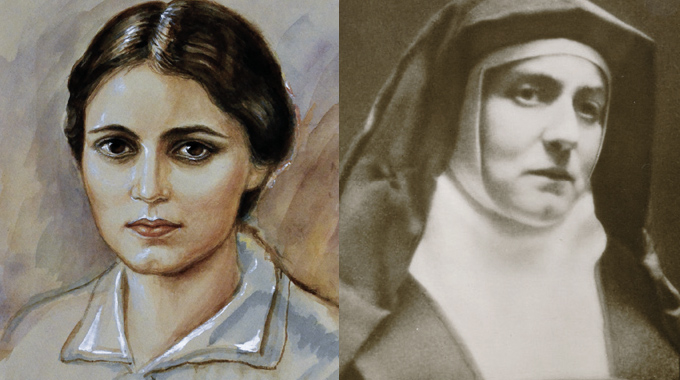 I’ll end with this quote from another Theresa, St. Theresa Benedicta of the Cross (the religious name of St. Edith Stein), who was a Jewish-convert to the Catholic faith, and martyred by the Nazis in Auschwitz. St. Theresa Benedicta of the Cross wrote this, which beautifully summarizes our reflection on the Good Samaritan: “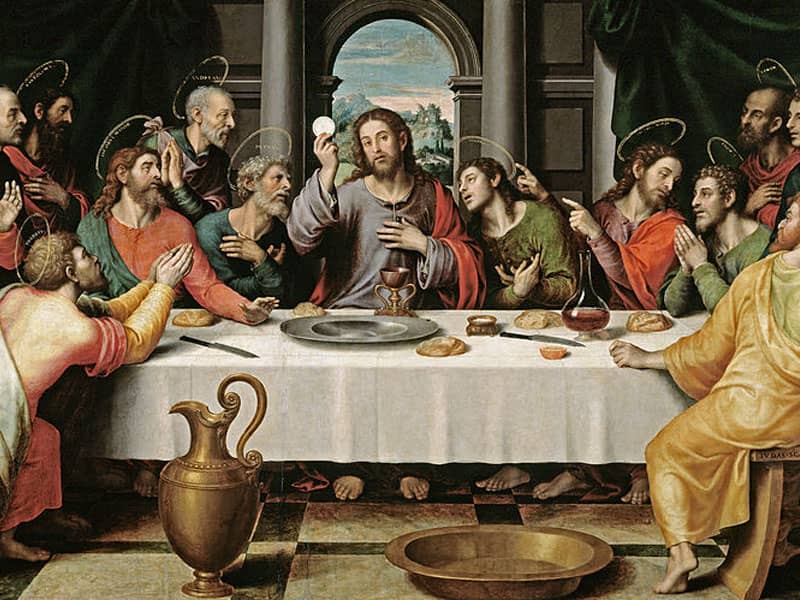


 He is the presence of the Father, the mediator with the Father. He is the ambassador of the Father, and yet He and the Father are one. If you have seen the Son, and if you know the Son, you have seen and know the Father.

 As God made the covenant at Sinai establishing Israel as the People of God, and gave them the Law of the Covenant on the stone tablets, here at Pentecost, in Jerusalem, the city of God’s presence with his people, the Holy Spirit in a similar way establishes the new covenant with the New Israel with his own divine ruah, and fire, and, as the prophets had said, he establishes the new law not carved into stone, but written into the flesh of their hearts.
 humanity, still speaking a single language, decides (as fallen humanity often tries to do in different ways in different ages) to build a giant tower—a siege tower—to take heaven by force. God observes what they’re doing, and divides and confuses their language, reflecting the division and confusion in their hearts and their relationships to Him and to one another. Thus confused and confounded, they each wander off to different parts of the world. But “Babel” is the root for our term “babbling,” that is, making unintelligible sounds. The city that opposes God is also the city of unintelligibility. Opposition to God leads to moral and intellectual confusion, the loss of truth and goodness. And we see this today among those who oppose God’s truth and his Church.

 So where the high priest is praying for the other priests who share in his high priesthood, Jesus, the true high priest, prays for the Apostles, and for their consecration and ministry. Then he begins the third part, which is our gospel reading today. Jesus prays, “
 In our second reading for today, which is the end of the book of Revelation, we have Jesus promising his return, the promise of judgment and justice on the good and the bad, a blessing for the suffering faithful, and finally, the reminder that we want this, we pray for it. The Church, the Bride of Christ, and the Spirit, the love that gives the Church unity, the Spirit and the Bride say to Jesus, “Come!” Let all who hear this say, “Come!” Then in the final verse, John as the narrator joins this chorus, saying, “
 This is the only place that describes Jesus as standing, rather than being seated, at the right hand of God. A king seated on his throne would rise to greet an honored guest, and Jesus stands to welcome Stephen, whose name means “crown,” as the first after Christ to win the crown of martyrdom, of witnessing to his faith in Christ to the extent of giving his life. Stephen had been mentioned earlier as one of the men nominated to be the first “deacons” in the Church, to help the Apostles by ministering to the temporal needs of the Christian community. He was described as a man filled with faith and the Holy Spirit. After testifying to Christ against the Jews who rejected him, Stephen was stoned to death. The description of his death is meant to set a model for future Christians, of imitating (and so, participating in) Christ’s giving his life. Not necessarily by the cause of death, as Jesus was crucified and Stephen was stoned, and later Christians would be killed in a cruel variety of methods. But like Christ, and like Stephen, Christians were to follow the example, in their final moments, of commending their spirit to the mercy of God, and praying for God’s forgiveness for their persecutors.
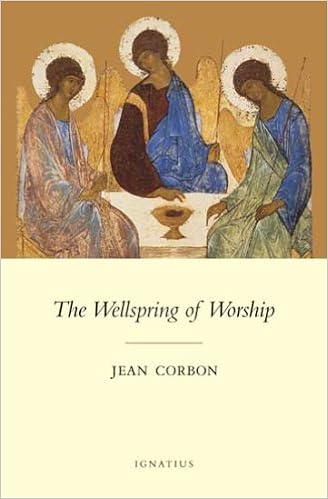 the Ascension as ongoing until the end of time, because the Ascension is the arrival of the Body of Christ into the presence of the Father, and the Body of Christ is all the members of the Church. The members of the Body continue the Ascension, as each one follows Christ, the head of the body, through death, and up into the heavenly banquet of the Father joyfully welcoming home His Son, returning from his mission of rescuing humanity, His Bride, his People, from death, and bringing them into communion with God. It is the supper of the Lamb, the wedding feast of the Lamb and the Bride, united in the Holy Spirit.