
Go to the readings for the 27th Sunday of Ordinary Time (Year A).
Ordinarily, I would try to find a story with a relevant image to help us focus on the theme of the readings, but this weekend, our readings already do that for themselves. For our gospel reading of Jesus giving a parable about the vineyard of the Lord, he is playing off an Old Testament image, which is given as our first reading. And not only does it unveil the image at the end of the reading, that “The vineyard of the LORD of hosts is the house of Israel,” but then that gets repeated throughout our responsorial psalm which in a more poetic form, just retells the image of the first reading from the prophet Isaiah. But of course, Jesus brings a new twist to it, as he continues his confrontation with the chief priests in the temple, following up from the last few weeks.
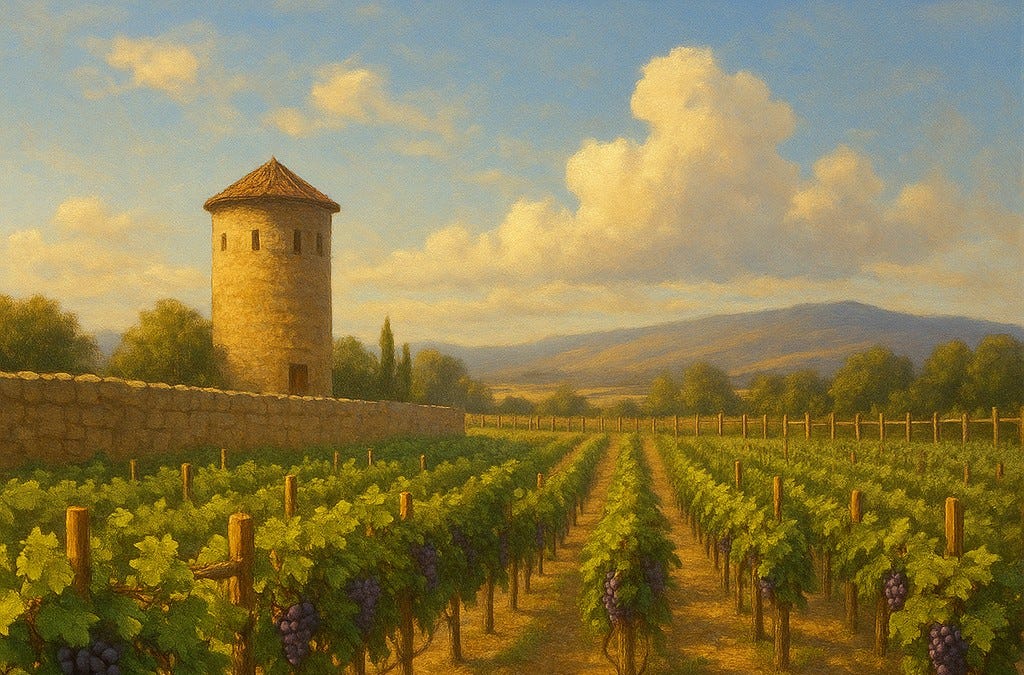
Isaiah presents his image as a song, often called “The Song of the Vineyard.” “Let me now sing of my friend, my friend’s song concerning his vineyard. My friend had a vineyard on a fertile hillside…” of course to the prophets and holy ones such as Isaiah, they are friends of the Lord, in a blessed intimate relationship, and what pains the heart of God, pains his friends as well. Isaiah gives this image of how the Lord has cared for Israel, setting them up in his holy land, clearing away the stones, the obstacles; building a wall, the Lord is their protection; setting up a watchtower, the holy leaders and messengers to protect them from sin and corruption; and hewed out wine press; the call for Israel to bear good fruit and produce from the blessings they had received. But they brought forth wild grapes, poor quality, unusable grapes. The original Hebrew is closer to “rotten grapes; grapes that stink.” In other words, they brought forth corruption, injustice, and idolatry.
Then interestingly the narrative shifts from Isaiah talking about his friend, to God speaking directly. “Now, inhabitants of Jerusalem and people of Judah, judge between me and my vineyard: What more was there to do for my vineyard that I had not done? Why, when I looked for the crop of grapes, did it bring forth wild grapes?” Why, God says, when I had given them everything, the covenant, the law, the prophets, the leaders, the land flowing with milk and honey, do I get back a harvest of sin and corruption and injustice and idolatry?
And God then tells Israel that because of their corruption and their turning away from him, he will allow the vineyard to be trampled. Or to use a more popular phrase, “He is trampling out the vintage where the grapes of wrath are stored. He has loosed the fateful lightning of His terrible swift sword.” And his sword is the Assyrian Empire, whom God permits to ravage the vineyard. As always, though, God’s will is love; his desire is for the repentance of his beloved Israel. And he will even later punish Assyria for being too cruel in their violence and too proud in their victory over Israel, when it was God who had given them the victory, and only for the corrective chastisement of his own people.
We see in Psalm 80 the prayer repentance of Israel using this same image: “Once again, O LORD of hosts, look down from heaven, and see; take care of this vine, and protect what your right hand has planted… Then we will no more withdraw from you; give us new life, and we will call upon your name. O LORD, God of hosts, restore us; if your face shine upon us, then we shall be saved.”
When we jump to the Gospel reading, we Jesus capitalizing on this Old Testament image of the Vineyard of the Lord. Of course, the chief priests, elders, and scholars would know this image well, but it was a very-well known image to all of Israel. And so Jesus lays out a similar beginning. “There was a landowner who planted a vineyard, put a hedge around it, dug a wine press in it, and built a tower. Then he leased it to tenants and went on a journey.” So here Jesus is focusing specifically on those entrusted with the care of the vineyard of Israel on behalf of God. Not that God ever left—he’s not an absentee God—but that Israel, particularly in its leadership—was to be a good and holy steward entrusted with the good of Israel. And that, as God had said, for the good of the whole world, that all the nations were to be able to look to Israel as the most just, most holy, most well-ordered and functional society in the world, a light to the nations, because of their close relationship with the one true God. And this was supposed to draw all nations to God. But just like Adam and Eve messed up their role in the divine plan (to the detriment of others), so did Israel.
“When vintage time drew near, he sent his servants to the tenants to obtain his produce. But the tenants seized the servants and one they beat, another they killed, and a third they stoned. Again he sent other servants, more numerous than the first ones, but they treated them in the same way.” These of course are the prophets, whom God sent to set Israel back on course, to recall them to faith and justice, to their mission and identity. And rather than repent and change from their ways of corruption, they literally tortured and killed the messengers.
“Finally, he sent his son to them, thinking, ‘They will respect my son.’ But when the tenants saw the son, they said to one another, ‘This is the heir. Come, let us kill him and acquire his inheritance.’ They seized him, threw him out of the vineyard, and killed him.” In ancient Israel, if a landowner died without an heir, the property became unoccupied land that went to the first claimant. The tenants had the first opportunity to claim by occupation. By killing the son, whom the master sent as the highest representative of himself, and who ought to have been owed the greatest respect, the tenants reveal their corruption in wanting to rule themselves by their own corruption, freed of the meddling reminders of the landowner that this was actually his land and they were merely stewards responsible to him for their care of the vineyard. Of course, Jesus knew the hearts of his opponents, and even foretells that he will be killed outside the walls. A killing within a vineyard would spoil the vineyard and make it ritually unclean according to their laws. And Jesus will indeed be led outside the city walls, to the place called Golgotha, and crucified outside the city. If you consider it carefully, from a certain point of view, Jesus is shining the light of truth on the corruption of their hearts, because he loves them, too, he desires their repentance and healing. But they are set in their corruption, and their course of ultimate self-destruction.
Jesus then springs what you would think would be the trap to alert his opponents that he’s on to them. He asks them, “What will the owner of the vineyard do to those tenants when he comes?” They answered him, “He will put those wretched men to a wretched death and lease his vineyard to other tenants who will give him the produce at the proper times.” One of the effects of sin is a glaring lack of self-awareness. Ask any recovering addict how long and what it took them to admit they were an addict. It might be, but shouldn’t be, surprising how harsh their response is, given that everyone else understands that Jesus is talking about them. The opponents think they’re being righteous in proposing a harsh punishment against the unjust. And perhaps because they might be rich land-owners too, they’re on the side of the vineyard owner being treated unjustly by bad workers.
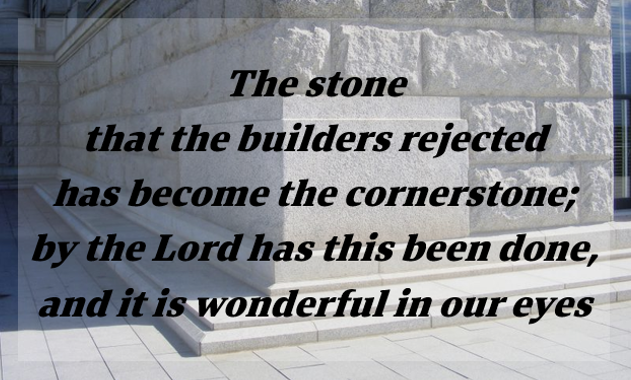
But then Jesus snaps the trap shut on them. “Jesus said to them, ‘Did you never read in the Scriptures: The stone that the builders rejected has become the cornerstone; by the Lord has this been done, and it is wonderful in our eyes?’”
Jesus quotes Psalm 118, which is considered a psalm about the Messiah, and the expectation of a new Jerusalem and a new Temple. And for each person, the Messiah will be either the cornerstone for them, the foundation of their life of holiness, or a stumbling block for them, who reject him. So Jesus is here essentially revealing his identity as the Messiah, that he is the Son of God, the owner of the vineyard. And this is in the Gospel of Matthew, in case you hear people say Jesus didn’t claim to be the Messiah or the Son of God, except maybe in the gospel of John. Nope. Jesus never says the words, “I am God,” outright. But in all the gospels he says it in many, many ways for those who have ears to hear and hearts to understand and accept the truth with the gift of faith.
Our gospel reading ends with Jesus’ prophesying to them: “Therefore, I say to you, the kingdom of God will be taken away from you and given to a people that will produce its fruit.” And of course that is the fulfillment of the Psalm he just quoted. The Church is the New Israel of the psalm. The New Temple is each of us, living stones of the New Temple, and individually temples of the Holy Spirit by our baptism. It is the Church whose cornerstone is Jesus, the Messiah, the Christ, the Son of God.
But it’s also a warning to the Church. The Church has the obligation to be faithful and holy stewards of the mystery of the Kingdom, the call to bear the fruit of the vineyard which is entrusted to its care. Every time the Church has faltered in this, it has led to divisions splitting away with false teachings and false claims of authority. Or it has led to great human suffering, such as its cruel treatment of dissidents in the middle ages, or 17th century Catholics participating in the use of slaves, or even the sexual abuse crisis. The Church is called to be holy, set apart, a city on a hill to shine its light out upon the world. And it can be frustrating, even scandalizing, when we see the Church failing to fulfill that call.
And it’s also a warning to us individually. This is related to Jesus’ parable of the 3 servants entrusted with their 1 or 5 or 10 talents, expected to yield a return for their master. What is the inward and outward fruit of our faith? We must each return fruitfulness to God for the care he has shown us, the resources he has entrusted to us, the protection he gives us, the mercy he shows toward us, and the grace of his life he has planted within us. Jesus assures us that it is a matter of “use it or lose it.” We must each choose Jesus as the cornerstone, the foundation, of our life of virtue and grace. We must continually return to the fount of living water: the sacraments of grace and the words of salvation, which water the seeds of faith within us that we might grow more into the image of Christ, who is the Bread of Life and the Living Word. Then as Saint Paul says, “Finally, brothers and sisters, whatever is true, whatever is honorable, whatever is just, whatever is pure, whatever is lovely, whatever is gracious, if there is any excellence and if there is anything worthy of praise, think about these things. Keep on doing what you have learned and received and heard and seen… Then the peace of God that surpasses all understanding will guard your hearts and minds in Christ Jesus.”


