
Go to the readings for the Solemnity of Christ the King (Year A).
In 1922, the Holy Father Pope Pius XI published his first encyclical, “Ubi Arcano Dei Consilio,” in which he exhorted the faithful to seek “the Peace of Christ in the Kingdom of Christ.” Three years later, in 1925, Pope Pius XI published the encyclical “Quas Primas” establishing today’s solemn feast of Christ the King. It was written in the aftermath of World War I, which saw the chaos and trauma of the fall of many historical (Christian) monarchies. In contrast, Pope Pius XI pointed to a king “of whose kingdom there shall be no end”.
The pope had recognized that the people had “thrust Jesus Christ and his holy law out of their lives,” believing “these had no place in public affairs or in politics.” The Pope attributed the increasing denial of Christ as King to the rise of secularism throughout Europe. At the time of Quas Primas, many Christians (including Catholics), had begun to doubt Christ’s authority and existence, as well as the Church’s power to continue under Christ’s authority, because they had been witnessing the rise of non-Christian dictatorships in Europe. These dictators often attempted to assert authority over the Church. New regimes were being established, or at least the seeds being sown, that not only rejected the Church and Christian wisdom, but were horrifically oppressive to the Church, and often ultimately to human dignity and freedom: The Bolshevik revolution in Russia, the beginnings of Mussolini’s fascism in Italy and Hitler’s Nazis in Germany, and the Cristero War in Mexico.
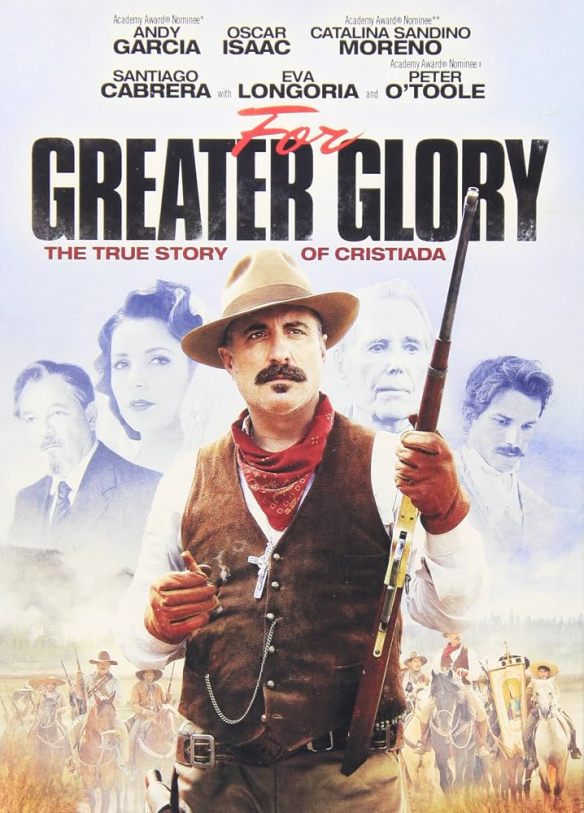
In this war in Mexico, a totalitarian regime gained control of Mexico and tried to suppress the Church, penalizing priests for wearing clerical garb in public, placing religious buildings under state ownership, closing church schools, and banning public religious instruction. To resist the regime, many Christians took up the cry, “Viva Cristo Rey!” [“Long live Christ the King!”] They called themselves “Cristeros,” and their resistance movement was called the “Cristiada.” The most famous Cristero was a young Jesuit priest named Padre Miguel Pro. Using various disguises, Padre Pro continued ministering and bringing the Sacraments to the people of Mexico City. Finally, the government arrested him on false charges, and sentenced him to public execution. The president of Mexico (Plutarco Calles) thought that Miguel Pro would beg for mercy, so he invited the press to the execution. Pro did not plead for his life, but instead holding the crucifix in his right hand, he extended his arms and shouted, “Viva Cristo Rey!” At that moment the soldiers fired. The pictures of his execution were published in Mexican newspapers to intimidate Catholics, but they were treated as holy pictures by the faithful and had the opposite effect. We celebrate the feast day for the martyr Blessed Miguel Agustin Pro tomorrow, November 23. For a taste of the times, you might want to watch the 2012 movie “For Greater Glory,” produced by the Knights of Columbus.
(Note: The Knights of Columbus condemned the persecution at its 1926 National Convention, and sent a delegation to President Calvin Coolidge, helping form the National League for the Defense of Religious Liberty. The Knights raised $1M to support the Mexican victims of religious persecution and established seminaries in the United States for displaced Mexican seminarians. Over 70 Knights of Columbus were killed during the Cristero war. Nine of those Knights have been beatified or canonized as martyrs, and Pope Pius XI repeatedly praised the Knights of Columbus in his 1926 encyclical Iniquis Afflictisque for their exemplary response.)
Initially celebrated on the last Sunday of October, after Vatican Council II the feast was transferred to the last Sunday of the Liturgical Year, to celebrate that all things have their end, their purpose and fulfillment, in their relationship with Christ, who will reign as eternal and heavenly king forever in the new world to come, the new heavens and the new earth, the kingdom of God, toward which this passing world groans in anticipation.
The Gospel reading today, showing Jesus coming in glory at the end of the age to judge the world, has an unexpected element. Those who are saved and rewarded, those who are the sheep, are in that group strictly because of their good treatment of the poor, the needy, the vulnerable. And those who are condemned and punished are in that group strictly because of their omission of their good treatment of the poor, the needy, the vulnerable.
So one of the lessons here is that sins of omission are important; our judgment for our eternal salvation isn’t just about the evil sins that we have committed, but about the opportunities for doing good that we failed to respond to.
But a bigger issue here is that it says nothing about faith, nothing about love, nothing about accepting Jesus, nothing about belonging to or going to church. But here’s where we can learn an important lesson about interpreting Scripture. If you just read the fifteen verses of our gospel reading and nothing else, you would get a certain impression of what is required to be saved. But the Church teaches that you have to read any piece of the Scripture within the context of its place in the entirety of the Scriptures, in a sense that everything harmonizes with everything else, because it’s all the inspired and true living Word of God. And so understood in the context of the whole gospel, our reading today three chapters from the end of the Gospel of Matthew assumes you’ve already prayerfully read and contemplated the twenty-five chapters that came before it… in which Jesus does talk at length about the necessity of faith, of love, of accepting and following him, and belonging to the Church.
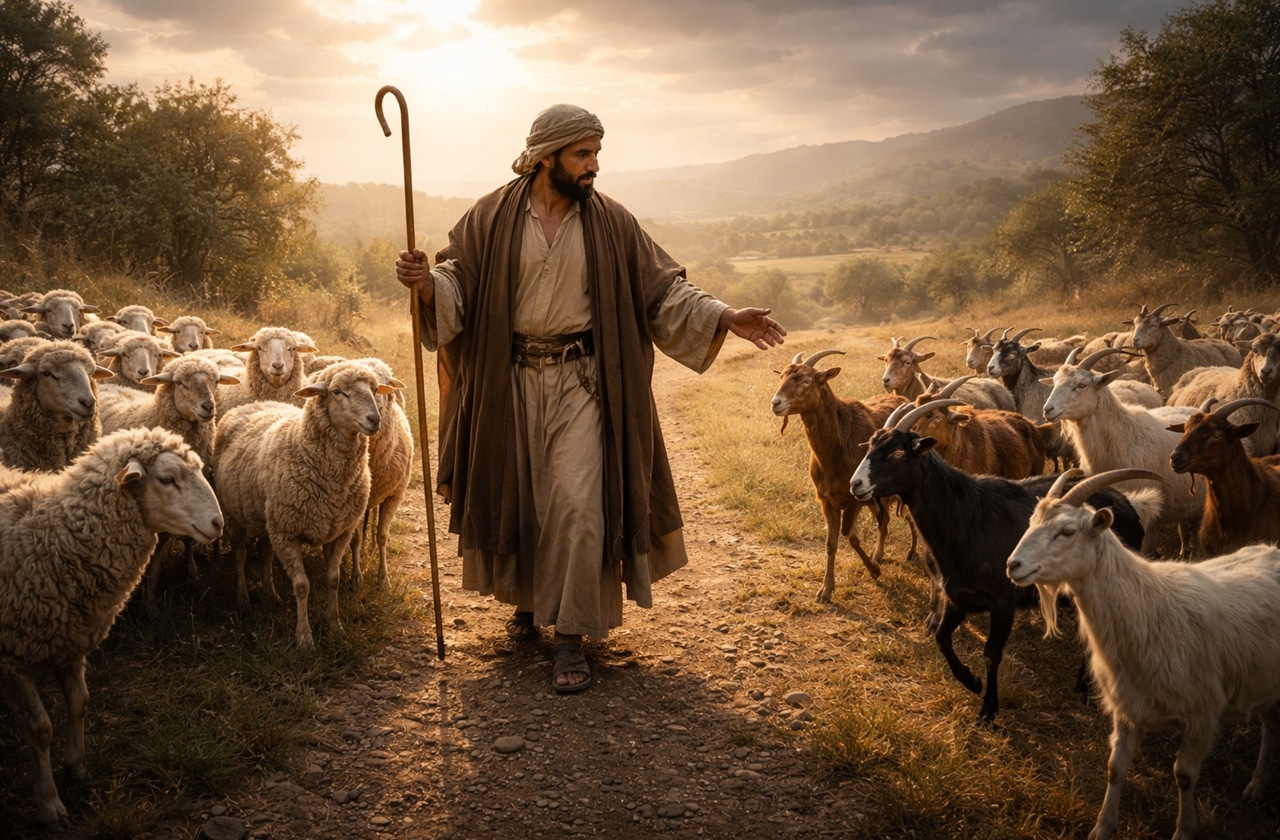
So in that context, this image today of the sheep and the goats, the teachable, docile, obedient sheep, and the stubborn, willful goats, is that your spiritual life of faith has to have the fruit of charitable works. In today’s world, when we consider the word “charity,” we get the image of giving generously to those in need. It’s an outward, visible act. But remember that “charity” is the Greek and Latin word for divine love, “caritas.” That is the heart of charity, our hearts overflowing with divine love from within, that causes us to act outwardly in the works of mercy, such as giving to those in need. Our modern way of thinking empties the essence, the heart, of the act, and only refers to the visible, outward act. And so we hear things like, “Being a good person doesn’t depend on what you believe, only on how you treat others.” But the reality of the gospel is that it is both. Good works don’t earn your way to heaven, unless they are good works that are fruit of the love of God overflowing out of your heart, out of your faith, out of your relationship with Christ, and your desire to obey him and imitate him in a holy life. At the same time, as the letter of Saint James says, your faith must have outward expressions of the works of mercy to be a living faith that saves, and not a dead faith without works. So you need to have both/and. Either one or the other isn’t sufficient. Both are necessary. As the first letter of Saint John says, “for whoever does not love a brother whom he has seen cannot love God whom he has not seen. This is the commandment we have from him: whoever loves God must also love his brother.”
Jesus, of course, takes it to the next level: Jesus is the brother. “Amen, I say to you, whatever you did for one of the least brothers of mine, you did it to me.” Mother Teresa very famously said that those five words were kind of the essence of her mission and ministry: “you did it to me.” In fact, there was a priest who went on a sabbatical to minister to the poor of Calcutta with Mother Teresa, and noticed that when Mother was at daily Mass beholding and receiving the Eucharist, her eyes and face glowed with love for Jesus as she expressed the desire to give him back her love completely. For the priest, that was understandable, for she was then already known as “a living saint.” But he saw her one evening when she was with a sick person. The same glow in her eyes and face was present when she was attending to him. For Mother Teresa, that sick person was also the true presence of Jesus himself, whom she desired to give him back her love completely. Jesus in the Scriptures is Jesus in the Eucharist is Jesus in the poor.
And so, somewhat obviously at this point I hope, we see the moral of the gospel reading, first, that we want to be of the sheep of God’s flock, to whom our judge and king will say, “Come, you who are blessed by my Father. Inherit the kingdom prepared for you from the foundation of the world. For I was hungry and you gave me food, I was thirsty and you gave me drink, a stranger and you welcomed me, naked and you clothed me, ill and you cared for me, in prison and you visited me.” And second, we actually have to do that. And so we have to challenge ourselves: do we see Jesus’ face in others, especially the poor, needy, marginalized, deprived, addicts, beggars, downtrodden, sick and suffering, all those in need of spiritual and material charity, love, from God, through us? Do we want Jesus to measure our love for him by our love for them? Not just what we donate, which is important, but also our own words and generosity from our heart, when we encounter them in their need.
Just a quick note before we wrap up, if we look at our first reading, we see the Old Testament prophet Ezekiel in a well-chosen reading to coordinate with our gospel reading. God, through his prophet Ezekiel, has been harshly criticizing the corrupt leaders of Israel for neglecting the care of the people who depend on them, and says, “As a shepherd tends his flock when he finds himself among his scattered sheep, so will I tend my sheep. I will rescue them from every place where they were scattered when it was cloudy and dark… I myself will give them rest, says the Lord GOD. The lost I will seek out, the strayed I will bring back, the injured I will bind up, the sick I will heal.” Then at the end he says, “I will judge between one sheep and another, between rams and goats.” And so we see Jesus, who brazenly proclaimed to the Pharisees, “I am the Good Shepherd,” making a clear divine claim in reference to this reading from Ezekiel, and also references this reading in today’s gospel reading as he judges between one sheep and another, between rams and goats. And of course what is our psalm today? Psalm 23: The LORD is my shepherd.
So now to wrap up… The Solemnity of Christ the King is not just the conclusion of the Church year. It is also a summary of our lives as Christians. On this great Feast, let us resolve to give Christ the central place in our lives, and to obey His commandment of love by sharing our blessings with all God’s flock, his children, who are in need of our help. Let us conclude the Church year by asking the Lord to help us to serve the King of Kings as He presents Himself in those reaching out to us. “To Him who loves us and has freed us from our sins by His Blood and made us a Kingdom… for His God and Father, to Him be glory and dominion for ever and ever. Amen”


