Go to readings for the 28th Sunday of Ordinary Time (Year A)
New York journalist Hugh Downs and his wife once attended a function in Washington. When the time came to return to New York, they discovered that their flight had been cancelled due to bad weather. Downs immediately called the front desk and was informed that they could catch a five o’clock train, which was leaving in 45 minutes. Mrs. Downs was showering, and to save time, Hugh hurriedly packed all their belongings, called the bell captain and asked that the bags be rushed right over to the station and put on the train. A bellhop came immediately and got them. Five minutes later, Mrs. Downs stepped out of the bathroom wrapped in a towel. “Dear,” she asked, “would you please hand me my green dress?” — We’re not told how Mr. and Mrs. Downs resolved this dilemma, but it reminds me of Jesus’ parable of the king’s wedding banquet and wedding garment.
Clothing is a common New Testament metaphor for spiritual change. Paul wrote in Romans, “Clothe yourselves with the Lord Jesus Christ, and do not think about how to gratify the desires of the sinful nature.” And in First Corinthians, “The perishable must clothe itself with the imperishable, and the mortal with immortality.” In Colossians, we read, “Therefore, as God’s chosen people, holy and dearly loved, clothe yourselves with compassion, kindness, humility, gentleness and patience.” In First Peter we are admonished, “All of you, clothe yourselves with humility toward one another, because, ‘God opposes the proud but gives grace to the humble’” (1 Peter 5:5). And lastly, in the Book of Revelation, about the Bride at her heavenly wedding, it says, “it was granted her to be clothed with fine linen, bright and pure” for the fine linen is the righteous deeds of the saints.” Being clothed anew is a consistent New Testament expression for holiness and righteousness. The old clothes have to come off and new ones need to be put on. — Today’s Gospel text confronts us with the paradox of God’s free invitation to the banquet with no strings attached and God’s requirement of “putting on” something appropriate to that calling. The theological point is that we are warned of the dire consequences of accepting the invitation and arriving unprepared.
Following the readings from the last few weeks, we’re still with Jesus in the Temple during Holy Week confronting the religious leaders, scribes, and elders. Last week we heard Jesus bring up in our Gospel Reading a reference to an Old Testament prophetic parable of the Vineyard of the Lord, and that was our first reading last week. This week we hear Jesus in the Gospel Reading bring up another Old Testament prophecy, that of the Messianic Banquet. And again, we have a reference to this in our first reading, again from the prophet Isaiah, which is just one of the Old Testament references to this long-awaited hope. And like last week, we see Jesus add his own element to the image.
Of course, for a society that dwells in a wilderness area, with a 40-year exodus through the wilderness deeply engrained in their social memory, it only makes sense that their vision of paradise would be opulent fountains of living water flowing in abundance, and an extravagant beautiful banquet of rich foods and drinks hosted by the generous king beyond all kings, the God of Israel.
“On this mountain the LORD of hosts will provide for all peoples a feast of rich food and choice wines, juicy, rich food and pure, choice wines.” Now that sounds wonderful. But if we go for a more literal translation, it says, “a feast of fat things, a feast of wine on the lees, of fat things full of marrow.” Obviously, meat that has a bit of fat in it brings out the flavor. And the same with lees in the wine, which are small, silky yeast particles that winemakers often leave in the wine to build flavor and weight. So even better, more flavorful than they could imagine.
But two other things to bring out in this: first, it’s a feast for all peoples, not just Israel. God’s plan was always universal for all humanity. Israel was meant to be first, but they were also meant to be the channel by which the whole world would share in the blessings of God. Second, the “fat things” are a reference to a sacrificial offering. Remember this verse from Leviticus when we get to Thanksgiving. Leviticus 3:16 says “the fat belongs to the Lord.” It’s good, holy fat. But in context, it means that when they would offer the sacrifices, they didn’t keep the fat of the animal — which was very valuable — for themselves, but they would offer it to God. It would be burned up in the fire as a sacrificial offering. And so, this is in some way referring to a sacrificial meal, a covenantal meal. Look at the rest of the first reading: “On this mountain he will destroy the veil that veils all peoples, the web that is woven over all nations; he will destroy death forever.” This is a sacrificial meal connected to a sacrificial offering that destroys death forever. Hopefully that is ringing some bells for you. In a few moments, you will hear ringing bells relating to another sacrificial meal. But that’s getting ahead of ourselves.
“On that day it will be said: ‘Behold our God, to whom we looked to save us! This is the LORD for whom we looked; let us rejoice and be glad that he has saved us!’” “On that day,” of course refers to the day of the Messiah, with the sacrificial offering that destroys death, when we are called to rejoice and be glad, because he is our savior. Way back here in the Old Testament prophet of Isaiah. As St. Augustine said, the “The New Testament lies hidden in the Old and the Old Testament is unveiled in the New.”
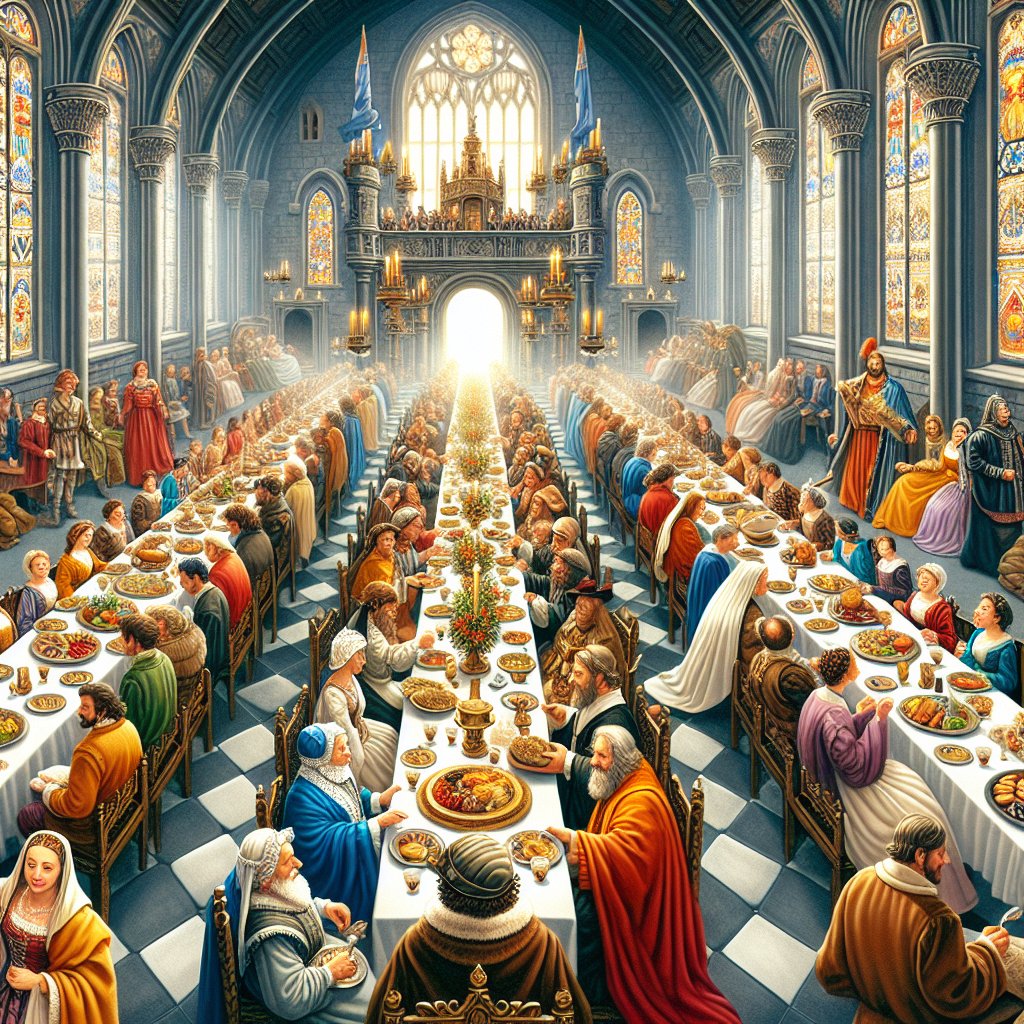
So let’s jump to the Gospel Reading then to look at how Jesus uses this image. “Jesus again in reply spoke to the chief priests and elders of the people in parables, saying, ‘The kingdom of heaven may be likened to a king who gave a wedding feast for his son. He dispatched his servants to summon the invited guests to the feast, but they refused to come. A second time he sent other servants, saying, ‘Tell those invited: ‘Behold, I have prepared my banquet, my calves and fattened cattle are killed, and everything is ready; come to the feast.’” Some ignored the invitation and went away, one to his farm, another to his business. The rest laid hold of his servants, mistreated them, and killed them.”
You can almost hear Jesus echo from last week’s reading, “What do you think the king will do to these invited guests?” They received a personal invitation to the royal wedding of the son of the king, who killed his best calves and cattle for this joyful banquet, and they’re like, “Nah, I got better things to do.” I have other priorities that are more important to me. Of course we know, this is a mystical image, not a regular king, not a regular wedding, not a regular invitation; not even a regular royal invitation. So maybe that helps explain that this isn’t a regular response on the part of the king: “The king was enraged and sent his troops, destroyed those murderers, and burned their city.” This sounds a bit over the top. Temper, temper. But another way to look at this, perhaps, is that it is describing a historical event in Israel’s past—the destruction of the Northern Kingdom for their corruption, when God allowed Assyria to attack them, and the destruction of the Southern Kingdom for their corruption two hundred years later, when God allowed Babylon to attack them, kill the royal family, and march everyone else off into exile—and perhaps also describing a future event—when the Romans will come in and destroy Jerusalem and its Temple in the year 70, forty years, a generation, after the gospels, and seen by the early Church as divine punishment against Jerusalem. Jesus is describing God allowing their corruption to have its natural consequences: suffering, death, and destruction. That’s what rejection and rebellion against the God of Life always brings: the covenantal curses. Woe to them.
“Then [the king] said to his servants, ‘The feast is ready, but those who were invited were not worthy to come. Go out, therefore, into the main roads and invite to the feast whomever you find.’ The servants went out into the streets and gathered all they found, bad and good alike, and the hall was filled with guests.” So just like the Old Testament feast for all peoples, here we see the servants gathering all the people into the feast, the good the bad, and the ugly—not just from Israel, but from gentiles; not just the Jews, but pagans, all called to be part of the sacrificial banquet meal. But there’s a catch.
“When the king came in to meet the guests, he saw a man there not dressed in a wedding garment.The king said to him, ‘My friend, how is it that you came in here without a wedding garment?’ But he was reduced to silence.” The whole introduction we had was a reflection on the scriptural image of being clothed with accepting spiritual change, with the clothing of virtues, such as compassion, kindness, humility, gentleness and patience; clothing yourself with the Lord Jesus Christ. And of course, the Bride’s wedding garment of the righteous deeds of the saints, the holy ones. We are called to the feast, but we must be clothed with holiness, with the fruits of grace and love. We should render to God the gratitude and praise that is right and just. Benedicamus Domino, “Let us praise the Lord!. Deo Gratias, Thanks be to God!
I recently saw a meme that said, “Protestants believe that pleasure is bad, and Catholics believe that suffering is good; that’s why Protestant C. S. Lewis made Edmund Pevensie and Catholic J. R. R. Tolkien made Bilbo Baggins.”
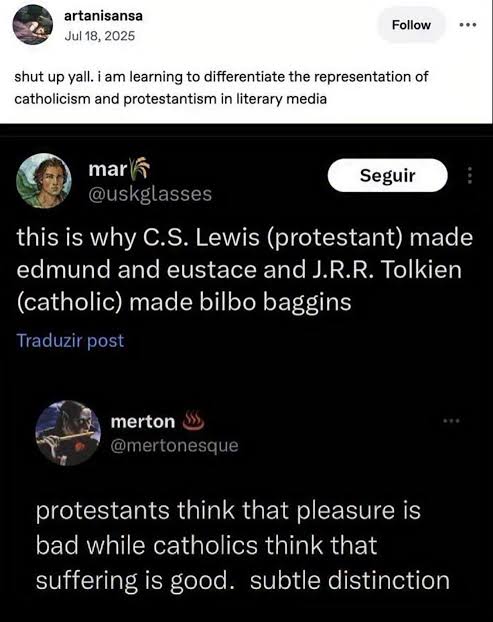
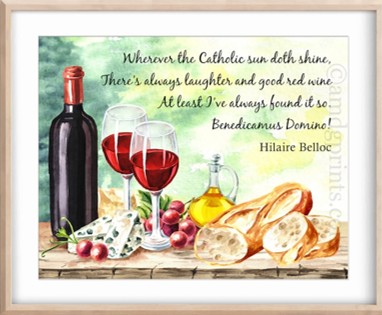
It’s a massive over-simplification of both, but essentially for a lot of (especially earlier, anabaptist, or fundamentalist) Protestant traditions, the default of life is suffering, and avoiding pleasure as if it were from the devil. While for Catholics, the default of life is that God made all things good and beautiful, but yes, there is necessary suffering. So, while those threads of Protestantism are, for example, fearful sinners in the hands of an angry God, such as Calvinists portray, Catholics are known for their celebrations and feast days (and monastic breweries and distilleries). And we see this as God blessing us with a foretaste of the joy of the heavenly wedding banquet, in which we will forever eat, drink, and be merry. Of course the greatest of these blessings is the actual sacrificial meal we were truly given by the Son of the King, which is the feast of the finest meat, the lamb of God, the finest bread, the Bread of life, and the richest wine, the Precious Blood, to allow us a true participation in the heavenly wedding feast of the Lamb and the Bride, the celebration of everlasting life, which is consummated here in every Mass, as we, the Church, the Bride, process up the aisle to receive our divine Bridegroom, to be united to him. And that divine love that should stir in us, if we receive it worthily and fruitfully, the great desire to invite others to accept the call to change into our wedding garments and join the party. In the words of Hilaire Belloc, a strongly Catholic French-born British writer and politician, who was close friends with G. K. Chesterton, “Wherever the Catholic sun doth shine, There’s always laughter and good red wine. At least I’ve always found it so. Benedicamus Domino!”