Go to the readings for the 32nd Sunday in Ordinary Time (Year A)
In Pennsylvania about 8,000 to 9,000 die suddenly and accidentally each year. Everyone one of them got up that morning, got ready, headed out the door, and at some point during the day, they went to eternal judgment with whatever condition their soul was in at that moment. In my reading to prepare for All Souls’ Day, I came across a Latin phrase, “Ubi te invenero, ibi te iudicabo,” “Where I find you, there will I judge you.” It is especially appropriate to consider this as we enter into the month of November, the last month of the Church’s liturgical year, as nature transitions into Fall and Winter with bare trees, dead leaves, and colder, darker, shorter days, that the Church encourages us to contemplate the Four Last Things: death, judgment, heaven, and hell. And there’s another Latin phrase that I like and use a lot, which is “Memento mori.” “Remember death,” or more literally, “Remember you are to die.”
That can be a frightening idea, but it doesn’t have to be. True, it is meant to make us consider that we will have to answer for the state of our soul at the moment of our judgment, and we know what our sins are, and how short we fall of the spiritual holiness that we ought to have. But the real message of “memento mori” is not to live in dread, but to live in faith. We know God loves us. We know he gives us the gifts of the Holy Spirit, like wisdom, courage, and reverence to help us. He’s on our side. He wants us in heaven. He’s rooting for us, like all the angels and saints. All we have to do is to do what he tells us to do, and not to do what he tells us not to do. Easy peasy, right? I wish!
Our readings today focus on one of those gifts God gives us: wisdom. In most languages, ancient and modern, wisdom is a feminine noun. The Greek word for “wisdom” is “sophia.” So if you know anyone named Sophia, you know what their name means. Philosophy is philo=love, sophia=wisdom, love of wisdom. And the true source of wisdom of God. Saint Thomas Aquinas, in the 13th century called philosophy the handmaiden of theology, the study or contemplation of God. Knowledge is the stuff we know. Wisdom is how we use and think and make choices with the stuff we know. You can have all the tools, like LEGO, or Minecraft, or a garage workshop. Wisdom is the art of creatively using all the tools and materials in ways that are true, good, and beautiful. These qualities (true, good, and beautiful) are only brought to their upper limit, perfection, in God. And so true philosophy, a right love of wisdom, leads us to God.
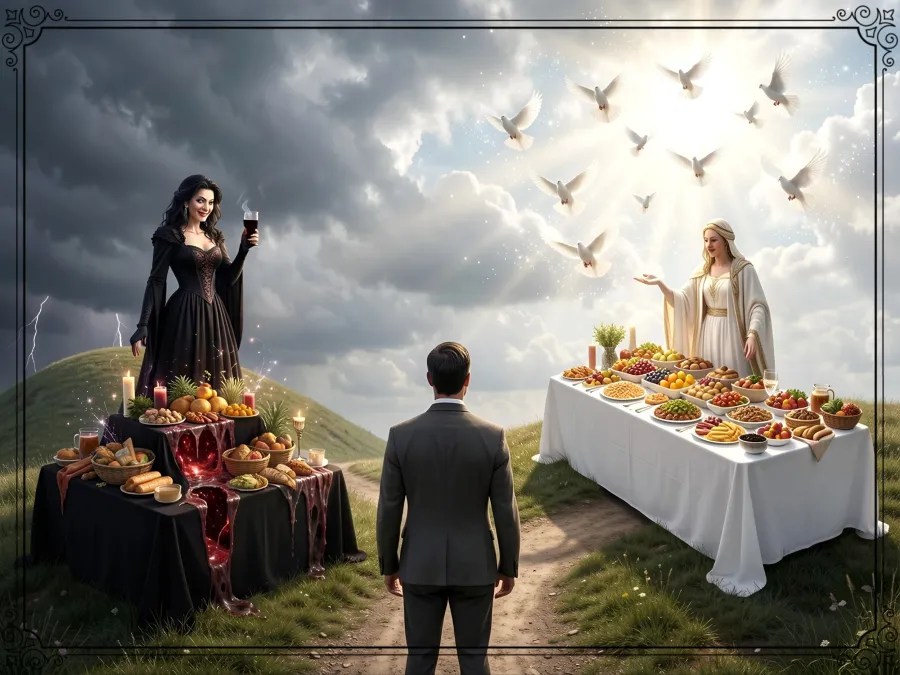
As I mentioned, sophia is a feminine noun. And so poetically, wisdom was personified as a woman. For men, it was like a woman you would pursue and court: pursuing Lady Wisdom, becoming wise yourself so as to attract her to you, and uniting yourself to her, not in a conquering way, but serving her. To women, it was like a woman you would want to become, the Proverbs 31 wife, the wise women of the scriptures, and the noble kind of woman that a man seeking a wise woman would want to be with, in a beautiful holy way, a way that brought out the best of you both, in truth, goodness, and beauty, God’s image in you.
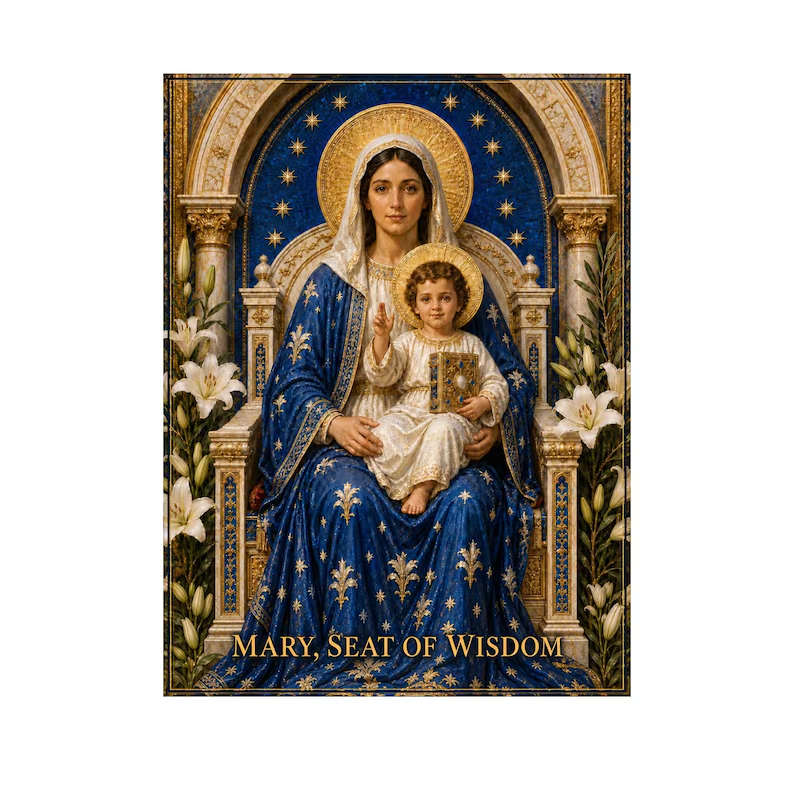
One of the great titles of the Blessed Mother is “Our Lady, Seat of Wisdom,” not only because of the wisdom seated in her sinless intellect, will, and soul, but because she literally had Christ, divine wisdom incarnate, sitting in her lap.
This personification of Lady Wisdom is all through the book of Proverbs in the bible, contrasted with Lady Folly, which would lead you to an unpleasant, foolish life. And of course, here in our first reading from the Old Testament Book of Wisdom (or sometimes called the book of the Wisdom of Solomon), we again see Wisdom personified. “Resplendent and unfading is wisdom, and she is readily perceived by those who love her and found by those who seek her…she makes her own rounds, seeking those worthy of her.”
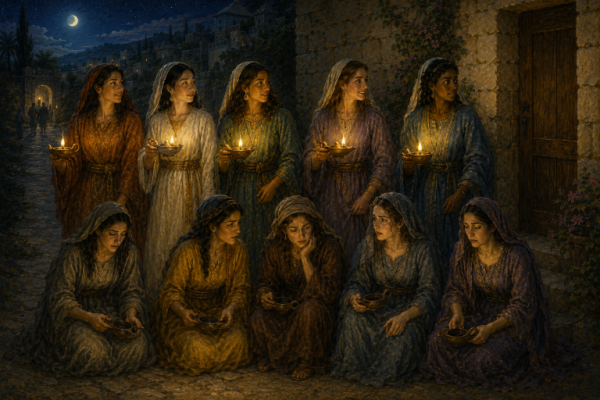
And then in our gospel reading we see Jesus make the proverbial contrast between the wise virgins and the foolish virgins. “Since the bridegroom was long delayed, they all became drowsy and fell asleep. At midnight, there was a cry, Behold, the bridegroom! Come out to meet him!”
In Israel, a young couple would first get betrothed, which is the first stage of legal marriage, although the bride and groom would not yet come together as spouses. It’s not the same as being engaged. This is why even though Joseph and Mary were betrothed, Mary could have been stoned to death for adultery for being with child that wasn’t Joseph’s child. During the betrothal, the groom would prepare a home for his bride, sometimes as an addition to his family’s home, and the bride’s family would start preparations for the seven-day marriage banquet. So the groom might say, “In my Father’s house there are many dwelling places. If there were not, would I have told you that I am going to prepare a place for you? And if I go and prepare a place for you, I will come back again and take you to myself, so that where I am you also may be.” You might recognize that as Jesus’ Last Supper Discourse before his Passion. So that’s connected with this, too.
Then the groom would send a messenger ahead to let the bride’s family know that the groom and his men were on their way. Of course, in this parable, Jesus is the bridegroom, which had a lot of scriptural connections to God being the covenant bridegroom of his bride, his people Israel, the king being a bridegroom to the kingdom of Israel, it’s mentioned by John the Baptist, and St. Paul writing to the Ephesians, and of course all over the Book of Revelation. And we see a slight reference to this situation in our second reading of the unexpected delay of the return of Christ, but that we must wisely be ready when he comes, at an unexpected time.
The bridegroom would arrive at the bride’s home (usually not at midnight!) and that would begin the great wedding banquet. And how embarrassing it would be if the wine ran out before the banquet was finished! So that story’s related to this, too. Then on the seventh day, the friends of the bridegroom, the groomsmen, would escort the groom and the bride back to the home the groom prepared for his bride, and they would consummate their wedding promises, and the wedding ritual is fulfilled.
So now in Jesus’ parable, we have this conversation among the virgins, and if we don’t properly understand it, it seems like the wise virgins are being selfish by not sharing their supply of oil. But obviously Jesus is communicating something else with this. “The foolish ones said to the wise, ‘Give us some of your oil, for our lamps are going out.’ But the wise ones replied, ‘No… go instead to the merchants and buy some for yourselves.’” Now remember, this is midnight. There’s no 24-hour Walmart to buy lamp oil at midnight. But off the foolish virgins go, anyway.
“While they went off to buy it, the bridegroom came and those who were ready went into the wedding feast with him. Then the door was locked. Afterwards the other virgins came and said, ‘Lord, Lord, open the door for us!’ But he said in reply, ‘Amen, I say to you, I do not know you.’” So here we have the main plot of the story. Jesus, the Bridegroom, comes back at an unexpected time, and, as it says, “those who were ready went into the wedding feast with him, then the door was locked.” So, the important question in this is, “What does it mean to be ready?” We can tie this to the previous parable we heard of the guest not having the wedding garment. And I made reference to a line in the Book of Revelation (19:8), “For the wedding day of the Lamb has come, his bride has made herself ready. She was allowed to wear a bright, clean linen garment. The linen represents the righteous deeds of the holy ones.” So being ready for the wedding supper of the Lamb is to be prepared with righteous deeds, to have lived a life of relationship, of faith, hope, and love for God, which spills out into righteous deeds. To be ready at all times with a life full of this active love and loving actions is to live wisely. To be unprepared is to live foolishly. And so, the wise virgins were prepared for whenever the bridegroom might come. They cannot give the oil of their relationship with God, their faith, hope, and love, and the deeds of that love, to the foolish virgins, who were not prepared.
Earlier in the Gospel of Matthew, we had the gospel reading of the Sermon on the Mount, in which Jesus teaches, “Not everyone who says to me, “Lord, Lord,” shall enter the kingdom of heaven, but he who does the will of my Father,” and we heard the foolish virgins locked out shouting, ‘Lord, Lord, open the door for us!’ But he said in reply, ‘Amen, I say to you, I do not know you.’” Now if this were a normal wedding, it takes a pretty brave groom to lock his bride’s bridesmaids out of the banquet. But as the Lord, he says, “Depart from me, I do not know you.” Because they do not have his life, his wisdom, his charity, visible in their lives.
We also see Jesus say, “You are the light of the world… Nor do they light a lamp and then put it under a bushel basket; it is set on a lampstand, where it gives light to all in the house… Just so, your light must shine before others, that they may see your good deeds and glorify your heavenly Father.” And so, we see Jesus here in connecting light, lamp, and good deeds. And then Jesus finishes off his parable with the moral lesson: “Therefore, stay awake, for you know neither the day nor the hour.” Memento Mori, always be prepared. Our Lady, Seat of Wisdom, pray for us.