Something that came across my social media feed this past week was an article called, “Principles of Neuroscience Embedded in the Spirituality of St. Francis de Sales – A Pastoral Approach to Addictive Behaviors.” This is the kind of thing some of us priests read for fun. But one of the concepts new to me brought up in the article was the acronym, “SUD”s, which stands for “Seemingly Unimportant Decisions” Examples might include a recovering alcoholic joining co-workers after-hours, and finding out their plan is to meet at a local bar, and still agreeing to go with them. Or taking a detour that goes past the home of someone with whom one committed adultery. Or spending time with an old friend who is a catalyst for risky, dangerous behaviors. Saint Francis de Sales might call all of these “occasions of sin.” Not sinful in themselves, but they present threats to sinful or dangerous behavior.
The idea of SUD’s in my mind, as I was also thinking about our weekend’s readings, is that seemingly unimportant decisions might be applied in the other direction, too. Seemingly unimportant decisions of virtue. Holding the door for the person behind you. Paying for the person after you at a store. Stopping to help someone fix a flat tire.
Our Lord speaks often about mercy: “Forgive us our trespasses, as we forgive those who trespass against us.” “Blessed are the merciful, for they will receive mercy.” The parable of the Good Samaritan. Why? Because the Lord wants to show us mercy, and he does show us mercy, but we can be unperceiving of it, not seeing, not being aware of it. How do we fix that? We have to attune our heart to the virtue of mercy. To God’s radio frequency. We can be on the wrong channel, listening to themes of revenge, pride, and anger. And we’re missing the important broadcast. We have to change the dial, turn to the channel that God’s message is going out on. And to hear God’s message of mercy, we have to change the frequency of our heart to the channel of mercy. We have to sensitize ourselves to the theme of mercy. And we do that by showing mercy to others. The more we get into that groove of living a life of mercy; the more we’re sensitized to opportunities of showing mercy, the more we will hear God’s message of how he is showing mercy to us. And, of course, even better, we will see more opportunities to show God’s mercy to others, and become his instrument of mercy. So sometimes these little SUDs, little seemingly unimportant decisions, can have big dividends in changing our heart little by little.
In the Old Testament reading, from the Book of Wisdom recalling the night of Passover, it says, “For in secret the holy children of the good were offering sacrifice and putting into effect with one accord the divine institution.” And so by this decision, they had disposed themselves to be sensitive to hearing God’s voice, and they were ready to respond when he gave the command to pack up and flee Egypt.
In our psalm it says, “See, the eyes of the LORD are upon those who fear him, upon those who hope for his kindness, to deliver them from death and preserve them in spite of famine. Our soul waits for the LORD, who is our help and our shield.” That listening closely for the voice of the Lord, hoping and trusting in the Lord, come what may, training the ear of faith to be attuned for that still small voice of the Lord among the loud voices around us, allows us to respond because we were ready. That image of our soul waiting for the Lord is not just one of being motionless, poised like runners on the starting blocks, but more like servants watching for the subtle gestures and signals of those they wait on, to be immediately responsive to the call to move.
Skipping over our second reading for a moment to go to the Gospel, Jesus is, as always, encouraging us to have that attentive yet active waiting on the Lord. If we practice that listening for the Lord, we can get a sense of what he is instructing us to do, not just in the word of the Scripture, but in the word of the Holy Spirit speaking to us in particular situations of our life.
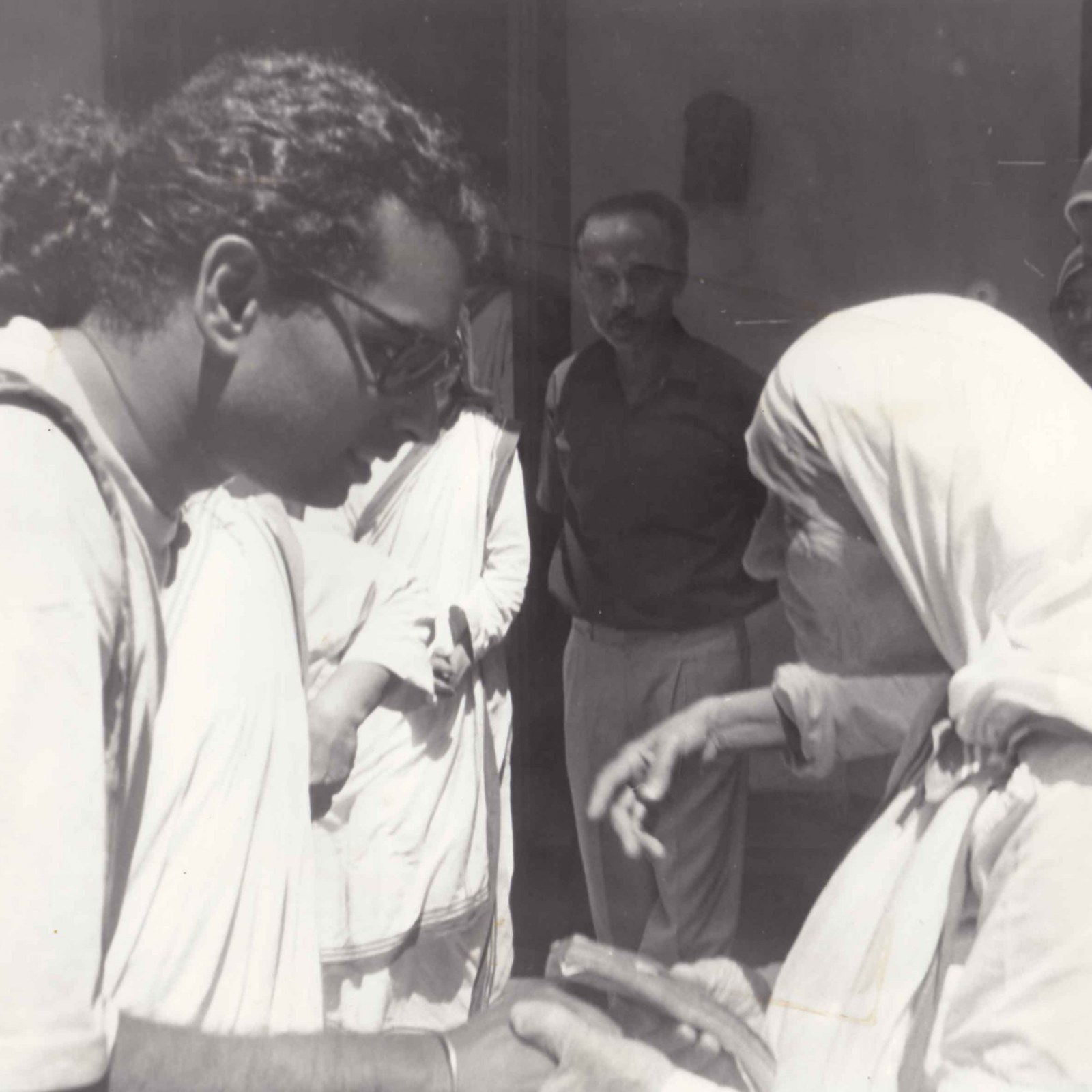
There was a man who spent a month working at the House of the Dying in Calcutta with Mother Teresa. He said that on the first morning, she asked him, “And what can I do for you?” He asked her to pray for him. “What do you want me to pray for?” He voiced the request he most desired for his discernment in God’s plan for his life. He asked her, “Pray that I have clarity.” She said “No.” That was that. When he asked why, she answered that clarity was the last thing he was clinging to and had to let go of. When he commented that she herself had always seemed to have the clarity he longed for, she laughed: “I never have had clarity; what I’ve always had is trust. So, I will pray that you have trust.”
Sometimes we can procrastinate following God’s will because we want more proof. We want a clearer instruction. We want the path marked out with lights and arrows. Believe me, I know, that was the story of my discernment for the priesthood. I was waiting for the divine 2’x4′ to remove any doubt of what I was supposed to do. But I came to understand I wasn’t going to have that removal of all doubt. It was going to take faith and trust. And the more I walked that path, praying and listening intently, the stronger my faith and trust got, and the assurance came later.
God willing, a soul becomes so attuned and responsive to the smallest whisper of the Holy Spirit that the will of the soul becomes united to the will of God. In the highest level of the spiritual life, Saint John of the Cross describes it this way: “The tenderness and truth of love by which the immense Father favors and exalts this humble and loving soul reaches such a degree… that the Father himself becomes subject to her for her exaltation, as though he were her servant and she his lord. And he is as solicitous in favoring her as he would be if he were her slave and she his god. So profound is the humility and sweetness of God.” We see that in our gospel reading where Jesus says, “Blessed are those servants whom the master finds vigilant on his arrival. Amen, I say to you, he will gird himself, have them recline at table, and proceed to wait on them.” Of course, that’s exactly what Jesus did as he took the role of a humble slave and washed the feet of the disciples at the Last Supper. Saint John of the Cross also says of the beautiful soul, “As she stretches heroically toward God, her love and trust in God explodes in strength. Her longing for God is spiritually all-consuming. And her will is achingly obedient to his slightest prompting. Her works of mercy and charity are heroic by normal standards.” This is the soul doing the Master’s will even when it feels he is absent. Those “seemingly unimportant decisions” to dispose the soul to the voice of God become the habitual life and radiant joy of the virtuous soul, and help her to hear his voice even more clearly, and respond even more generously. Peter asks, “Lord, is this parable meant for us or for everyone?” Jesus applies it universally. Everyone is called to be a steward of the spiritual, natural gifts they have received, the truth of the gospel they have received, and to share them generously in love as a participation in God’s generous unconditional love.
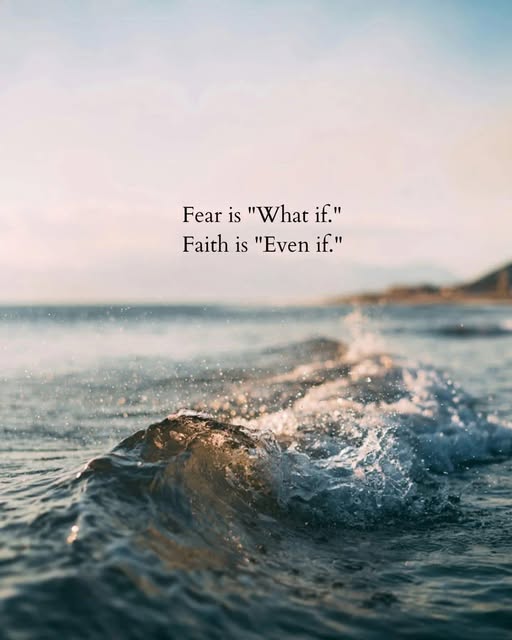
The end of the gospel reading I address in the bulletin column, but let’s wrap up here by going back to the second reading. I saw a Christian T-shirt some time ago, and I was very tempted to buy it, because in big letters it just said, “Even if.” Some of you might immediately get that reference. It’s a call-back to the book of Daniel when the three young men were threatened with being burned in the white hot furnace for being faithful Israelites. They respond to the king, “There is no need for us to defend ourselves before you in this matter. If our God, whom we serve, can save us from the white-hot furnace and from your hands, O king, may he save us! But EVEN IF he will not, you should know, O king, that we will not serve your god or worship the golden statue which you set up.” A few weeks ago I saw the next level of that, in a social media image, one of my favorites now, that says, “Fear says, ‘What if.’ Faith says, ‘Even if.’” Also related to our reading is the great quote by Saint Augustine, “Faith is to believe in what cannot be seen, and the reward of faith is to see that in which you have believed.” Saint Paul in our reading uses the beautiful example of the Old Testament mystics and prophetic figures who put their faith in God and were led through beautiful, sometimes excruciatingly difficult, acts of faith. They had listened to that voice that didn’t always tell them what they wanted to hear, but told them what they needed to do. And responding to that, they grew into the person they were called to be. They looked for and longed for the fulfillment of the great covenantal promises of God, when God would be all in all, and the world would be full of his glory and love. But these promises were not fulfilled in their time.
Paul says, “All these died in faith. They did not receive what had been promised but saw it and greeted it from afar.” They saw it through faith, and even if they didn’t see it fulfilled in their own time, they had so grown in faith in God by being obedient to his voice that they knew by faith that God was working all things toward that fulfillment. We have that fulfillment now, through Christ, however we have it only veiled in faith and mystery, signs and sacraments, awaiting the beautiful manifestation of the divine plan, even if we don’t see it in this life.
By our eager listening, waiting, and responding to the Word of God, and the whisper of the Holy Spirit within us, may we grow in our longing and love for him. May his will be done, through us, on earth as it is in heaven, through our “seemingly unimportant decisions,” which in faith are really our following the loving and beautiful will of God.
Saint Theresa of Avila said that you pay God a big compliment when you ask big things of him. Saint Augustine said that God sometimes delays answering our prayers because he wants to give us more than we prayed for, and our hearts aren’t big enough to receive what he wants to give us; so our waiting and longing grows our heart to be large enough to receive the abundance of God’s response to our prayer.
If we ask God for something in prayer, there are three possibilities: No, Yes, and Not yet. And unlike asking the sun, or the moon, or a shooting star, when we ask God, his answer to our prayers—even if his answer is not what we hoped for—we have faith and trust is what is best for us, his answer out of his perfect love for us. The sin of the garden of Eden was humanity’s failure to trust God. And our prayer in the Holy Spirit is the healing of that wound: we offer our prayers in trust in God’s love for us. That’s the last part of our gospel reading: being able to trust God that he’s going to give us the good that we need, the best things, and of course, the best thing is the gift of the Holy Spirit.
Our readings are on the theme of persisting in prayer. I remember someone saying, “Every time a woman prays in the bible, God answers that prayer.” Maybe it’s that men ask God for something in prayer, they wait a bit, and then if they don’t get a response, they shrug it off and move on. But women in prayer are more persistent. And that persistence is the key.
Our gospel reading has a bunch of different parts. One is a parable on being persistent. The man in the parable, like Martha last week, wants to show the virtue of hospitality. But he has an unexpected guest show up in the middle of the night, and this poor man has to go to his neighbor’s house, pound on the door, and ask for bread to give to his guest. And the neighbor’s like, “Are you out of your mind? Go away, it’s midnight, we’re in bed, and I’m not getting up to give you bread.” And the man keeps pounding at the door. I think it’s Father Mike Schmitz who defined persistence as “the shameless refusal to quit.” The shameless refusal to quit. That’s what we need to bring to prayer. I’m going to keep persistently pursuing the Lord and asking for what I need and trusting in him. And if he doesn’t seem to be answering, then I’m going to allow my trust and my desire to grow as I shamelessly refuse to quit until he responds. Of course, it’s not that we have to keep pounding at the door to change God’s mind, like in the parable. It’s that we have to persist because we need to grow in our desire to receive from the Lord.
The beginning of our gospel reading is the shorter version of the Lord’s Prayer found in the Gospel of Luke. The disciples of Jesus see him deep in prayer, and when he’s finished, they ask him to teach them, to give them his deep, beautiful relationship of prayer with the Father. One thing we can learn from the difference between Matthew’s version and Luke’s version is that our prayer should not be just the same formula of words.
Some people just rattle off the same prayers, day after day. Remember that prayer is our relationship with God, like a relationship with our spouse, or other loved one. We don’t say the exact same words, as fast as we can, and end the conversation. Our words should be organic, natural, flowing expressively; we mean, from the heart, the words we say to our beloved God. Even if we’re persisting in the same prayers, even if we’re reading a given prayer, like the rosary, mean every word, every time. It’s a conversation, an invitation to a deeper relationship. I’ll often slow down people in confession: We just had this deep, beautiful, authentic conversation, and then they race through the Act of Contrition. And I’ll stop them. No, start again, slower, and mean from your heart what you’re saying.
The same is true in the Mass. The words of the Mass are important. They come down to us through Sacred Tradition as the participation of the people of God in the authentic worship of the Church. They’re meaningful, and they’re important. We should think about them and take them seriously. And they help us to shape our own prayer life according to the spirit of the Church.
For those of you who are musicians, you’ll appreciate this. When I was teaching ensemble music, especially marching band or horn lines for drum corps, I would tell them, there’s a difference between practice and rehearsal. Practice is your own work: to learn the parts, learning the notes, the articulations, the timing, dynamics, and getting past the mechanics into actually being musical. Then rehearsal is when we come together to unite our individual parts into the offering of the whole group, unifying all of our individual work. And also, what we learn in rehearsal then helps us when we go back home to practice better.
The same is true with prayer. People often say, “I pray to God all day long.” That’s good, depending on the prayer. If you’re just giving God your wish list, giving him his instructions for the day, maybe that’s not such a healthy prayer life. Just like if your relationship with your spouse was just the list of chores to do, and nothing else to your relationship. Not a healthy marriage. Have deep conversations; listen as well as talking; give and receive.
God isn’t a wish granter. He’s a loving father who loves you and wants a meaningful relationship with you. Sometimes as Catholics we can bristle at the phrase, “a personal relationship with God.” It sounds un-Catholic to some. But it is absolutely the heart of Catholic life. God is not just personal, but a communion of persons, and prayer is for us to get personal with God. We have that access through the gift of the Holy Spirit. Get comfortable with the idea of the truly personal essence of prayer.
Look at the dialogue between Abraham and God in our first reading. What courage Abraham has to dare to haggle with God to save Sodom, principally on Abraham’s part to save his relative Lot and his family. Abraham repeatedly shows his humility and his awareness of the audacity of his requests. And God accepts and responds to his requests. It’s a personal conversation. Of course, God does destroy Sodom, after warning Lot and his family to flee. But the point is Abraham’s persistence in prayer, and his personal relationship with God that allowed that closeness (and courage) in conversation.
So nourishing that beautiful life of prayer, then bring the grace of your relationship with God and unite that to the prayer of the communion of the church. Each person’s personal prayer fuels our communal prayer, and our communal prayer shapes our personal prayer. We need both parts, the parts we do on our own, and then bringing that personal energy into the power of the church’s prayers of the Mass. In the Mass, we’re not a passive audience to an entertaining performance; we’re active participants in the Church’s liturgical worship of God.
For example, when the archangel Gabriel greets the virgin Mary, some artwork portrays Gabriel, this great angelic presence, as bowing low to this innocent teenage girl, and Gabriel addresses her with reverence, a reversal of roles from what we would expect, as Gabriel waits for Mary’s humble “Fiat,” her consent, her “May what you have said be true,” to the message of the angel. Do we pray the “Hail Mary” with that kind of authentic reverence and awe, like Gabriel did. Or like Elizabeth, filled with Holy Spirit, announcing, “Blessed are you among women, and blessed is the fruit of your womb.” Another example: Pope Saint John Paul the II in his reflection, “On the Church of the Eucharist” says that when the faithful receive communion, “there is a profound analogy between the ‘Fiat’ which Mary said in reply to the angel, and the ‘Amen’ which every believer says when receiving the body of the Lord.” Do we rush through and mumble our “Amen,” like saying “thank you” at the convenience store when we’re being given a receipt? Or do we reverently consider the gravity of that moment of encounter and gift? How much holiness can we inject into our response to the minister who holds up the sacred host and says to us, “The Body of Christ” and awaits the word of our response? Our “fiat”; our “Amen.”
How much can we consider the important words of the creed we proclaim, for which people at various times suffered and gave their lives to define and defend, in preserving the one / holy / catholic / and apostolic / church? Do we bow our heads, as the Church instructs us, as we say the words announcing our faith in the incarnation, that God himself “by the Holy Spirit was incarnate of the Virgin Mary, and became man.”? Do we sing what we are called upon to sing? Do we say what we’re called upon to say? All of which the Church requires of us to help us strengthen and shape our Christian spiritual life rightly—our life as disciples of Christ, and through him, children of God, living out our faith, persevering in prayer, trusting that God will abundantly and lovingly give us the good things that we need.
“The main thing is to keep the main thing the main thing.” There’s a good reason that the first commandment in the Old Testament, “I am the LORD your God, who brought you out of the land of Egypt, out of the house of slavery. You shall not have other gods beside me,” sounds quite a bit like the first and greatest commandment in the New Testament, “You shall love the Lord your God with all your heart, and with all your soul, and with all your strength, and with all your mind.” It’s because God, in the fullness of his divine Word, given to us for our salvation, wants to make sure that the main thing is that we keep the main thing the main thing. Or, “Put first things first.” Because that not only makes sure you take care of the first things, but also because it helps you view all the other things in light of the main thing.
Martha, Martha. Poor Martha. She gets such a bad rap from this gospel reading. She’s doing God’s work. The good and charitable work of hospitality. The Letter to the Hebrews says, “Do not neglect hospitality, for through it some have unknowingly entertained angels.” That seems to be a New Testament reference to our First Reading from the Old Testament. The reading starts out, “The LORD appeared to Abraham by the terebinth of Mamre, as he sat in the entrance of his tent, while the day was growing hot. Looking up, Abraham saw three men standing nearby.”
Now, strangely for the Old Testament, long before any revelation of the Holy Trinity, the reading gives us right up front who we’re talking about. “The Lord appeared,” and “Abraham saw three men standing.” In the Hebrew, it’s kind of peculiar, because Abraham inconsistently switches back and forth between singular and plural, like he’s not sure if he’s talking to one person or more than one. Maybe you have seen the beautiful 15th century icon, by Andrei Rublev called, “The Hospitality of Abraham” (sometimes just called “Rublev’s Trinity”). It shows three almost identical (with a few meaningful differences) figures sitting at a table, affirming the Christian belief that this Old Testament reading is giving a hint at the Holy Trinity. And I think this is quite fitting for the Church to have paired this with our gospel reading, in which Martha and Mary are definitely offering hospitality for a divine visit, with Jesus, Emmanuel, in their home. So, Martha is clearly doing something good and holy in offering hospitality to Jesus and his disciples. That’s not the trouble. Jesus doesn’t say anything like “don’t offer hospitality.” What does he say, “Martha, Martha, you are anxious and worried about many things.” That’s where the trouble is.
What did Martha say first, to elicit this response from Jesus? She said, “Lord, do you not care that my sister has left me by myself to do the serving? Tell her to help me.” Wow. Martha is… direct. Lord, do you not care? We can feel that way a lot of times. I’m suffering over here, there’s this injustice, don’t you care? Even in church, we can sometimes feel this way. Some kind of appreciation for my work, my visiting the sick, my stacking the chairs, my organizing this or that ministry, this or that committee, my this or that. “My God why have you abandoned me?” I’m left by myself to do the serving. All the cleaning up, the cooking, the drinks, the dishes… Meanwhile, Mary over there is just relaxing. Sure, I’d like to just sit and listen, too, but this meat and cheese tray ain’t gonna serve itself. You know what, Lord. That person over there enjoying themselves: You need to tell her to help me.
And that’s when Jesus… he doesn’t chastise her, doesn’t scold her… he frees her. He gives her a gentle, loving, knowing smile. I do see you, Martha. You are anxious and worried about many things. Important things, urgent things, things that have to get done. Getting the kids to soccer practice, working extra hours to pay the bills, sleeping in after getting home late last night. Getting ready for the things you have to do later. I see you. But you’re not making the main thing the main thing. Let go of those burdens for a while, and come sit with me. Listen to me. Just be with me. I’m here to spend time with you. Because I love you. Waste time with me, and just sit here and receive from me. That’s the cure to being anxious and worried about many things. That’s the cure to the poison of resentment to being busy, especially, in the church, when it becomes a burden instead of a gift of love.
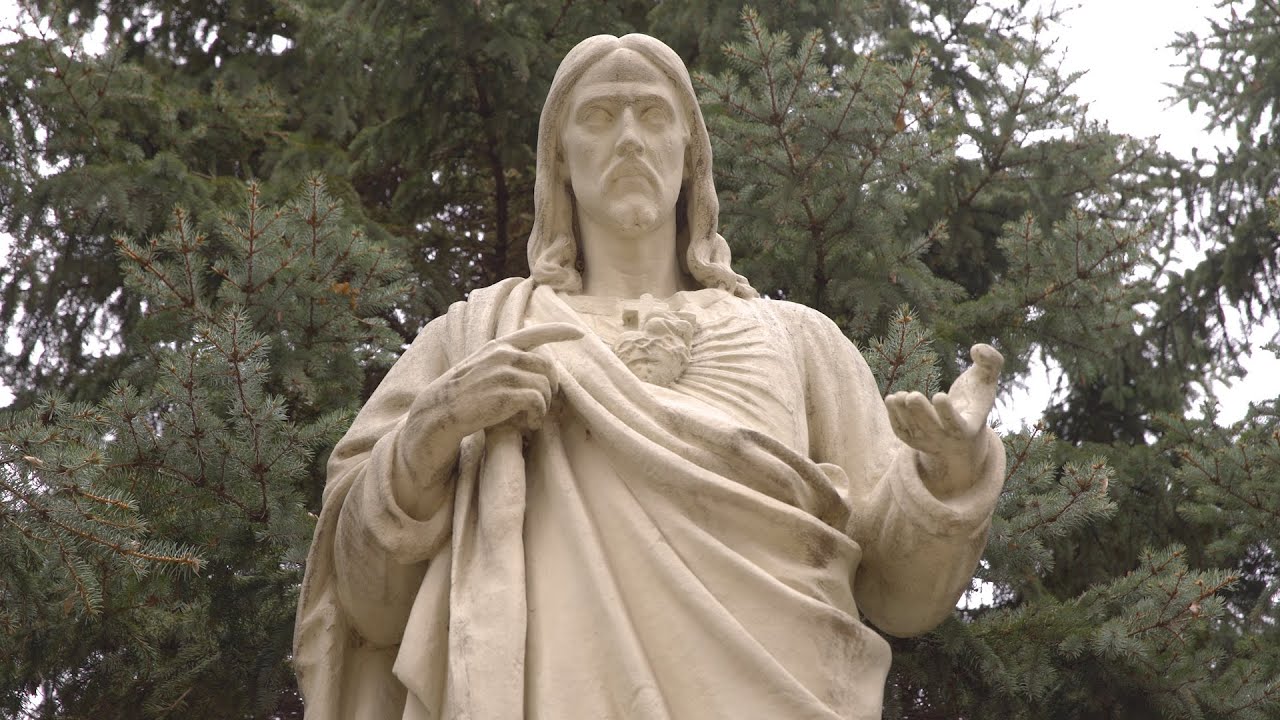
Recharge your heart and soul by plugging them back into the Sacred Heart. “Jesus, meek and humble of heart, make my heart like unto Thine.” So Jesus here, he’s not condemning hospitality. He’s not saying don’t serve. He’s saying service is good, but intimacy with Christ is the better part. Service is good, but intimacy with Christ needs to come first. And that’s the fuel, and the right perspective, for everything else. We end up skipping church or prayer because we’re too busy, we don’t have time. And then we get upset that we feel that we’re just spinning our wheels, and we’re always busy and tired.
And on the other side, we can fall into a kind of entitlement mentality. Why am I not being recognized? Why am I not getting the good things? I’ve been doing everything right. I’ve been praying. I’ve been being faithful. Why would God let this bad thing happen to me? Show me where in the Bible where Jesus said that bad things wouldn’t happen, that by being a good person we won’t suffer. He even warns them in the Last Supper about all these terrible things that are going to happen. And then he says, I tell you all this now, so you will know that I know you are suffering, and I am with you always. In this world, you will have trouble, but take courage, I have overcome the world. You will not overcome it. But if you have me, I will provide a way. I am the way. And that’s our bridge into our last section here, the second reading.
I remember a lecture by Dr. Scott Hahn in which he said that Colossians 1:24 was one of the key verses of his Catholic conversion. “I am filling up what is lacking in the afflictions of Christ.” We know that the afflictions of Christ are perfectly sufficient for our salvation. So what could Paul mean by this? Dr. Hahn said he looked up dozens of different commentaries and explanations and ended up dividing them into three piles. Ones which just ignored the difficulty, ones which gave a rather unsatisfactory explanation, and ones which gave a pretty convincing explanation. And he noticed that the third category was all from Catholic sources. To sum up, it is what we call, “redemptive suffering.” It’s behind what a Catholic means when we say, “Offer it up.” It means that we unite our sufferings into the suffering of Christ, and he draws us more deeply into the mystery and grace of his suffering. We then receive the two-fold benefit of having our suffering unite us more perfectly to Christ’s perfect love, purifying ourselves of distractions and errors and self-pity, to be made into a more selfless, self-surrendering gift to God. But also, God allows our suffering with Christ to give us grace through Christ that we can offer for a particular holy intention, such as our loved ones. What is lacking in the afflictions of Christ is our offering up of our suffering, our affliction, into the afflictions of Christ, so that we become sanctified by our own suffering with Christ, and through that, we also become vessels of the grace of the afflictions of Christ into the world around us.
And what strikes me, personally, as a priest, is the rest of Paul’s sentence. He says: “Now I rejoice in my sufferings for your sake, and in my flesh I am filling up what is lacking in the afflictions of Christ on behalf of his body, which is the church, of which I am a minister in accordance with God’s stewardship given to me to bring to completion for you the word of God, the mystery hidden from ages and from generations past.” Paul feels that, by his ordained vocation as their spiritual father, he has a special obligation and privilege of offering his afflictions for the people he is appointed by God to care for, to offer the grace of his redemptive suffering on behalf of the church, to help bring his people into the fullness of the mystery, now revealed in Christ, which is God’s suffering and saving love for us.
So what do we do with this? We tie it back to Martha and Mary. Mary chose the better part, the one thing, which is uniting herself, forming her heart, by intimate discipleship of Christ. We need to do the works of Martha, but in the spirit of Mary. Fill your heart with Christ, unite yourself to his love poured out for you, and nourished from that source, do your work. Serve God and others, as your participation, your unique personal share of loving others, offering your suffering for others, from the overflowing wellspring of divine life and love within you, out into the world and the people around us. That’s why putting God first is the first thing. That’s the main thing, of not being distracted and worried about many things. Not only avoiding our trying to pour out of an empty tank, trying to do the divine work before us with only our own human resources, but also to understand what is the most important work for us that we are called to do, and how the other things are rightly sorted after it. There is need of only one thing, the better part, and it will not be taken from us.
St. Philip Neri, who earned the title “Apostle of Rome”, is an example of the missionary zeal in today’s Gospel. Philip came to Rome in the early 1500s as an immigrant. He was horrified by the moral condition of the city. Philip prayed to God to learn what he might do. He read the letters that St. Francis Xavier had sent back from India, where he had been converting tens of thousands. Philip thought that God was calling him to follow the great missionary to India. When he told his spiritual director what he thought God was asking of him, the wise old priest affirmed his desire to bear witness to Christ. However, he told Philip to focus his attention on re-evangelizing those around him, declaring, “Rome is to be your India!” Philip, relying on God’s help, started — first as a layman, then as a priest — to convert Rome. He would cheerfully go to street corners and say, “Friends, when are we going to start to do good?” He developed various social and religious activities to give the people better alternatives for their hearts and time than those offered by the culture around them. When he died in 1595, much of Rome had been reconverted. This would also be a good example of what the Church in the 20th century is calling “The New Evangelization,” to call back to faithful discipleship those who already received the gospel yet have fallen away from following it. The same God who spoke to Philip almost five hundred years ago challenges each one of us this morning through the Scriptures, “Your home and your family, your workplace and your parish are your mission field!” Or to use one of my favorite phrases, “Bloom where you’re planted.”
Our Gospel reading reminds us of when Jesus first sent out his twelve apostles. And he had given them a share in his power and authority. It says, “He summoned the Twelve and gave them power and authority over all demons and to cure diseases, and he sent them to proclaim the kingdom of God and to heal [the sick].”
The scene in our gospel reading is in the chapter of Saint Luke’s gospel after that, and here Jesus sends out seventy-two disciples. Here it says, “At that time the Lord appointed seventy-two others whom he sent ahead of him in pairs to every town and place he intended to visit. He said to them, ‘The harvest is abundant, but the laborers are few; so, ask the master of the harvest to send out laborers for his harvest. Go on your way; behold, I am sending you like lambs among wolves.’”
So, some interesting things to notice here. First, we might hear it said by some Christians that Jesus didn’t have organization to his followers, they were a motley crew of believers who just went out and shared the good news about Jesus. However, the gospels, especially Matthew, present Jesus as a new Moses, a new prophetic lawgiver. Moses was instructed by God to ordain Aaron and his two sons, and then, again instructed by God, appointed seventy elders to help him in his ministry over the twelve tribes of Israel. Jesus frequently set apart Peter, James and John as special witnesses of his works, he had twelve apostles, and now commissions seventy (or seventy-two) to assist him in his ministry. Just as in Jesus’ time, there was the High Priest, and the Sanhedrin, or high council, of seventy (or seventy-two) elders. So, Jesus is not being random here, it is very intentional. He is establishing something new, but in a well-established structure.
He tells them of their purpose: not only prepare the way for him, but also recruit more laborers; to reap the harvest that the master of the harvest has already prepared in the hearts of those who will respond and join in the work to be done for the kingdom.
And he tells them that it will not necessarily go smoothly, like lambs among wolves. There’s a quote attributed to G. K. Chesterton that says, “Jesus promised his disciples three things—that they would be completely fearless, absurdly happy, and in constant trouble.” We sometimes need to remember that the gospels are written after Pentecost to often suffering communities of the faithful, to both better instruct them in the faith, and also to inspire them to live out the faith. And so sometimes the current experiences of the community, such as suffering persecution, feeling like lambs among wolves, are written in the gospels as part of that affirmation that they are living out what Jesus had taught.
The rest of the instructions that Jesus gives the seventy-two are almost the same as what he had told the twelve in the previous chapter. But the ending here is wonderfully important. “The seventy-two returned rejoicing, and said, ‘Lord, even the demons are subject to us because of your name.’ Jesus said, ‘I have observed Satan fall like lightning from the sky. Behold, I have given you the power to ‘tread upon serpents’ and scorpions and upon the full force of the enemy and nothing will harm you. Nevertheless, do not rejoice because the spirits are subject to you, but rejoice because your names are written in heaven.’” So obviously as we all know, there is great joy in seeing how God has worked through us to help someone else. He has given his Church a share in his power and authority to vanquish demons and other evils, represented here by Old Testament references to serpents and scorpions, by Jesus’ authority. And he says something we’ve often heard, the war of good and evil is already won. But the spiritual battles continue. There’s another old quote, “When Satan reminds you of your past, you remind him of his future.” But there we see the crux of the gospel reading: don’t rejoice just because you saw the losing side losing; rejoice because by your faith you are on the winning side winning. You’re on the right side, even when it doesn’t seem that way. Again, that affirmation and encouragement the Word of God provides us for difficult times.
This ties in beautifully with our first reading from the Old Testament prophet Isaiah, giving Israel, represented by its mother city of Jerusalem, God’s promise of victory and consolation. And we know that this promise, this victory, is won by the fulfillment of the long-awaited Messiah of Israel, Jesus Christ, and in the Church, the fulfillment of Israel. Isaiah says, “Thus says the LORD: Rejoice with Jerusalem and be glad because of her, all you who love her; exult with her, all you who were mourning over her!” Another great quote, again by Chesterton, “Christianity has died many times and risen again; for it had a God who knew the way out of the grave.” Back to the reading, with God speaking through Isaiah, “Lo, I will spread prosperity over Jerusalem like a river, and the wealth of the nations like an overflowing torrent… as a mother comforts her child, so will I comfort you; in Jerusalem you shall find your comfort. When you see this, your heart shall rejoice…the LORD’s power shall be known to his servants.” The traditional understanding of the prophecy of the world’s treasures flowing toward Jerusalem, is the opposite of how it was ultimately fulfilled: not that they would come to Jerusalem, but that the faith and the divine kingdom that started in Jerusalem, the Church, would flow out to include all the world. And we find our greatest comfort, our peace and affirmation of love in the Church, in God, and when we see this, the Lord’s power is known to those who serve him, and our hearts rejoice. So beautiful. Dr. Scott Hahn has a book called, “A Father Who Keeps His Promises,” and it’s about things like this, how the promises of the Old Testament are fulfilled in the New Testament.
And lastly, as is often the case, Saint Paul brings it home in the second reading. “Brothers and sisters: may I never boast except in the cross of our Lord Jesus Christ, through which the world has been crucified to me, and I to the world. For neither does circumcision mean anything, nor does uncircumcision, but only a new creation.” We don’t put our hearts, our worth, our identity, our priority, on anything in this passing world. Certainly, there are things that are both urgent and important, and cause us stress, but never to the extent that they interfere with the faith and worship we owe to God, and nourishing our relationship with Him. We are made a new creation in Him, still body and spirit, still with bills to pay and problems to solve, but one who has peace that the world cannot give. Happiness that comes from knowing we have a great purpose, even to our suffering, and in God’s plan for our life and our salvation, he included how dumb we can be sometimes, and to me, that is a great comfort. So let us continue detaching our sense of self and priorities from this world and strengthen their hold on the true and eternal world to come. And help and inspire others to do the same. “The grace of our Lord Jesus Christ be with your spirit, brothers and sisters. Amen.”
Saint Peter, with upside-down cross of his crucifixion and the keys of the kingdom. Saint Paul, with the sword, both the instrument of his martyrdom, and the Word of God
One of my favorite movies is “Big Fish,” a 2003 Tim Burton movie with Albert Finney, Ewen McGregor, Steve Buscemi, and of course, Helena Bonham Carter, because it’s a Tim Burton movie. In the movie, the main character, Ed Bloom, is in a hospital on his deathbed, and he has a strained relationship with his son, because everything the father has ever said about his own life is encoded in fantastic stories of mythic proportion, which the son feels has kept them from having an honest relationship. But as the movie goes on, you start to wonder if the myth isn’t in fact more fact than myth, and in fact, the distinction is easy to myth (I mean, “miss”!). The common becomes extraordinary, and vice versa. We’re made for stories, and myth makes the stories memorable and inspiring. And even in myth, the truth is just under the surface. An old Irish priest, Fr. McNeil, once told me, “All stories are true. And some of them actually happened.”
Our story as Christians is encapsulated between the inspired books of Genesis and the Apocalypse, our origin story and our destiny. The rest of Scripture and Tradition fills in details, while our Catholic faith informs it so that our lives are our own personal part of this great epic drama of salvation history.
The poet Virgil, in his epic poem, the Aeneid, tells the ancient story of the founding of the city of Rome. Aeneus takes his family and flees from the fall of Troy to start a new city on the Italian peninsula (The Aeneid is from the first century BC, and builds on earlier stories of Aeneus, most popularly Homer’s 8th century BC epic poem, the Iliad). He becomes the ancestor of the twin brothers Romulus and Remus, about whom there are many stories, some more believable than others, sometimes involving being brought up by a mother wolf. Eventually, they were raised as shepherds. When they were grown to adulthood, they one day got into a pastoral altercation with another nearby shepherd, and the brothers decided to build a fortified city. But they could not agree on where.
The Seven Hills of what would become Rome were the general area, but Romulus chose the Palatine Hill, while Remus preferred the Aventine. Each set out to build, and when Remus made fun of Romulus’ defensive walls by having the audacity to jump over them to show their uselessness, Romulus ended the matter by killing his brother. Thus, in a story echoing the tragic account from Genesis, a sort of “original sin” came to Rome by way of fratricide. In his work, TheCity of God, Saint Augustine, who was well acquainted with Roman myths, would compare the story of Romulus and Remus to that of Cain and Abel.
By the time we come to the mid-fifth century, the era of persecution now mostly a thing of the past, the City of Rome having been substantially Christianized, a newer founding narrative comes into the Roman consciousness: This narrative depicts the Holy Apostles Peter and Paul, shepherds, pastors, brothers in the faith and in the Apostolic College, as the founders of the new and eternal Rome, something better and more noble than its pagan origin story. In a homily preached for the Feast of Saints Peter and Paul in the year 441, Pope Saint Leo the Great says:
That reverence which today’s festival has gained from all the world, it is to be honored with special exultation in our city, that there may be a predominance of gladness in the place where the chief of the Apostles met their glorious end. For these are the men, through whom the light of Christ’s gospel shone on you, O Rome, and through whom you, who was the teacher of error, was made the disciple of Truth. These are your holy Fathers and true shepherds, who built you under much better and happier auspices than they, by whose zeal the first foundations of your walls were laid: and of whom the one that gave you your name defiled you with his brother’s blood. These [the apostles] are they who promoted you to such glory, that being made a holy nation, a chosen people, a priestly and royal state [1 Peter 2:9], and the head of the world through the blessed Peter’s holy See, you attained a wider sway by the worship of God than by earthly government. For although you were increased by many victories, and extended your rule on land and sea, yet what your toils in war subdued, is less than what the peace of Christ has conquered.
Thus, we will often see in the ancient documents and doctors of the Church references to “Peter and Paul” as a pair, as brothers in the Christian Faith, as the tradtional foundation of Christendom.
Like Mary and Martha, the sister virtues of “ora et labora” (to take a traditional Benedictine phrase), “prayer and work,” we see a holy complementarity in this pairing. As Mary is often associated with the virtues of the contemplative life, sitting at the feet of the Lord, and Martha with the virtues of the active life, showing hospitality, caring for the needy, providing food for the hungry, etc., we also see a complementarity in the figures of Peter and Paul. Peter is often associated with the charisms of the hierarchical church, the structure of organization and the sacraments, the noble grandeur of the Mass and the great basilicas and cathedrals, the organization of laws and instructions for order and discipline in the People of God. Meanwhile Saint Paul is more often associated with the charismatic evangelization, going out to the fringes to make disciples, preaching the gospel, as well as the building up of the mystical body of Christ through the spiritual gifts given to its members for serving the community.
This complementarity is not strictly mutually exclusive. Peter also had mystical visions and experiences and the holy charisms of his office received from Jesus and which Peter passed on to his successors. And Paul also taught rules and boundaries for discipline and correction within the Christian communities. And of course, both of them, in Peter’s denial in the garden, and Paul’s zealous persecution of the Church, had stories of their shame and forgiveness that inspired their personal love of the Lord and their mission to spread the gospel.
Sometimes we’ll see Peter and Paul presented as alternative versions of Christianity in tension with each other, because of one moment described in Paul’s letter to the Galatians. In this tension, Peter often represents traditionally structured “religion,” while Paul often represents a personal, evangelical “spirituality.” We saw this play out over the last thousand years with Catholics being “the church of the sacraments” and others being “the church of the bible.” But perhaps that’s one of the important dimensions of today’s feast day of these spiritual and apostolic brothers. It’s not “either/or,” but “both/and.” Saints Peter and Paul are together. The Church is both apostolic and charismatic. It is both traditionally structured and spiritually personal. It is both the sacraments and the scriptures. It is both liturgical and evangelical. It is attentive to both the personal believer and the communion of believers, and attentive to its adherence to its supernatural Tradition and its supernatural Great Commission to go out and spread the Gospel.
Our readings contemplate key moments in the holy lives of these Apostles, particularly near their end. After Herod had already martyred Saint James, Saint Peter is arrested, as it says, during the feast of unleavened bread, with intention of having him brought out, presumably for a meaningless trial and tortuous martyrdom, after Passover. So we see Peter, now full of the Holy Spirit after Pentecost, courageously living out that love of God and the Church that he was unable to muster in dialogue with Jesus by the seashore, but in which Jesus calls him both to be his shepherd of his flock, and also to follow him, and we see in Saint Peter an echo of the passion of Christ. Saint Paul is writing to Timothy in our second reading, aware, as the Spirit has told him, that his martyrdom is also drawing close. “I… am already being poured out like a libation, and the time of my departure is at hand. I have competed well; I have finished the race; I have kept the faith… so that through me the proclamation might be completed, and all the Gentiles might hear it.”
And so to end, I want to contemplate an interesting contrast between Peter and Paul that we can take with us today. I had a gentleman in spiritual direction, a successful business owner, pose this question to me. We have this scene in our first reading from Acts 12, of Peter in prison, and he’s given an out, a way to escape prison. And he goes, and it’s the right thing. But later, in Acts 16, we have the scene of Paul in prison with Silas. And because of an earthquake, the jail’s foundation was broken, the doors and chains came loose, and he’s given an out, a way to escape, but he stays, and it’s the right thing. So, the same or similar situation, and one time the right thing was one thing, and another time the right thing was the almost-opposite thing. So how do we know what we’re supposed to do?
I had to think about that, and we talked, as we exchanged ideas, exploring this question. And what we came up with was very interesting, I think. Our reasoning for asking the question, “Given these sets of circumstances, how do I know what choice to make?” can be a way of asking, “How do I make a rule so that I know what I should do, without having to ask God what I should do?” It’s a subtle attempt to substitute a relationship with God with our independence from him. Certainly, rules and principles of ethical and moral choices are important. But instead of (or in addition to) setting out to create a schema in which we want to always know the right response to every moral dilemma, we should always be turning toward God, after the example of St. Peter and St. Paul, and ask Him, in every circumstance, “God, what do you want me to do? Here I am, Lord. Send me. Lead me. Help me to love you, to listen to you, and to follow you.” Let Him be the writer of your amazing story, so full of miracles it’s almost hard to believe it’s all true.
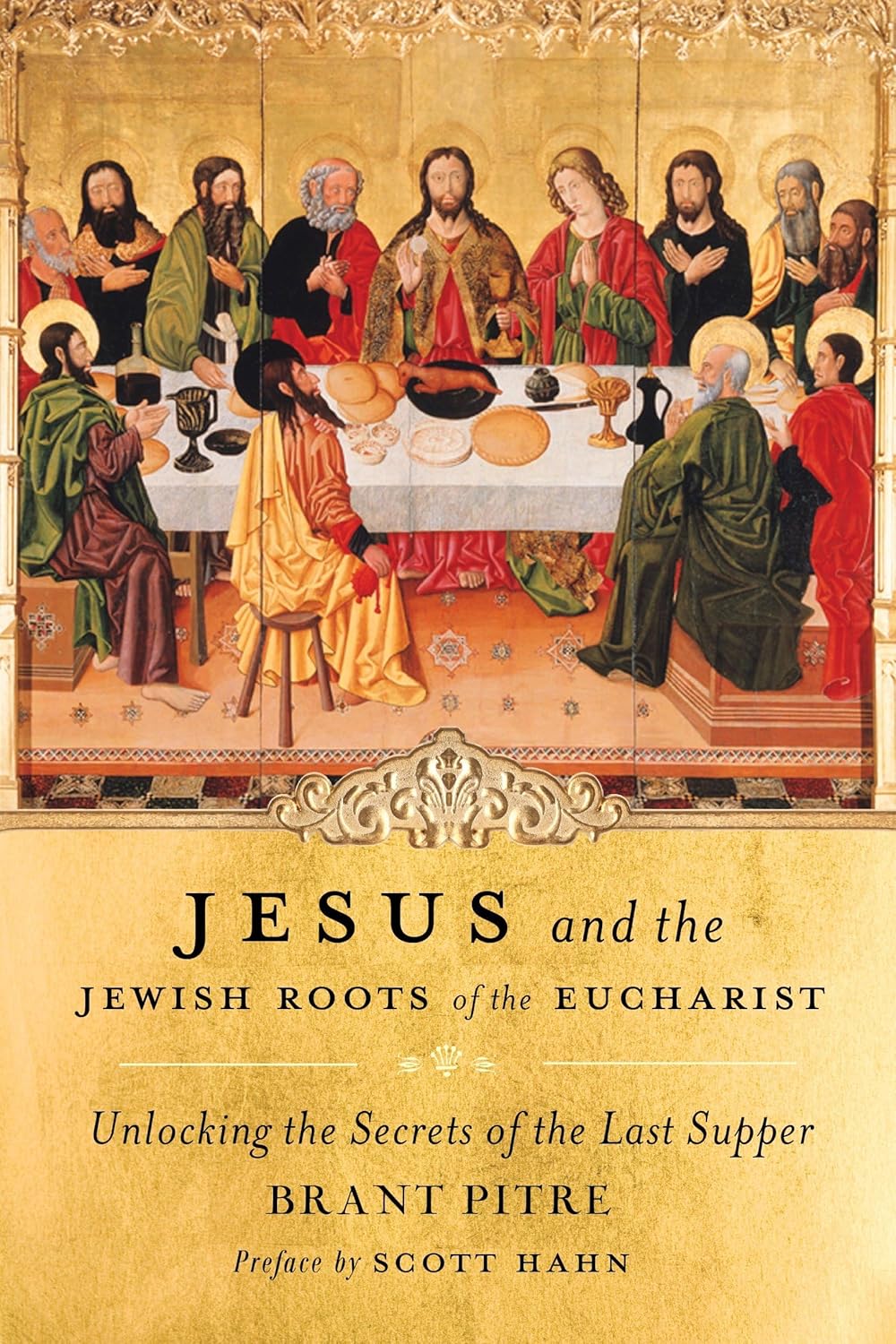
“Behold God’s Love for You!” In his book, “Jesus and the Jewish Roots of the Eucharist,” Catholic author Dr. Brant Pitre poses the question, “Why did the early Christians so strongly believe in the real presence of Jesus in the Eucharist, and yet modern Christians struggle with this belief? And he proposes the answer that it is “because the early Christians knew the Jewish scriptures, the Old Testament, better than most modern Christians do.” And in his book, he traces the Eucharist along three threads that weave through the Old Testament. He looks at the Passover Lamb, the Manna in the wilderness, and my favorite one, the bread of presence in the Holy Place in the Temple.
To make a long story less long, the proper translation of the Jewish “lahem ha panim” is “the Bread of the Face of God.” It was a visible presentation of the invisible God, and it was twelve cakes of bread, a grain offering, also called an oblation, on a golden table, also with a flagon of wine, that were always to be present in the Holy Place with the golden lampstand. The golden lampstand, in Hebrew, a menorah, was always lit in the presence of the Lord, represented by the mercy seat on the golden box that was the ark of the covenant. And the bread and wine were an offering to the Lord by the priest on behalf of the children of Israel as an everlasting covenant, says the book of Leviticus.
Here is my favorite part. On the major pilgrimage feasts of Jewish Tradition (Passover, Pentecost, Tabernacles), all Jewish men were required to go to the Jerusalem Temple. In fact, the law didn’t just say they were required to go to the Temple, but they were required “see the face of the LORD”. How many psalms are there of an impatient pilgrim on his journey to Jerusalem singing, “when may I come to see the face of God?” And on these feasts, the temple priests would solemnly carry the table of the holy bread, from the holy place in the Temple to the outer courts, and while they lifted up the table, they would proclaim, “Behold God’s love for you!”
The holy bread of the presence of God was called the bread of the covenant, not a sign or symbol of the covenant, along with the wine that was poured out as a libation offering. The bread made present the invisible God, as it was a promise of the invisible temple of which the visible temple was a participation and promise. The bread, before it was offered, could be placed on any surface, but after it was consecrated, it was the miraculous food of the holy place, and could only be laid on a surface of gold.
Toward the end of this chapter, Dr. Pitre raises two points: First, in the Holy Place in the temple, as we said, there was the gold box of the presence of God, whom we would call God the Father; there was the lampstand, the tongues of fire, always present with the ark of the Lord, who do we associate with tongues of Fire? The Holy Spirit. And so we have the Father, the Holy Spirit, and this “bread of the presence of God,” the bread of the everlasting covenant, so this would be…God the Son. We have the Holy Trinity presented in the Holy Place in the Temple way back in the beginnings of the Old Testament! And what do we have front and center in the holiest place of a Catholic sanctuary? A gold box! And what is always close to the gold box in every Catholic sanctuary? A sanctuary candle, always lit in the presence of the Lord. And what do we have on the altar in the Eucharist in every Catholic sanctuary? The bread of the presence of God, and the offering of wine. The sanctuary is based on the holy place of the Temple, which was based on the image God showed Moses in constructing the Tent of Meeting.
In the Passover, the tradition would have been to have a lamb (also called “the body”) on the table. And of course, one of the criteria of completing the Passover is not just that you sacrifice the lamb, but you have to eat the body of the lamb. If the New Testament lamb of the Passover—Jesus, the Lamb of God, who said that the bread was his body—must be greater than the Old Testament lamb of the Passover, then it can’t be a symbol—it can’t be what Jesus intended—because we have to eat the body of the Lamb, not just a symbol of it. It was pretty clear he intended it when he said, “My body (flesh) is true food and my blood is true drink, and unless you eat my flesh and drink my blood, you have no life in you.”
But more to the point, why didn’t Jesus just identify his body with “the body” of the Passover lamb? That would have been an easier image! But where might Jesus have pulled the notion that a he as a person (a divine person!) can be made present in bread and wine? From the Temple: the sign of God’s real presence to Israel, and the covenant offering from Israel to God.
And so, in the Mass, after the people of God chant the Agnus Dei, the Lamb of God, the priest holds up the consecrated bread and wine, the body and blood of Jesus, crucified and resurrected for our salvation, and the priest proclaims, “Behold the Lamb of God!” But also, in my heart as I proclaim that, I’m also thinking, “Behold God’s love for you! Behold the face of the God who loves you so much, that he became human for you, was crucified and died for you, and rose again for you, to send the Holy Spirit upon you, and through that same Holy Spirit, now gives himself to you, to feed and nourish you with the bread that came down from heaven!”
And again, if the Old Testament manna was really understood to be bread from heaven, then the New Testament manna, the Eucharist, must be really understood to be bread from heaven and more, not less. It cannot be merely a symbol or reminder of bread from heaven, it must be a greater reality in the New Testament. It must be more than the miraculous bread that God gave his people in the Old Testament to nourish them as their food for the journey, to strengthen them through their preparations to become His people and live as His people and worship him, set apart, consecrated, as his peculiar and holy people, as a sign and promise for the world.
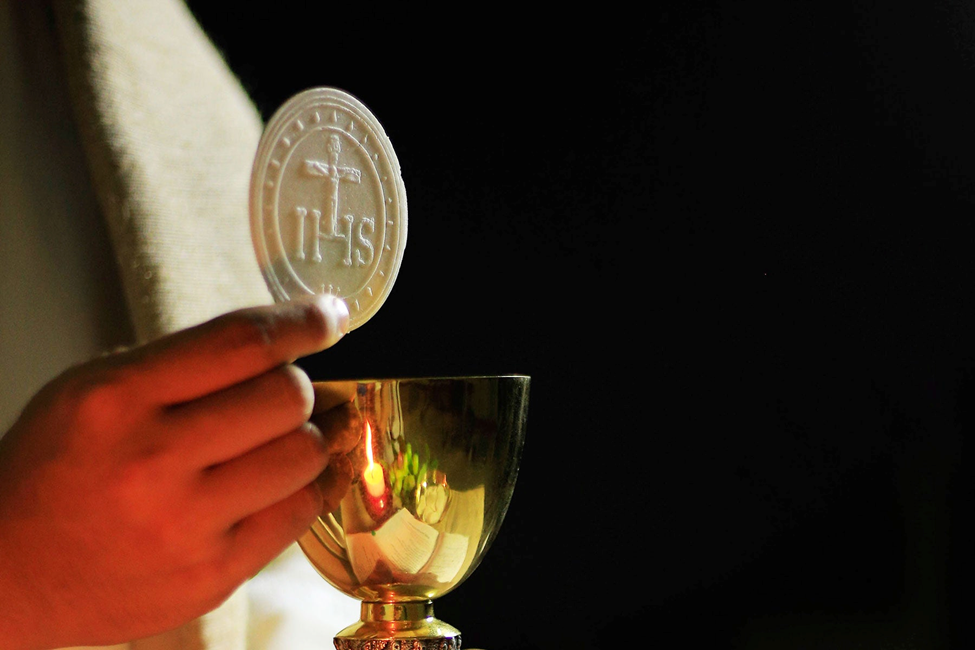
The Eucharist is more than the manna, and it is more than the sacrificial lamb of the Passover, and it is more than the bread and wine of the Temple that became the presence and the face of God. When we are on our knees receiving the gift of Jesus of Himself in the Eucharist, raised up to draw all men to himself, through the Holy Spirit, when the minister of communion holds up the host in front of you, in that moment of Eucharistic Adoration, and proclaims to you, “The body of Christ,” you should also hear the words in your heart, “Behold God’s love for you,” and you can respond with a reverent and joyful profession of faith, “Amen.”
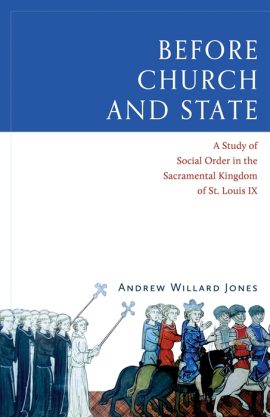
This is a transcription (slightly edited for length and continuity) of a conversation between Matthew S. Leonard, who runs his Catholic Podcast “The Art of Catholic” (now changed to “The Science of Sainthood),” and Dr. Andrew Jones, author of the book pictured above, “Before Church and State: A Study of Social Order in the Sacramental Kingdom of St. Louis IX.” You can find the audio of this interview here, if you prefer, and I highly recommend it. I tend to listen to Catholic podcasts and lectures through the BlueTooth audio in my car. But I wanted to type this out so that I could search it and reference it as the need arises. And in doing so, I was reminded just how monumental this concept is. I read the book with great interest and joy, and that too, I highly recommend. Here again is the link. So in the interview below, I don’t really distinguish between what’s Matt, and what’s Andrew. But if you read through it, I have no doubt it will be quite eye-opening, and I hope you will take that as a cue to buy and read the book. Enjoy!
Almost all of us have been co-opted by a completely false narrative that has totally corrupted our view of the world and our practice of the faith. Among other things, we’re going to look at the whole notion of “church and state”: categories that are treated almost as gospel by the modern world. And we’re going to expose how what so many of us have taken for granted as gospel truth is basically bull. In other words, the very categories that we use are totally modern inventions that totally undermine the very fabric of a Christian worldview and the Catholic Church, frankly, in particular.
So much of what we have been taught all of our lives is intrinsically opposed to our beliefs, and many of us have accepted it blindly, even though it essentially crushes our faith.
The way we’re going to approach all of this is to set off the problem of the narrative we’ve been fed, and then go back and look at how things really were, using the high middle ages as an example: the time before there was such a thing as “Church and State.” What we’re going to see is that the way things have progressed from there (or regressed, as it were) basically has made it so that Christianity has nothing to say about the way things are structured in society. So we’re going to try to start to put things back in their right order and realign our perspective to a truly Catholic worldview.
And to help us begin this rethinking is a guest with whom regular listeners to the program are familiar: Dr. Andrew Jones. He’s got a PhD in Medieval History from St. Louis University, and is an expert on the Church in the High Middle Ages. He is a faculty fellow at Franciscan University, and is also the Executive Director at the St. Paul Center for Biblical Theology. He loves to destroy the anti-Catholic paradigms and the false narratives we’re all taught to believe. He has a new book: “Before Church and State – A Study of the Social Order in Saint Louis IX’s Sacramental Kingdom.” I think many of you will find this book, and hopefully our discussion today particularly relevant, given what’s happening in society.
History’s about human beings, and it’s about the course of human beings in time. In order to do history, you necessarily bring in the theory of anthropology, or theory of humanity: who is this thing that I’m studying, called man? What are we? And modernity has a certain answer to that question, and Christianity has a different one. And so if we go to history, to the evidence of history as a Christian, we’re going to see things differently, because we believe human beings are different than the way modernity presents them as.
In the past, in the Middle Ages, which we all imagine as rainy and dark and muddy, there was the Church, and there were the kings. The pope and the bishops on one side, and then there was the king and the knights and all of those. These are two different institutions, and what you’re looking at in the middle ages, there’s a lot of conflict between the two. This is the typical narrative to those who read history.
And the way we normally tell it is that the Church (so the bishops and the papacy) are corrupt, by which we mean (and you see this by the way Hollywood makes movies about them) that they’re trying to be involved in politics, basically. So they’re after power, or wealth, or whatever the things that politics are about, the Church is trying to be in charge of that, or take over it, or somehow be involved, and the result is conflict with the monarchy, with the various kings and the emperors. And so, you have the battle between the Church and State. And this manifests itself in multiple different conflicts, most famously with the investiture controversy, which if you’re kind of a history buff, you recognize the story. But basically, the story is normally told, is that over the course of the middle ages, the papacy in its attempt to beat the monarchies, sort of corrupted itself to the point where it lost all credibility. And when it did that, that’s when you get into the Avignon papacy, where the papacy is moved into France, because it’s dominated by the French monarchy. While at the same time, the papacy is sort of corrupting itself, and the bishops along with them.
In politics you have the construction of the monarchies. So the French and the English in particular, starting in the 11th century. And so you have the two corresponding movements: the decline of the power of the papacy, and the rise of the monarchies. And they’re presented as necessarily correlated in that way. Because the power of the papacy is defined, basically, as its ability to coerce monarchies. So if the monarchies are getting stronger, the papacy’s getting weaker. That’s the way we normally tell the story.
So then you move into the early modern period where you have confessionalization, basically all that means is the creation of State Churches, Protestant or Catholic, it doesn’t matter. And then you get the wars of religion spin out of that, where all these kings are fighting each other, and their religion is all wrapped up into it. And that’s universally viewed as being this horrible sequence of events that are primarily caused by the confusion of religion and politics.
And what we get out of that is the final modern “proper” sorting, where religion becomes a private, reflective category called “morality.” And then you have politics and economics, that are a different category. And the politics and economics become the social and public thing, and religion and morality becomes the private thing. The perfect example of this would be Catholic politicians who say things like, “Well, I’m personally opposed to abortion, but you know, when I’m voting for the public good or making laws, I’m going to act this other way, because my religion is separate from the secular world.”
But the reason why people can say those sorts of things is because when we say religion, now, what we mean is “things that don’t really matter.” That sounds like an extreme thing to say, but I believe that’s kind of what we mean. So, what doesn’t really matter? Heaven. And when I say it doesn’t really matter, it doesn’t really matter here and now, as I walk down the street. Your relationship with God. So, your prayer life. What you do on Sunday morning. You go to the Sacraments or you don’t. You go to church or you don’t. None of these things affect the stock market. None of these things affect the war in Iraq. And so they’re not important. That’s what I mean by religion. We’ve created this category, in the modern period, where we can sort certain things that used to have real significance, socially, and declare them to be insignificant, socially, and then have a place for them to continue to survive.
The modern period was not interested, at least in its early phases, with the annihilation of Christianity. That’s not really what it’s about. In fact I would argue that, in contrary, that the modern period in a lot of ways constructs Christianity as a religion as we know it, as something that can be compared to something like Islam or Buddhism, like one religion among many. Where do we get that idea? Well that’s a modern idea, where you have this category called “religion,” and there can be different kinds of people who have different religions. [And when we’re saying, “religion doesn’t matter, we’re talking about it from the view of modernity.] My argument is going to be that this is totally wrong.
Take someone like John Locke, for example. So John Locke basically defined religion as that category of a person’s life that is a matter of opinion, a matter of personal beliefs. And what defines it as that is that it doesn’t have social consequences. So, for example John Locke is all about religious liberty, but not for Catholics. Why? Because he’ll argue that Catholicism isn’t really a religion. Catholicism is political. Because Catholicism makes demands on the body politic, on society. And so that makes it political, as a matter of definition, not religious.
This is the same sort of thing, you can see this today, with Islam. In the pop culture we have the narrative of Islam is peaceful, it’s a peaceful religion. And that people who kill in the name of Islam are distorting it. Really (modernity will say), they’re being political. It’s a political action that’s using the religion of Islam as a tool for its ideological objectives.
But my point here is that, that’s a modern understanding of religion, and that’s all a matter of definitions. As soon as a religion becomes politically meaningful, then by definition it’s not religion anymore. So, Islam is peaceful, because all religion is peaceful. That’s what religion is. Religion is this peaceful thing we do in our private life. As soon as we try to take it out of that, and apply it anywhere else, then it becomes political, and then it’s a perversion of religion. And this is just modernity projecting its definitions of its terms. There’s no real substance there. So religion is defined as this private reflective peaceful (because it’s not politically relevant) category. And religion operates, then, within [the space politics allows it].
Here’s another example, which is great, where you can see this. The contraception mandate. What do we have going on there? The government is saying that certain businesses have to provide contraception to their employees regardless of their personal religious beliefs. Look at the way I just phrased that: “their personal religious beliefs.” So we’ve created this distinction. And what the government’s saying here is that, once you go out into the marketplace, then that’s in the public space; that’s no longer the place where religion operates. So your religious beliefs are relevant at home, and they’re relevant on Sunday, and they’re relevant those places, and that’s fine, that’s where they can survive. But once you go out into the marketplace, and start a business, then that’s where economics and politics happen, not religion. So it’s inappropriate for religion to govern how you perform those functions. And so, it’s ok for the State to coerce you to provide contraception.
The point, though, is that, that used to not be the case. So only a few decades ago, it would have seemed obvious that a private business owner, that the way he ran his business was a part of his religious beliefs. [Well you see this right now with the bakeries that won’t bake the cake to celebrate the wedding of two homosexuals.] Exactly right. So what you’re seeing happening is the re-definition of religion. So religion as a category is a category that functions within the secular politics [within the view of modernity]. That means that secular politics gets to define what the boundaries of religion are: what counts as religious and what doesn’t. That’s just another way of saying, to modernity, what are you allowed to do, and what are you not allowed to do. It doesn’t matter to us if you do this and this and this, so that’s religion. It matters to us if you do this, so that’s no longer religion, now it’s politics. What I’m arguing is that, within modernity, religion is a category of domination [by secular politics], really. To view Christianity as simply a religion, and to accept modernity’s terms on what that means, is to say that Christianity doesn’t really have anything to say about the structure of society. [And that’s where we are.]
Religious liberty, religion, all these ideas, these categories, are concepts that the overriding fundamental secular dominance controls. So what does it mean to have religious liberty? It’s like, I have the right to do this sort of thing, this list of things, in juxtaposition to this whole other world which isn’t a part of those things. [You’re setting them up against one another.] But religious liberty, or the thing we’re free to do, which is called religion, subsists within the larger context, which is the secular. And the secular really gets to determine where the boundaries are. The government gets to say what counts as religious liberty and what doesn’t. [The secular is basically the reality, and religion just sort of exists as part of that reality.]
[So your whole argument here is basically is that there is an integration, there used to be, an integration of all this, so that these categories didn’t exist previously.] What I argue is not that in the past, the religious and the secular and the political and the Church were all mixed up together. What I’m trying to suggest is that those categories themselves didn’t exist.
Let’s talk about Sovereignty. Thomas Hobbes. 17th century, English. And he is one of the founding fathers of modern political thought. Thomas Hobbes famously wrote the book, “Leviathan.” And what he argues in it is that mankind, in its state of nature, as he calls it, is engaged in a war of “all against all.” So there’s just continual violence and each individual against every other individual, they’re all trying to seek their personal gain at the expense of each other, and that this is really sort of a nasty world. This is the famous Hobbes quote (I’m not sure I’m going to get it exactly right) that, “in the state of nature, man’s existence is nasty, brutish, and short.” What’s the solution to this war of all against all? And what Hobbes tells us is that the solution is for everybody to surrender their power to inflict violence against each other to one power, one person, who assembles together all of that power, and then has the ability to inflict violence everywhere and always; and that his power will be so overwhelming that all the other people in society will refrain from exerting their own violence, because if they do so, they’ll get the wrath of this Sovereign against them. So he’ll enforce peace. But the way in which he enforces peace is suppression of all violence. So the idea is that as soon as the overwhelming violence of the State, of the Sovereign, is weak enough that someone thinks they can get away with an act of violence against someone and profit from it, they’ll do it. Modern political thought starts here, with this idea of the conflict between people necessarily. This is human nature. There really is something to that. What is human nature? Human nature is totally depraved. [This is a completely Protestant notion, obviously, of original sin.]
One thing that is important, also, is that if that is correct, if Hobbes is right, then modern political theory may be correct. The only way you achieve any type of peace is with the overwhelming power of a State that monopolizes all violence in society, and is capable of enforcing a concord between people [a police force].
So, the Sovereign is that absolute power that all legitimate power in society is derived from. So it’s all delegation from the Sovereign. But it’s not simply that it’s the absolute power. It has to be all-encompassing power. So there’s nothing that falls outside of the power of the Sovereign. There’s no compartments of society that the Sovereign couldn’t exert force in if he saw fit.
So we have all these things like constitutions, and all these legal ways of managing the sovereign power. But when it really comes down to it, the Sovereign power can make war. Including civil war. And that is the suspension of whatever those legal formalities are. So we can have all the constitutions we want. But if there’s always the sovereign power to suspend that in the name of peace, that’s one of the defining features of sovereignty. So there is no legal limit to the power of the Sovereign. There can’t be.
[What’s the alternative?] This goes back to anthropology—the question of who we are as human beings. And this is the core of the argument I’m making. The underlying idea that leads to sovereignty is this idea of a ubiquitous and primordial violence, from the state of nature. And what Catholicism teaches us that that’s not the case. That in fact, the primordial condition is condition of peace and love.
Think of Adam and Eve. And that sin hasn’t led to total depravity [the Protestant teaching of original sin]; sin has wounded us severely [the Catholic teaching of original sin] (and there’s all sorts of political consequences to that, which I can talk about in a minute), but it’s not complete. So, there’s still the ability for charity, for love. And that grace is what actualizes that ability. Through grace we can achieve actual virtue. What the Catholic anthropology shows us is that different people can be united with each other in their difference in a true unity that is not one of domination and submission, and it is not one of destruction of their differences. An example of this would be a father and a son. A father is a father only because he has his son. A son is a son only because he has his father. And they are very different from each other. So, the father’s responsibilities, his duties, his obligations, his role, is very different from that of the son. And their relationship, though, when they come together, if they have a relationship of perfect peace, it’s precisely in those differences that that peace exists. So, they each fulfill their obligations to each other, and they find peace, through love. But it’s not a peace of exchange—it’s a peace of gift. So, the father gives himself to the son, and the son gives himself back to the father. And they give themselves to each other in a way that’s reciprocal, that constitutes each other. Like I said, the father can’t be the father without the son, and vice versa. And it’s precisely their gifts of each other, in their difference between each other that makes their peace a real thing.
[So you’re saying that it’s differences that beget peace, and sameness will lead to violence.] In the Hobbsian modern view, the reason why two men go to war with each other is because they’re different. So one of them has more land than the other, or has land that the other guy wants, whatever it is. And those differences are what opens up the possibility of violence between the two, because they can look at each other and say, I have more power than you, therefore, I can take your things. Or, you have things I want, I’m more powerful, I think I can win, so I’m going to take it. So differences lead to conflict when two people encounter each other. And so the drive in modernity is toward sameness. How do we create peace? We create peace by making everyone the same. And the way that modernity does that is through things like rights. In the Catholic view, difference is precisely the place where there are things like gifts, duty, responsibility, love. And it’s only in giving those gifts to each other that they have the common good, which is a family. Obviously, the reason why I’m using the father and the son analogy is because of the trinitarian connection. And that is, that man is trinitarian. By analogy we are like the trinity. And the trinity is the ultimate example of different persons whose very personhood contains within it the other persons. You can’t even talk about the Father in the Trinity without talking about the Son and the Holy Spirit. They’re constituted by each other, and yet they’re not lost into each other. Their distinctions are so profound that it’s where we get the very notion of persons. And yet their unity is real. And it’s not the unity of contract, or agreement, or compromise. It’s a true unity of perfect charity.
So, what I’m suggesting here is that in the Catholic anthropology, the Catholic conception of humanity, it’s possible for human beings to associate with each other in a way that is not based in conflict. In fact, we would reverse the modern notion, and say that human beings’ normal way of interacting with each other is in love. And that sin, which is an aberration, which is a distortion of the norm (of the very structure of reality), is where that conflict comes in.
So, what that means then, is that if you go back to that Hobbesian idea, that violence is everywhere and always, and you have the Sovereign, which is just superior violence, and that’s the only path to peace and political order. But in the Catholic conception, we deny those points. It’s not the case that human beings are necessarily always and everywhere at war with each other. And it’s not the case therefore that we need a more powerful human being who has absolute total power over all of us in order to suppress all of our violence.
[So if the modern model is wrong, how does society look, if it’s not that?] The way that I would answer that is to ask, has there ever been a society ordered by Catholic principles, and what did it look like? And that, I think, is 13th century France. It doesn’t mean it’s perfect. And that’s the thing. One of the things that’s overriding in this study is that the overarching thought is about conflict and violence and how we do deal with it, because we live in a fallen world. So it’s not some sort of utopia where there isn’t fighting. The whole father and son analogy is a perfect one, because fathers and sons fight with each other all the time. But we don’t think that a father’s relationship with his son should be the same as a father’s relationship with an employee. We think something should be really different about it. So if you imagine that relationship, of a family, extending out into larger concentric circles, involving more and more people. So you have a nuclear family, then an extended family, then a village, a tribe, a clan—but the difference in relationships is what you have in 13th century France. What that means is that relationships between people are personal.
The first thing is, stop being fooled by modernity’s linguistic games. So, Christianity is not a religion, in the modern sense. It’s a vision of all of reality, all of the cosmos. It’s a worldview that includes everything. So there’s no area of our lives that isn’t governed by what Christianity tells us to be true about the universe. All human interaction is necessarily about charity. It’s all ethical, it all has moral implications. There’s no such thing as an amoral interaction two people.
So what that is, is denying the existence of the secular. It doesn’t exist. If Christians internalize that, then it changes the way we do politics, profoundly. So what that means is that the division is not between the secular and the religious. The division is between the truth and untruth, between virtue and vice, between charity and hatred. Those are the divisions of the world. And so when you view the political scenario, that’s what you’re looking for. Not that there’s some realm of politics or economics that we can engage in in a sort of neutral way. So the first step is we stop thinking that way.
And part of that is acknowledging that other people in society that are not Christians are not themselves neutral. If you really adopt a Christian world view, you’re going to see, you’re really going to start to understand, that the opponents of Christianity are rival theologies, rival churches, rival doctrines. In religion, everything involves these questions of truth and justice.
The second thing to recognize that human beings, that the only way you get out of violence and conflict is through transforming yourself into virtue, and the Church, moving into virtue as a community, who loves God and loves neighbor. To the extent that we don’t do that, to the extent that we are selfish and greedy, and grasping, then the moderns are right, and what we need is a totalitarian state that treats us as numbers, gives us our little battery of rights, and consigns us to our little place where we can not kill each other. But to the extent that we do move out of sin and into virtue, and to the extent that we do improve ourselves and become faithful and charitable people, that’s not true, and that’s not true of society, either. Because we become sons, and not slaves, as we move toward God.
The point, then, is that politics is not the answer. We can’t look at society and say, oh there’s this big sea of individuals out here and they’re just the way we are, and we need better policies. But Christianity teaches us that the big sea of individuals out there ought to be better people, not just better governed. So, converting society is the only path to peace. Not politics. In fact, politics, by which we mean the use of force to achieve some set of objectives, is precisely the area in the social life where sin reigns, because we’re using violence against people. So, politics is–the goal of our social action ought to be—to make politics as unnecessary as possible. To achieve social virtue to the point that the police functions of society, the coercive aspects, can recede. So, if you want liberty, if you want less state, the only way that works is through virtue. From a Christian perspective, we would like to have less people coerced, because our relationships are based on truth and love and charitable relationships, so that the need for an all-encompassing force just altogether disintegrates (or rather recedes). That’s the eschaton, in heaven. We have no problem imagining an individual getting better spiritually, but we have difficulty imagining society getting better spiritually. But human beings are by nature social, so the pursuit of sanctity is a social thing, it’s an ecclesial thing. And so for a society to pursue sanctity is inevitable if individuals are doing so. It’s two parts of the same movement.
So what does that look like? That’s the thing about a Catholic political theology. It doesn’t view humanity as this great sea of inert desires and movements like the way modern economics or modern political theory does. It views humanity as a large family of individual persons who are to love each other and have relationships with each other. And that that family’s dysfunctional. But correcting that dysfunction is the objective of the Church. And that correction is real. It actually changes. And the way people need to be instructed changes as they grow in sanctity.
If we believe that, we don’t say that there’s some sort of laws of society that are fixed. And if we figure them out properly, and design the correct mechanism, it will construct the perfect society and engineer the way people interact because we have these laws of human behavior. No, actually. The laws of human behavior change as human beings ascend toward God. So those principles of sociology, of economics, of politics, those modern principles, all assume sort of fixed nature of man. And that fixed thing is total depravity.
So you look at economics, and what’s the assumption? The underlying assumption is that man is self-interested, irrational, he makes decisions in his own self-interest, and that there’s a scarcity of resources. By which they mean that everyone would rather have more of everything at every moment if they could. So there’s always a scarcity because you would always take one more if you could. And then all of modern economics is based on that. So, I as a Christian say that’s just not true. That’s not the way human beings are. It’s the way human beings can be, and it’s maybe the way that a lot of are, and maybe the way a lot of society is. But we don’t have to be that way. And to the extent that we are that way, ok, modern economic theory may be very good at predicting the way we’re going to behave. But it’s not going to be good at predicting the way a convent of cloistered nuns are going to behave. Why? Because they’re not that way.
So we can move away from that starting point and ascend to a higher point. And then our way of understanding human society, politics, has to change with it. What I hope you take away from this discussion is that a lot of the things we take for granted as the narrative is not right, and it’s not the Catholic worldview. This other worldview that has been foisted upon us, a lot of us have just bought this without realizing this isn’t the way that it has to be. The objective of the book is to show a time and a place where things were different, and to allow us therefore to imagine that there is a more Catholic way to approach society than what we find in modernity. We wonder why it is we’re constantly running up against these walls, and butting our heads into the rest of society? It’s because there used to be an integration that does not exist anymore. Catholicism contains the answer, because it’s given to us, the Church has been given to us, by God, so that we can ascend the divine ladder toward Christ and toward our end goal, which is the complete and full integration, that grafting into the family of God for which every one of us was made. That grafting can take place now. This worldview is what everyone one of us is called to, and the only way we’re going to get through is through a life of grace and a life of prayer. It always come back to personal sanctity.
In a recent homily, I rattled off a short list of Catholic movies as a way to introduce my discussion of “A Man for All Seasons.” I got a lot of positive feedback (for which I am very humbled and grateful), and a number of requests for that list. So I decided to assemble my particular list of movies I think Catholics who are into movies would enjoy, or at least would benefit from watching. Some of them are fun; some are more serious dialogue than action; some are difficult to watch and deal with more difficult themes, or have some violent content that parents might want to preview before watching with children. There are movies I intentionally left out, either because I didn’t particularly care for the movie, or haven’t seen the movie, or don’t remember enough of it to include. I’m sure there will be comments of recommendations, and you can take them as you will. There’s a moderate chance that I will also update this list as I watch more movies that feel they would improve my list! God bless, and Enjoy!
So…first, the Catholic movies… (in no particular order)
Going My Way (1944) Bing Crosby, Frank McHugh, Risë Stevens Bing Crosby plays Fr. O’Malley, a young, joyful priest who replaces a faithful old pastor, and raises up a boy’s choir to help raise funds for the parish
The Bells of St. Mary’s (1945) Ingrid Bergman, Bing Crosby Bing Crosby reprises his role as Fr. O’Malley, this time to help a Catholic parochial school, run by Mother Superior, played by Ingrid Bergman
Nunsense (1993) Rue McClanahan A wonderfully funny and moving stage musical presented by a small cast of sisters to raise funds for their convent, and convey the beauty of religious life
Sister Act (1992) & Sister Act 2 (1993) Woopie Goldberg, Maggie Smith Lounge singer gets in trouble with the mob, Witness Protection hides her in a convent, and she can’t resist but to “help” the sisters’ struggling choir
Pope John Paul II (2005) Cary Elwes, John Voight, Christopher Lee Cary Elwes plays the young JP2, and John Voight takes over in the second half. A beautiful tribute to a beautifully holy pope.
Passion of the Christ (2004) Jim Caviezel, Monica Bellucci (dir. Mel Gibson) A powerfully graphic presentation of the the Passion of Christ, creatively presented in the original language of Aramaic with subtitles
Doubt (2008) Meryl Streep, Philip Seymour Hoffman, Amy Adams Adapted from the stage play, it explores the distrust borne of the clergy abuse crisis. Very well acted, of course, with such a phenomenal cast.
I Confess (1953) Montgomery Clift, Anne Baxter (dir. Alfred Hitchcock) A murderer confesses his criminal sin to a priest, who then becomes suspected for the murder, and is unable to defend himself.
The Scarlet and the Black (1983) Gregory Peck, Christopher Plummer A Jesuit monsignor conspires to protect the people of Rome in a dangerous battle of wits with the Nazis
Becket (1964) Richard Burton, Peter O’Toole The story of Saint Thomas Becket, 12th century Archbishop of Canterbury, appointed by his friend King Henry II, expecting an easy alliance
A Man for All Seasons (1966) Paul Scofield, Robert Shaw, Orson Welles The story of St. Thomas More, the 16th century martyr who refused to acquiesce to Henry VIII. Very clever dialogue!
For Greater Glory (2012) Andy Garcia, Ruben Blades, Peter O’Toole Movie sponsored by the Knights of Columbus, explores the Cristero movement resisting the anti-Catholic politics of early 20th c. Mexico
Romero (1989) Raul Julia The story of Archbishop Oscar Romero, who worked for peace in El Salvador’s violent mid-20th century. He was assassinated while celebrating Mass.
Calvary (2014) Brendan Gleeson, Chris O’Dowd, Kelly Reilly A priest is told in confession he will be killed for the sins of the priesthood. The priest continues his ministry, trying to identify his would-be attacker.
Babette’s Feast (1987) Stéphane Audran In 19th century Denmark, two religious elderly women take in a French refugee, Babette. Pope Francis’ favorite movie.
The Mission (1986) Robert De Niro, Jeremy Irons, Liam Neeson Eighteenth-century Spanish Jesuits try to protect a remote South American tribe in danger of falling under the rule of pro-slavery Portugal.
The Passion of Joan of Arc (1928) Maria Falconetti French silent film; regarded as a landmark of cinema, especially for Falconetti’s performance, which is listed as one of the finest in cinema history.
There Be Dragons (2011) Charlie Cox, Wes Bentley, Dougray Scott A journalist investigating the life of JoseMaria Escriva, the founder of Opus Dei, discovers that his father was a long-time intimate friend of the saintly priest.
Christian movies (inspiring, not specifically Catholic)
The Chosen (2017) New series available online, only season one so far, presenting Jesus from the perspective of the Apostles. Beautifully done!
The Robe (1953) The Roman centurion who wins Jesus’ cloak at the foot of the cross is haunted by his cooperation in the crucifixion, and seeks the Christians.
Risen (2016) Joseph Fiennes, Tom Felton, Peter Firth A Roman Tribune in Judea is tasked to find the missing body of Jesus Christ to quash the rising tensions in the wake of the crucifixion.
The Nativity Story (2006) Keisha Castle-Hughes A beautiful presentation of Joseph and Mary as they grapple with the angel’s message and the events leading up to the birth of Jesus.
Son of God (2014) Diogo Morgado, Roma Downey Continuing from Roma Downey’s miniseries “The Bible,” which covers the Old Testament, this is one of my favorite movies of the life of Jesus.
The Gospel of John (2003) Christopher Plummer The ENTIRE Gospel of John, in 3 hours. It helps to experience this rich Gospel book in complete continuity.
Godspell (1973) Victor Garber, Lynne Thigpen (music by Stephen Schwartz) A classic “passion play” with a hippie visual representation. Beautiful, silly, and poignant, with very memorable presentations of the parables!
Ben Hur (1959) Charlton Heston, Jack Hawkins, Stephen Boyd Epic classic movie of a 1st century Roman Jew whose adventurous life periodically encounters Jesus. The chariot race scene!
The Ten Commandments (1956) Charlton Heston, Yul Brynner, Anne Baxter The classic epic movie of Moses. The parting of the Red Sea!
The Shack (2017) Sam Worthington, Octavia Spencer, Tim McGraw A powerful and unusual encounter with God, bringing healing from grief and unforgiveness after a child’s abduction and death
Favorite Evangelical Christian movies (mostly the same people involved):
Courageous (2011) Four police officers struggle with their faith and their roles as husbands and fathers; together they make a new commitment.
Mom’s Night Out (2014) The moms’ version of Courageous, builds up Christian motherhood and women trying to make it as faithful Christians in the modern world
War Room (2015) Made by the same troupe as the previous two, but better, the focus is on the family, and the spiritual battle of prayer
God’s Not Dead (2014) Kevin Sorbo This had a lot of the same feel as the above movies, perhaps a bit preachy as well, but feel-good contemporary Christian movie
Heaven is for Real (2014) Greg Kinnear, Kelly Reilly Based on the book of the near-death experience of 4-year-old Colton Burpo, and his childlike revelation of what he experienced
Unplanned (2019) Ashley Bratcher About Abby Johnson, who left her prestigious job as a Planned Parenthood director after witnessing an abortion on an ultrasound
In looking at different lists from different sources to remind me what movies I didn’t want to to forget, I ran across this personal list on IMDB (Internet Movie Database) that has a lot of the same movies and a whole lot more! Truly Catholic Films
This evening our parish celebrated Evening Prayer as a community, gathered on the occasion of offering prayers and Eucharistic Adoration for Henry Reese, who is set to be ordained as a permanent deacon in Harrisburg tomorrow morning by Bishop Gainer. Below is the reflection I offered after the ordinary psalmody for the day, and the reading from Acts 6 describing the 7 men chosen and ordained as deacons for the distribution for the needy of the Church.
“Praise him, servants of the Lord, who stand in the house of the Lord, in the courts of the house of our God. Praise the Lord for the Lord is good. Sing a psalm to his name for he is loving.”
These words from the psalms beautiful describe what we’re doing here this evening. It is truly right and just, our duty and our salvation, always and everywhere to give Him thanks, our holy Father, almighty and eternal God, through Jesus Christ our Lord. We praise God for the grace he gives us to fruitfully and faithfully live out the call he gives us: our vocation: our beautiful part to play in his perfect plan of love; for our salvation, and the salvation of others, and for the glorious majesty of God. As Henry will later witness to us of God’s presence with us, in his intercession for us, and in his compassionate, loving service to us, in God’s love poured out to us through him, so this evening, we witness to Henry God’s presence with him, our prayers of intercession for him, in God’s love poured out to him through us.
The word “vocation” comes from the Latin, “voco, vocare, vocatio” – to call. God creates us in our mother’s womb with a job to do, a unique and irreplaceable function in God’s perfect plan of love. Of course, God wouldn’t be much of a loving and wise God if he created us for a function, and then didn’t give us the capacity to fulfill that function. So we each have our own unique assortment of gifts, talents, and natural abilities, which help us not only to discern our vocation, but to enable us to fulfill our vocation.
Unfortunately, the more we fulfill, or even prepare to fulfill, our part in God’s beautiful plan, the more the diabolical enemy is going to attack us with doubts and fear and other tools of his trade. We need to acknowledge our doubts, fears, and struggles, and entrust them to God, and ask for his protection, even asking the Saints for their prayers as well.
So now that we are aware of why we are here—to praise God as the assembly of his church, and to lift Henry up in the prayers of the Church—let’s talk for a moment about what it is that Henry’s getting himself into.
Of the seven holy sacraments of the Church, Holy Orders is one of the three that imprint an eternal mark on the soul. Like Baptism and Confirmation, once the sacrament is received, the person who received the sacrament is forever different, forever more configured to Christ according to the character of the particular sacrament. However, Holy Orders is unique among the sacraments in that it can be conferred and received in three different degrees. It is also the only sacrament that can only be conferred by a bishop, a direct successor to the apostles. The three degrees of the Sacrament of Holy Orders, to remind you, are the order of the diaconate, for deacons, the order of the presbyterate, for priests, and the order of the episcopacy, for bishops. All those fancy words are from the Greek, the Church’s first language, and the language of the New Testament. “Episcopacy,” from “episcopos,” literally means “overseer,” one who is responsible for that particular community of the Church, which is a diocese. “Presbyterate” from “presbyteros” literally means an “elder,” those who manage, temporally and spiritually, a smaller grouping, a parish, within the Christian community, representing the authority and ministry of the bishop, the overseer. And then “Diaconate,” from “diakonos,” means a “servant,” those who, like in our reading from the Acts of the Apostles, are ordained to work closely with the priests in their pastoral care of the Church. Of course many people can and do assist the pastor in his pastoral care, as appointed pastoral assistants, such as those of religious orders who humbly and beautifully carry out this role with great love. So without downplaying their invaluable ministry in any way, the deacon has a particular sacramental grace, which orders his personal faculties in a way that is unique to diaconal ministry.
The deacon’s role in the order of the Church’s community is reflected in the deacon’s role in the celebration of the Church’s liturgy. The deacon has an invaluable insight, being both clergy, on the one hand, and sharing in the secular, marital, and family concerns of the laity, on the other hand. The deacon represents the Church’s care for the particular temporal and spiritual needs of the members of the Body of Christ. The deacon calls the people to repentance and conversion, in offering the Penitential Act at the beginning of the Mass, and offers the intercessions in the Mass, bringing the needs of the Church into her liturgical prayer. As the deacon proclaims the gospel in his ministry to the Church in the world, the deacon also proclaims the gospel reading to the Church in the liturgy of the Mass. He is also ordained to preach, bringing the gospel into relationship with the context and needs of the faithful living in the current times, informed by the particular experience of the faithful, and inspired by the Holy Spirit to both console—and challenge—the faithful in their own call to holiness.
The deacon, of course, also assists at the altar. As the priest is the fulfillment of the Old Testament priesthood, offering the sacrifice of the Lamb on the altar of God for the atonement and thanksgiving of the people of God, so the deacon is the fulfillment of the Old Testament Levite, the Temple attendants, assisting the priests in their liturgical sacrifice. The deacon is most especially associated with the chalice, the blood of Christ sacrificed and poured out for the salvation of the world. As Christ is the union between the life of the divine and the human, the deacon, in a way, is the union of the life of the clergy and the faithful.
For a short description of the experience of a deacon, wanting to faithfully live out his living ministry to the Church, I defer to Deacon James Keating, whose intellectual insight, dry sense of humor, and desire for holy ministry, I greatly appreciate. To paraphrase Deacon Keating:
“…[T]he vocation of the deacon is complex. The complexity arises from the net of relationships in which the deacon finds himself upon ordination, a net that is not to be escaped but embraced. Unfortunately, the intricacy of the relationships of the diaconate can tempt a man to despair, as he makes efforts to please all of his constituencies: wife, children, bishop, pastor, employer, parishioners… fellow deacons, and more. …[T]he deacon also feels pressed to “perform” well in his ministries, which can be various and often emotionally consuming; however, looking at the vocation of deacon from the perspective of what Christ is sharing with him, the deacon can receive clarity on a vital truth: it is not the quantity of acts of service that matter to Christ, but simply one’s fidelity to the character of ordination. Excessive activity and neurotic hand-wringing about whether “I am doing enough to help others” gives birth only to stress, not holiness…
The key to living the diaconate in a simple yet effective way is found within one’s fidelity to the character received at ordination. … As one meditates upon the meaning of diaconal character, one realizes that Holy Orders mediates a gift to be received and not simply tasks to accomplish. [As a deacon embraces his ordained vocation…], the various and complex relationships that make up his life will become a support to him in his ministry and will no longer be rivals for his time and emotional capital.”
We’re gathered here this evening to praise God, and to thank him for his merciful love. We’re gathered here to pray for Henry, and to assure him of our love and support, as he becomes, and learns and embraces what it means to be… a holy deacon of the Church.
Saint Stephen, the Deacon… Pray for us. St. Philip, the Deacon… Pray for us. St. Lawrence the deacon, and patron saint of deacons… Pray for us.
The book “The Weight of Glory,” was published in 1941, containing nine sermons and addresses delivered by Lewis during World War II, including “Transposition,” “On Forgiveness,” “Why I Am Not a Pacifist,” “Learning in War-Time,” and his most famous, “The Weight of Glory.” This text is widely available online. But so that I am not dependent on any of those sites maintaining their pages, I have added another page here. The blue text is what I highlighted when I originally read it. The red text is the substance of what is usually being spoken of when anyone makes reference to “the weight of glory.”
If you asked twenty good men today what they thought the highest of the virtues, nineteen of them would reply, Unselfishness. But if you had asked almost any of the great Christians of old, he would have replied, Love. You see what has happened? A negative term has been substituted for a positive, and this is of more than philological importance. The negative idea of Unselfishness carries with it the suggestion not primarily of securing good things for others, but of going without them ourselves, as if our abstinence and not their happiness was the important point. I do not think this is the Christian virtue of Love. The New Testament has lots to say about self-denial, but not about self-denial as an end in itself. We are told to deny ourselves and to take up our crosses in order that we may follow Christ; and nearly every description of what we shall ultimately find if we do so contains an appeal to desire. If there lurks in most modern minds the notion that to desire our own good and earnestly to hope for the enjoyment of it is a bad thing, I submit that this notion has crept in from Kant and the Stoics and is no part of the Christian faith. Indeed, if we consider the unblushing promises of reward and the staggering nature of the rewards promised in the Gospels, it would seem that Our Lord finds our desires not too strong, but too weak. We are half-hearted creatures, fooling about with drink and sex and ambition when infinite joy is offered us, like an ignorant child who wants to go on making mud pies in a slum because he cannot imagine what is meant by the offer of a holiday at the sea. We are far too easily pleased.
We must not be troubled by unbelievers when they say that this promise of reward makes the Christian life a mercenary affair. There are different kinds of rewards. There is the reward which has no natural connection with the things you do to earn it and is quite foreign to the desires that ought to accompany those things. Money is not the natural reward of love; that is why we call a man mercenary if he marries a woman for the sake of her money. But marriage is the proper reward for a real lover, and he is not mercenary for desiring it. A general who fights well in order to get a peerage is mercenary; a general who fights for victory is not, victory being the proper reward of battle as marriage is the proper reward of love. The proper rewards are not simply tacked on to the activity for which they are given, but are the activity itself in consummation. There is also a third case, which is more complicated. An enjoyment of Greek poetry is certainly a proper, and not a mercenary, reward for learning Greek; but only those who have reached the stage of enjoying Greek poetry can tell from their own experience that this is so. The schoolboy beginning Greek grammar cannot look forward to his adult enjoyment of Sophocles as a lover looks forward to marriage or a general to victory. He has to begin by working for marks, or to escape punishment, or to please his parents, or, at best, in the hope of a future good which he cannot at present imagine or desire. His position, therefore, bears a certain resemblance to that of the mercenary; the reward he is going to get will, in actual fact, be a natural or proper reward, but he will not know that till he has got it. Of course, he gets it gradually; enjoyment creeps in upon the mere drudgery, and nobody could point to a day or an hour when the one ceased and the other began. But it is just insofar as he approaches the reward that he becomes able to desire it for its own sake; indeed, the power of so desiring it is itself a preliminary reward.
The Christian, in relation to heaven, is in much the same position as this schoolboy. Those who have attained everlasting life in the vision of God doubtless know very well that it is no mere bribe, but the very consummation of their earthly discipleship; but we who have not yet attained it cannot know this in the same way, and cannot even begin to know it at all except by continuing to obey and finding the first reward of our obedience in our increasing power to desire the ultimate reward. Just in proportion as the desire grows, our fear lest it should be a mercenary desire will die away and finally be recognized as an absurdity. But probably this will not, for most of us, happen in a day; poetry replaces grammar, gospel replaces law, longing transforms obedience, as gradually as the tide lifts a grounded ship.
But there is one other important similarity between the schoolboy and ourselves. If he is an imaginative boy, he will, quite probably, be reveling in the English poets and romancers suitable to his age some time before he begins to suspect that Greek grammar is going to lead him to more and more enjoyments of this same sort. He may even be neglecting his Greek to read Shelley and Swinburne in secret. In other words, the desire which Greek is really going to gratify already exists in him and is attached to objects which seem to him quite unconnected with Xenophon and the verbs in μι. Now, if we are made for heaven, the desire for our proper place will be already in us, but not yet attached to the true object, and will even appear as the rival of that object. And this, I think, is just what we find. No doubt there is one point in which my analogy of the schoolboy breaks down. The English poetry which he reads when he ought to be doing Greek exercises may be just as good as the Greek poetry to which the exercises are leading him, so that in fixing on Milton instead of journeying on to Aeschylus his desire is not embracing a false object. But our case is very different. If a transtemporal, transfinite good is our real destiny, then any other good on which our desire fixes must be in some degree fallacious, must bear at best only a symbolical relation to what will truly satisfy.
In speaking of this desire for our own far-off country, which we find in ourselves even now, I feel a certain shyness. I am almost committing an indecency. I am trying to rip open the inconsolable secret in each one of you—the secret which hurts so much that you take your revenge on it by calling it names like Nostalgia and Romanticism and Adolescence; the secret also which pierces with such sweetness that when, in very intimate conversation, the mention of it becomes imminent, we grow awkward and affect to laugh at ourselves; the secret we cannot hide and cannot tell, though we desire to do both. We cannot tell it because it is a desire for something that has never actually appeared in our experience. We cannot hide it because our experience is constantly suggesting it, and we betray ourselves like lovers at the mention of a name. Our commonest expedient is to call it beauty and behave as if that had settled the matter. Wordsworth’s expedient was to identify it with certain moments in his own past. But all this is a cheat. If Wordsworth had gone back to those moments in the past, he would not have found the thing itself, but only the reminder of it; what he remembered would turn out to be itself a remembering. The books or the music in which we thought the beauty was located will betray us if we trust to them; it was not in them, it only came through them, and what came through them was longing. These things—the beauty, the memory of our own past—are good images of what we really desire; but if they are mistaken for the thing itself, they turn into dumb idols, breaking the hearts of their worshipers. For they are not the thing itself; they are only the scent of a flower we have not found, the echo of a tune we have not heard, news from a country we have never yet visited. Do you think I am trying to weave a spell? Perhaps I am; but remember your fairy tales. Spells are used for breaking enchantments as well as for inducing them. And you and I have need of the strongest spell that can be found to wake us from the evil enchantment of worldliness which has been laid upon us for nearly a hundred years. Almost our whole education has been directed to silencing this shy, persistent, inner voice; almost all our modern philosophies have been devised to convince us that the good of man is to be found on this earth. And yet it is a remarkable thing that such philosophies of Progress or Creative Evolution themselves bear reluctant witness to the truth that our real goal is elsewhere. When they want to convince you that earth is your home, notice how they set about it. They begin by trying to persuade you that earth can be made into heaven, thus giving a sop to your sense of exile in earth as it is. Next, they tell you that this fortunate event is still a good way off in the future, thus giving a sop to your knowledge that the fatherland is not here and now. Finally, lest your longing for the transtemporal should awake and spoil the whole affair, they use any rhetoric that comes to hand to keep out of your mind the recollection that even if all the happiness they promised could come to man on earth, yet still each generation would lose it by death, including the last generation of all, and the whole story would be nothing, not even a story, for ever and ever. Hence all the nonsense that Mr. Shaw puts into the final speech of Lilith, and Bergson’s remark that the élan vital is capable of surmounting all obstacles, perhaps even death—as if we could believe that any social or biological development on this planet will delay the senility of the sun or reverse the second law of thermodynamics.
Do what they will, then, we remain conscious of a desire which no natural happiness will satisfy. But is there any reason to suppose that reality offers any satisfaction to it? “Nor does the being hungry prove that we have bread.” But I think it may be urged that this misses the point. A man’s physical hunger does not prove that man will get any bread; he may die of starvation on a raft in the Atlantic. But surely a man’s hunger does prove that he comes of a race which repairs its body by eating and inhabits a world where eatable substances exist. In the same way, though I do not believe (I wish I did) that my desire for Paradise proves that I shall enjoy it, I think it a pretty good indication that such a thing exists and that some men will. A man may love a woman and not win her; but it would be very odd if the phenomenon called “falling in love” occurred in a sexless world.
Here, then, is the desire, still wandering and uncertain of its object and still largely unable to see that object in the direction where it really lies. Our sacred books give us some account of the object. It is, of course, a symbolical account. Heaven is, by definition, outside our experience, but all intelligible descriptions must be of things within our experience. The scriptural picture of heaven is therefore just as symbolical as the picture which our desire, unaided, invents for itself; heaven is not really full of jewelry any more than it is really the beauty of Nature, or a fine piece of music. The difference is that the scriptural imagery has authority. It comes to us from writers who were closer to God than we, and it has stood the test of Christian experience down the centuries. The natural appeal of this authoritative imagery is to me, at first, very small. At first sight it chills, rather than awakes, my desire. And that is just what I ought to expect. If Christianity could tell me no more of the far-off land than my own temperament led me to surmise already, then Christianity would be no higher than myself. If it has more to give me, I expect it to be less immediately attractive than “my own stuff.” Sophocles at first seems dull and cold to the boy who has only reached Shelley. If our religion is something objective, then we must never avert our eyes from those elements in it which seem puzzling or repellent; for it will be precisely the puzzling or the repellent which conceals what we do not yet know and need to know.
The promises of Scripture may very roughly be reduced to five heads. It is promised (1) that we shall be with Christ; (2) that we shall be like Him; (3) with an enormous wealth of imagery, that we shall have “glory”; (4) that we shall, in some sense, be fed or feasted or entertained; and (5) that we shall have some sort of official position in the universe—ruling cities, judging angels, being pillars of God’s temple. The first question I ask about these promises is “Why any one of them except the first?” Can anything be added to the conception of being with Christ? For it must be true, as an old writer says, that he who has God and everything else has no more than he who has God only. I think the answer turns again on the nature of symbols. For though it may escape our notice at first glance, yet it is true that any conception of being with Christ which most of us can now form will be not very much less symbolical than the other promises; for it will smuggle in ideas of proximity in space and loving conversation as we now understand conversation, and it will probably concentrate on the humanity of Christ to the exclusion of His deity. And, in fact, we find that those Christians who attend solely to this first promise always do fill it up with very earthly imagery indeed—in fact, with hymeneal or erotic imagery. I am not for a moment condemning such imagery. I heartily wish I could enter into it more deeply than I do, and pray that I yet shall. But my point is that this also is only a symbol, like the reality in some respects, but unlike it in others, and therefore needs correction from the different symbols in the other promises. The variation of the promises does not mean that anything other than God will be our ultimate bliss; but because God is more than a Person, and lest we should imagine the joy of His presence too exclusively in terms of our present poor experience of personal love, with all its narrowness and strain and monotony, a dozen changing images, correcting and relieving each other, are supplied.
I turn next to the idea of glory. There is no getting away from the fact that this idea is very prominent in the New Testament and in early Christian writings. Salvation is constantly associated with palms, crowns, white robes, thrones, and splendor like the sun and stars. All this makes no immediate appeal to me at all, and in that respect I fancy I am a typical modern. Glory suggests two ideas to me, of which one seems wicked and the other ridiculous. Either glory means to me fame, or it means luminosity. As for the first, since to be famous means to be better known than other people, the desire for fame appears to me as a competitive passion and therefore of hell rather than heaven. As for the second, who wishes to become a kind of living electric light bulb?
When I began to look into this matter I was shocked to find such different Christians as Milton, Johnson, and Thomas Aquinas taking heavenly glory quite frankly in the sense of fame or good report. But not fame conferred by our fellow creatures—fame with God, approval or (I might say) “appreciation” by God. And then, when I had thought it over, I saw that this view was scriptural; nothing can eliminate from the parable the divine accolade, “Well done, thou good and faithful servant.” With that, a good deal of what I had been thinking all my life fell down like a house of cards. I suddenly remembered that no one can enter heaven except as a child; and nothing is so obvious in a child—not in a conceited child, but in a good child—as its great and undisguised pleasure in being praised. Not only in a child, either, but even in a dog or a horse. Apparently what I had mistaken for humility had, all these years, prevented me from understanding what is in fact the humblest, the most childlike, the most creaturely of pleasures—nay, the specific pleasure of the inferior: the pleasure of a beast before men, a child before its father, a pupil before his teacher, a creature before its Creator. I am not forgetting how horribly this most innocent desire is parodied in our human ambitions, or how very quickly, in my own experience, the lawful pleasure of praise from those whom it was my duty to please turns into the deadly poison of self-admiration. But I thought I could detect a moment—a very, very short moment—before this happened, during which the satisfaction of having pleased those whom I rightly loved and rightly feared was pure. And that is enough to raise our thoughts to what may happen when the redeemed soul, beyond all hope and nearly beyond belief, learns at last that she has pleased Him whom she was created to please. There will be no room for vanity then. She will be free from the miserable illusion that it is her doing. With no taint of what we should now call self-approval she will most innocently rejoice in the thing that God has made her to be, and the moment which heals her old inferiority complex forever will also drown her pride deeper than Prospero’s book. Perfect humility dispenses with modesty. If God is satisfied with the work, the work may be satisfied with itself; “it is not for her to bandy compliments with her Sovereign.” I can imagine someone saying that he dislikes my idea of heaven as a place where we are patted on the back. But proud misunderstanding is behind that dislike. In the end that Face which is the delight or the terror of the universe must be turned upon each of us either with one expression or with the other, either conferring glory inexpressible or inflicting shame that can never be cured or disguised. I read in a periodical the other day that the fundamental thing is how we think of God. By God Himself, it is not! How God thinks of us is not only more important, but infinitely more important. Indeed, how we think of Him is of no importance except insofar as it is related to how He thinks of us. It is written that we shall “stand before” Him, shall appear, shall be inspected. The promise of glory is the promise, almost incredible and only possible by the work of Christ, that some of us, that any of us who really chooses, shall actually survive that examination, shall find approval, shall please God. To please God…to be a real ingredient in the divine happiness…to be loved by God, not merely pitied, but delighted in as an artist delights in his work or a son—it seems impossible, a weight or burden of glory which our thoughts can hardly sustain. But so it is.
And now notice what is happening. If I had rejected the authoritative and scriptural image of glory and stuck obstinately to the vague desire which was, at the outset, my only pointer to heaven, I could have seen no connection at all between that desire and the Christian promise. But now, having followed up what seemed puzzling and repellent in the sacred books, I find, to my great surprise, looking back, that the connection is perfectly clear. Glory, as Christianity teaches me to hope for it, turns out to satisfy my original desire and indeed to reveal an element in that desire which I had not noticed. By ceasing for a moment to consider my own wants I have begun to learn better what I really wanted. When I attempted, a few minutes ago, to describe our spiritual longings, I was omitting one of their most curious characteristics. We usually notice it just as the moment of vision dies away, as the music ends, or as the landscape loses the celestial light. What we feel then has been well described by Keats as “the journey homeward to habitual self.” You know what I mean. For a few minutes we have had the illusion of belonging to that world. Now we wake to find that it is no such thing. We have been mere spectators. Beauty has smiled, but not to welcome us; her face was turned in our direction, but not to see us. We have not been accepted, welcomed, or taken into the dance. We may go when we please, we may stay if we can: “Nobody marks us.” A scientist may reply that since most of the things we call beautiful are inanimate, it is not very surprising that they take no notice of us. That, of course, is true. It is not the physical objects that I am speaking of, but that indescribable something of which they become for a moment the messengers. And part of the bitterness which mixes with the sweetness of that message is due to the fact that it so seldom seems to be a message intended for us, but rather something we have overheard. By bitterness I mean pain, not resentment. We should hardly dare to ask that any notice be taken of ourselves. But we pine. The sense that in this universe we are treated as strangers, the longing to be acknowledged, to meet with some response, to bridge some chasm that yawns between us and reality, is part of our inconsolable secret. And surely, from this point of view, the promise of glory, in the sense described, becomes highly relevant to our deep desire. For glory means good report with God, acceptance by God, response, acknowledgement, and welcome into the heart of things. The door on which we have been knocking all our lives will open at last.
Perhaps it seems rather crude to describe glory as the fact of being “noticed” by God. But this is almost the language of the New Testament. St. Paul promises to those who love God not, as we should expect, that they will know Him, but that they will be known by Him (1 Cor. 8:3). It is a strange promise. Does not God know all things at all times? But it is dreadfully reechoed in another passage of the New Testament. There we are warned that it may happen to anyone of us to appear at last before the face of God and hear only the appalling words, “I never knew you. Depart from Me.” In some sense, as dark to the intellect as it is unendurable to the feelings, we can be both banished from the presence of Him who is present everywhere and erased from the knowledge of Him who knows all. We can be left utterly and absolutely outside—repelled, exiled, estranged, finally and unspeakably ignored. On the other hand, we can be called in, welcomed, received, acknowledged. We walk every day on the razor edge between these two incredible possibilities. Apparently, then, our lifelong nostalgia, our longing to be reunited with something in the universe from which we now feel cut off, to be on the inside of some door which we have always seen from the outside, is no mere neurotic fancy, but the truest index of our real situation. And to be at last summoned inside would be both glory and honor beyond all our merits and also the healing of that old ache.
And this brings me to the other sense of glory— glory as brightness, splendor, luminosity. We are to shine as the sun, we are to be given the Morning Star. I think I begin to see what it means. In one way, of course, God has given us the Morning Star already: you can go and enjoy the gift on many fine mornings if you get up early enough. What more, you may ask, do we want? Ah, but we want so much more—something the books on aesthetics take little notice of. But the poets and the mythologies know all about it. We do not want merely to see beauty, though, God knows, even that is bounty enough. We want something else which can hardly be put into words—to be united with the beauty we see, to pass into it, to receive it into ourselves, to bathe in it, to become part of it. That is why we have peopled air and earth and water with gods and goddesses and nymphs and elves—that, though we cannot, yet these projections can enjoy in themselves that beauty, grace, and power of which Nature is the image. That is why the poets tell us such lovely falsehoods. They talk as if the west wind could really sweep into a human soul; but it can’t. They tell us that “beauty born of murmuring sound” will pass into a human face; but it won’t. Or not yet. For if we take the imagery of Scripture seriously, if we believe that God will one day give us the Morning Star and cause us to put on the splendor of the sun, then we may surmise that both the ancient myths and the modern poetry, so false as history, may be very near the truth as prophecy. At present we are on the outside of the world, the wrong side of the door. We discern the freshness and purity of morning, but they do not make us fresh and pure. We cannot mingle with the splendors we see. But all the leaves of the New Testament are rustling with the rumor that it will not always be so. Some day, God willing, we shall get in. When human souls have become as perfect in voluntary obedience as the inanimate creation is in its lifeless obedience, then they will put on its glory, or rather that greater glory of which Nature is only the first sketch. For you must not think that I am putting forward any heathen fancy of being absorbed into Nature. Nature is mortal; we shall outlive her. When all the suns and nebulae have passed away, each one of you will still be alive. Nature is only the image, the symbol; but it is the symbol Scripture invites me to use. We are summoned to pass in through Nature, beyond her, into that splendor which she fitfully reflects.
And in there, in beyond Nature, we shall eat of the tree of life. At present, if we are reborn in Christ, the spirit in us lives directly on God; but the mind and, still more, the body receives life from Him at a thousand removes—through our ancestors, through our food, through the elements. The faint, far-off results of those energies which God’s creative rapture implanted in matter when He made the worlds are what we now call physical pleasures; and even thus filtered, they are too much for our present management. What would it be to taste at the fountainhead that stream of which even these lower reaches prove so intoxicating? Yet that, I believe, is what lies before us. The whole man is to drink joy from the fountain of joy. As St. Augustine said, the rapture of the saved soul will “flow over” into the glorified body. In the light of our present specialized and depraved appetites, we cannot imagine this torrens voluptatis, and I warn everyone most seriously not to try. But it must be mentioned, to drive out thoughts even more misleading—thoughts that what is saved is a mere ghost, or that the risen body lives in numb insensibility. The body was made for the Lord, and these dismal fancies are wide of the mark.
Meanwhile the cross comes before the crown and tomorrow is a Monday morning. A cleft has opened in the pitiless walls of the world, and we are invited to follow our great Captain inside. The following Him is, of course, the essential point. That being so, it may be asked what practical use there is in the speculations which I have been indulging. I can think of at least one such use. It may be possible for each to think too much of his own potential glory hereafter; it is hardly possible for him to think too often or too deeply about that of his neighbor. The load, or weight, or burden of my neighbor’s glory should be laid on my back, a load so heavy that only humility can carry it, and the backs of the proud will be broken. It is a serious thing to live in a society of possible gods and goddesses, to remember that the dullest and most uninteresting person you can talk to may one day be a creature which, if you saw it now, you would be strongly tempted to worship, or else a horror and a corruption such as you now meet, if at all, only in a nightmare. All day long we are, in some degree, helping each other to one or other of these destinations. It is in the light of these overwhelming possibilities, it is with the awe and the circumspection proper to them, that we should conduct all our dealings with one another, all friendships, all loves, all play, all politics. There are no ordinary people. You have never talked to a mere mortal. Nations, cultures, arts, civilizations—these are mortal, and their life is to ours as the life of a gnat. But it is immortals whom we joke with, work with, marry, snub, and exploit—immortal horrors or everlasting splendors. This does not mean that we are to be perpetually solemn. We must play. But our merriment must be of that kind (and it is, in fact, the merriest kind) which exists between people who have, from the outset, taken each other seriously—no flippancy, no superiority, no presumption. And our charity must be a real and costly love, with deep feeling for the sins in spite of which we love the sinner—no mere tolerance, or indulgence which parodies love as flippancy parodies merriment. Next to the Blessed Sacrament itself, your neighbor is the holiest object presented to your senses. If he is your Christian neighbor, he is holy in almost the same way, for in him also Christ vere latitat—the glorifier and the glorified, Glory Himself, is truly hidden.