
The Solemnity of the Most Holy Trinity (Year C)
Proverbs 8:22-31
Psalm 8:4-5, 6-7, 8-9
Romans 5:1-5
John 16:12-15
Many people will say that God is the greatest mystery of existence—an infinite mystery. And they would be right. But they would also say that what we know about God is the smallest drop of this infinite mystery, so it’s foolish to attempt to say anything at all. And they would be wrong. God created humanity to be in an intimate relationship with him… as it is said, “to know Him, to love Him, and to serve Him in this world, and to be happy with Him forever in heaven.“ For that, God freely revealed himself to us. But because God is infinite, and we are not, there’s only so much that God could give us to understand, and even then, only in symbolic, allegorical images; which on the one hand can speak to a greater truth than a detailed explanation, but on the other hand, can lead to misinterpretation. But by using the gifts of our nature God gave us, such as reason, faith, and love, we can say quite a few things about what God has revealed to us about himself.
In the scriptures, Jesus reveals distinctions between God the Father and Himself, the Son. The Father is essentially what the Jews always believed God to be: the One, the Source, the fountain of goodness and being, the source of justice and peace, the Creator of all things, and also the one who cares for His people, and revealed for us the right way to worship Him and live by His truth.
Jesus reveals Himself as the eternal Son of the Father. “Before Abraham was, I AM,” He said. He uses language referring to being and time, to convey that His existence is beyond the scope of passing time, like the Father.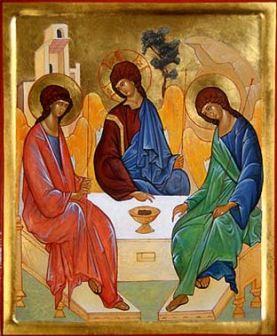 He is the presence of the Father, the mediator with the Father. He is the ambassador of the Father, and yet He and the Father are one. If you have seen the Son, and if you know the Son, you have seen and know the Father.
It has been speculated, because of this relationship—that the Son is the One who reveals the Father—the “interface” between God and His Creation—that it is in fact the Son who Moses encounters in the Burning Bush, who said that His name will be “I AM.” And as I have said in previous posts, the mechanics of the Hebrew might be rendered less succinctly, but more as the Hebrew would convey it, as “I AM for/toward you, in the way that I always was, am, and will be.” This, to me, connects beautifully with the Incarnate Son’s title of Emmanuel, “God with us.” It is one truth, revealed at the Burning Bush, made manifest in the Incarnation of the Divine Son, and enduring forever with the Ascension and Pentecost: “And behold, I am with you always, until the end of the age.”
It is the nature of the Father to be the source of all, and to generously give all from Himself. It is the nature of the Son to be the recipient of all that the Father gives. The Father perfectly loves and gives Himself to the Son, as a perfect Bridegroom might strive to love and give himself to his Bride. And in experiencing the Father’s perfect self-gift of love, the Son, like a Bride, rejoices in the Father’s self-giving love, and reciprocates by pouring Himself out in perfect generosity to the Father, as would the perfect Bride on receiving the perfect love of her Bridegroom, strive to reciprocate the perfect gift of herself to him. This is the exchange eternally going on in the interior life of the Holy Trinity. And this exchange of divine persons has his own divine personhood, his own identity, which is the Holy Spirit (similar to how the relationship of love of a bride and a bridegroom has its own nature, and in some ways, its own personality, that is beyond either individual).
In the sacrament of Marriage, the Bridegroom is like the incarnation of (sacramentally participating in and making present to the marriage and to the world) the provident, protective, generous care of the Father. And the Bride is like the incarnation of (sacramentally participating in and making present to the marriage and to the world) the receptive, reciprocating, beloved person of the Son. And their fruitful exchange of love (sacramentally participating in and making present the self-giving love of the Holy Spirit) is incarnated as their children (as God might will for them, and the imperfection of our material nature not impede). This is the truth at the heart of the sacrament of marriage—the heart we cannot excise to redefine marriage according to our will and pleasure.
In our experience of love, there are these three elements: the subject/the lover; the object/the beloved; and the relationship/the love. Of course, these are human terms for human understanding, so while God is something like this, God is also infinitely more than this; a more intense (more real) reality than our imagination can conceive of.
In our Gospel reading, we hear of the three divine persons. Jesus tells the disciples that the truth is beyond what he can convey to them. They’re not ready yet, even at the time of the Last Supper. “I have much more to tell you, but you cannot bear it now.
But when he comes, the Spirit of truth, he will guide you to all truth… he will take from what is mine and declare it to you. Everything that the Father has is mine…” What the Father is and has, he perfectly shares with the Son. And the Holy Spirit will share it with the Disciples. The Father, the Son, and the Spirit are equal in dignity and nature; whatever it is to be of the substance of God, they are consubstantial, in these Three Divine Persons, as the One Divine God.
The week before Pentecost, we celebrated the Mystery of the Ascension: the return of the incarnate and victorious Son to the Father, who welcomes his Son home to Him. It is the Father and Son’s joy in their union with one another that is the joy of heaven, and heaven’s feast. At Pentecost, we celebrated the outpouring of that joy in the Holy Spirit into the Church through the power of the Sacraments, the healing, the wisdom, the inspiration, and the love of the Father, won for us by Christ, and shared with us in the Holy Spirit. Now, a week after Pentecost, we have the mystery of the Holy Trinity, who we can now intimately know and serve in love because, unlike the Disciples at the Last Supper, we have received the gift of the Holy Spirit. The Holy Spirit “loops us into” sharing in the interior life of God, as the Spirit, now within each of us, is the bond of love in the Holy Trinity.
As the Bridegroom’s and Bride’s love overflows into fruitfulness, creating a family, so does the Fathers’ and Son’s love, the Holy Spirit, overflow into fruitfulness, creating the Family of those reconciled and united to God. This is the message of Paul’s writing in our second reading. “…we have peace with God through our Lord Jesus Christ, through whom we have gained access by faith to this grace in which we stand…” In our tension and suffering endured in conflict with the world of Flesh, our spiritual union with God (particularly the paradox of the Cross), transforms all our sufferings into joy by grace. All their attempts (inspired by the Enemy) only go to encourage us in hope and holiness. “…we even boast of our afflictions, knowing that affliction produces endurance, and endurance, proven character, and proven character, hope, and hope does not disappoint, because the love of God has been poured out into our hearts through the Holy Spirit that has been given to us.” In the Life of the Spirit, our union with Christ, the cross doesn’t lead to despair but to glory.
We couldn’t have a complete celebration of the Holy Trinity without talking about the creed that we say almost every Sunday. The first part of the Creed is about the Father. The large middle part is about Jesus, the Son. And then the third part is about the Holy Spirit, and the effects of the Holy Spirit, namely the Church, the forgiveness of sins, and salvation. This was developed in the context of heavy conflict on the question of who or what Jesus is. Some popular, brilliant theologians of the 4th century were arguing that Christ is not divine, but the first of God’s creations, and through which all other things were made. In their defense, Greek philosophy had ideas of the one creator god, and the logos—the intelligible “interface” between god and creation. John taps into this in the prologue of the Gospel, when he says, “In the beginning was the logos” (the Word, the intelligibility, the reasonability, of God. But John also made sure to identify the logos as divine: The Word was with God, and the Word was God.” But these 4th century theologians were not as careful, hence their confusion and error. And one of the key scriptures used to support their incorrect argument was what we have as our first reading, from Proverbs Chapter 8. These theologians were Greek, arguing in Greek, over the Scriptures, which were in Greek. The New Testament was originally written in Greek, but the Old Testament had been translated from Hebrew into the Greek (the Septuagint) about 200 years before Jesus. In the Greek, our first reading says, “Thus says the wisdom of God: ‘The LORD created me, the beginning of his ways, the forerunner of his prodigies of long ago; from of old I was poured forth, at the first, before the earth.” “The Lord created me.” There’s the rub. In the Hebrew, the word there is qaneh, which (like most ancient vocabulary) has a wide range of meaning, including “created, acquired, begat, possessed.” The Greek translation rendered it as “created.” But in the larger context of Scripture, the word is best translated as possess, or beget, as in being part of one’s personal nature, like one possesses a talent or acquired a virtue. “The Lord possessed me; the Lord begot me.”
A person creates something that might reveal something of himself but is unlike himself. An artist creates a painting. But a person begets something like oneself. A parent begets a child. The child shares in the nature of the parent. A painting doesn’t share in the nature of its creator (even though the painting reveals something of the artist). Creatures made by God bear something of an image of God, but do not share in the divine nature of God. But the Son begotten by God does. So when the whole controversy resolved (at least temporarily) at the Council of Nicaea in 325, the Church wrote out the Nicene Creed. And that (for the most part) is the creed we still profess about the Holy Trinity through all these centuries later: our belief in “one Lord Jesus Christ, the Only Begotten Son of God, born of the Father before all ages. God from God, Light from Light, true God from true God, begotten, not made, consubstantial with the Father; through him all things were made.” These were the arguments and images used during the controversy to articulate and solidify the Church’s understanding of the truth of the Holy Trinity, and so they were enshrined in the words of the Church’s creed. (I had to look up the meaning of “born of the Father before all ages.” This is in correction to those who held that Jesus was “adopted” by God as his Son at his baptism, or some other point. The word “born” is being used allegorically, affirming that Jesus was born of Mary his mother, in time, in his human nature, and born of God the Father, in eternity, in his divine nature. The Son exists eternally as the Beloved and Recipient of the self-giving love of the Father. If the Son is not the eternal Son, then the Father is not the eternal Father.)
So lastly, to apply some of this. Since God created us, and we reflect the image of God, how we understand what God is affects how we understand what we are. If the Son were not divine, then God could not be love, as a solitary person. There would be the eternal lover, but no eternal beloved, and no eternal relationship of love in God. But what a difference it makes that the Son is a divine person within God! This image then is not one of eternal solitude, but of eternal, self-giving, fruitful, relationship, three persons of Love, in an eternal embrace and exchange, like a perfect dance, within the interior life of the One God in Three persons. Only if the Son is Divine can God truly be Love and Communion. And that reveals that our own human nature is not perfected in isolation/solitude, but in relationship/communion. We (even we introverts!) flourish and are perfected in communion with God, and in communion with all others in communion with Him: We are perfected in and as the Church: our holy communion as members of the mystical body of Christ, the family of God the Father, united by the Holy Spirit. Happy parish feast day of the Holy Trinity. God bless you.

(We worship) the True God, One in Trinity and (the) Trinity in Unity. Come Let us Adore.

The Athanasian Creed
(St. Athanasius defended the divinity of Christ at the Council of Nicaea).
Whoever desires to be saved should above all hold to the catholic faith.
Anyone who does not keep it whole and unbroken will doubtless perish eternally.
Now this is the catholic faith:
That we worship one God in trinity and the trinity in unity,
neither blending their persons
nor dividing their essence.
For the person of the Father is a distinct person,
the person of the Son is another,
and that of the Holy Spirit still another.
But the divinity of the Father, Son, and Holy Spirit is one,
their glory equal, their majesty coeternal.
What quality the Father has, the Son has, and the Holy Spirit has.
The Father is uncreated,
the Son is uncreated,
the Holy Spirit is uncreated.
The Father is immeasurable,
the Son is immeasurable,
the Holy Spirit is immeasurable.
The Father is eternal,
the Son is eternal,
the Holy Spirit is eternal.
And yet there are not three eternal beings;
there is but one eternal being.
So too there are not three uncreated or immeasurable beings;
there is but one uncreated and immeasurable being.
Similarly, the Father is almighty,
the Son is almighty,
the Holy Spirit is almighty.
Yet there are not three almighty beings;
there is but one almighty being.
Thus the Father is God,
the Son is God,
the Holy Spirit is God.
Yet there are not three gods;
there is but one God.
Thus the Father is Lord,
the Son is Lord,
the Holy Spirit is Lord.
Yet there are not three lords;
there is but one Lord.
Just as Christian truth compels us
to confess each person individually
as both God and Lord,
so catholic religion forbids us
to say that there are three gods or lords.
The Father was neither made nor created nor begotten from anyone.
The Son was neither made nor created;
he was begotten from the Father alone.
The Holy Spirit was neither made nor created nor begotten;
he proceeds from the Father and the Son.
Accordingly there is one Father, not three fathers;
there is one Son, not three sons;
there is one Holy Spirit, not three holy spirits.
Nothing in this trinity is before or after,
nothing is greater or smaller;
in their entirety the three persons
are coeternal and coequal with each other.
So in everything, as was said earlier,
we must worship their trinity in their unity
and their unity in their trinity.
Anyone then who desires to be saved
should think thus about the trinity.
But it is necessary for eternal salvation
that one also believe in the incarnation
of our Lord Jesus Christ faithfully.
Now this is the true faith:
That we believe and confess
that our Lord Jesus Christ, God’s Son,
is both God and human, equally.
He is God from the essence of the Father,
begotten before time;
and he is human from the essence of his mother,
born in time;
completely God, completely human,
with a rational soul and human flesh;
equal to the Father as regards divinity,
less than the Father as regards humanity.
Although he is God and human,
yet Christ is not two, but one.
He is one, however,
not by his divinity being turned into flesh,
but by God’s taking humanity to himself.
He is one,
certainly not by the blending of his essence,
but by the unity of his person.
For just as one human is both rational soul and flesh,
so too the one Christ is both God and human.
He suffered for our salvation;
he descended to hell;
he arose from the dead;
he ascended to heaven;
he is seated at the Father’s right hand;
from there he will come to judge the living and the dead.
At his coming all people will arise bodily
and give an accounting of their own deeds.
Those who have done good will enter eternal life,
and those who have done evil will enter eternal fire.
This is the catholic faith:
one cannot be saved without believing it firmly and faithfully.

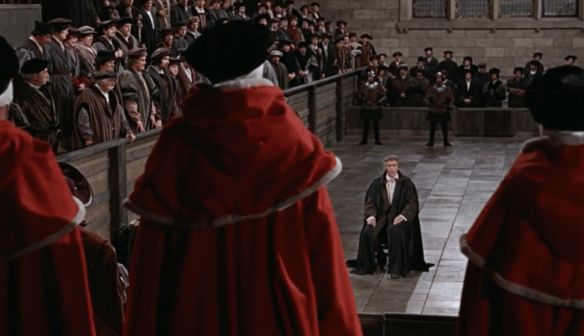
 Having failed to have a son with his wife Catherine, and frustrated that the pope would not grant him an annulment so he could marry Lady Anne Boleyn instead, Henry passed into law the “Act of Succession,” and required his public officials to swear an oath which a) recognized the child of Henry and his second wife Anne Boleyn as the heir to the throne; b) declared Henry’s first marriage with Catherine as null and void, and c) repudiated the authority of the Pope, and declared the king the head of the Church in England. Thomas More refused to take the oath. He spent fifteen lonely months imprisoned in the Tower of London. His family implored him, for his sake and theirs, to take the oath, but Thomas refused. He was convicted of treason and was beheaded. On mounting the scaffold, Thomas More proclaimed that he died as “his majesty’s good servant… but God’s first.” St. Thomas More put his discipleship of Christ above his employment, king, security, reputation; above his wife, children, and even his own life. (I highly recommend the movie called “A Man for All Seasons,” which is based on St. Thomas More.)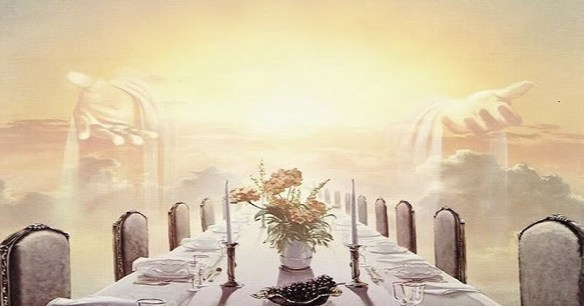


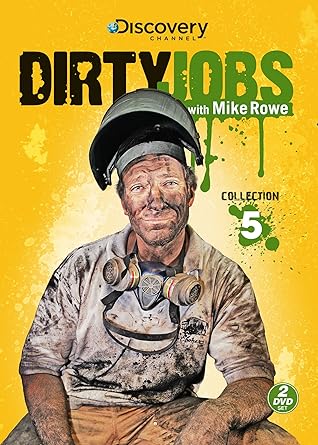 You have to do something you don’t want to do, that’s beneath your dignity? Watch Mike Rowe’s “Dirty Jobs.” There’s a saying, “If serving is beneath you, leadership is beyond you.” Get down in the muck and do what has to be done.

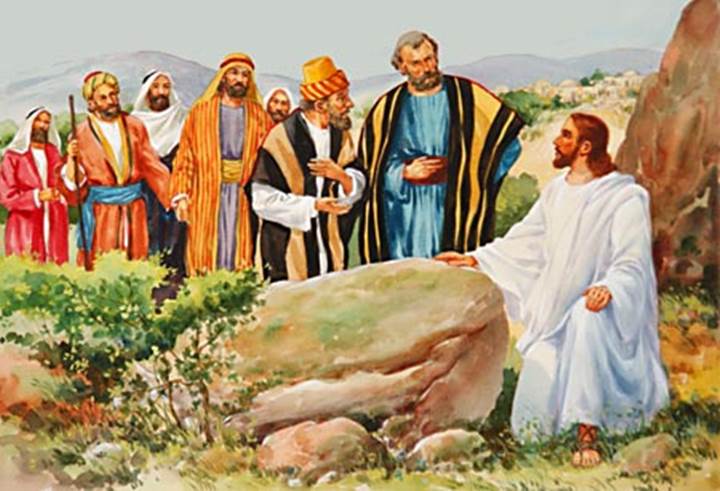


 God does sometimes do this, when we’re in a position of really not paying attention to Him, and he really wants to get something through to us. This is a good technique for communicating, but it’s not good for formation, which is what he really wants. He wants to form us into saints by our free will, by our decision to direct our faith, hope, and love to him. He wants us teach us to be His dance partner, to live gracefully, and to be so attuned to His will, that He need only give us the slightest gesture of how to move, how to serve Him, and we respond with grace and joy.
 Your neighbor, whom you are obligated to love as you love yourself, is also the people you dislike, the people you’ve been having fights with, the people you ignore, the people who are strangers. And especially, your neighbor is anyone you see who is in need: the vulnerable, the outcast, the poor, and frightened. Your neighbor is every person who is made by God in His image, which is every person. What does it mean to love your neighbor? To do as the Samaritan did: to show mercy, to personally sacrifice, to put yourself out and become vulnerable, to invest yourself (in love) in their well-being and flourishing.
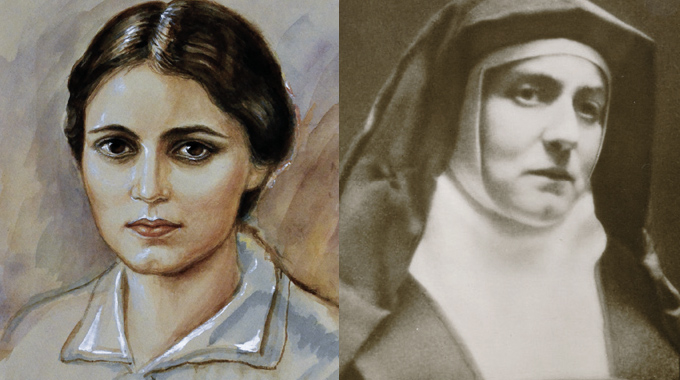 I’ll end with this quote from another Theresa, St. Theresa Benedicta of the Cross (the religious name of St. Edith Stein), who was a Jewish-convert to the Catholic faith, and martyred by the Nazis in Auschwitz. St. Theresa Benedicta of the Cross wrote this, which beautifully summarizes our reflection on the Good Samaritan: “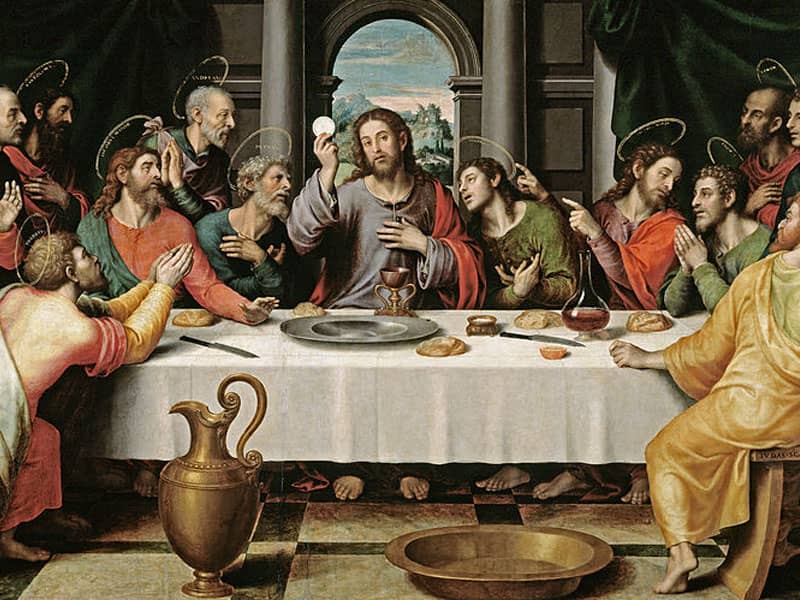

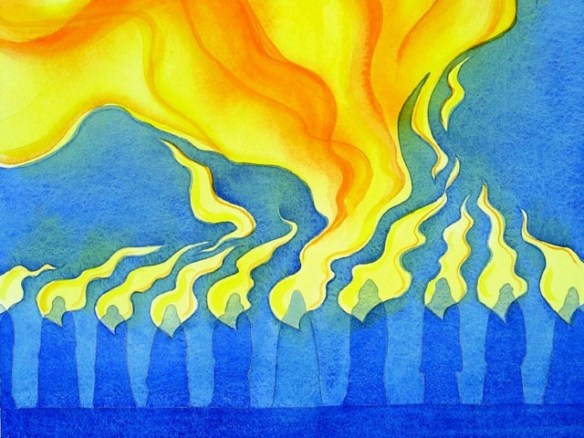
 As God made the covenant at Sinai establishing Israel as the People of God, and gave them the Law of the Covenant on the stone tablets, here at Pentecost, in Jerusalem, the city of God’s presence with his people, the Holy Spirit in a similar way establishes the new covenant with the New Israel with his own divine ruah, and fire, and, as the prophets had said, he establishes the new law not carved into stone, but written into the flesh of their hearts.
 humanity, still speaking a single language, decides (as fallen humanity often tries to do in different ways in different ages) to build a giant tower—a siege tower—to take heaven by force. God observes what they’re doing, and divides and confuses their language, reflecting the division and confusion in their hearts and their relationships to Him and to one another. Thus confused and confounded, they each wander off to different parts of the world. But “Babel” is the root for our term “babbling,” that is, making unintelligible sounds. The city that opposes God is also the city of unintelligibility. Opposition to God leads to moral and intellectual confusion, the loss of truth and goodness. And we see this today among those who oppose God’s truth and his Church.

 So where the high priest is praying for the other priests who share in his high priesthood, Jesus, the true high priest, prays for the Apostles, and for their consecration and ministry. Then he begins the third part, which is our gospel reading today. Jesus prays, “
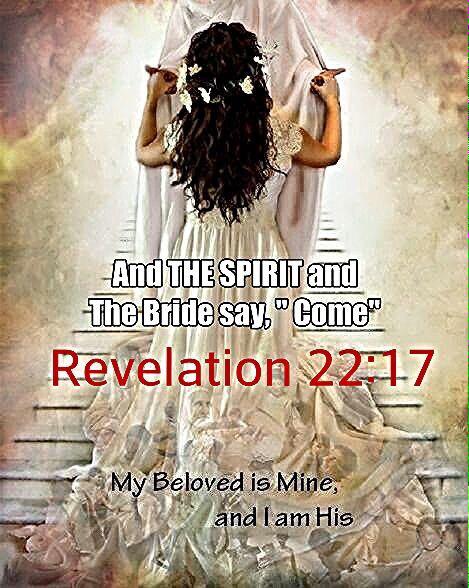 In our second reading for today, which is the end of the book of Revelation, we have Jesus promising his return, the promise of judgment and justice on the good and the bad, a blessing for the suffering faithful, and finally, the reminder that we want this, we pray for it. The Church, the Bride of Christ, and the Spirit, the love that gives the Church unity, the Spirit and the Bride say to Jesus, “Come!” Let all who hear this say, “Come!” Then in the final verse, John as the narrator joins this chorus, saying, “
 This is the only place that describes Jesus as standing, rather than being seated, at the right hand of God. A king seated on his throne would rise to greet an honored guest, and Jesus stands to welcome Stephen, whose name means “crown,” as the first after Christ to win the crown of martyrdom, of witnessing to his faith in Christ to the extent of giving his life. Stephen had been mentioned earlier as one of the men nominated to be the first “deacons” in the Church, to help the Apostles by ministering to the temporal needs of the Christian community. He was described as a man filled with faith and the Holy Spirit. After testifying to Christ against the Jews who rejected him, Stephen was stoned to death. The description of his death is meant to set a model for future Christians, of imitating (and so, participating in) Christ’s giving his life. Not necessarily by the cause of death, as Jesus was crucified and Stephen was stoned, and later Christians would be killed in a cruel variety of methods. But like Christ, and like Stephen, Christians were to follow the example, in their final moments, of commending their spirit to the mercy of God, and praying for God’s forgiveness for their persecutors.
 The Snarky Vicar