
Palm Sunday of the Lord’s Passion (Year A)
Matthew 21:1-11 (Gospel for Procession with Palms)
Isaiah 50:4-7
Psalm 22:8-9, 17-18, 19-20, 23-24
Philippians 2:6-11
Matthew 26:14-27:66
Welcome to Holy Week!
Holy Week opens with “Palm Sunday of the Passion of the Lord.” Since Easter begins its own liturgical season (starting with the Easter Vigil), today’s celebration contains the entirety of Holy Week, the finale week of Lent: beginning with the Triumphal entry into Jerusalem, the Last Supper, the passion, crucifixion, and death, and ending with the silence of the body of Jesus laying in the sealed tomb, all in today’s readings.
Before getting into the main part of our reflection, I just want to share two precursory thoughts.
The first thought is about our “processional gospel reading” of Palm Sunday. It says that the people spread their cloaks on the road, and waved palm branches, as Jesus entered Jerusalem riding on an ass. The first part of this is the fulfillment of Psalm 118 “Blessed be he who enters in the name of the LORD! We bless you from the house of the LORD… The LORD is God, and he has given us light. Bind the festal procession with branches, up to the horns of the altar!” So it’s a royal celebration of welcoming the procession of Jerusalem’s king, who will then proceed to the temple and offer sacrifice to God. And certainly that fits with what Jesus is going to do in this final week. And ordinarily, the faithful of the church joins across time with the people in ancient Jerusalem, as we hold our palm branches, sharing in the glorious entry of Jesus up to the house (sanctuary) of the Lord.
And the second thought is that, of course, we’re not celebrating Palm Sunday, or any of these celebrations, as we ordinarily do. And I share in the deprivation that our current situation brings to these central celebrations at the heart of our faith. But here we are. As we have been doing since this situation began, let us even more fervently bring into this week our growing desire for, and spiritual communion with, the celebrations of the mysteries of Lent and Easter. Let us intercede on behalf of those who continue their preparation to enter into full communion with the Church, and those who have entered into situations that wound their full communion with the Church, and those who are merely slothful and apathetic about their communion with the Church. Of course, it’s perhaps a mixed blessing that with the current situation, the focus hasn’t been on the abuse scandal and the bankruptcies of Catholic dioceses. But there many who have been so wounded by the abuse and scandal that their love for the Church has become a source of pain, shame, and suffering. So let us intercede for all these people, offering our own sacrifice–of not being able to be physically together with the church and receive her sacraments–as an offering to God for them, and for our own growth in faith also.
Following the example of Dr. Brant Pitre’s reflection on our gospel reading, I want to touch on seven points, particularly as they are uniquely presented in St. Matthew’s gospel.
First point…
Matthew emphasizes over and over again that the Last Supper was a Passover meal. He goes on to recount the words of institution and the Last Supper. The Passover meal was the annual memorial of the deliverance of the 12 tribes of Israel from slavery to Pharaoh in Egypt. So, on the Passover night, the lamb was sacrificed, unleavened bread was eaten, and Israel embraced their redemption. They were delivered. And they began their journey to the promised land. Each generation united themselves to that original generation that left Egypt: a perpetual memorial which also makes present the reality of what it celebrates. So when Jesus institutes the Eucharist at the Last Supper, in the context of the Passover meal, he is inaugurating the New Passover (or the Passover of the New Covenant). It involves the sacrifice of the Lamb with the 12 Apostles, as they enter into the event that will free them from slavery to Satan (and sin and death), and set them on their journey to the new promised land, and will give them the heavenly bread of life for the journey. It will be a perpetual memorial, with each celebration of the Last Supper making present the whole Paschal Mystery of Christ for all generations. So the Last Supper is a New Passover, in which the sacrificial lamb is eaten, beginning a New Exodus to the Promised Land of God’s presence in heaven.
Second point…
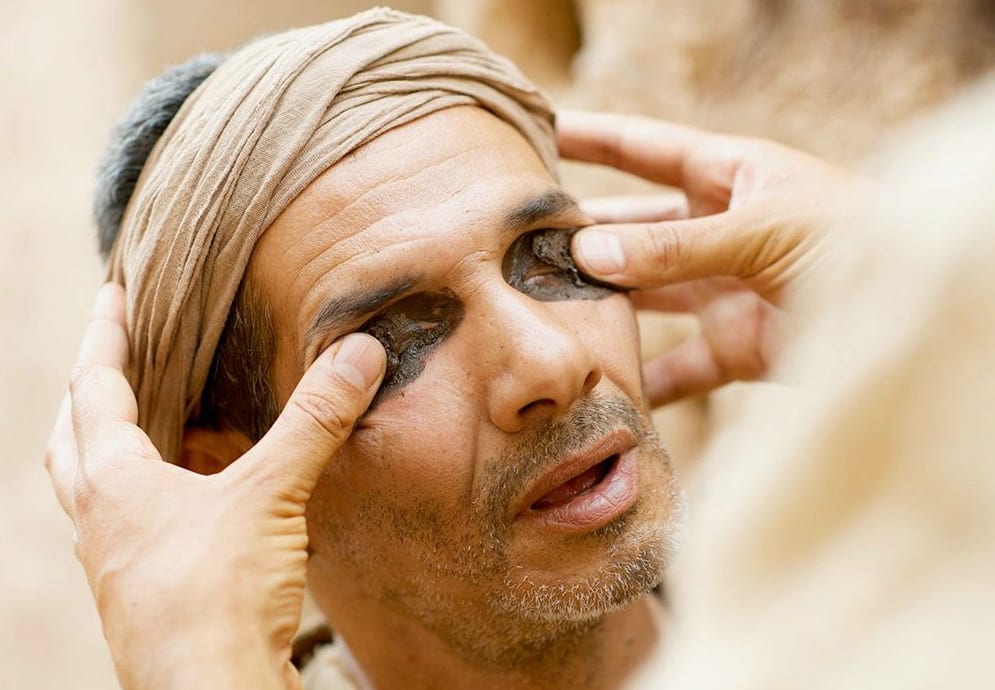
Matthew emphasizes the beginning of Jesus’ Passion with his agony in the Garden of Gethsemane, on the Mount of Olives. This one is a bit more speculative. Jewish tradition had that in the Garden of Eden, the tree of the knowledge of good and evil was a fig tree, and that the tree of life was an olive tree. Gethsemane, in Hebrew, refers to an olive press. So Jesus is on the Mount of Olives, in a grove of olive trees, preparing himself for the cross, which by his passion and blood will become the tree of life, the source of eternal life for all who embrace it. There’s also a Jewish tradition, a bit more ambiguous, that Jerusalem is where the Garden of Eden was. We mentioned last week about the Gihon river, which feeds the pool Jesus told the blind man to wash in, was named for one of the four rivers of Eden, and that this washing was Jesus re-creating the blind man’s sight. It was thought that Adam and Eve were buried somewhere (way down) in Jerusalem (perhaps specifically Golgotha). Sometimes you will see icons of Adam and Eve underground beneath the cross, so Jesus is the New Adam, in perfect obedience to the Father, providing the Tree of Life, superseding the old Adam, who in disobedience to the Father, led humanity into the slavery of disorder and death.
Third point…
Matthew emphasizes the cruel treatment of Jesus, beginning with the Sanhedrin at his trial. They spit at him and beat him, and he does not recoil or reply. Jesus is personifying the Suffering Servant of Isaiah, which is a mysterious figure described in four excerpts in the last section of the book of Isaiah. The third excerpt is our first reading today. “I have not rebelled, have not turned back. I gave my back to those who beat me, my cheeks to those who plucked my beard; my face I did not shield from buffets and spitting. The Lord GOD is my help, therefore I am not disgraced; I have set my face like flint, knowing that I shall not be put to shame.” We often hear excerpts about the Suffering Servant, that he is a man of sorrow, pierced for our offenses, led like a lamb to the slaughter, as a lamb before the shearers is silent, he opened not his mouth, that on him was laid the guilt of us all, that by his stripes we are healed, etc. At the altercation in the Garden, Jesus tells his disciples, “Put your sword back into its sheath, for all who take the sword will perish by the sword. Do you think that I cannot call upon my Father and he will not provide me at this moment with more than twelve legions of angels? But then how would the Scriptures be fulfilled which say that it must come to pass in this way?” Jesus is intentional in following the plan of the Father. Jesus is the Suffering Servant.
Fourth point…
Matthew talks about the betrayal of Judas, and is the only one to mention the thirty pieces of silver being paid. This might call to mind a much earlier parallel, of Joseph, of the technicolor dreamcoat fame. Joseph was righteous, the favorite of his father (the father of the twelve tribes of Israel), but betrayed by his brother Judah (Judah and Judas are the same in Hebrew), and sold for twenty pieces of silver. Joseph was sent down into a pit, and considered dead. But then, he’s found to be alive! By his righteousness, he was vindicated, favored, honored, given great power, and led to the feeding of the multitude, which led to reconciliation and reunion with his father and brothers. So Jesus is a new Joseph.
Fifth point.
Jesus vs. Barabbas. Most people get the contrast between Jesus, the prince of peace who by grace will redeem the world, vs. the violent revolutionary in Barabbas. But Matthew takes it deeper than that. It becomes even more poignant when we know that “Barabbas” is “Bar Abbas” – “Son of the Father.” And even more so, looking some manuscripts of Matthew, in which Barabbas’ first name is given… as Jesus. So given the choice between the true Jesus, Son of the Father, who comes in peace, meekness, and healing signs, but challenges the corrupted ways of Israel, vs. Jesus, son of the father, who comes in violence and rebellion, who wants to liberate Israel from the Romans, the people, egged on by their leaders, shout their choice of the second one. Pontius Pilate, seeing no crime in Jesus, washes his hands of the guilt of innocent blood, and the Jews infamously accept the consequences: “his blood be upon us and upon our children.” This line was used for centuries of deeply ingrained anti-Jewish prejudice and persecution, even into the 20th century. The Jews, it was said, accepted the guilt of crucifying Christ, a diabolical act, of infinite scale, and so rebelled against their covenant with God, who has cut them off as forsaken. The Catholic Church, in the wake of the Jewish holocaust, has accepted the guilt of contributing to this anti-semitism, and taken measures, including in the text of the liturgy, to clarify that we definitively do not hold Jews of any time and place guilty for Christ’s death, or deserving of prejudice. The crowd in the gospel is representative of everyone of all time and place who sins, and thus participates in the need for Jesus to be crucified for the sake of their redemption. The Catechism of the Catholic Church, says beautifully, in paragraph 598: “All sinners are the authors of Christ’s passion.” As Dr. Pitre says in his commentary:
In other words, there’s a real sense that at a mystical level every single person who has ever been born, every single sinner, is responsible for the death of Jesus, because when we sin we, in a sense, crucify Jesus once again. We participate in the evil that led him to the cross. So I just want to stress that. Christians today need to make very clear that the statement of this particular Jewish crowd at the trial and death of Jesus is not something that makes all Jews of all time in all places collectively responsible for Jesus’s death. However, as Pope Benedict points out in his book Jesus of Nazareth, by saying “his blood be upon us and our children,” the irony is that at a deeper spiritual level they are in a sense praying for precisely what all of us need, which is for the powerful redeeming blood of Jesus to “be upon us and upon our children,” so that it might cleanse us from sin and set us free from sin and death. So there’s an irony in their words here.
Sixth point…
Is about the “Cry of Dereliction,” or Jesus’ words from the cross, “My God, my God, why have you forsaken me?” A lot of people have a lot of wrong ideas about this. A lot of modern commentary expresses the opinion that God the Father, who is all good, turned away from Christ, who was covered in the imperfection of our sin, and that Jesus was truly abandoned by the Father, until his death, when the sin was also put to death, and Jesus was cleansed of all our sin, and we along with him. While it is true that Jesus was indeed experiencing the human anguish of the crucifixion, and perhaps a feeling of the separation from God we experience because of our sin, Jesus is God the Son, in perfect union with God the Father, and truly was not forsaken by the Father. What Jesus is really doing here is calling to everyone’s mind Psalm 22, which begin with that cry of dereliction, written by King David. The psalms didn’t have a numbering system at the time of Jesus. They were known by their opening words (as the church still does with many prayers and church documents). The important thing about Psalm 22 is not only that it very much describes the experiences of Jesus in his passion, but also that the psalm ends with hope, vindication, and all the nations coming together in worship of God. Psalm 22 doesn’t just describe Jesus’ crucifixion; it describes his whole messianic mission. After the next point, which is the seventh and last, I give you Psalm 22 in its entirety, along with some notes and commentary in green, to deepen the experience and meditation on this psalm, which is perfect for contemplating during this final week of Lent.
Finally, the seventh point…
The burial of Jesus in the tomb. Joseph of Arimathea was part of the Jewish upper class, and part of the Sanhedrin, and one who came to Jesus at night. He asked Pilate for the body of Jesus, that he might be given a proper burial. Of course, this would be highly unusual for crucified Roman criminals, so evidence of a buried man with both Jewish burial rites and crucifixion wounds would be pretty unique (a compelling point regarding the Shroud of Turin). Also, Mary Magdalene “and the other Mary” remained sitting and facing the tomb. So some people say that when they returned on Sunday and found the tomb opened, they mistakenly had the wrong tomb. Nope, they knew exactly which tomb it was. And finally, in another irony, the Pharisees were so paranoid about the possibility of Jesus’ followers taking the body from the tomb and claiming that he had risen on the third day as he had said, that they requested Pilate to seal the tomb and provide soldiers to guard it. And so by that, the Pharisees made it absolutely certain that if the tomb were to end up opened and empty, it was not carried out by a conspiracy of Jesus’ followers.
And that is where we leave things on this last Sunday of Lent… with the tension of the sealed tomb, holding the dead body of the crucified Christ, and the unresolved question of whether he was indeed the Messiah, the one was coming into the world, who would be raised from the dead on the third day, as he had said.
And so, as promised… Psalm 22 in its entirety. God bless you!
For the leader; according to “The deer of the dawn.” A psalm of David.
“The deer of the dawn” seems to be the tune for singing the psalm.
My God, my God, why have you abandoned me?
Why so far from my call for help,
from my cries of anguish?
My God, I call by day, but you do not answer;
by night, but I have no relief.
Yet you are enthroned as the Holy One;
you are the glory of Israel.
In you our fathers trusted;
they trusted and you rescued them.
To you they cried out and they escaped;
in you they trusted and were not disappointed.
But I am a worm, not a man,
scorned by men, despised by the people.
The psalmist’s sense of isolation and dehumanization, an important motif of the psalm is vividly portrayed here.
All who see me mock me;
they curl their lips and jeer;
they shake their heads at me:
“He relied on the LORD—let him deliver him;
if he loves him, let him rescue him.”
These words are echoed in the mockery shouted at Jesus on the cross.
For you drew me forth from the womb,
made me safe at my mother’s breasts.
Upon you I was thrust from the womb;
since my mother bore me you are my God.
Not really part of our reflection, but “I was thrust from the womb” means that *I* was there in the womb and then thrust out when my mother bore me, for those Christians who think that the bible permits abortion… just saying…
Do not stay far from me,
for trouble is near,
and there is no one to help.
Many bulls surround me;
fierce bulls of Bashan encircle me.
They open their mouths against me,
lions that rend and roar.
The enemies of the psalmist are also portrayed in less-than-human form, as wild animals. Bashan was a region of a grazing land northeast of the Sea of Galilee, famed for its cattle.
Like water my life drains away;
all my bones are disjointed.
My heart has become like wax,
it melts away within me.
As dry as a potsherd is my throat;
my tongue cleaves to my palate;
you lay me in the dust of death.
The dust of death is the netherworld, the domain of the dead.
Dogs surround me;
a pack of evildoers closes in on me.
They have pierced my hands and my feet
I can count all my bones.
While it is a mystery what David might have meant in speaking of his hands and feet being pierced, this was experienced literally in Jesus’ crucifixion.
They stare at me and gloat;
they divide my garments among them;
for my clothing they cast lots.
The Roman soldiers cast lots for the seamless garment Jesus had been wearing. Those who are crucified, are crucified naked, adding to the shame and humiliation.
But you, LORD, do not stay far off;
my strength, come quickly to help me.
Deliver my soul from the sword,
my life from the grip of the dog.
Save me from the lion’s mouth,
my poor life from the horns of wild bulls.
Then I will proclaim your name to my brethren;
in the assembly I will praise you:
Here begins the praise of God given by someone offering a Todah sacrifice, giving his testimony, to all assembled in the Temple, of his experience of God saving and delivering him in answer to his prayer…which thereby becomes an exhortation to praise and trust in the LORD.
“You who fear the LORD, give praise!
All descendants of Jacob, give honor;
show reverence, all descendants of Israel!
For he has not spurned or disdained
the misery of this poor wretch,
Did not turn away from me,
but heard me when I cried out.
“Turn away”: lit., “hides his face from me,” an important metaphor for God withdrawing his favor/protection/delight from someone. Notice that in referencing this psalm by its opening words, Jesus is affirming that the Father did not turn His face from His Son, as many modern commentators have asserted in their interpretation of his very use of those opening words.
I will offer praise in the great assembly;
my vows I will fulfill before those who fear him.
The poor will eat their fill;
those who seek the LORD will offer praise.
May your hearts enjoy life forever!”
Not only could this be a reference to the Todah sacrifice being shared with the poor who come to the Temple looking for assistance, but also a reference to the poor being tended to with Christian care (“whatsoever you do for the least…”). Also, it could refer to the pious and devout having their deepest needs met in the New Covenant in Christ, namely grace, and communion, and everlasting life.
All the ends of the earth
will remember and turn to the LORD;
All the families of nations
will bow low before him.
For kingship belongs to the LORD,
the ruler over the nations.
The Scriptures (bold Old and New) abound with prophecies of all the nations uniting in a single faith and praise of the one true God, in a new covenant. Isaiah (42:6) foretold, “I will keep you and will make you to be a covenant for the people and a light for the nations.” How can a person be a covenant? By being the covenant sacrifice whose blood is spilled for the forgiveness of sins. Kingship belongs to God, the transcendental standard of truth, justice, and righteousness, and earthly rulers are subject to their stewardship of their office: the Cathedral outranks the Capitol.
All who sleep in the earth
will bow low before God;
All who have gone down into the dust
will kneel in homage.
This could be a reference to Jesus, in the three days after his death, going into Sheol, the underworld, and bringing the just ones who died and were in the Bosom of Abraham, through the gates of heaven to the glorious reward for which they have waited. This connects directly with our second reading, the Philippians hymn:
“He humbled himself, becoming obedient to the point of death, even death on a cross. Because of this, God greatly exalted him and bestowed on him the name which is above every name, that at the name of Jesus, every knee should bend, of those in heaven and on earth and under the earth, and every tongue confess that Jesus Christ is Lord, to the glory of God the Father.”
And I will live for the LORD;
my descendants will serve you.
The generation to come will be told of the Lord,
that they may proclaim to a people yet unborn
the deliverance you have brought.
The generation to come is the Church, the New Israel in the New Covenant. We have received the Good News of the Lord, the Gospel… that we may proclaim it to those who have not yet turned to the Lord, “a people yet unborn” in water and spirit to new life, and deliverance from sin and death, through the blood of Christ.
Psalm 22 is the psalm of Christ’s passion, but also of His deliverance by God, and the fulfillment of the plan of salvation. Of course, immediately following Psalm 22 is Psalm 23, “The Lord is my Shepherd.” Not only does this express a restful, personal trust in God, this psalm was used in the ancient Church to teach about the sacraments (restorative waters, the anointing with oil, the overflowing cup…). The sacramental life of the Church, and the covenantal relationship with God, flow directly from passing through the cross, through our feeling of abandonment and darkness and suffering, to the glory of the life of the resurrection, the life of grace, and eternal life.



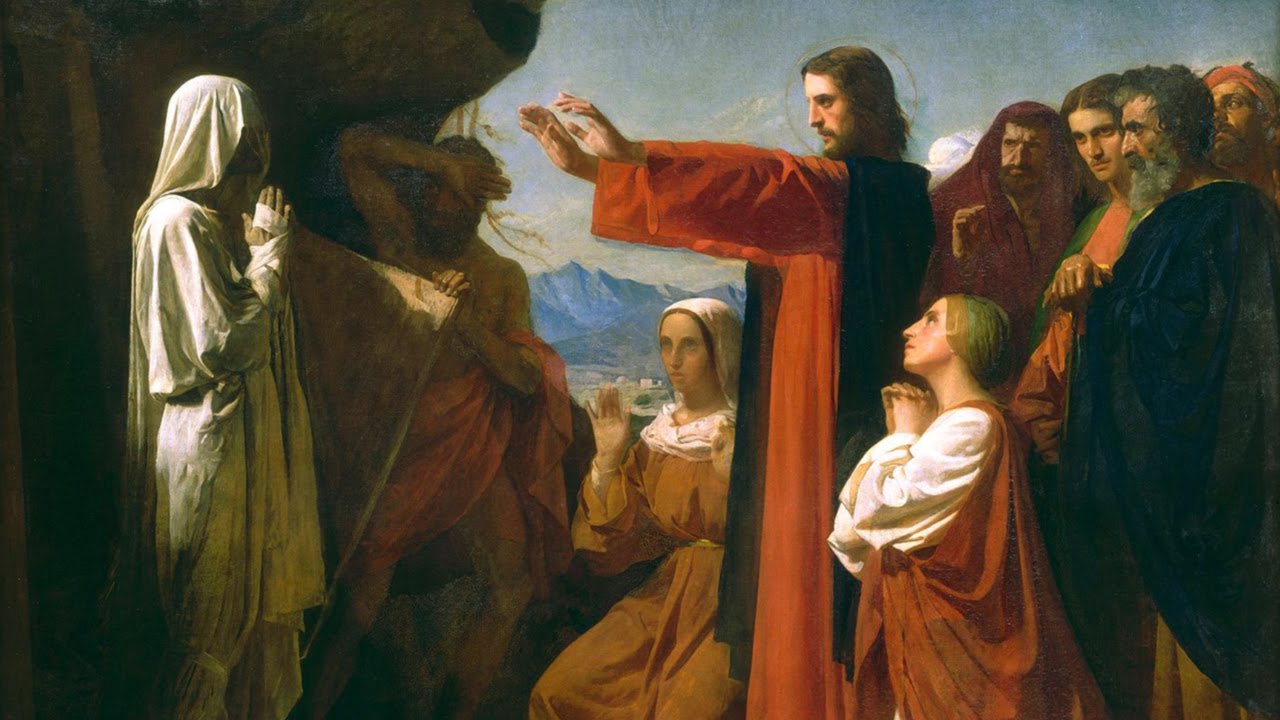
 The second thing to point out in this delay, is that he knew Lazarus was very ill and going to die. He knew it would cause great anguish and suffering to Mary and Martha. They both lamented that if Jesus had been there, Lazarus wouldn’t have died. But Jesus chose to allow all that to happen. Jesus didn’t kill Lazarus, nor was Mary and Martha’s suffering assigned to them as punishment for something they did. In fact, Jesus shared in their suffering. In English, it’s the shortest verse in the bible: “

 Third, we have to understand the term, “living water.” The common meaning of “living water” was moving water, like a stream or a spring, water that seemed to have a life of its own, in contrast to the stagnant water of a pond, or even a well. Jesus offers the woman “living water.” Not just natural water for natural life, but eternal life. She doesn’t quite get it—she wants it so she doesn’t have to come to the well to draw more water. But she asks, so Jesus has the opportunity take her to the next level.
 So what does that mean for us? When Jesus is pierced on the cross, it’s the living water and blood of the covenant, the life of His Bride, the Church, that flow from his side (which just might be related to Adam having his bride taken from his side; and may also be related to the psalm of life-giving water flowing from the right side of the temple, from the sanctuary…). And when do we individually receive the living waters that wash us clean from our sins? In our baptism. When you get baptized, all the sin and the effects of sin are washed away at that moment of baptism. This reading is preparing catechumens to receive the living water at the celebration of their baptism (and the other sacraments of initiation) at the Easter Vigil.


 The answer is, “Jesus being baptized is why our baptism forgives our sins.” We see in today’s gospel reading that all three persons of the Holy Trinity are present: the glory cloud of the Holy Spirit, the voice of the Father from the cloud, and the Father acknowledging Jesus as his beloved divine Son. The baptism of Jesus is the total will of God to provide the forgiveness of our sins.
 We know very well that God miraculously parted the Red Sea and led the people on dry land at the beginning of the Exodus. But most of don’t know that the priests carrying the Ark led the crossing of the Jordan River, which then stopped flowing, and God led the people on dry land across the Jordan at the end of the Exodus. So one of the important expectations of the Messiah was to be a sort of New Moses, who would inaugurate a new exodus, from this earthly promised land to the true heavenly Promised Land, and that this new exodus would launch from the same point the original exodus ended: at the Jordan River. By the way, Moses didn’t finish the exodus and lead the people across the Jordan…he died just before that. It was Joshua who led the people into the Promised Land, and in Hebrew, Joshua and Jesus are the same name. So, Jesus, as the New Moses and New Joshua, is going to lead his people all the way from the beginning threshold of the New Exodus (the Jordan) to the threshold of its fulfillment (the gates of heaven).
 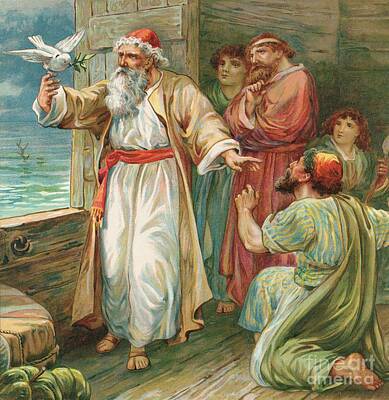 God flooded the world because it had turned from God, and become proud and corrupt, except for the family of Noah. God washed the infection of sin away by the waters of the flood and recreated the world anew. When the rain stopped, Noah sent a dove out, and it came back with an olive branch, and the olive branch is a symbol of the new creation—that creation has been restored, that new life has sprung up out of the waters of death that were the flood. In the Church’s blessing of the water for the sacrament of baptism, it makes reference to the importance of water in salvation history. It says, “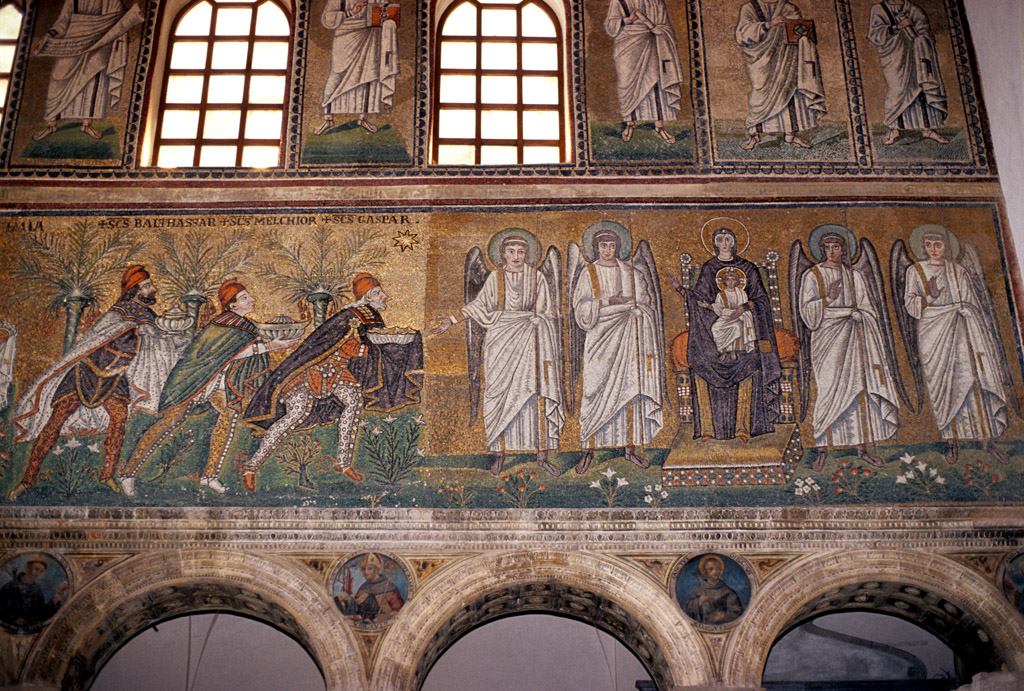
 So that, of course takes us to another point of our reading: the gifts. Matthew doesn’t say what the gifts mean, but scholars generally agree that gold represented Jesus as the great King. Frankincense, an incense used in the sanctuary, represented Jesus as High Priest, and the myrrh could mean that Jesus was anointed as the True Prophet, or it could also point to the anointing of Jesus for his death for the forgiveness of sins. Also, Matthew doesn’t say how many magi there were, or if it was just men. It could have been any number, and possibly men or women. We might remember the Queen of Sheba being a great admirer of King Solomon, and she brought him gifts in honor of his wisdom, and there is something much greater than Solomon here. So following the precedent set by the Queen of Sheba and Solomon, the magi could very well have been wise kings (but again, probably not, as Matthew probably would have said they were kings, rather than magi).

