
Go to Readings for 3rd Sunday of Easter (Year A).
In the season of Easter, our first reading isn’t from the Old Testament, but from the New Testament book of the Acts of the Apostles. We see the early Church wrestling with the challenge of applying the meaning of Jesus and his teachings as the first and second generation of Christians, spreading the good news, led and inspired by the power of the Holy Spirit, as more and more come to believe through them that Jesus indeed is the way, the truth, and the life.
We have one reading from the Old Testament, the Psalm, then in the Gospel, our encounter with the Jesus on the day of his resurrection, then in our first reading, we see Peter preaching on the day of Pentecost, and then a letter of St. Peter to the Church as our second reading, encouraging us and sending us out into our world to continue the work of the Church, to be the continuation of the life, the presence, and the ministry of Jesus to our age, to those around us. “Bloom where you’re planted.”
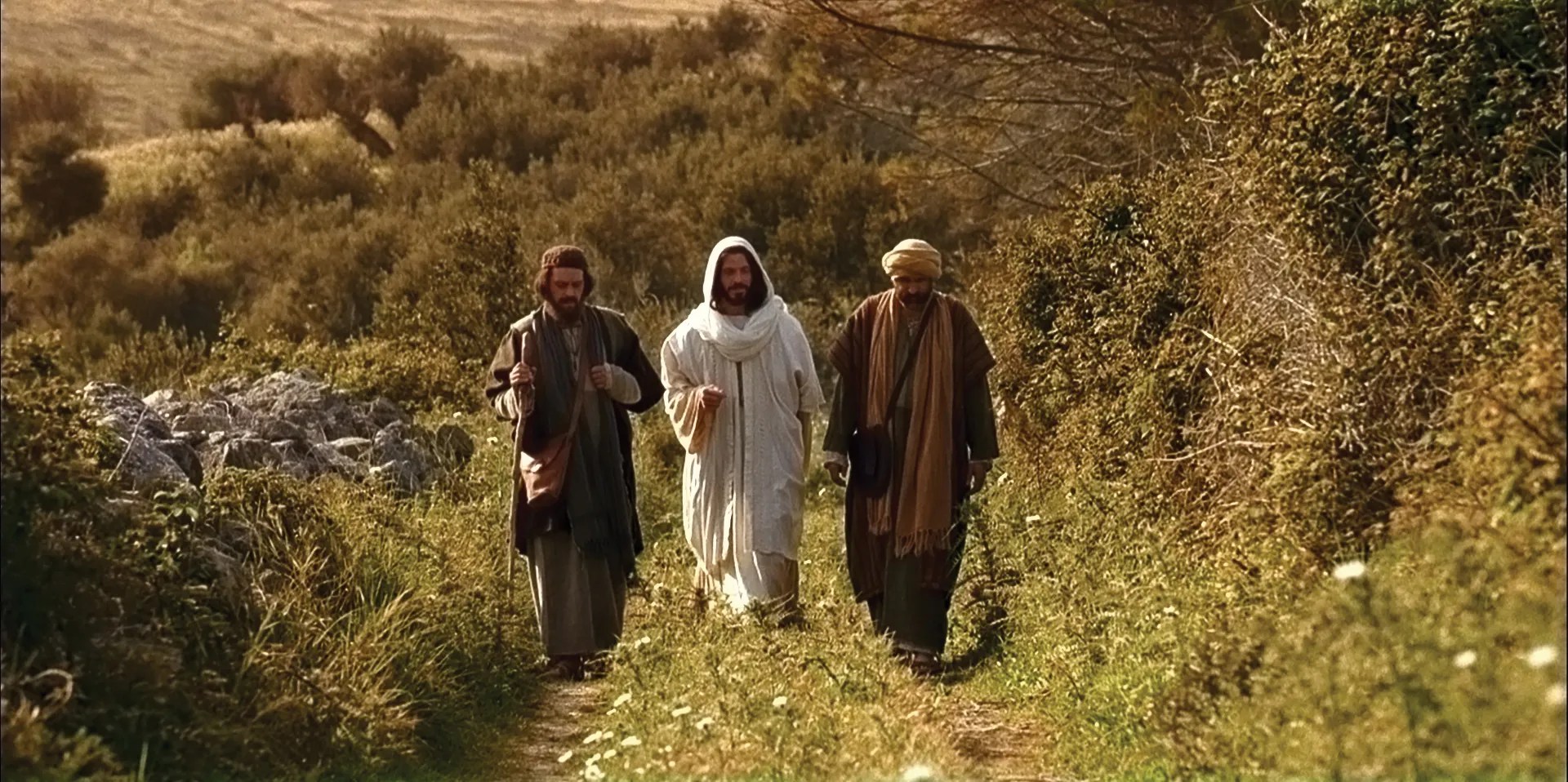
In our Gospel reading, we read, “That very day, the first day of the week, two of Jesus’ disciples were going to a village seven miles from Jerusalem called Emmaus, and they were conversing about all the things that had occurred.” That very day means the same day as the gospel was just talking about. Immediately before our reading is the discovery of the empty tomb, first by the women, and then by Peter.
“And it happened that while they were conversing and debating, Jesus himself drew near and walked with them, but their eyes were prevented from recognizing him.” So, they are Jesus’ disciples, they’re walking away from Jerusalem three days after the crucifixion, and Jesus himself joins them. But as we have already seen, Jesus can appear to his disciples in a way that they don’t immediately recognize him. He looks different somehow. We saw it with Mary Magdalene, we’ll see it later with the Apostles on the seashore. We see it here, and we’ll see it in a special way at the end of our gospel reading.
He asked them, “What are you discussing as you walk along?” They stopped, looking downcast. One of them, named Cleopas…” Cleopas, we believe probably to be the same person as Clopas, was a relative of the Holy Family. In John’s Gospel, we see the women standing at the foot of the cross: “Mary, Mary’s sister, the wife of Clopas, and Mary Magdalene.” There’s an ambiguity of whether “Mary’s sister, the wife of Clopas” is one person or two people. Ancient interpreters such as Eusebius and St. Jerome interpret this as one person: That Clopas is the brother of Saint Joseph, and his wife is mentioned in Scripture as “the other Mary, the mother of James and Joses,” these men who are elsewhere called the brothers of the Lord. But as we see, they are more precisely cousins of Jesus, and the Blessed Mother’s sister, called “the other Mary,” is more precisely her sister-in-law. Also, many biblical interpreters say that in our Gospel reading for today, the other disciple walking with Cleopas/Clopas on the road to Emmaus might his wife, this same Mary.
Anyway, “Cleopas said to him in reply, ‘Are you the only visitor to Jerusalem who does not know of the things that have taken place there in these days?’ And he replied to them, ‘What sort of things?’” Now the scriptures do mention the time that Jesus wept. But they don’t say much about his sense of humor. But here, the irony is so rich. They say to Jesus, “Are you the only one who doesn’t know what just happened?” Who knows better than Jesus himself! Not only what was seen, but what was unseen during his three days in the tomb, his descent to the netherworld, the realm of the dead, and his resurrection. But Jesus just goads them on. “Really? What sort of things happened?”
And they relate the story of Holy Week, and even including the women finding the empty tomb, that morning. And even after that, they had left, downcast, because clearly, to them, three days later was not only merely dead but really most sincerely dead. And they don’t call him Lord or Messiah, but in their disappointment they downgrade him to just “a prophet mighty in deed and word.”
“And he said to them, ‘Oh, how foolish you are! How slow of heart to believe all that the prophets spoke! Was it not necessary that the Christ should suffer these things and enter into his glory?’ Then beginning with Moses and all the prophets, he interpreted to them what referred to him in all the Scriptures.” Now it doesn’t say that they recognize him yet. But Jesus here gives us our example of Christian biblical interpretation. St. Augustine beautifully said that the New Testament lies hidden in the Old, and the Old is revealed in the New. The Church calls this “typology,” how Jesus shows them how the Old Testament, from Moses through the Prophets, point to Christ as their fulfillment, how the seeds of the Christian faith are planted way back from the beginning, and the figures, events, and words have their spiritual fulfillment through Jesus and the new covenant. We might say this also becomes like the seed of the Sacred Tradition of the Church, not necessarily written down, but they lens by which the Church understands, interprets, and applies the Scriptures.
“And it happened that, while he was with them at table, he took bread, said the blessing, broke it, and gave it to them. With that their eyes were opened and they recognized him, but he vanished from their sight.” So, if you’re attentive, you’ll recognize this sequence of actions of Jesus with the bread. Because hear it almost every time Jesus does the miraculous feeding of the multitudes, and did the same thing the night of the Last Supper, and he does the same thing in the person of the Priest at every Mass. “On the day before he was to suffer, on the night of the Last Supper, he took bread, blessed it, broke it, and gave it to his disciples.” At the end of the Gospel reading today, it says, “the two recounted what had taken place on the way and how he was made known to them in the breaking of bread.” That was the original way of referring to the Eucharist. And what happens in the Eucharist, Jesus makes the bread into his own body, in anticipation of, in connection with, his body being given up on the cross. “Take this, all of you, and eat of it, for this is my body, which will be given up for you.” Sitting with these two disciples, whose minds were opened to understand his revelation, he offers the ritual of the breaking of the bread, the Eucharist, but then what? He vanished from their sight! Was it because Jesus changed his mind and once again prevented them from recognizing him? No. It was so that they would recognize him in the breaking of the bread, in the Eucharist. This is my body. This is how his body is present to us in the Church. A human person is spirit and body. The Holy Spirit is how he continues to be with us in spirit; the Eucharist is how he continues to be with us in body, in the flesh. This is what he wants to open our eyes to see and recognize.
“Then [the two] said to each other, ‘Were not our hearts burning within us while he spoke to us on the way and opened the Scriptures to us?’ So, they set out at once and returned to Jerusalem.” Remember at the end of John 6, after a miraculous feeding of the multitude, and he is teaching them that his flesh and blood and true food and drink, he says to them, “Does this shock you? What if you were to see the Son of Man ascending to where he was before? It is the spirit that gives life, while the flesh is of no avail. The words I have spoken to you are spirit and life.”
Jesus doesn’t feed us with his crucified and dead flesh, but his risen, supernatural, transfigured flesh, of humanity healed from the effects of sin and death, that those who eat his flesh and drink his blood might abide in him and he in them, us. It is our humanity fed by his flesh renewed by his spirit that gives life, despite appearances. Don’t let the eyes of your flesh deny the true presence of Jesus but let Jesus open your eyes that you recognize him in the breaking of the bread. That is the meaning of “the flesh is of no avail.” He doesn’t say “his flesh,” “my flesh” is of no avail, that would undermine the entire reality of the incarnation, the crucifixion, and the resurrection, much less the Eucharist. The limitations of the flesh, your physical eyes that are spiritually blind, let them be opened that you might receive him, be fed and nourished, and be the continuation of his body in the world, your hands and feet, your heart, your words and actions of divine love.
That was just the first day of the week, the day of the resurrection, Sunday, when Jesus broke bread with his disciples. In the morning, before this, as we have seen, was the discovery of the empty tomb. And in the evening, after this, the apostles encounter Jesus in the locked upper room. The evening encounter will then be repeated the following week, with Thomas among them. This series of encounters might be the inspiration for the Church to celebrate Sunday, the “first day”/”eighth day” (the day after the Jewish sabbath, on the 7th day), as the new covenant sabbath, but it doesn’t explicitly say that in the scriptures. On the fiftieth day after that, on the day named for the Greek word for fiftieth, which is Pentecost, we see Peter, after he was reconciled with Jesus on the seashore, after leading the Apostles to select Matthias to replace the empty office of Judas, after having prayed with the Apostles and the Blessed Mother in the upper room, and now newly anointed with the Holy Spirit, Peter, being the outspoken voice of the newly born Church in her identity and mission in the Spirit, proclaims, “This man, [Jesus,] delivered up by the set plan and foreknowledge of God, you killed, using lawless men to crucify him. But God raised him up, releasing him from the throes of death, because it was impossible for him to be held by it.” Then he quotes the Psalm that we also proclaimed today, Psalm 16, that David here is speaking not of himself, for David’s tomb was there in Jerusalem. So David was speaking of his successor, a Son of David, King of the Jews, who would be on the Throne of Israel long after him, “[my flesh] will dwell in hope, because you will not abandon my soul to the netherworld, nor will you suffer your holy one to see corruption. You have made known to me the paths of life; you will fill me with joy in your presence.” Peter uses this psalm as pointing to Jesus, just as Jesus had taught his disciples to do when he opened their eyes and their hearts to see how the Old Testament is fulfilled in him. And Peter concludes, “God raised this Jesus; of this we are all witnesses. Exalted at the right hand of God…” adding apostolic witness to the authority of Scripture.
At the conclusion (which will be our gospel reading for next week) of this first homily of Peter, which goes on much longer than I have, it says, “Now when they heard this, they were cut to the heart, and they asked Peter and the other apostles, ‘What are we to do, my brothers?’ Peter said to them, ‘Repent and be baptized, every one of you, in the name of Jesus Christ for the forgiveness of your sins; and you will receive the gift of the Holy Spirit.’… Those who accepted his message were baptized, and about three thousand persons were added that day.” Not a bad first homily, Peter!
Then, lastly, in our second reading, Peter writes his first encyclical, a letter to the whole church, in which he says, “If you invoke as Father him who judges impartially according to each one’s works, [then] conduct yourselves with reverence during the time of your sojourning…” How we live, what we do, does matter, and this is what it means to confess Jesus and proclaim him as Lord. Jesus himself said, “You call me, Lord, Lord, but you do not do what I say.”
Let us invoke the Father, and conduct ourselves with reverence. Let us allow Jesus to open our eyes, that our hearts might burn with in us with love for our living Lord as we live out the truth that sets us free, the truth of the Word of God who became flesh, a body, and dwelt among us, and offered himself, and rose from the dead, that we might have new life in him. Let us be nourished and give thanks for the true presence of Jesus which is the Eucharist, and then let us see and serve the presence of Jesus our Lord in all those around us.

 The Snarky Vicar