Homily: Increase Our Faith

Homily for the 27th Sunday of Ordinary Time (Year C) (go to readings)
Habakkuk 1:2-3; 2:2-4
Psalm 95:1-2, 6-7, 8-9
2 Timothy 1:6-8, 13-14
Luke 17:5-10


Youโ€™ve heard of the 20th century Catholic social activist Dorothy Day, a woman many considered a living saint. Many admirers came to visit her, to have a look at her, to speak to her, to touch her, if possible. Sometimes they would tell her, โ€œYou are a saint,โ€ or she would overhear others saying of her, โ€œShe is a saint.โ€ She would get upset, turn to them, and say, โ€œDonโ€™t say that. Donโ€™t make it too easy for yourself. Donโ€™t escape this way. I know why you are saying, โ€˜she is a saint.โ€™ You say that to convince yourself that you are different from me, that I am different from you. I am like you. You could do what I do. You donโ€™t need any more than you have; get moving!โ€ While that might be a good introduction to our readings, I think a good summary might be a quote from the Old Testament prophet Zechariah: โ€œDo not despise small beginnings, for the Lord rejoices to see the work begin. (Zec 4:10).

Weโ€™re blessed with a short gospel reading this week, and in the gospel of Luke it follows right after the parable of Lazarus and the rich man which we heard last week, and then thereโ€™s a few verses about radical forgiveness and the danger of leading others astray. And then we have the first part of our gospel reading. The disciples ask Jesus, โ€œIncrease our faith,โ€ and he responds โ€œIf you have faith the size of a mustard seed, you would say to this mulberry tree, โ€˜Be uprooted and planted in the sea,โ€™ and it would obey you.โ€ Mustard seeds are like black ground pepper, theyโ€™re very small, but they yield a surprisingly large bush, which is actually rather invasive like a weed, it spreads very fast. So Jesus more than once has taught his disciples that their faith should be like a mustard seed. A seed of a little faith received by a heart thatโ€™s fertile ground can change a personโ€™s whole life, and even those around them! And a little seed of a community of believers can spread and lead to the conversion of the Roman Empire!

So, the mulberry tree is a tree with an expansive underground root system. Ancient Israel actually had regulations that planting trees had to be 30 feet from a well or a building or a road so their roots wouldnโ€™t expand out and ruin the foundations or the well, but mulberry trees couldnโ€™t be planted within 50 feet of anything to allow for their huge root system. They were very firmly planted trees, and they could be moved only with great difficulty. But Jesus says that with faith like a mustard-seed you could say to a mulberry tree to uproot itself and be planted in the salty sea, in sand, and it would do it. So, we might say that when we live by our faith, we should expect God to yield unbelievable outcomes to our prayers and our obedience to faith. We are called to cooperate with grace, and grace will produce results that could never have been anticipated, that defy what we could imagine.

But also, the disciples ask for this gift of increase of faith after Jesus challenges them. And so, another thing we can get out of this image of the mustard seed is that we shouldnโ€™t procrastinate being bold in living out our faith because we donโ€™t think weโ€™re ready. We donโ€™t need big faith, we need little faith, in fact, we need whatever faith we have, and to act on it, and let God yield the increase. To say we need to wait until we have more faith is to say that it depends on us instead of on God. You canโ€™t wait until youโ€™re ready, because youโ€™ll wait the rest of your life, because youโ€™ll never feel ready. You have to just do the thing, to launch, and course correct along the way, like learning to ride a bike. You canโ€™t ride if youโ€™re not moving forward.

On my blog where I post many of my homilies, I have one of my favorite quotes from G. K. Chesterton, โ€œAnything worth doing is worth doing badly.โ€ The meaning is that some things are so important that we cannot put off doing them simply because weโ€™re not the best person, or we donโ€™t have enough time or ability, or all the proper preparations. The simple importance of the thing requires it to be done, and the simple fact of having done it is more important than whether we have done it as well as we would have liked. The problem with mustard-seed sized faith isnโ€™t that our faith isnโ€™t even as big as a mustard seed, it’s that weโ€™re too big. Our faith is too much about what we have to do, or what we have to be. Just say yes to God and start out, get some momentum, and let God show you what he does with that. That will make you humble. Keep going, and he will keep you going the right way.

So then thereโ€™s the second part of our gospel reading, about the slave that worked all day, then has to make dinner, before he or she can have dinner themselves. And we might get a little grumpy toward the master there, but remember the masterโ€™s an image of God, so get yourself back down to a mustard seed, and try to see what heโ€™s trying to teach you. What heโ€™s saying is that you can never do so much for God that God owes you anything. You canโ€™t do so much good that you have one up on God, or you can manipulate God into your debt. We are unworthy servants. So, the good that we get from God is out of his goodness and his love toward us, not because he owes us. And our work should not be motivated out of trying to get anything out of God.

How many times does our prayer just sound like making wishes we want God to fulfill, like heโ€™s a genie, instead of a dialogue of love with God? Often, we look at prayer as trying to convince God to give us the good things we want. The thing is, God already wants to give us good things, but heโ€™s trying to get us to want to receive the good things he wants to give us. Often the problem is that what we think we really want is far too small compared to what God wants to give us. So God has to wait while he guides and prepares us to receive his superabundant gifts. And it seems in that time that heโ€™s just not answering our prayers, it might seem like heโ€™s not even listening.

Part of the above paragraph is inspired by (ok, taken from) my absolute favorite of the Lighthouse Media CDs and MP3s, given by Msgr. Thomas Richter of the Diocese of Bismarck, entitled, “Trust in the Lord.” I’ve listened to it countless times, and I cannot recommend it enough. I’d link it here for free, but the only online free copy has poor quality. So get the MP3, and tell me what you think!

Thatโ€™s where the Old Testament prophet Habakuk is in our first reading. Itโ€™s a very small book, only three chapters, and Habakuk is complaining that God is allowing his people to see such destruction and suffering. โ€œHow long, O LORD? I cry for help, but you do not listen! I cry out to you, โ€˜Violence!โ€™ but you do not intervene.โ€ This is a terrible experience, and weโ€™ve all been there, and depending on what weโ€™re asking, it seems like forever. And many people lose their faith in suffering and grief, and it seems like prayers are useless and God is not even there listening.

But God responds to Habakuk, โ€œThen the LORD answered me and said: โ€˜Write down the vision clearly upon the tablets, so that one can read it readily. For the vision still has its time, presses on to fulfillment, and will not disappoint; if it delays, wait for it, it will surely come, it will not be late. The rash one has no integrity; but the just one, because of his faith, shall live.โ€ The vision is of course the rescue of Israel from their oppression and suffering. And Habakuk is to write it down clearly because it is not only for him, but for all to see that God has been preparing this vision and will fulfill it, and all will see how God has made and fulfilled his promise of redemption for his people. And of course, the ultimate fulfillment of this promise is in Christ, the true and perfect redemption of God’s people from the oppression of sin, their call to conversion, and the lasting peace through the open gates of heaven.

And this ties back to our gospel reading, teaching the kind of faith we are to have. It cannot be a demanding faith, or a weak faith, but a powerful faith. Paul tells Timothy in our second reading, โ€œFor God did not give us a spirit of cowardice but rather of power and love and self-control. So do not be ashamed of your testimony to our Lordโ€ฆโ€ and then he says, โ€œbut bear your share of hardship for the gospel with the strength that comes from God.โ€ So, God is working and preparing his gifts, even when we cannot sense it. So yes, we do have to suffer, as Christ our Lord suffered, with great faith in God. And God gives us the grace and strength to persevere in waiting in confident faith, in sure and certain hope. God said to Habakuk, โ€œif it delays, wait for itโ€ฆ The rash one has no integrity; but the just one, because of his faith, shall live.โ€

So, the one who is impatient loses their faith, but the one who perseveres, who relies on God to supply his grace and an increase of faith, shall live and see the goodness of God. Thereโ€™s a very loose but beautiful interpretation of this that says, โ€œThere will come a time when your tears will fall not because of your troubles, but because God has answered your prayers.โ€

And so, we can end on the high note of our responsorial psalm, Psalm 95, which, if you pray the liturgy of the hours, you pray at the beginning of every day. โ€œIf today you hear his voice, harden not your hearts. Come, let us sing joyfully to the LORD; let us acclaim the Rock of our salvation. Let us come into his presence with thanksgiving; let us joyfully sing psalms to him. Come, let us bow down in worship; let us kneel before the LORD who made us. For he is our God, and we are the people he shepherds, the flock he guides.โ€ How beautiful is the life God invites us to, even redeeming our suffering, our tears, our patient waiting on him, and our privilege to eagerly to serve him in love and joy.

Homily: The Main Thing

Twenty-fifth Sunday of Ordinary Time (Year C) (go to readings)
Amos 8:4-7
Psalm 113:1-2, 4-6, 7-8
1 Timothy 2:1-8
Luke 16:1-13


A recent article about an interview with Pope Leo XIV summarizes his message, โ€œMy priority is the Gospel, not solving the worldโ€™s problems.โ€ In the interview, Pope Leo says, โ€œI donโ€™t see my primary role as trying to be the solver of the worldโ€™s problems. I donโ€™t see my role as that at all, really, although I think that the Church has a voice, a message that needs to continue to be preached, to be spoken and spoken loudly.โ€

In todayโ€™s social and political climate, itโ€™s too easy to get pulled away from what should be our main mission. In the words of Stephen Covey, โ€œThe main thing is to keep the main thing the main thing.โ€ And the main thing for the Church is to carry forward the message of the gospel of Jesus Christ, in how we think, how we see the world, how we speak, and how we live.

In a recent parish meeting we were talking about the call to evangelization, and how Catholics seem to be notoriously shy about stepping up as messengers of the gospel. And the comment was made that the last few generations of Catholics feel very underequipped to talk about our faith. And there is so much that the Catholic Church has taught and done across two thousand years, itโ€™s difficult for anyone to feel comfortable with their understanding of all this and to have what feels like an awkward conversation about the faith.

Fair enough. But is that what evangelization is? Teaching theology and Church history? How many people have seen the Lord of the Rings movies? Did you like them? Were they amazing? Inspiring? Did you tell anyone that? Did you suggest that they watch them? Maybe even suggest that they read the books? Thatโ€™s the basic idea of evangelization. Weโ€™re not sharing the good news about the Church teachings or history. Thatโ€™s important, but not the main thing. The main thing is how much we love Jesus, how inspired we are by him, by our relationship with him, by his words in the scriptures and in our hearts, how our lives have more joy, hope, beauty, and love, because our faith in Jesus enriches our life. It can even be our story of how we once were so lost, and the effect of our encounter and putting our faith in him to work in our lives, and how that has been a risk that has paid unbelievable dividends. Saint Paul made his conversion story the basis of all his ministry (“I was once a blasphemer and a persecutor and an arrogant man, but I have been mercifully treated because I acted out of ignorance in my unbelief. Indeed, the grace of our Lord has been abundant, along with the faith and love that are in Christ Jesus.” he says in 1 Tim 1:13). Or the beautiful line of Mary Magdalene which she says to Nicodemus in the Chosen, “I was one way, and now I am completely different. And the thing that happened in between was Him.” And then we ask if they might like to see if coming to Church and hopefully having an encounter with Christ might help them, and we tell them weโ€™ll meet them at Church.

I think Catholics sometimes use our poor catechesis (which indeed is a tragic reality) about our faith as a delay tactic. After I take some bible courses or join this prayer group, or this catechesis class, and maybe after that, Iโ€™ll feel comfortable sharing the gospel. First, please do learn more about our faith (to learn it more is to love it more). Do keep growing your relationship with Jesus (such as spending time in the Adoration Chapel) and sharing with others the peace and joy that comes from that quality time with the Lord. Your own words flowing from your heart shining with the love of Christ are your best tools of evangelization! But second, that will not make you comfortable sharing the gospel. The only thing that will make it comfortable is to keep doing it, like other things that feel awkward at first, but you get better at it.

But itโ€™s easy to get caught up in the world. To have a strong opinion, the right opinion, and get fixated on correcting the other side for their errors of judgment, facts (or ignorance of facts), and beliefs. Itโ€™s easy to get caught up in defending one side or the other, or a particular figure, perhaps one villanized or silenced by the machinations of political opponents. And of course we know of the rash of shocking tragedies that have rocked our society, especially the police officers shot near Spring Grove. We thank them for their service, pray for the three who died, and the two recovering in the hospital, and their families and fellow officers and other first responders, and for an end of violence and the taking of innocent human life. This is an important thing, but not the main thing.


Our Old Testament reading from the prophet Amos harshly criticizes those caught up in the values of the world, particularly the greed and selfishness that gives God the minimum while being impatient to get back to โ€œreal lifeโ€ and making money, even to the extent of being dishonest in business. โ€œWhen will the new moon be over,โ€ you ask, โ€œthat we may sell our grain, and the sabbath, that we may display the wheat?โ€ How much longer is Mass going to last? Why do I have to go to Mass on Holy Days of Obligation? These get in the way of work and my schedule, โ€œmy time.โ€  Maybe I can sneak out before itโ€™s over, especially if it means I donโ€™t have to deal with other people in the parking lot. Why does the Church say we have to do this or that, or it says we canโ€™t do this or that? Everyone else seems more free to do what they want.

God has given us everything, he gave the maximum sacrifice, he gives the maximum revelation, the maximum grace, he even made the best possible most beautiful world, which he then entrusted to our stewardship in our free will. God is perfect in all things, including his generosity. And our response should not only be what is required of us, but it should be with joy and thanksgiving, and to return the maximum to him in his glory and goodness. If we made our entire life, our maximum offering, to him, with the same family, job, vocation, and gifts that he has given us, how would our life look different? Not only staying for all of the Mass, but having read and prayed on the readings as our preparation, arriving early to focus our hearts, being as engaged as possible during the liturgy and our spoken and sung participation, receiving the Eucharist with maximum reverence, and staying a few minutes after Mass to give thanks and ask for his blessings throughout the upcoming week. Giving intentionally and generously a portion of our material resources to the support of the Church and to various charitable opportunities. Praying with the scriptures daily, driving with patience and safety, working our best at our jobs (or at school) with maximum virtue, kindness, preparation, and wisdom, living out the various teachings of the Church in their intent to sanctify and open every moment of our lives to glorify God and receive the grace of God available to us, that we might “pray without ceasing” by making our every moment, every aspect of our humanity and our time, talent, and treasure, an offering to him. Would your life be more or less holy? More or less successful? More or less happy? Godโ€™s way is always the best way. But thatโ€™s just the fruit of keeping the main thing the main thingโ€”making our life about loving and serving God, including serving him in our neighbors. And if our neighbors donโ€™t know him, inviting them into that relationship and inviting them to church.


Our gospel reading has long been considered one of Jesusโ€™ most difficult parables to understand. Why does he tell of the rich master (usually an image of God in the parables of Jesus), praising a dishonest thief? Without getting into the weeds on the parable, I want to just take a few lines out of it in the time we have here.

โ€œFor the children of this world are more prudent in dealing with their own generation than are the children of light.โ€ The people committed to worldly life are better at being worldly than the people of faith are at being commited to living like people of faith. The life of faith is meant to be transformative. And a lot of times, people of faith are more like the worldly than we are at living like we are set apart from it. I recently heard a quote that said, โ€œJesus called us to be salt and light. What do salt and light have in common? They change the environments they come in contact with. They don’t conform, they don’t affirm, they transform what they come in contact with. Are you transforming the environment you are coming in contact with? โ€ฆWe must challenge people to be greater, to reach higher, to be biblical, to be Christlike, as we continue to be salt and light.โ€ That was quoting Charlie Kirk. He may have talked about politics and social issues, but he always kept the main thing the main thing: bringing people to Christ. And in the wake of his death, young adults are checking out church, some for the first time, in a way they havenโ€™t in generations (especially at that stage of life when most Christians drift away from church).

Then one of the difficult phrases of this parable, maybe made even harder with the translation, โ€œI tell you, make friends for yourselves with dishonest wealth, so that when it fails, you will be welcomed into eternal dwellings.โ€ Jesus is using the phrase dishonest wealth to mean the things of this world, passing material things, earthly money. And by making friends with it he means use it to wisely invest it in spiritually beneficial ways, in holy ways, knowing how unimportant it really is in terms of eternity, so that when you leave this world and you canโ€™t take it with you, that you have made yourself into a spiritually rich person, having been a good and holy steward of what was entrusted to your care.

If you are not trustworthy with what belongs to another, who will give you what is yours?” If you are a good and virtuous steward of God’s gifts entrusted to your care, investing them to become rich in what matters to God, you will receive the reward of your responsible care of those gifts: the greatest gift, your eternal life, the perfect fulfillment of your humanity in God, what you were created for. Because you kept the main thing the main thing. You kept your focus on God, on your eternal soul, and the eternal souls of those around you, which you have a responsibility for, to the extent that you have a potential impact on them. Read C. S. Lewisโ€™ essay, โ€œThe Weight of Glory,โ€ itโ€™s a beautiful reflection on that topic, of the weight of obligation we have of being a holy influence on others for the sake of their eternal heavenly glory.


And so, itโ€™s easy to think that what is most important is what the world is telling us to be emotionally invested in, or even the worldy effects of the gospel and the Church teachings that flow from it. Yes, there are political, social, and moral dimensions of Church teachingโ€”care for the poor, the environment, for peace, for morality, for human rights, which have their source in God’s generous Creation and our God-given image and dignity.ย  And as Christians we do need to be involved in the public dialogue, and in voting wisely for what the gospel requires of us. But these are indirect ways of serving the gospel. Secondary things. Not the main thing. The main thing is not solving the problems of the world. The main thing is the gospel. The Church has a prophetic role in the world, the voice of conscience, reminding us of good and evil, life and death, and we should understand, share, and live the prophetic truth of the gospel in our lives. Is it Jesus that comes out of our mouth? That comes out in our actions? Is it Jesus alone that sits on the throne of our heart? He has given us everything. Everything we do is by his generosity poured upon us. Do we respond by serving him as generously in return? Do we praise him, glorify him, serve him, share him, speak to others of him, and keep him as the center of our life?

Because thatโ€™s the main thing.

Homily: Exaltation of the Cross

Feast of the Exulatation of the Holy Cross (Sept 14) (go to readings)
Numbers 21:4b-9
Psalm 78:1bc-2, 34-35, 36-37, 38
Philippians 2:6-11
John 3:13-17


Last week in the gospel reading we heard Jesus tell his disciples, โ€œWhoever does not carry his own cross and come after me cannot be my disciple.โ€ Today we celebrate the Feast of the Exaltation of the Cross. So letโ€™s look at the mystery of the cross.

Our first reading is from one of the first books in the bible, the book of Numbers. It presents the people of Israel on their exodus from Egypt to the promised land, and this book picks up after they enter into the covenant and set out from Mount Sinai.

All along the journey, the Israelites have been murmuring against Moses and against God. Just a note, my friends, the people murmuring among themselves is never a good thing in the bible. Always a temptation; never a good thing. In response to their complaining that they would rather go back to Egypt to full bellies and slavery, than embraces the invitation to the challenges to purify their hearts from slavery and become truly free as the people of God, God had given them the encouragement of the miracle of the manna, the miraculous bread of heaven that covered the land each morning, except for the Sabbath, and which would finish with their first Passover in the Promised Land. And each evening God sent quail into the camp and people ate them. And to slake their thirst, God provided water from the rock in the wilderness. And that kept them content, for a moment. Then we pick up with our reading today: โ€œWith their patience worn out by the journey, the people complained against God and Moses, โ€˜Why have you brought us up from Egypt to die in this desert, where there is no food or water? We are disgusted with this wretched food!โ€™โ€ Their response to the miraculous bread of heaven is โ€œwe are disgusted with this wretched food!?โ€ Now, to borrow from the Hebrew language, thatโ€™s some chutzpah. Or to say it in English, โ€œthe audacity!โ€

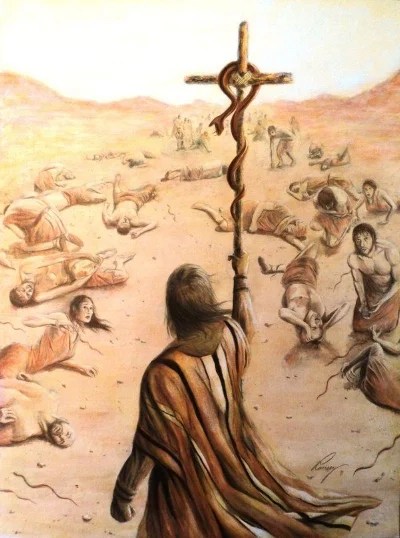
God, in punishment, overruns their camp with seraph serpents. Seraph is from the Hebrew word for โ€œburning.โ€ The highest choir of angels are the โ€œseraphim,โ€ the โ€œburning ones,โ€ the ones closest and who most intimately participate in the burning furnace of divine love. So presumably the bite of these seraph serpents caused inflammation, a burning reaction, and many of the people died. And this divine punishment on Israel had its intended effect. โ€œThen the people came to Moses and said, โ€˜We have sinned in complaining against the LORD and you. Pray the LORD to take the serpents from us.โ€™โ€ Holy punishment is always out of love, and with the hope of conversion, reconciliation, and salvation. The same with the regulations taught by the Church. Itโ€™s not intended to exclude but given out of love for the integrity of the person and the faith, and with the hope of conversion, reconciliation, and salvation. How people respond to it is up to their free will, and their choice of humility or pride.

So now we get to why this reading was chosen for todayโ€™s feast: โ€œSo Moses prayed for the people, and the LORD said to Moses, โ€˜Make a seraph and mount it on a pole, and if any who have been bitten look at it, they will live.โ€™ Moses accordingly made a bronze serpent and mounted it on a pole, and whenever anyone who had been bitten by a serpent looked at the bronze serpent, he lived.โ€ Now, while the psalm and second reading are important for todayโ€™s feast, I want to skip to the gospel reading, with these words fresh in our minds.

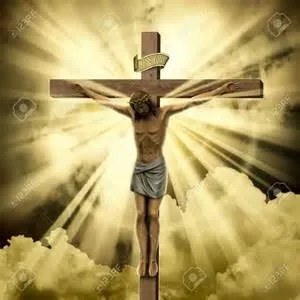
โ€œJesus said to Nicodemusโ€ฆ โ€˜And just as Moses lifted up the serpent in the desert, so must the Son of Man be lifted up, so that everyone who believes in him may have eternal life.โ€™โ€ Why does Jesus make a reference to the serpent on the pole? Iโ€™ve heard people say that the serpent is one of the Old Testament images of Jesus. Iโ€™m sorry, I donโ€™t think so. The biblical image of a serpent is usually the opposite of Jesus. So, what is it then? Itโ€™s an image of the cost of our rebellion against God. Think about what Jesus looked like on the cross. Scourged at the pillar, crowned with thorns, carried and was nailed to the cross (bloody, beaten, and naked). Now, some people rightly say that thousands of people were crucified by the Roman Empire; Jesus wasnโ€™t unique in being crucified. True. But Jesus was unique in carrying the enitre weight of humanityโ€™s rebellion against God, our sin and anger and resentment and pride and infidelity and disobedience against God, bearing all that in his humanity, held together by his divinity. His appearance on the cross was horrific to behold. Like the Israelites being instructed to look at the bronze serpent, the consequence of their rebellion against God, we can look at a crucifix and see the consequence of our rebellion against God. And we can see the love of God in that he accepted the consequence of our sin to save us. The word โ€œsalvationโ€ and the word โ€œhealingโ€ come from the same root. Something that is โ€œsalutaryโ€ is both for our salvation and for our healing. So, it isnโ€™t just that Jesus was crucified to save us, like he wrote a check to cover our debt to let us off the hook. He was crucified also to heal us, to root out from within us the poisonous spirit of sin and death, that he might put in us his Holy Spirit of light and eternal life.

We have the obligation to live out, in this life and in this world, this holy spirit of light and eternal life. I often say at funerals that we often say that our dearly departed has recently entered eternal life. In a way, yes, but thatโ€™s not really accurate. They entered eternal life at their baptism (when they die to the spirit of fallen humanity, and take on the spirit of Christ). And hopefully that person had discerned and lived out this new spiritual life, by how they exercise their free will, live out their vocation to holiness, and fulfill their particular mission in the Body of Christ for Godโ€™s plan of salvation for the world. Thatโ€™s what all of us are called to, obligated to. Itโ€™s what every human being is created for, and where we find our deepest joy, peace, and fulfillment. And so it is our obligation of love to share that message and call people to this truth, that they, also, would know the deep joy, peace, and fulfillment of living out their vocation.


This week, as we were just recovering from all the media coverage and reactions to the shooting at Annunciation Catholic School in Minneapolis two weeks earlier, then on the eve of remembering how September 11, 2001 rocked our American society with shocking tragedy, on Wednesday, September 10 our American society was again rocked with shocking tragedy at the killing of Charlie Kirk in the middle of a conversation with an opponent about mass shooters and gun violence.

Mass media and social media have been flooded with messages of his noble and friendly character, his strong Christian faith, and how they informed his well-defended political and social values, but most especially, how he saw it as his mission to talk, to engage, to listen, to ask questions, to be truly open to the joy of meeting other people, even (or maybe especially) if they disagreed with him, and doing what he could, as he saw it, to lead them more deeply into truth. Of course many people, especially on the college campuses where he did much of his public debates, disagreed with his Christian or conservative views, and many saw him as a dangerous voice promoting what they saw as hate. But to his core, even publicly acknowledging that he had received death threats against himself and his family, Charlie led his life courageously, engaged opponents with genuine openness, and fully giving God the credit for any of his success, professionally or personally, including the virtues of his character, and the beautiful gift of his family. He saw and accepted the inherent danger and vulnerability of his public events as the cross he was called to carry for his personal vocation to spread the gospel and speak the truth.


And this then is the final part of our reflection. The area in our life where we know we are most weak, where we are most tempted, where we most sin, where know we need Godโ€™s grace to help us, requires the cross of our humility, to acknowledge we need God, and to reach up, like a little child, to ask God for his help. And because we know God will give us his help, and that this area of weakness is where we will experience his love and grace poured into our life, we can exalt in the cross of our weakness, because asking God into our life is what will save us, and that area of weakness is where we are most of aware of our need for that. St. Paul was never ashamed to speak about his weakness, โ€œI will rather boast most gladly of my weaknesses, in order that the power of Christ may dwell with me.โ€, “I was once a blasphemer and a persecutor and an arrogant man, but I have been mercifully treated…Indeed, the grace of our Lord has been abundant,” and โ€œIt is not I who live, but Christ who lives within me.โ€ And in our gratitude we lift up our praise to Jesus, we lift up Christ, who came into our humanity with his divinity. Thatโ€™s the meaning of our incarnation. We lift up Christ as our hope in God. Jesus is our perfect offering of prayer and worship of the Father. Jesus said, โ€œWhen I am lifted up, I shall draw all men to myself.โ€ That means a number of things. It means when he is lifted up on the cross for our repentance, and to pay the cost of the salvation of all humanity. It means when he is lifted up in the resurrection in victory over death. It means when he is lifted up in the ascension and crowned with glory. It means when he is lifted up in our hearts and acknowledged, worshiped, and obeyed as our Lord and our God. The Greek for that โ€œlifted upโ€, also means exalted, hupsoรณ. It is similar to what we find in our second reading from the letter to the Philippians, โ€œGod highly exalted him, hyper-hupsoรณ, for his obedient, faithful, incomprehensible sacrifice in love in embracing his part in the plan of salvation, his death and resurrection to save us.

So, in our feast we celebrate today we lift up, we exalt, the cross, because by his holy Cross he has redeemed the world. We lift up the cross we carry of our own weakness, because in entrusting our weakness to Christ as an offering to be transformed by his grace, we are made strong in Him.”For God so loved the world that he gave his only Sonโ€ฆ [not] to condemn the world, but that the world might be saved through him.โ€

Homily: “The beauty remains; the pain passes.”

โ€˜Landscape at Beaulieuโ€™, Pierre-Auguste Renoir, 1893

Twenty-Third Sunday of Ordinary Time, Year C (go to readings)
Wisdom 9:13-18b
Psalm 90:3-4, 5-6, 12-13, 14 and 17
Philemon 9-10, 12-17
Luke 14:25-33


French artists Henri Matisse and Auguste Renoir were close friends and frequent companions, even though Renoir was twenty-eight years older than Matisse. During the last several years of his life, Renoir was virtually crippled by arthritis; nevertheless, he painted every day, and when his fingers were no longer supple enough to hold the brush correctly, he had his wife, Alice, attach the paintbrush to his hand in order that he might continue his work. Matisse visited him daily. One day, as he watched his older friend wincing in excruciating pain with each colorful stroke, he asked, โ€œAuguste, why do you continue to paint when you are in such agony?โ€ Renoirโ€™s response was immediate, โ€œThe beauty remains; the pain passes.โ€ Passion for his art empowered Renoir to paint until the day he died. Those who continue to admire the enduring beauty of his smiling portraits, his landscapes, his still-life studies, will find no trace therein of the pain required to create them. Most will agree that the temporary cost was worth the enduring result.


Our readings today give us the theme of putting what is eternal over what is temporal, what is true, good, and beautiful, what endures forever, over what will pass away, like dust in the wind. But the problem is that this is very difficult for us. The power of what is visual, what is seen, what is pleasing to the physical senses, what is urgent (regardless of whether it is important) and short term, immediately in front of us, claims a great, even overwhelming, demand on our attention.

But our readings are trying to pull us out of this materialistic, temporal mindset and fix our attention on what is higher, of higher reality, higher importance, higher dignity, and requires a higher level of priorities to understand, believe, and practice.

In our gospel reading, Jesus is giving us the true understanding of what it costs to be his disciple. People want to call themselves Christian, and claim the reward of being Christian, without wanting to understand the cost, consider the cost, and pay the cost. They want Christianity on their own terms, and thatโ€™s not at all how Christianity works. As someone said, โ€œAll are welcome, but on Christโ€™s terms, not on their own.โ€ And itโ€™s not that Christโ€™s terms have become more strict, more out of touch with society, but rather that society has become more out of touch with Christโ€™s terms, the cost of what takes to make our lives about what is above, resplendent with divine wisdom, rather than the dust on the wind that is what the world wants us to focus on.

In the first part of our gospel reading, Jesus teaches that he has a greater calling on his disciples than even the relationships of family. In ancient Israel, family was everything, who your family is was who you are, your role in society, how you were related to Israel, the ancient hereditary Father of the Israelites. This is why genealogies were so important in the bible and in Israel. And the only thing more important than oneโ€™s family was God himself. So for Jesus to teach that โ€œHe who loves father or mother more than me, is not worthy of me; he who loves son or daughter more than me, is not worthy of meโ€ is to say that Jesus is the one thing more important than family; Jesus is revealing his divine identity, by taking this divine prerogative of being the one thing more important than family. In fact, in other places of the gospels (“ย For whoever does the will of my Father in heavenย is my brother and sister and mother” Mt 12:50), Jesus teaches that oneโ€™s spiritual family of the Church is more important than oneโ€™s blood family of the flesh; and its no wonder why he attracted attention, both positive and negative.

Jesus then teaches โ€œWhoever does not carry his own cross and come after me cannot be my disciple.โ€ Weโ€™ve heard this many times. In the time of the early Church, when Christians were persecuted and executed for their faith, this could have been taken literally. To be a disciple, you had to accept that you have to hold to this faith all the way. At many times during the Churchโ€™s history, we see Christians not only executed, but their property confiscated, their professional credentials and opportunities disappear, their public reputation and privileges destroyed. And we see this script being replayed today, not only in other countries where Christians are literally executed, but even in our own society. Christian bakers and venue owners are targeted for refusing to cooperate in supporting same-sex marriage, medical staff are persecuted for refusing to participate in (or even criticize) abortion or transgender affirmation, and the Little Sisters of the Poor are being sued by the Pennsylvania attorney general for the seventh time (after theyโ€™ve been exonerated in 6 previous lawsuits) for refusing to include contraception in their employee healthcare packages. To be Christian is to lay all of what we are and all that we have on the altar of God, to be sacrificed if called to do so for the sake of faithfulness to the kingdom of heaven.

But since many of us will hopefully not be called to such explicit examples of carrying the cross of the faith, we can also understand this requirement as crucifying those things in our lifeโ€”our evil habits, our unhealthy attachments, our disordered attractionsโ€”that are incompatible with the call to holiness and the teaching of the Church. That doesnโ€™t mean that these things arenโ€™t good. Families are good. Our reputation, our businesses we have built up, our money and resources and security, these are all goodโ€”even some of our attachments and attractions, although they might be wounded and distorted, and need to be healed to be healthy and holy. But nothing else is the ultimate good, which is God. We have to put first things first, and other things afterward. If we put secondary things in the place that only God should be, we lose everything.

Jesus then teaches his disciples that this is a high calling, the very highest demand, and before deciding to be a Christian, it is foolish to start if youโ€™re not going resolve to take it all the way to the finish, come what may (as a man considering building a tower, or a general considering engaging in battle). If you quit, or compromise, what it means to be Christian, what the Christian faith teaches and requires, you lose the only thing that matters, and you also become a stumbling block for others. As Yoda said to Luke Skywalker, โ€œDo, or do not; there is no try.โ€ If we tell ourselves we are merely trying, it’s a preparation to have an excuse for failing, instead of fully committing everything to what is required.

Dietrich Bonhoeffer, the Lutheran minister who died resisting against the Naziโ€™s, talked about cheap grace: โ€œCheap grace is the preaching of forgiveness without requiring repentance, baptism without church discipline, Communion without confession, absolution without personal confession. Cheap grace is grace without discipleship, grace without the cross, grace without Jesus Christโ€ฆ Costly grace is the treasure hidden in the field; for the sake of it a man will go and sell all that he has. It is the pearl of great price to buy which the merchant will sell all his goods. It is the kingly rule of Christ, for whose sake a man will pluck out the eye which causes him to stumbleโ€ฆ It is costly because it costs a man his life, and it is grace because it gives a man the only true life. It is costly because it condemns sin, and grace because it justifies the sinner.โ€ So, what we might call the โ€œbad newsโ€ is that there is a high cost to identifying oneself as a Christian, and only those who are all-in deserve the name. But the good news is that we receive the grace to do exactly that, if we surrender ourselves completely to it, to allow God to work on us, perfect us, and unite us to the incredible heavenly beauty and joy of his own divine life.

Our first reading expounds on the beauty of the heights of divine wisdom and truth we are called to center our life on, and the utter difficulty, or rather impossibility, of this without God. โ€œFor the deliberations of mortals are timid, and unsure are our plans. For the corruptible body burdens the soul and the earthen shelter weighs down the mind that has many concerns. And scarcely do we guess the things on earth, and what is within our grasp we find with difficulty; but when things are in heaven, who can search them out? Or who ever knew your counsel, except you had given wisdom and sent your holy spirit from on high?โ€

Again, not that our physical nature is evil, but it distracts us from what is most important. Our bodies are good. God gave us our bodies. And Jesus even united himself to our bodily nature to restore the goodness of our human nature, which is body and soul as a unity of a human person. Fr. Robert Spitzer wrote a beautiful book called, โ€œFinding True Happiness,โ€ which, among other things, outlines four levels of happiness we pursue and enjoy, from the lowest and most immediate gratification that flees as soon as the act is completed, to the highest and most abstract levels of happiness, which give us an enduring, fulfilling happiness. But to attain the higher, more spiritual levels, we often have to say โ€œnoโ€ to the lower, more physical levels.


Our psalm today has the beautiful line, โ€œTeach us to number our days aright, that we may gain wisdom of heart.โ€ When we contemplate the reality that we have a limited amount of time to become what we will be forever, either holy or hell-bound, it should inspire us to always be moving upward. Blessed Carlo Acutis, a young person who is being canonized as a saint this weekend by Pope Leo XIV, said, โ€œI die serene because I have not wasted even a minute of my life in things God does not like.โ€ He had a great devotion to young saints, and now he is one of them.

And lastly, our second reading from one of the shortest books in the bible, Saint Paulโ€™s letter to Philemon. It is one of the letters written by Paul while in prison. And in prison, Paul meets and converts a man named Onesimus, who was a slave who fled from his master Philemon, who Paul knows, as he was a prominent Christian in the community of the Colossians. And so Paul is writing to Philemon not only to tell him, โ€œHey, I just found your escaped slave,โ€ but also, โ€œHey, Iโ€™m sending your escaped slave back to you as a member of the church, a brother in Christ, who is dear to my heart, so treat him as you would treat me.โ€ Obviously, this is going to make for an awkward reunion. Ordinarily, Onesimus would be flogged and branded. But Paul is reminding Philemon that our spiritual relationships, such as brothers and sisters in the family of Christ, as children of God our Father, take a higher place than our relationships in the flesh. Also, note that Paul says, โ€œI appeal to you for my child, Onesimus, whose father I have becomeโ€ฆโ€ for those who condemn Catholics for calling priests their spiritual โ€œfather.โ€

And so again, to end with this example from Saint Paul, we must put the high demand, even sacrificial demand, of the Christian faith, first in our lives, the solid rock foundation of our lives. We must be Christian first, and everything else we are, we do, and we have in our lives is to serve, witness, and reinforce our Chrisitan identity, over all the things of this fallen world, and our temporary existence as part of it. We are called to be in the world, but not of the world, witnessing to the world by the faith, hope, and love of our Christian life.

Homily: Praise the LORD, all you nations

21st Sunday in Ordinary Time, Year C (go to readings)


We know from rabbinic sources from around the time of Jesus that one of the big questions they were wrestling with was, โ€œwho will be saved?โ€ You hear it a number of times in the New Testament, including in our Gospel reading today. Rabbis leaning toward the conservative side were saying that not all of Israel would be saved. The generation of Noah, the people of Sodom, the rebellious generation that left Egypt in the Exodus, the ten lost tribes of the Northern Kingdom. They were excluded. Other rabbis, leaning toward a more liberal interpretation, were saying that God would restore the lost tribes, and perhaps show mercy to all who had sinned, and perhaps all of Israel might be saved. But on both sides, the scope of who would be saved was still limited to Israel, Godโ€™s chosen people. Even the more liberal suggestion was that being an Israelite, a Jew, was a guarantee of salvation. And so, with this question circulating around Israel, someone finally asks the Messiah, the one who perhaps would know for sure, this burning question. And Jesus, being typical Jesus, doesnโ€™t answer the question. In fact, he answers a whole different question, which wasnโ€™t asked. In response to this one personโ€™s question, he said to the crowd, โ€œStrive to enter through the narrow gate, for many, I tell you, will attempt to enter but will not be strong enough.โ€ So a few things in that important sentence: First, the narrow gate seems to favor the narrow interpretation of the question that was asked. Second, we might picture a crowd trying to get through a pass that narrows down to one person at a time. Like an amusement park gate or sports venue gate. The entrance seems wide, but as you get close, you see it’s rather narrow and guarded. And if there were a big rush trying to pass through that narrow gate, the strong would seem to have an advantage. But for this gate, itโ€™s not the physically strong, but the spiritually strong. Those who have disciplined themselves and their appetites to be virtuous, because they have battled against their vices in prayer and surrender to God to grow in holiness. These are the ones who will be strong enough to pass through this gate. And third and most important about this, is that Jesus doesnโ€™t answer the question of whether there will be few or many, but rather the instruction to make sure that no matter how many there are, you make sure that you are among them. Your call is not to be holier than the next person, but to be as holy as you can possibly be.

โ€œYou stand outside knocking and saying, ‘Lord, open the door for us.’ He will say to you in reply, ‘I do not know where you are from. And you will say, ‘We ate and drank in your company, and you taught in our streets.’ Then he will say to you, ‘I do not know where you are from. Depart from me, all you evildoers!‘โ€

Thereโ€™s a difference between “knowing about Jesus” and “knowing Jesus.” When Pope Leo XIV was elected, a lot of people got to know a lot about him. But not like his family knows him. Itโ€™s not enough to know about Jesus, to hear the bible stories, to say daily prayers, go to Mass, even receive communion, and be done with it until next time. We have to intentionally enter into spiritual communion with Jesus, give him permission to change our hearts, our lives, and then prayerfully respond to his invitation to these changes heโ€™s leading us through, becoming closer to him, conforming our heart to his sacred heart, hearing his voice and obeying in love.

God makes each of us with great care. He is our heavenly father. But we can make ourselves into something else, we can distort ourselves, distort our humanity, our goodness, by sin, by rejection of Godโ€™s discipline, and then fearfully hear God say, โ€œI do not know you. I do not know where you are fromโ€ as the gates of heaven are locked against us, and we are outside wailing in eternal sorrow, or even eternal anger, railing against God for having the audacity to exclude us.

It can apply to us in the church as much as it applied to the Jews hearing Jesus say, โ€œwhen you see Abraham, Isaac, and Jacob and all the prophets in the kingdom of God and you yourselves cast out. And people will come from the east and the west and from the north and the south and will recline at table in the kingdom of God.โ€ Jesus doubles down on that personal message: not just saying directly, โ€œStrive to enter through the narrow gate,โ€ but โ€œyou yourselves cast out.โ€ The Greek word for strive there is โ€œagonizomai,โ€ where we get the word โ€œagonyโ€ and โ€œagonize,โ€ which also appears in Paulโ€™s first letter to the Corinthians, when he is talking about athletes exercising discipline, โ€œagonizomaiโ€, struggling, striving, with all their might, their mind, their heart, for their little reward, and how much more should we strive for salvation, which we could lose by vice, sin, and distraction?

Weโ€™re going to end with the last part of that quote: โ€œAnd people will come from the east and the west and from the north and the south and will recline at table in the kingdom of God.โ€ In this, Jesus is confirming Old Testament passages like our first reading in which Israel will be restored not for its own sake, but for the sake of the whole world. The Jews were angry with Jesus for being a Messiah that claimed to be not just Israelโ€™s own private savior from the oppression of the Romans, but the universal savior of humanity from the oppression of sin. I love irony, but sometimes irony can be dark. Just as Eve in the Garden of Eden fell to the serpentโ€™s lie that eating the fruit would make her like God, when she was already more like God than she would be after eating the fruit, the Jews were unhappy with Jesus, as we just said, but it was in being the Messiah, the Savior of the World, by which he would restore Israel to its special privileged place of being Godโ€™s holy city. And because of their angry rejection of Jesus, they crucified him just outside of Jerusalem, and fulfilled what Jesus had promised, the Messianic Age, but now in a way in which the Jewsโ€™ relationship to this fulfillment is difficult, and the city of the glory of the New Covenant people, the Church, is no longer Jerusalem, which was destroyed, as Jesus said would happen if they killed him. โ€œIf you destroy this temple, I will rebuild it in three days.โ€

But weโ€™re going to sum all this up to two points Jesus gives us. First, we should focus more on our personal commitment to striving for our personal holiness without the distraction of asking if it will be many or few, or comparing ourselves to other people. There are places in the scriptures where it seems like a few, such as our gospel reading, and there are places where it seems like many, such as the numberless multitude in the book of Revelation.

Our faith teaches us that God has given humanity through the Catholic Church all the necessary means of salvation, which is to say the Sacred Scriptures, sacred Tradition, sacred Liturgy, and sacred sacraments, particularly the grace which protects the integrity of the Church and its Faith. The downside for us of course is not only are we more under attack by the enemy who wants to destroy the Church and its members, but that we are held to a higher standard. “To whom much is given, of them much is expected.” As Israel should have been the beacon of holiness to the ancient world, guided by the gift of the divine law, the Church ought to be even more so to the modern world, guided by the grace and truth of the New Covenant.

The Catholic Church teaches that although God instructs us about what is necessary for salvation, and we must take that with absolute seriousness, God himself is not limited to what he has given us. He is God, and he can freely choose to save whom he wills, how he wills, but he willed to reveal to us the way he intended to save us, and so we would be wise to obey, and foolish to be presumptuous.

Those who were raised outside the faith or with an immature faith will be judged less harshly, as we heard a few weekends ago. To the extent that they do good and avoid evil as they perceive it in their fallen and limited human nature, the good that they do outside the state of grace will not be salvific, but will help conform them and open them up more to goodness, and help them to more easily hear the call of God in them toward Jesus and his Church. However, even though whatever evil they choose is in greater ignorance, while their sinfulness is not as grave, they still must suffer the consequences of the evil of their actions. While those outside the Church have a hope of salvation by the mystery of Godโ€™s mercy beyond what he has instructed for the Church, it is still a great act of love to evangelize lost souls, because not only does it help them avoid sin and the consequences of evil choices, but more importantly it invites them to the joy of the life of grace, the beauty of the Church temporally and spiritually, the spiritual blessings of the sacraments, and the fuller blossoming of their particular gifts. While many consider the Catholic Church to be their enemy, the Church does not consider them to be her enemy. They are her lost children, her mission field, and those yet to be reborn to her in the womb of baptism and brought into full communion in her spousal relationship with the Lord.

Jesus was and is the Messiah, sent to restore Israel, including the expectation of reuniting the ten lost tribes who had been dispersed among the nations of the world. And so, if the Messianic covenant is going to include the descendants in all the world, then all the world, those who are outside the covenant, must be invited. And so, after Pentecost until the end of the age, in the gift of the Holy Spirit, Jesus sends out his Apostles to north, south, east, and west, inviting all to enter into the New Covenant: responding to grace by living the life of love, faith, and obedience, striving for holiness as God has revealed it to us, including sharing the fullness of truth we have received. Although God loves all and calls all to accept the invitation, not all will humbly submit themselves to his discipline and formation, to be able to answer the call to the banquet. His love is unconditional, and our response is up to us. We can be those warned about being shut out. Or we can be the beneficiaries of our readings today: the ones invited from all the nations, north, south, east, and west. Blessed are those called to the supper of the Lamb.

Homily: SUDS

Homily for the 19th Sunday of Ordinary Time, Year C (go to readings)
Wisdom 18:6-9
Psalm 33:1, 12, 18-19, 20-22
Hebrews 11:1-2, 8-19
Luke 12:32-48


Something that came across my social media feed this past week was an article called, โ€œPrinciples of Neuroscience Embedded in the Spirituality of St. Francis de Sales – A Pastoral Approach to Addictive Behaviors.โ€ This is the kind of thing some of us priests read for fun. But one of the concepts new to me brought up in the article was the acronym, โ€œSUDโ€s, which stands for โ€œSeemingly Unimportant Decisionsโ€ Examples might include a recovering alcoholic joining co-workers after-hours, and finding out their plan is to meet at a local bar, and still agreeing to go with them. Or taking a detour that goes past the home of someone with whom one committed adultery. Or spending time with an old friend who is a catalyst for risky, dangerous behaviors. Saint Francis de Sales might call all of these โ€œoccasions of sin.โ€ Not sinful in themselves, but they present threats to sinful or dangerous behavior.

The idea of SUDโ€™s in my mind, as I was also thinking about our weekendโ€™s readings, is that seemingly unimportant decisions might be applied in the other direction, too. Seemingly unimportant decisions of virtue. Holding the door for the person behind you. Paying for the person after you at a store. Stopping to help someone fix a flat tire.

Our Lord speaks often about mercy: โ€œForgive us our trespasses, as we forgive those who trespass against us.โ€ โ€œBlessed are the merciful, for they will receive mercy.โ€ The parable of the Good Samaritan. Why? Because the Lord wants to show us mercy, and he does show us mercy, but we can be unperceiving of it, not seeing, not being aware of it. How do we fix that? We have to attune our heart to the virtue of mercy. To Godโ€™s radio frequency. We can be on the wrong channel, listening to themes of revenge, pride, and anger. And weโ€™re missing the important broadcast. We have to change the dial, turn to the channel that Godโ€™s message is going out on. And to hear Godโ€™s message of mercy, we have to change the frequency of our heart to the channel of mercy. We have to sensitize ourselves to the theme of mercy. And we do that by showing mercy to others. The more we get into that groove of living a life of mercy; the more weโ€™re sensitized to opportunities of showing mercy, the more we will hear Godโ€™s message of how he is showing mercy to us. And, of course, even better, we will see more opportunities to show Godโ€™s mercy to others, and become his instrument of mercy. So sometimes these little SUDs, little seemingly unimportant decisions, can have big dividends in changing our heart little by little.

In the Old Testament reading, from the Book of Wisdom recalling the night of Passover, it says, โ€œFor in secret the holy children of the good were offering sacrifice and putting into effect with one accord the divine institution.โ€ And so by this decision, they had disposed themselves to be sensitive to hearing Godโ€™s voice, and they were ready to respond when he gave the command to pack up and flee Egypt.

In our psalm it says, โ€œSee, the eyes of the LORD are upon those who fear him, upon those who hope for his kindness, to deliver them from death and preserve them in spite of famine. Our soul waits for the LORD, who is our help and our shield.โ€ That listening closely for the voice of the Lord, hoping and trusting in the Lord, come what may, training the ear of faith to be attuned for that still small voice of the Lord among the loud voices around us, allows us to respond because we were ready. That image of our soul waiting for the Lord is not just one of being motionless, poised like runners on the starting blocks, but more like servants watching for the subtle gestures and signals of those they wait on, to be immediately responsive to the call to move.

Skipping over our second reading for a moment to go to the Gospel, Jesus is, as always, encouraging us to have that attentive yet active waiting on the Lord. If we practice that listening for the Lord, we can get a sense of what he is instructing us to do, not just in the word of the Scripture, but in the word of the Holy Spirit speaking to us in particular situations of our life.

There was a man who spent a month working at the House of the Dying in Calcutta with Mother Teresa. He said that on the first morning, she asked him, โ€œAnd what can I do for you?โ€ He asked her to pray for him. โ€œWhat do you want me to pray for?โ€ He voiced the request he most desired for his discernment in Godโ€™s plan for his life. He asked her, โ€œPray that I have clarity.โ€ She said โ€œNo.โ€ That was that. When he asked why, she answered that clarity was the last thing he was clinging to and had to let go of. When he commented that she herself had always seemed to have the clarity he longed for, she laughed: โ€œI never have had clarity; what Iโ€™ve always had is trust. So, I will pray that you have trust.โ€

Sometimes we can procrastinate following Godโ€™s will because we want more proof. We want a clearer instruction. We want the path marked out with lights and arrows. Believe me, I know, that was the story of my discernment for the priesthood. I was waiting for the divine 2’x4′ to remove any doubt of what I was supposed to do. But I came to understand I wasnโ€™t going to have that removal of all doubt. It was going to take faith and trust. And the more I walked that path, praying and listening intently, the stronger my faith and trust got, and the assurance came later.

God willing, a soul becomes so attuned and responsive to the smallest whisper of the Holy Spirit that the will of the soul becomes united to the will of God. In the highest level of the spiritual life, Saint John of the Cross describes it this way: โ€œThe tenderness and truth of love by which the immense Father favors and exalts this humble and loving soul reaches such a degreeโ€ฆ that the Father himself becomes subject to her for her exaltation, as though he were her servant and she his lord. And he is as solicitous in favoring her as he would be if he were her slave and she his god. So profound is the humility and sweetness of God.โ€ We see that in our gospel reading where Jesus says, โ€œBlessed are those servants whom the master finds vigilant on his arrival. Amen, I say to you, he will gird himself, have them recline at table, and proceed to wait on them.โ€ Of course, thatโ€™s exactly what Jesus did as he took the role of a humble slave and washed the feet of the disciples at the Last Supper. Saint John of the Cross also says of the beautiful soul, โ€œAs she stretches heroically toward God, her love and trust in God explodes in strength. Her longing for God is spiritually all-consuming. And her will is achingly obedient to his slightest prompting. Her works of mercy and charity are heroic by normal standards.โ€ This is the soul doing the Masterโ€™s will even when it feels he is absent. Those โ€œseemingly unimportant decisionsโ€ to dispose the soul to the voice of God become the habitual life and radiant joy of the virtuous soul, and help her to hear his voice even more clearly, and respond even more generously. Peter asks, โ€œLord, is this parable meant for us or for everyone?โ€ Jesus applies it universally. Everyone is called to be a steward of the spiritual, natural gifts they have received, the truth of the gospel they have received, and to share them generously in love as a participation in Godโ€™s generous unconditional love.

The end of the gospel reading I address in the bulletin column, but letโ€™s wrap up here by going back to the second reading. I saw a Christian T-shirt some time ago, and I was very tempted to buy it, because in big letters it just said, โ€œEven if.โ€ Some of you might immediately get that reference. Itโ€™s a call-back to the book of Daniel when the three young men were threatened with being burned in the white hot furnace for being faithful Israelites. They respond to the king, โ€œThere is no need for us to defend ourselves before you in this matter. If our God, whom we serve, can save usย from the white-hot furnace and from your hands, O king, may he save us! But EVEN IF he will not, you should know, O king, that we will not serve your god or worship the golden statue which you set up.โ€ A few weeks ago I saw the next level of that, in a social media image, one of my favorites now, that says, โ€œFear says, โ€˜What if.โ€™ Faith says, โ€˜Even if.โ€™โ€ Also related to our reading is the great quote by Saint Augustine, โ€œFaith is to believe in what cannot be seen, and the reward of faith is to see that in which you have believed.โ€ Saint Paul in our reading uses the beautiful example of the Old Testament mystics and prophetic figures who put their faith in God and were led through beautiful, sometimes excruciatingly difficult, acts of faith. They had listened to that voice that didnโ€™t always tell them what they wanted to hear, but told them what they needed to do. And responding to that, they grew into the person they were called to be. They looked for and longed for the fulfillment of the great covenantal promises of God, when God would be all in all, and the world would be full of his glory and love. But these promises were not fulfilled in their time.

Paul says, โ€œAll these died in faith. They did not receive what had been promised but saw it and greeted it from afar.โ€ They saw it through faith, and even if they didnโ€™t see it fulfilled in their own time, they had so grown in faith in God by being obedient to his voice that they knew by faith that God was working all things toward that fulfillment. We have that fulfillment now, through Christ, however we have it only veiled in faith and mystery, signs and sacraments, awaiting the beautiful manifestation of the divine plan, even if we donโ€™t see it in this life.

By our eager listening, waiting, and responding to the Word of God, and the whisper of the Holy Spirit within us, may we grow in our longing and love for him. May his will be done, through us, on earth as it is in heaven, through our “seemingly unimportant decisions,” which in faith are really our following the loving and beautiful will of God.

Homily: Teach Us How to Pray

17th Sunday in Ordinary Time, Year C
Genesis 18:20-32
Psalm 138:1-2, 2-3, 6-7, 7-8
Colossians 2:12-14
Luke 11:1-13


Saint Theresa of Avila said that you pay God a big compliment when you ask big things of him. Saint Augustine said that God sometimes delays answering our prayers because he wants to give us more than we prayed for, and our hearts arenโ€™t big enough to receive what he wants to give us; so our waiting and longing grows our heart to be large enough to receive the abundance of Godโ€™s response to our prayer.

If we ask God for something in prayer, there are three possibilities: No, Yes, and Not yet. And unlike asking the sun, or the moon, or a shooting star, when we ask God, his answer to our prayersโ€”even if his answer is not what we hoped forโ€”we have faith and trust is what is best for us, his answer out of his perfect love for us. The sin of the garden of Eden was humanityโ€™s failure to trust God. And our prayer in the Holy Spirit is the healing of that wound: we offer our prayers in trust in Godโ€™s love for us. Thatโ€™s the last part of our gospel reading: being able to trust God that heโ€™s going to give us the good that we need, the best things, and of course, the best thing is the gift of the Holy Spirit.

Our readings are on the theme of persisting in prayer. I remember someone saying, โ€œEvery time a woman prays in the bible, God answers that prayer.โ€ Maybe itโ€™s that men ask God for something in prayer, they wait a bit, and then if they donโ€™t get a response, they shrug it off and move on. But women in prayer are more persistent. And that persistence is the key.

Our gospel reading has a bunch of different parts. One is a parable on being persistent. The man in the parable, like Martha last week, wants to show the virtue of hospitality. But he has an unexpected guest show up in the middle of the night, and this poor man has to go to his neighborโ€™s house, pound on the door, and ask for bread to give to his guest. And the neighborโ€™s like, โ€œAre you out of your mind? Go away, itโ€™s midnight, weโ€™re in bed, and Iโ€™m not getting up to give you bread.โ€ And the man keeps pounding at the door. I think it’s Father Mike Schmitz who defined persistence as โ€œthe shameless refusal to quit.โ€ The shameless refusal to quit. That’s what we need to bring to prayer. I’m going to keep persistently pursuing the Lord and asking for what I need and trusting in him. And if he doesnโ€™t seem to be answering, then Iโ€™m going to allow my trust and my desire to grow as I shamelessly refuse to quit until he responds. Of course, itโ€™s not that we have to keep pounding at the door to change Godโ€™s mind, like in the parable. Itโ€™s that we have to persist because we need to grow in our desire to receive from the Lord.

The beginning of our gospel reading is the shorter version of the Lordโ€™s Prayer found in the Gospel of Luke. The disciples of Jesus see him deep in prayer, and when heโ€™s finished, they ask him to teach them, to give them his deep, beautiful relationship of prayer with the Father. One thing we can learn from the difference between Matthewโ€™s version and Lukeโ€™s version is that our prayer should not be just the same formula of words.

Some people just rattle off the same prayers, day after day. Remember that prayer is our relationship with God, like a relationship with our spouse, or other loved one. We donโ€™t say the exact same words, as fast as we can, and end the conversation. Our words should be organic, natural, flowing expressively; we  mean, from the heart, the words we say to our beloved God. Even if weโ€™re persisting in the same prayers, even if weโ€™re reading a given prayer, like the rosary, mean every word, every time. Itโ€™s a conversation, an invitation to a deeper relationship. Iโ€™ll often slow down people in confession: We just had this deep, beautiful, authentic conversation, and then they race through the Act of Contrition. And Iโ€™ll stop them. No, start again, slower, and mean from your heart what youโ€™re saying.

The same is true in the Mass. The words of the Mass are important. They come down to us through Sacred Tradition as the participation of the people of God in the authentic worship of the Church. Theyโ€™re meaningful, and theyโ€™re important. We should think about them and take them seriously. And they help us to shape our own prayer life according to the spirit of the Church.

For those of you who are musicians, youโ€™ll appreciate this. When I was teaching ensemble music, especially marching band or horn lines for drum corps, I would tell them, thereโ€™s a difference between practice and rehearsal. Practice is your own work: to learn the parts, learning the notes, the articulations, the timing, dynamics, and getting past the mechanics into actually being musical. Then rehearsal is when we come together to unite our individual parts into the offering of the whole group, unifying all of our individual work. And also, what we learn in rehearsal then helps us when we go back home to practice better.

The same is true with prayer. People often say, โ€œI pray to God all day long.โ€ Thatโ€™s good, depending on the prayer. If youโ€™re just giving God your wish list, giving him his instructions for the day, maybe thatโ€™s not such a healthy prayer life. Just like if your relationship with your spouse was just the list of chores to do, and nothing else to your relationship. Not a healthy marriage. Have deep conversations; listen as well as talking; give and receive.

God isnโ€™t a wish granter. Heโ€™s a loving father who loves you and wants a meaningful relationship with you. Sometimes as Catholics we can bristle at the phrase, โ€œa personal relationship with God.โ€ It sounds un-Catholic to some. But it is absolutely the heart of Catholic life. God is not just personal, but a communion of persons, and prayer is for us to get personal with God. We have that access through the gift of the Holy Spirit. Get comfortable with the idea of the truly personal essence of prayer.

Look at the dialogue between Abraham and God in our first reading. What courage Abraham has to dare to haggle with God to save Sodom, principally on Abrahamโ€™s part to save his relative Lot and his family. Abraham repeatedly shows his humility and his awareness of the audacity of his requests. And God accepts and responds to his requests. Itโ€™s a personal conversation. Of course, God does destroy Sodom, after warning Lot and his family to flee. But the point is Abrahamโ€™s persistence in prayer, and his personal relationship with God that allowed that closeness (and courage) in conversation.

So nourishing that beautiful life of prayer, then bring the grace of your relationship with God and unite that to the prayer of the communion of the church. Each personโ€™s personal prayer fuels our communal prayer, and our communal prayer shapes our personal prayer. We need both parts, the parts we do on our own, and then bringing that personal energy into the power of the churchโ€™s prayers of the Mass. In the Mass, weโ€™re not a passive audience to an entertaining performance; weโ€™re active participants in the Churchโ€™s liturgical worship of God.

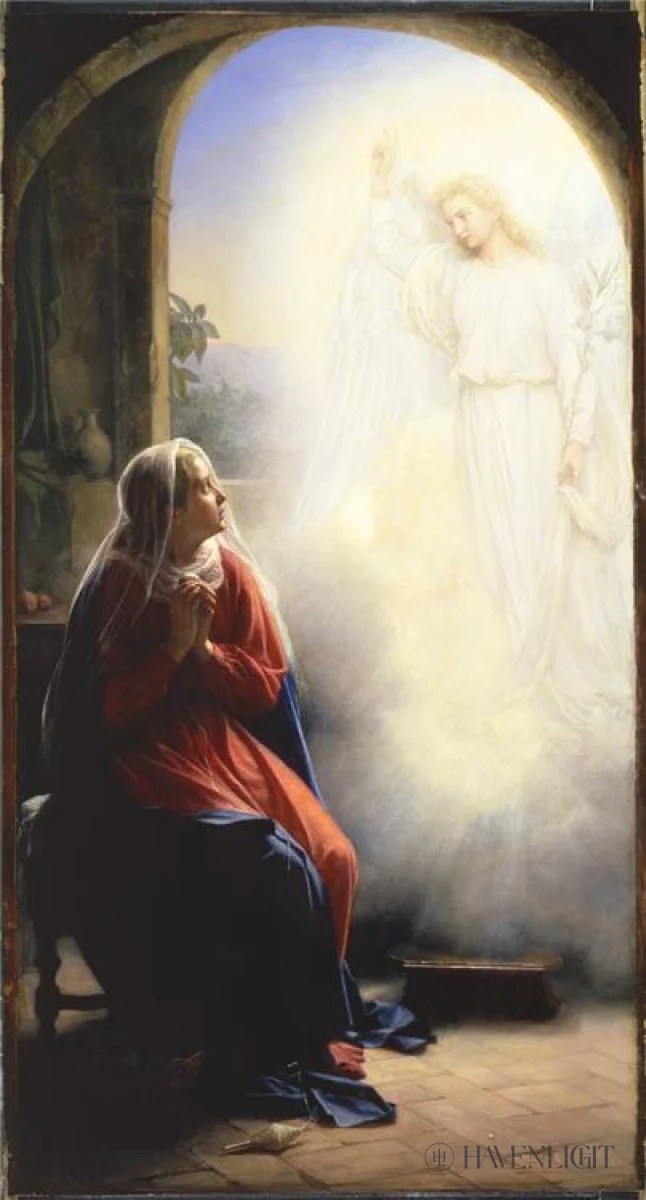
For example, when the archangel Gabriel greets the virgin Mary, some artwork portrays Gabriel, this great angelic presence, as bowing low to this innocent teenage girl, and Gabriel addresses her with reverence, a reversal of roles from what we would expect, as Gabriel waits for Maryโ€™s humble โ€œFiat,โ€ her consent, her โ€œMay what you have said be true,โ€ to the message of the angel. Do we pray the โ€œHail Maryโ€ with that kind of authentic reverence and awe, like Gabriel did. Or like Elizabeth, filled with Holy Spirit, announcing, โ€œBlessed are you among women, and blessed is the fruit of your womb.โ€ Another example: Pope Saint John Paul the II in his reflection, โ€œOn the Church of the Eucharistโ€ says that when the faithful receive communion, โ€œthere is a profound analogy between the โ€˜Fiatโ€™ which Mary said in reply to the angel, and the โ€˜Amenโ€™ which every believer says when receiving the body of the Lord.โ€ Do we rush through and mumble our โ€œAmen,โ€ like saying โ€œthank youโ€ at the convenience store when weโ€™re being given a receipt? Or do we reverently consider the gravity of that moment of encounter and gift? How much holiness can we inject into our response to the minister who holds up the sacred host and says to us, โ€œThe Body of Christโ€ and awaits the word of our response? Our โ€œfiatโ€; our โ€œAmen.โ€

How much can we consider the important words of the creed we proclaim, for which people at various times suffered and gave their lives to define and defend, in preserving the one / holy / catholic / and apostolic / church? Do we bow our heads, as the Church instructs us, as we say the words announcing our faith in the incarnation, that God himself โ€œby the Holy Spirit was incarnate of the Virgin Mary, and became man.โ€? Do we sing what we are called upon to sing? Do we say what weโ€™re called upon to say? All of which the Church requires of us to help us strengthen and shape our Christian spiritual life rightlyโ€”our life as disciples of Christ, and through him, children of God, living out our faith, persevering in prayer, trusting that God will abundantly and lovingly give us the good things that we need.

Homily: Martha and Mary

โ€œThe main thing is to keep the main thing the main thing.โ€ Thereโ€™s a good reason that the first commandment in the Old Testament, โ€œI am the LORD your God, who brought you out of the land of Egypt, out of the house of slavery. You shall not have other gods beside me,โ€ sounds quite a bit like the first and greatest commandment in the New Testament, โ€œYou shall love the Lord your God with all your heart, and with all your soul, and with all your strength, and with all your mind.โ€ Itโ€™s because God, in the fullness of his divine Word, given to us for our salvation, wants to make sure that the main thing is that we keep the main thing the main thing. Or, โ€œPut first things first.โ€ Because that not only makes sure you take care of the first things, but also because it helps you view all the other things in light of the main thing.

Martha, Martha. Poor Martha. She gets such a bad rap from this gospel reading. Sheโ€™s doing Godโ€™s work. The good and charitable work of hospitality. The Letter to the Hebrews says, โ€œDo not neglect hospitality, for through it some have unknowingly entertained angels.โ€ That seems to be a New Testament reference to our First Reading from the Old Testament. The reading starts out, โ€œThe LORD appeared to Abraham by the terebinth of Mamre, as he sat in the entrance of his tent, while the day was growing hot. Looking up, Abraham saw three men standing nearby.โ€

Now, strangely for the Old Testament, long before any revelation of the Holy Trinity, the reading gives us right up front who weโ€™re talking about. โ€œThe Lord appeared,โ€ and โ€œAbraham saw three men standing.โ€ In the Hebrew, itโ€™s kind of peculiar, because Abraham inconsistently switches back and forth between singular and plural, like heโ€™s not sure if heโ€™s talking to one person or more than one. Maybe you have seen the beautiful 15th century icon, by Andrei Rublev called, โ€œThe Hospitality of Abrahamโ€ (sometimes just called โ€œRublevโ€™s Trinityโ€). It shows three almost identical (with a few meaningful differences) figures sitting at a table, affirming the Christian belief that this Old Testament reading is giving a hint at the Holy Trinity. And I think this is quite fitting for the Church to have paired this with our gospel reading, in which Martha and Mary are definitely offering hospitality for a divine visit, with Jesus, Emmanuel, in their home. So, Martha is clearly doing something good and holy in offering hospitality to Jesus and his disciples. Thatโ€™s not the trouble. Jesus doesnโ€™t say anything like โ€œdonโ€™t offer hospitality.โ€ What does he say, โ€œMartha, Martha, you are anxious and worried about many things.โ€ Thatโ€™s where the trouble is.

What did Martha say first, to elicit this response from Jesus? She said, โ€œLord, do you not care that my sister has left me by myself to do the serving? Tell her to help me.” Wow. Martha isโ€ฆ direct. Lord, do you not care? We can feel that way a lot of times. Iโ€™m suffering over here, thereโ€™s this injustice, donโ€™t you care? Even in church, we can sometimes feel this way. Some kind of appreciation for my work, my visiting the sick, my stacking the chairs, my organizing this or that ministry, this or that committee, my this or that. โ€œMy God why have you abandoned me?โ€ Iโ€™m left by myself to do the serving. All the cleaning up, the cooking, the drinks, the dishesโ€ฆ Meanwhile, Mary over there is just relaxing. Sure, Iโ€™d like to just sit and listen, too, but this meat and cheese tray ainโ€™t gonna serve itself. You know what, Lord. That person over there enjoying themselves: You need to tell her to help me.

And thatโ€™s when Jesusโ€ฆ he doesnโ€™t chastise her, doesnโ€™t scold herโ€ฆ he frees her. He gives her a gentle, loving, knowing smile. I do see you, Martha. You are anxious and worried about many things. Important things, urgent things, things that have to get done. Getting the kids to soccer practice, working extra hours to pay the bills, sleeping in after getting home late last night. Getting ready for the things you have to do later. I see you. But youโ€™re not making the main thing the main thing. Let go of those burdens for a while, and come sit with me. Listen to me. Just be with me. Iโ€™m here to spend time with you. Because I love you. Waste time with me, and just sit here and receive from me. Thatโ€™s the cure to being anxious and worried about many things. Thatโ€™s the cure to the poison of resentment to being busy, especially, in the church, when it becomes a burden instead of a gift of love.

Recharge your heart and soul by plugging them back into the Sacred Heart. โ€œJesus, meek and humble of heart, make my heart like unto Thine.โ€ So Jesus here, he’s not condemning hospitality. He’s not saying don’t serve. He’s saying service is good, but intimacy with Christ is the better part. Service is good, but intimacy with Christ needs to come first. And thatโ€™s the fuel, and the right perspective, for everything else. We end up skipping church or prayer because weโ€™re too busy, we donโ€™t have time. And then we get upset that we feel that weโ€™re just spinning our wheels, and weโ€™re always busy and tired.

ย And on the other side, we can fall into a kind of entitlement mentality. Why am I not being recognized? Why am I not getting the good things? I’ve been doing everything right. I’ve been praying. I’ve been being faithful. Why would God let this bad thing happen to me? Show me where in the Bible where Jesus said that bad things wouldn’t happen, that by being a good person we wonโ€™t suffer. He even warns them in the Last Supper about all these terrible things that are going to happen. And then he says, I tell you all this now, so you will know that I know you are suffering, and I am with you always. In this world, you will have trouble, but take courage, I have overcome the world. You will not overcome it. But if you have me, I will provide a way. I am the way. And thatโ€™s our bridge into our last section here, the second reading.

I remember a lecture by Dr. Scott Hahn in which he said that Colossians 1:24 was one of the key verses of his Catholic conversion. โ€œI am filling up what is lacking in the afflictions of Christ.โ€ We know that the afflictions of Christ are perfectly sufficient for our salvation. So what could Paul mean by this? Dr. Hahn said he looked up dozens of different commentaries and explanations and ended up dividing them into three piles. Ones which just ignored the difficulty, ones which gave a rather unsatisfactory explanation, and ones which gave a pretty convincing explanation. And he noticed that the third category was all from Catholic sources. To sum up, it is what we call, โ€œredemptive suffering.โ€ Itโ€™s behind what a Catholic means when we say, โ€œOffer it up.โ€ It means that we unite our sufferings into the suffering of Christ, and he draws us more deeply into the mystery and grace of his suffering. We then receive the two-fold benefit of having our suffering unite us more perfectly to Christโ€™s perfect love, purifying ourselves of distractions and errors and self-pity, to be made into a more selfless, self-surrendering gift to God. But also, God allows our suffering with Christ to give us grace through Christ that we can offer for a particular holy intention, such as our loved ones. What is lacking in the afflictions of Christ is our offering up of our suffering, our affliction, into the afflictions of Christ, so that we become sanctified by our own suffering with Christ, and through that, we also become vessels of the grace of the afflictions of Christ into the world around us.

And what strikes me, personally, as a priest, is the rest of Paulโ€™s sentence. He says: โ€œNow I rejoice in my sufferings for your sake, and in my flesh I am filling up what is lacking in the afflictions of Christ on behalf of his body, which is the church, of which I am a minister in accordance with Godโ€™s stewardship given to me to bring to completion for you the word of God, the mystery hidden from ages and from generations past.โ€ Paul feels that, by his ordained vocation as their spiritual father, he has a special obligation and privilege of offering his afflictions for the people he is appointed by God to care for, to offer the grace of his redemptive suffering on behalf of the church, to help bring his people into the fullness of the mystery, now revealed in Christ, which is Godโ€™s suffering and saving love for us.

So what do we do with this? We tie it back to Martha and Mary. Mary chose the better part, the one thing, which is uniting herself, forming her heart, by intimate discipleship of Christ. We need to do the works of Martha, but in the spirit of Mary. Fill your heart with Christ, unite yourself to his love poured out for you, and nourished from that source, do your work. Serve God and others, as your participation, your unique personal share of loving others, offering your suffering for others, from the overflowing wellspring of divine life and love within you, out into the world and the people around us. Thatโ€™s why putting God first is the first thing. Thatโ€™s the main thing, of not being distracted and worried about many things. Not only avoiding our trying to pour out of an empty tank, trying to do the divine work before us with only our own human resources, but also to understand what is the most important work for us that we are called to do, and how the other things are rightly sorted after it. There is need of only one thing, the better part, and it will not be taken from us.

Homily: Gathering the Harvest

14th Sunday in Ordinary Time (Year C)
Isaiah 66:10-14c
Psalm 66:1-3, 4-5, 6-7, 16, 20
Galatians 6:14-18
Luke 10:1-12, 17-20 


St. Philip Neri, who earned the title โ€œApostle of Romeโ€, is an example of the missionary zeal in todayโ€™s Gospel. Philip came to Rome in the early 1500s as an immigrant. He was horrified by the moral condition of the city. Philip prayed to God to learn what he might do. He read the letters that St. Francis Xavier had sent back from India, where he had been converting tens of thousands. Philip thought that God was calling him to follow the great missionary to India. When he told his spiritual director what he thought God was asking of him, the wise old priest affirmed his desire to bear witness to Christ. However, he told Philip to focus his attention on re-evangelizing those around him, declaring, โ€œRome is to be your India!โ€ Philip, relying on Godโ€™s help, started โ€” first as a layman, then as a priest โ€” to convert Rome. He would cheerfully go to street corners and say, โ€œFriends, when are we going to start to do good?โ€ He developed various social and religious activities to give the people better alternatives for their hearts and time than those offered by the culture around them. When he died in 1595, much of Rome had been reconverted. This would also be a good example of what the Church in the 20th century is calling โ€œThe New Evangelization,โ€ to call back to faithful discipleship those who already received the gospel yet have fallen away from following it. The same God who spoke to Philip almost five hundred years ago challenges each one of us this morning through the Scriptures, โ€œYour home and your family, your workplace and your parish are your mission field!โ€ Or to use one of my favorite phrases, โ€œBloom where youโ€™re planted.โ€

Our Gospel reading reminds us of when Jesus first sent out his twelve apostles. And he had given them a share in his power and authority. It says, โ€œHe summoned the Twelve and gave them power and authority over all demons and to cure diseases, and he sent them to proclaim the kingdom of God and to heal [the sick].โ€

The scene in our gospel reading is in the chapter of Saint Lukeโ€™s gospel after that, and here Jesus sends out seventy-two disciples. Here it says, โ€œAt that time the Lord appointed seventy-two others whom he sent ahead of him in pairs to every town and place he intended to visit. He said to them, โ€˜The harvest is abundant, but the laborers are few; so, ask the master of the harvest to send out laborers for his harvest. Go on your way; behold, I am sending you like lambs among wolves.โ€™โ€

So, some interesting things to notice here. First, we might hear it said by some Christians that Jesus didnโ€™t have organization to his followers, they were a motley crew of believers who just went out and shared the good news about Jesus. However, the gospels, especially Matthew, present Jesus as a new Moses, a new prophetic lawgiver. Moses was instructed by God to ordain Aaron and his two sons, and then, again instructed by God, appointed seventy elders to help him in his ministry over the twelve tribes of Israel. Jesus frequently set apart Peter, James and John as special witnesses of his works, he had twelve apostles, and now commissions seventy (or seventy-two) to assist him in his ministry. Just as in Jesusโ€™ time, there was the High Priest, and the Sanhedrin, or high council, of seventy (or seventy-two) elders. So, Jesus is not being random here, it is very intentional. He is establishing something new, but in a well-established structure.

He tells them of their purpose: not only prepare the way for him, but also recruit more laborers; to reap the harvest that the master of the harvest has already prepared in the hearts of those who will respond and join in the work to be done for the kingdom.

And he tells them that it will not necessarily go smoothly, like lambs among wolves. Thereโ€™s a quote attributed to G. K. Chesterton that says, โ€œJesus promised his disciples three thingsโ€”that they would be completely fearless, absurdly happy, and in constant trouble.โ€ We sometimes need to remember that the gospels are written after Pentecost to often suffering communities of the faithful, to both better instruct them in the faith, and also to inspire them to live out the faith. And so sometimes the current experiences of the community, such as suffering persecution, feeling like lambs among wolves, are written in the gospels as part of that affirmation that they are living out what Jesus had taught.

The rest of the instructions that Jesus gives the seventy-two are almost the same as what he had told the twelve in the previous chapter. But the ending here is wonderfully important. โ€œThe seventy-two returned rejoicing, and said, โ€˜Lord, even the demons are subject to us because of your name.โ€™ Jesus said, โ€˜I have observed Satan fall like lightning from the sky. Behold, I have given you the power to ‘tread upon serpents’ and scorpions and upon the full force of the enemy and nothing will harm you.  Nevertheless, do not rejoice because the spirits are subject to you, but rejoice because your names are written in heaven.โ€™โ€ So obviously as we all know, there is great joy in seeing how God has worked through us to help someone else. He has given his Church a share in his power and authority to vanquish demons and other evils, represented here by Old Testament references to serpents and scorpions, by Jesusโ€™ authority. And he says something weโ€™ve often heard, the war of good and evil is already won. But the spiritual battles continue. Thereโ€™s another old quote, โ€œWhen Satan reminds you of your past, you remind him of his future.โ€ But there we see the crux of the gospel reading: donโ€™t rejoice just because you saw the losing side losing; rejoice because by your faith you are on the winning side winning. Youโ€™re on the right side, even when it doesnโ€™t seem that way. Again, that affirmation and encouragement the Word of God provides us for difficult times.

This ties in beautifully with our first reading from the Old Testament prophet Isaiah, giving Israel, represented by its mother city of Jerusalem, Godโ€™s promise of victory and consolation. And we know that this promise, this victory, is won by the fulfillment of the long-awaited Messiah of Israel, Jesus Christ, and in the Church, the fulfillment of Israel. Isaiah says, โ€œThus says the LORD: Rejoice with Jerusalem and be glad because of her, all you who love her; exult with her, all you who were mourning over her!โ€ Another great quote, again by Chesterton, โ€œChristianity has died many times and risen again; for it had a God who knew the way out of the grave.โ€ Back to the reading, with God speaking through Isaiah, โ€œLo, I will spread prosperity over Jerusalem like a river, and the wealth of the nations like an overflowing torrentโ€ฆย as a mother comforts her child, so will I comfort you; in Jerusalem you shall find your comfort. When you see this, your heart shall rejoiceโ€ฆthe LORD’s power shall be known to his servants.โ€ The traditional understanding of the prophecy of the worldโ€™s treasures flowing toward Jerusalem, is the opposite of how it was ultimately fulfilled: not that they would come to Jerusalem, but that the faith and the divine kingdom that started in Jerusalem, the Church, would flow out to include all the world. And we find our greatest comfort, our peace and affirmation of love in the Church, in God, and when we see this, the Lordโ€™s power is known to those who serve him, and our hearts rejoice. So beautiful. Dr. Scott Hahn has a book called, โ€œA Father Who Keeps His Promises,โ€ and itโ€™s about things like this, how the promises of the Old Testament are fulfilled in the New Testament.

And lastly, as is often the case, Saint Paul brings it home in the second reading. โ€œBrothers and sisters: may I never boast except in the cross of our Lord Jesus Christ, through which the world has been crucified to me, and I to the world. For neither does circumcision mean anything, nor does uncircumcision, but only a new creation.โ€ We donโ€™t put our hearts, our worth, our identity, our priority, on anything in this passing world. Certainly, there are things that are both urgent and important, and cause us stress, but never to the extent that they interfere with the faith and worship we owe to God, and nourishing our relationship with Him. We are made a new creation in Him, still body and spirit, still with bills to pay and problems to solve, but one who has peace that the world cannot give. Happiness that comes from knowing we have a great purpose, even to our suffering, and in Godโ€™s plan for our life and our salvation, he included how dumb we can be sometimes, and to me, that is a great comfort. So let us continue detaching our sense of self and priorities from this world and strengthen their hold on the true and eternal world to come. And help and inspire others to do the same. โ€œThe grace of our Lord Jesus Christ be with your spirit, brothers and sisters. Amen.โ€

Solemnity of Saints Peter and Paul, Apostles

Saint Peter, with upside-down cross of his crucifixion and the keys of the kingdom.
Saint Paul, with the sword, both the instrument of his martyrdom, and the Word of God

Solemnity of Saints Peter and Paul, Apostles (go to readings)
Acts 12:1-11
Psalm 34:2-3, 4-5, 6-7, 8-9
2 Timothy 4:6-8, 17-18
Matthew 16:13-19


One of my favorite movies is โ€œBig Fish,โ€ a 2003 Tim Burton movie with Albert Finney, Ewen McGregor, Steve Buscemi, and of course, Helena Bonham Carter, because itโ€™s a Tim Burton movie. In the movie, the main character, Ed Bloom, is in a hospital on his deathbed, and he has a strained relationship with his son, because everything the father has ever said about his own life is encoded in fantastic stories of mythic proportion, which the son feels has kept them from having an honest relationship. But as the movie goes on, you start to wonder if the myth isnโ€™t in fact more fact than myth, and in fact, the distinction is easy to myth (I mean, “miss”!). The common becomes extraordinary, and vice versa. Weโ€™re made for stories, and myth makes the stories memorable and inspiring. And even in myth, the truth is just under the surface. An old Irish priest, Fr. McNeil, once told me, โ€œAll stories are true. And some of them actually happened.โ€

Our story as Christians is encapsulated between the inspired books of Genesis and the Apocalypse, our origin story and our destiny. The rest of Scripture and Tradition fills in details, while our Catholic faith informs it so that our lives are our own personal part of this great epic drama of salvation history.

The poet Virgil, in his epic poem, the Aeneid, tells the ancient story of the founding of the city of Rome. Aeneus takes his family and flees from the fall of Troy to start a new city on the Italian peninsula (The Aeneid is from the first century BC, and builds on earlier stories of Aeneus, most popularly Homer’s 8th century BC epic poem, the Iliad). He becomes the ancestor of the twin brothers Romulus and Remus, about whom there are many stories, some more believable than others, sometimes involving being brought up by a mother wolf. Eventually, they were raised as shepherds. When they were grown to adulthood, they one day got into a pastoral altercation with another nearby shepherd, and the brothers decided to build a fortified city. But they could not agree on where.

The Seven Hills of what would become Rome were the general area, but Romulus chose the Palatine Hill, while Remus preferred the Aventine. Each set out to build, and when Remus made fun of Romulusโ€™ defensive walls by having the audacity to jump over them to show their uselessness, Romulus ended the matter by killing his brother. Thus, in a story echoing the tragic account from Genesis, a sort of โ€œoriginal sinโ€ came to Rome by way of fratricide. In his work, The City of God, Saint Augustine, who was well acquainted with Roman myths, would compare the story of Romulus and Remus to that of Cain and Abel.

By the time we come to the mid-fifth century, the era of persecution now mostly a thing of the past, the City of Rome having been substantially Christianized, a newer founding narrative comes into the Roman consciousness: This narrative depicts the Holy Apostles Peter and Paul, shepherds, pastors, brothers in the faith and in the Apostolic College, as the founders of the new and eternal Rome, something better and more noble than its pagan origin story. Inย a homily preached for the Feast of Saints Peter and Paulย in the year 441, Pope Saint Leo the Great says:

That reverence which todayโ€™s festival has gained from all the world, it is to be honored with special exultation in our city, that there may be a predominance of gladness in the place where the chief of the Apostles met their glorious end. For these are the men, through whom the light of Christโ€™s gospel shone on you, O Rome, and through whom you, who was the teacher of error, was made the disciple of Truth. These are your holy Fathers and true shepherds, who built you under much better and happier auspices than they, by whose zeal the first foundations of your walls were laid: and of whom the one that gave you your name defiled you with his brotherโ€™s blood. These [the apostles] are they who promoted you to such glory, that being made a holy nation, a chosen people, a priestly and royal state [1 Peter 2:9], and the head of the world through the blessed Peterโ€™s holy See, you attained a wider sway by the worship of God than by earthly government. For although you were increased by many victories, and extended your rule on land and sea, yet what your toils in war subdued, is less than what the peace of Christ has conquered.

Thus, we will often see in the ancient documents and doctors of the Church references to โ€œPeter and Paulโ€ as a pair, as brothers in the Christian Faith, as the tradtional foundation of Christendom.

 Like Mary and Martha, the sister virtues of โ€œora et laboraโ€ (to take a traditional Benedictine phrase), โ€œprayer and work,โ€ we see a holy complementarity in this pairing. As Mary is often associated with the virtues of the contemplative life, sitting at the feet of the Lord, and Martha with the virtues of the active life, showing hospitality, caring for the needy, providing food for the hungry, etc., we also see a complementarity in the figures of Peter and Paul. Peter is often associated with the charisms of the hierarchical church, the structure of organization and the sacraments, the noble grandeur of the Mass and the great basilicas and cathedrals, the organization of laws and instructions for order and discipline in the People of God. Meanwhile Saint Paul is more often associated with the charismatic evangelization, going out to the fringes to make disciples, preaching the gospel, as well as the building up of the mystical body of Christ through the spiritual gifts given to its members for serving the community.

This complementarity is not strictly mutually exclusive. Peter also had mystical visions and experiences and the holy charisms of his office received from Jesus and which Peter passed on to his successors. And Paul also taught rules and boundaries for discipline and correction within the Christian communities. And of course, both of them, in Peterโ€™s denial in the garden, and Paulโ€™s zealous persecution of the Church, had stories of their shame and forgiveness that inspired their personal love of the Lord and their mission to spread the gospel.

Our readings contemplate key moments in the holy lives of these Apostles, particularly near their end. After Herod had already martyred Saint James, Saint Peter is arrested, as it says, during the feast of unleavened bread, with intention of having him brought out, presumably for a meaningless trial and tortuous martyrdom, after Passover. So we see Peter, now full of the Holy Spirit after Pentecost, courageously living out that love of God and the Church that he was unable to muster in dialogue with Jesus by the seashore, but in which Jesus calls him both to be his shepherd of his flock, and also to follow him, and we see in Saint Peter an echo of the passion of Christ. Saint Paul is writing to Timothy in our second reading, aware, as the Spirit has told him, that his martyrdom is also drawing close. โ€œIโ€ฆ am already being poured out like a libation, and the time of my departure is at hand. I have competed well; I have finished the race; I have kept the faithโ€ฆ so that through me the proclamation might be completed, and all the Gentiles might hear it.โ€

And so to end, I want to contemplate an interesting contrast between Peter and Paul that we can take with us today. I had a gentleman in spiritual direction, a successful business owner, pose this question to me. We have this scene in our first reading from Acts 12, of Peter in prison, and heโ€™s given an out, a way to escape prison. And he goes, and itโ€™s the right thing. But later, in Acts 16, we have the scene of Paul in prison with Silas. And because of an earthquake, the jailโ€™s foundation was broken, the doors and chains came loose, and heโ€™s given an out, a way to escape, but he stays, and itโ€™s the right thing. So, the same or similar situation, and one time the right thing was one thing, and another time the right thing was the almost-opposite thing. So how do we know what weโ€™re supposed to do?

I had to think about that, and we talked, as we exchanged ideas, exploring this question. And what we came up with was very interesting, I think. Our reasoning for asking the question, โ€œGiven these sets of circumstances, how do I know what choice to make?โ€ can be a way of asking, โ€œHow do I make a rule so that I know what I should do, without having to ask God what I should do?โ€ Itโ€™s a subtle attempt to substitute a relationship with God with our independence from him. Certainly, rules and principles of ethical and moral choices are important. But instead of (or in addition to) setting out to create a schema in which we want to always know the right response to every moral dilemma, we should always be turning toward God, after the example of St. Peter and St. Paul, and ask Him, in every circumstance, โ€œGod, what do you want me to do? Here I am, Lord. Send me. Lead me. Help me to love you, to listen to you, and to follow you.โ€ Let Him be the writer of your amazing story, so full of miracles itโ€™s almost hard to believe itโ€™s all true.