Homily: Who Is My Neighbor?

Related image

The Fifteenth Sunday of Ordinary Time (Year C)

Deuteronomy 30:10-14
Psalm 69:14, 17, 30-31, 33-34, 36, 37
Colossians 1:15-20
Luke 10:25-37


Who are the people in your neighborhood? Who is your neighbor? This is the question of our gospel reading. It was a legitimate question to Jesus from the Jewish scholar, but it wasn’t asked with a legitimate intention.

There were over 600 statutes of the Jewish Law, stemming from the Ten Commandments, and other precepts, especially in Exodus, Leviticus, and Deuteronomy. So it was not unusual for the scribes (the trained biblical scholars) to ask a new teacher about his interpretation. One of the common ways to do this was to ask him to summarize his interpretation by identifying what he saw as the most important of the laws, his key for interpreting all the other laws. So this scholar asks Jesus what his opinion is of the key to salvation. And Jesus (who, unknown to them, is the very Law of God incarnate) responds by reversing the question back to the scholar, as if to say, I think it’s self-evident, what interpretation could there be? So the scholar then answers his own question to Jesus, “You shall love the Lord, your God, with all your heart, with all your being, with all your strength, and with all your mind, and your neighbor as yourself.” And Jesus respond to him, “You have answered correctly; do this and you will live.” In Matthew’s Gospel, it’s Jesus who says these words. Here in Luke’s Gospel, Jesus inspires these words in his examiner.

The scholar then asks, “So who is my neighbor?” As I said at the beginning, it was a legitimate question to Jesus from the Jewish scholar, but it wasn’t asked with a legitimate intention. These two parts of the scholar’s answer come from two different places. The part about loving God with all your heart and strength comes from Deuteronomy 6. And the part about loving one’s neighbor as yourself comes from Leviticus 19. But if we look at that whole verse, it says, “Take no revenge and cherish no grudge against your own people. You shall love your neighbor as yourself. I am the LORD.” So the scholar’s question is, “Who is ‘my own people’? Is it my family? My tribe? All Jewish people? Just those striving to be pure and holy? How far is this love of neighbor like myself supposed to reasonably extend?” Jesus then responds to his question with the parable of the Good Samaritan.

What’s Jesus’ point about this parable? That it wasn’t the Temple Priest, and it wasn’t the Temple Levite (who spent their lives offering the Sacrifices of the Temple, and were experts in the Law) who gave the example of living out the law, but the no-good Samaritan, the despised outsider. Jesus was saying, your neighbor is not just fellow Israelites, fellow believers, fellow people who look and act and believe the same as you… which is not what the scholar wanted to hear, who wanted to constrict the command of love.

Image result for fight with neighborYour neighbor, whom you are obligated to love as you love yourself, is also the people you dislike, the people you’ve been having fights with, the people you ignore, the people who are strangers. And especially, your neighbor is anyone you see who is in need: the vulnerable, the outcast, the poor, and frightened. Your neighbor is every person who is made by God in His image, which is every person. What does it mean to love your neighbor? To do as the Samaritan did: to show mercy, to personally sacrifice, to put yourself out and become vulnerable, to invest yourself (in love) in their well-being and flourishing.


This comes into even clearer focus in light of the first reading. This is the basic law written into our nature of being a human person, natural law. That’s what Moses means when he tells the Israelites, “For this command that I enjoin on you today is not too mysterious and remote for you. It is not up in the sky, that you should say, ‘Who will go up in the sky to get it for us and tell us of it, that we may carry it out?’ Nor is it across the sea, that you should say, ‘Who will cross the sea to get it for us and tell us of it, that we may carry it out?’ No, it is something very near to you, already in your mouths and in your hearts; you have only to carry it out.

Carry what out? The basic human principle that is distorted by sin: that we are to love God, and to love every other person with the same love God has shown us, especially in Christ. Christ is humanity without sin. As the Church said in Vatican II, Christ not only reveals God to man, but reveals man to himself. That’s why we’re supposed to imitate Christ: not just because he’s God, which is very true and important, but because he’s man without the effects caused by sin. He’s man reset to factory settings, before the Fall, in intimate communion with God. In Christ’s example, and his teaching, he gives us images and example of what the Old Testament points us toward: what it means to truly be human.

To recap an earlier conversation we had, we often hear the question, “Do you need to be Christian to be a good person?” And the answer is, “YES.” Why? Because of sin. St Theresa of Avila says, if the “soul were always attached to God’s will, it is clear that it would not go astray. But the devil comes along with some skilled deception and… confuses it… Then little by little he darkens the intellect, cools the will’s ardor, and makes self-love grow until in one way or another he withdraws the soul from the will of God and brings it to his own.

Almost everyone wants to consider themselves a good person. Which is good. We have the love and need for the good, the true, and the beautiful (which is God) written in our hearts. And much of what humanity does is good. But without the light of the true faith, people promote abortion, thinking it’s morally good. People promote false imitations of marriage (including cohabitation) thinking it’s morally good. People promote all sorts of bad things that offend love of God, love of our neighbor, and even our love of ourselves, because sin darkens the intellect. And then disordered sentiment (desire) pulls the intellect and the will to justify what it wants to be true, but isn’t. We can allow that darkness to control us, or we can cooperate with God who wants to heal us and free us, and then send us out in love to heal and free others by our testimony. Love and Truth go together, and cannot thrive if separated… because they can’t be separated, they have the same source, which is God. There are things that seem good, and seem just, and seem loving, but in truth, are not. To truly be good, to be holy (which is to be like God), we need the light of faith, and the grace of God given to us in the sacraments, to heal us from sin and error.

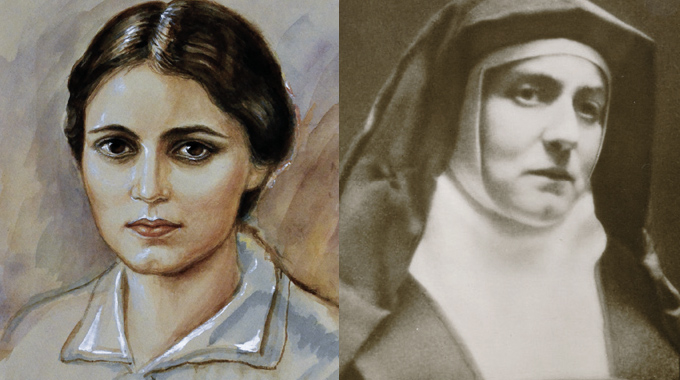
Image result for edith steinI’ll end with this quote from another Theresa, St. Theresa Benedicta of the Cross (the religious name of St. Edith Stein), who was a Jewish-convert to the Catholic faith, and martyred by the Nazis in Auschwitz. St. Theresa Benedicta of the Cross wrote this, which beautifully summarizes our reflection on the Good Samaritan: “Our love for our fellow humans is the measure of our love for God. But it is different from a natural love of our neighbor. Natural love goes out to this one or that one, who may be close to us through the bond of blood or through a kinship of character or common interests. The rest then are ‘strangers’ who ‘do not concern’ us, who, it may be, eventually come to be repulsive, so that one keeps them as far away as possible from contact with us. For the Christian, there are no such ‘strangers.’ Rather, he is the ‘neighbor,’ this one who stands before us and who is in the greatest need of our help; it doesn’t matter whether he is related to us or not; whether we ‘like’ him or not; whether he is ‘morally worthy’ of help or not. The love of Christ knows no bounds, it never stops, it does not shrink back from ugliness and dirt. He came for the sake of sinners and not for the sake of the just. If the love of Christ lives in us then we will, like Him, go out after the lost sheep.

Horizontal Rule Cross

Homily: Corpus Christi

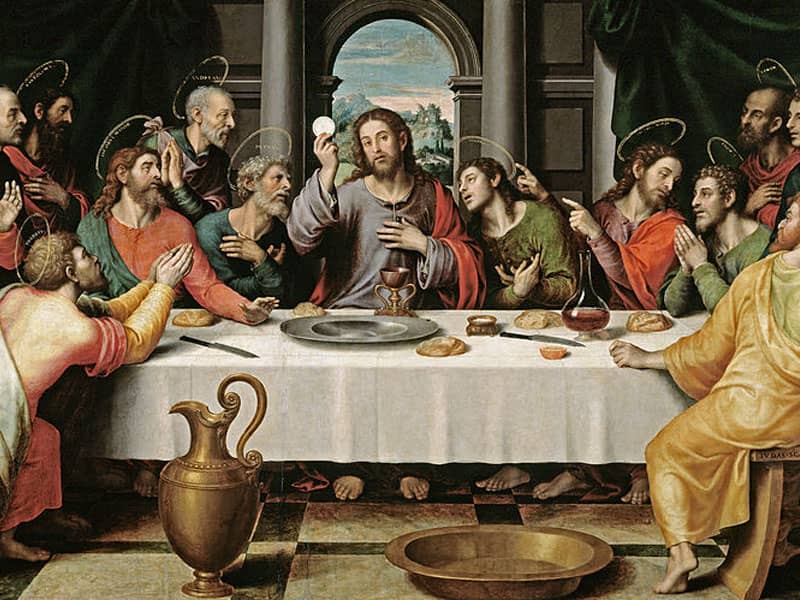
Image result for last supper

The Solemnity of the Most Holy Body and Blood of Christ (Year C)
Genesis 14:18-20

Psalm 110:1, 2, 3, 4
1st Corinthians 11:23-26
Luke 9:11b-17


The Easter Season ends with four great feast days in a row: The Ascension, Pentecost, then a week later, Holy Trinity Sunday, and a week after that, today’s feast day, The Solemnity of the Most Holy Body and Blood of Christ, more commonly known as the Feast of Corpus Christi (Latin for “Body of Christ”).


You would think then that our Gospel reading would be about Jesus at the Last Supper instituting the Eucharist, but you’d be wrong. As we just heard, our gospel reading is about Jesus miraculously feeding the crowd of 5000. I want to highlight just three important points from this reading.

First, the words used to describe what Jesus does. It says, “Then taking the five loaves and the two fish, and looking up to heaven, he said the blessing over them, broke them, and gave them to the disciples to set before the crowd.” Taken, blessed, broken, given. That is an important sequence, and we hear it over and over. We’re going to hear it again when St. Paul recalls the Last Supper in the second reading, and we’re going to hear it again after that, when we recall the Last Supper in the Eucharistic Prayer. 

The second thing I want to point out in the Gospel is an unusual reference to Moses. In Exodus, Moses is serving as Judge of Israel, settling all their disputes all day long. His Father-in-law comes along, and says, there’s a better way to do this. Find some holy, trustworthy men, and set them as commanders of thousands, of hundreds, of fifties, and of tens. By the 1st Century, the idea of twelve judges organizing the people of Israel into multiple groups (the one that gets highlighted is groups of fifty) becomes an image associated with the organizational structure of the Exodus. So when Jesus does something similar, taking twelve men and appointing them to organize the people into groups of fifty, he’s revealing his identity as the new Moses. The twelve Apostles are like the new twelve judges, and the people are like a new Israel, because this is the new Exodus. You might recall that prophecy by Jesus to the Twelve: that they would sit on twelve thrones judging the tribes of Israel.

And the third highlight from the Gospel is their location. They’re in the desert wilderness, which of course has lots of spiritual significance. In the Old Testament, it’s the location of the Exodus, and the miraculous bread of the manna, the bread from heaven, the food for the journey. In the New Testament, it’s the location of Jesus’ three temptations from the devil, where Jesus was fasting and hungry, and the devil tempted him to use his power to miraculously provide himself bread. Here in our reading today, Jesus uses his power not for himself, but to provide superabundantly for the sake of his followers. So Jesus again is revealing his mission as the New Moses, who deputizes his appointed leaders to administer his authority over the New Israel, and provides a miraculous outpouring of the New Manna, bread from heaven in the wilderness, on the way to the New Promised Land.

While there is definitely an intentional scriptural connection between the miraculous multiplication of loaves, and the institution of the Eucharist at the Last Supper, we can see how the Church understood the distinction of these two miracles of bread. Yes, we should feed the poor, and not withhold our generosity in meeting their human needs. Jesus does (often miraculously) meet our needs, and we need to do likewise, and meet the needs of others. But Jesus didn’t institute the Last Supper in the presence of the multitudes, telling them that it was his body, and to do so in remembrance of him. He instituted the Eucharist among those who were in communion with him (Judas then carried out his betrayal, breaking communion, to his own downfall). St. Paul, at the beginning of the letter that is our first reading, reprimanded the Corinthian Christian community for tolerating or accepting someone living in an immoral relationship, and instructs them that “the one who did this deed should be expelled from your midst” –essentially excommunicating him (for the sake of his conversion and salvation, which continues to be the Church’s goal in any censure). The Catholic Church, which is unusual but far from alone in practicing “closed communion,” often endures criticism for withholding the Eucharist from those who are not living in full communion with the Church. This practice is clearly rooted in Sacred Scripture and Tradition, and so cannot validly be put aside.


In our first reading, we have the three lone verses of a figure that looms large in the history of Jewish conscience, and especially of Christian conscience, the priest-king Melchizedek.

Abram (long before God changes his name to Abraham) had just defeated five Canaanite kings to rescue his nephew Lot, and he was returning home with his nephew and his spoils of war, when in the valley of kings, he meets Melchizedek. “Melchi” means “king” and “zedek” means righteous. He’s the righteous king… of Salem, a word that later evolved into the word “Shalom,” “peace.” (He is the righteous king of peace). The place where Melchizedek was king—Salem—later became known as Jerusalem.

Image result for Melchizedek

In the first lines of Psalm 76, David sings, “In Judah God is known, his name is great in Israel. His abode has been established in Salem, his dwelling place in Zion.” Judah is the southern region (eventually the southern kingdom), whose capital is Jerusalem. Zion is the mountain Jerusalem is built on. Salem, Jerusalem, Zion, are all the same place. 

And Melchizedek is a king, but he is also a priest. He offers a thanksgiving sacrifice of bread and wine, and pronounces a blessing on Abram: two distinctively priestly actions. Why does the Church have this reading for the feast of Corpus Christi?

In the three-year cycle of the Sunday readings, there is a different theme each year for this feast. In Cycle A the theme is the Eucharist as our food and drink; in Cycle B the emphasis is on the Eucharist as the sign of the covenant; and in Cycle C (this year) the theme focuses on the priesthood of Jesus.

The Letter to the Hebrews in the New Testament goes to great lengths to show that King David of Jerusalem, and his sons after him, also saw themselves as priest-kings, after the pattern of Psalm 110, our psalm for today (a coronation psalm, singing “you are a priest forever”). And Jesus, as the ultimate Son of David, not only inherited the kingship of his ancestor-father David, but also his priesthood. Jesus is the fulfillment of the figure Melchizedek, the righteous priest-king of Jerusalem, who offered the sacrifice of bread and wine, in thanksgiving (in Greek, eucharistía) to God for having delivered him from victory over his enemies. 


And lastly our second reading. St. Paul emphasizes that although he wasn’t at the Last Supper, this is a firm part of Christian Tradition; Tradition, from the Latin meaning, “to hand on.” Paul says, “I received from the Lord what I also handed on to you.” And what does he hand on? “That the Lord Jesus, on the night he was handed over, took bread, and, blessed it, broke it and gave it to his disciples, saying, ‘This is my body that is for you. Do this in remembrance of me,’” and so on. That sequence of verbs should ring a bell. We heard it before, right?

I’ll just end with this. Paul continues after the end of our reading, saying, “Therefore whoever eats the bread or drinks the cup of the Lord unworthily will have to answer for the body and blood of the Lord. A person should examine himself, and so eat the bread and drink the cup. For anyone who eats and drinks without discerning the body, eats and drinks judgment on himself.”

According to the commentary on these verses in the New American Bible…Paul uses a series of wordplays in these verses; references to judgment (krimakrinō) discernment (diakrinō), and condemnation (katakrinō).

We are called, by our human nature, and our Christian vocation, to unite ourselves to God, in mind, heart, soul, and strength. If we participate in the sacrament of communion, but in reality having broken communion by mortal sin, we disrespect the truth; and we profane the gift of the Lord’s body and blood in the sacrament. We will invite not grace but judgment on ourselves. The prayers of the Mass forgive the non-deadly venial sins we commit. But if we are guilty of grave sins, mortal sins, then we must seek healing in the particular sacrament of Reconciliation, the power of the keys given to Peter to bind and loose sins, before we can worthily share in the sacrament of communion. 

In the mystery of this sacrament, the body and blood of Christ, truly present in the thanksgiving sacrifice on the altar, we unite our whole human nature, body and spirit, with Christ,  worthily participating in the communion of the mystical body of Christ, that we might be nourished on the Way to the true Promised land, our heavenly and eternal home.

Horizontal Rule Cross

Homily: Trinity Sunday

Trinity2

The Solemnity of the Most Holy Trinity (Year C)
Proverbs 8:22-31
Psalm 8:4-5, 6-7, 8-9
Romans 5:1-5
John 16:12-15


Many people will say that God is the greatest mystery of existence—an infinite mystery. And they would be right. But they would also say that what we know about God is the smallest drop of this infinite mystery, so it’s foolish to attempt to say anything at all. And they would be wrong. God created humanity to be in an intimate relationship with him… as it is said, “to know Him, to love Him, and to serve Him in this world, and to be happy with Him forever in heaven. For that, God freely revealed himself to us. But because God is infinite, and we are not, there’s only so much that God could give us to understand, and even then, only in symbolic, allegorical images; which on the one hand can speak to a greater truth than a detailed explanation, but on the other hand, can lead to misinterpretation. But by using the gifts of our nature God gave us, such as reason, faith, and love, we can say quite a few things about what God has revealed to us about himself.

In the scriptures, Jesus reveals distinctions between God the Father and Himself, the Son. The Father is essentially what the Jews always believed God to be: the One, the Source, the fountain of goodness and being, the source of justice and peace, the Creator of all things, and also the one who cares for His people, and revealed for us the right way to worship Him and live by His truth.

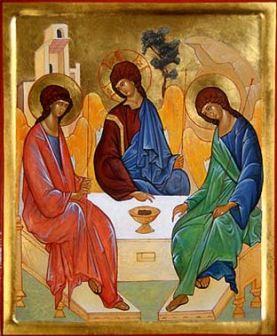
Jesus reveals Himself as the eternal Son of the Father. “Before Abraham was, I AM,” He said. He uses language referring to being and time, to convey that His existence is beyond the scope of passing time, like the Father.Rublev Trinity He is the presence of the Father, the mediator with the Father. He is the ambassador of the Father, and yet He and the Father are one. If you have seen the Son, and if you know the Son, you have seen and know the Father.
It has been speculated, because of this relationship—that the Son is the One who reveals the Father—the “interface” between God and His Creation—that it is in fact the Son who Moses encounters in the Burning Bush, who said that His name will be “I AM.” And as I have said in previous posts, the mechanics of the Hebrew might be rendered less succinctly, but more as the Hebrew would convey it, as “I AM for/toward you, in the way that I always was, am, and will be.” This, to me, connects beautifully with the Incarnate Son’s title of Emmanuel, “God with us.” It is one truth, revealed at the Burning Bush, made manifest in the Incarnation of the Divine Son, and enduring forever with the Ascension and Pentecost: “And behold, I am with you always, until the end of the age.”

It is the nature of the Father to be the source of all, and to generously give all from Himself. It is the nature of the Son to be the recipient of all that the Father gives. The Father perfectly loves and gives Himself to the Son, as a perfect Bridegroom might strive to love and give himself to his Bride. And in experiencing the Father’s perfect self-gift of love, the Son, like a Bride, rejoices in the Father’s self-giving love, and reciprocates by pouring Himself out in perfect generosity to the Father, as would the perfect Bride on receiving the perfect love of her Bridegroom, strive to reciprocate the perfect gift of herself to him. This is the exchange eternally going on in the interior life of the Holy Trinity. And this exchange of divine persons has his own divine personhood, his own identity, which is the Holy Spirit (similar to how the relationship of love of a bride and a bridegroom has its own nature, and in some ways, its own personality, that is beyond either individual).

In the sacrament of Marriage, the Bridegroom is like the incarnation of (sacramentally participating in and making present to the marriage and to the world) the provident, protective, generous care of the Father. And the Bride is like the incarnation of (sacramentally participating in and making present to the marriage and to the world) the receptive, reciprocating, beloved person of the Son. And their fruitful exchange of love (sacramentally participating in and making present the self-giving love of the Holy Spirit) is incarnated as their children (as God might will for them, and the imperfection of our material nature not impede). This is the truth at the heart of the sacrament of marriage—the heart we cannot excise to redefine marriage according to our will and pleasure.

In our experience of love, there are these three elements: the subject/the lover; the object/the beloved; and the relationship/the love. Of course, these are human terms for human understanding, so while God is something like this, God is also infinitely more than this; a more intense (more real) reality than our imagination can conceive of.


In our Gospel reading, we hear of the three divine persons. Jesus tells the disciples that the truth is beyond what he can convey to them. They’re not ready yet, even at the time of the Last Supper. “I have much more to tell you, but you cannot bear it now.
But when he comes, the Spirit of truth, he will guide you to all truth… he will take from what is mine and declare it to you. Everything that the Father has is mine…” What the Father is and has, he perfectly shares with the Son. And the Holy Spirit will share it with the Disciples. The Father, the Son, and the Spirit are equal in dignity and nature; whatever it is to be of the substance of God, they are consubstantial
in these Three Divine Persons, as the One Divine God.


The week before Pentecost, we celebrated the Mystery of the Ascension: the return of the incarnate and victorious Son to the Father, who welcomes his Son home to Him. It is the Father and Son’s joy in their union with one another that is the joy of heaven, and heaven’s feast. At Pentecost, we celebrated the outpouring of that joy in the Holy Spirit into the Church through the power of the Sacraments, the healing, the wisdom, the inspiration, and the love of the Father, won for us by Christ, and shared with us in the Holy Spirit. Now, a week after Pentecost, we have the mystery of the Holy Trinity, who we can now intimately know and serve in love because, unlike the Disciples at the Last Supper, we have received the gift of the Holy Spirit. The Holy Spirit “loops us into” sharing in the interior life of God, as the Spirit, now within each of us, is the bond of love in the Holy Trinity. 

As the Bridegroom’s and Bride’s love overflows into fruitfulness, creating a family, so does the Fathers’ and Son’s love, the Holy Spirit, overflow into fruitfulness, creating the Family of those reconciled and united to God. This is the message of Paul’s writing in our second reading. “…we have peace with God through our Lord Jesus Christ, through whom we have gained access by faith to this grace in which we stand…” In our tension and suffering endured in conflict with the world of Flesh, our spiritual union with God (particularly the paradox of the Cross), transforms all our sufferings into joy by grace. All their attempts (inspired by the Enemy) only go to encourage us in hope and holiness. “…we even boast of our afflictions, knowing that affliction produces endurance, and endurance, proven character, and proven character, hope, and hope does not disappoint, because the love of God has been poured out into our hearts through the Holy Spirit that has been given to us.” In the Life of the Spirit, our union with Christ, the cross doesn’t lead to despair but to glory.


We couldn’t have a complete celebration of the Holy Trinity without talking about the creed that we say almost every Sunday. The first part of the Creed is about the Father. The large middle part is about Jesus, the Son. And then the third part is about the Holy Spirit, and the effects of the Holy Spirit, namely the Church, the forgiveness of sins, and salvation. This was developed in the context of heavy conflict on the question of who or what Jesus is. Some popular, brilliant theologians of the 4th century were arguing that Christ is not divine, but the first of God’s creations, and through which all other things were made. In their defense, Greek philosophy had ideas of the one creator god, and the logos—the intelligible “interface” between god and creation. John taps into this in the prologue of the Gospel, when he says, “In the beginning was the logos” (the Word, the intelligibility, the reasonability, of God. But John also made sure to identify the logos as divine: The Word was with God, and the Word was God.” But these 4th century theologians were not as careful, hence their confusion and error. And one of the key scriptures used to support their incorrect argument was what we have as our first reading, from Proverbs Chapter 8. These theologians were Greek, arguing in Greek, over the Scriptures, which were in Greek. The New Testament was originally written in Greek, but the Old Testament had been translated from Hebrew into the Greek (the Septuagint) about 200 years before Jesus. In the Greek, our first reading says, “Thus says the wisdom of God: ‘The LORD created me, the beginning of his ways, the forerunner of his prodigies of long ago; from of old I was poured forth, at the first, before the earth.” “The Lord created me.” There’s the rub. In the Hebrew, the word there is qaneh, which (like most ancient vocabulary) has a wide range of meaning, including “created, acquired, begat, possessed.” The Greek translation rendered it as “created.” But in the larger context of Scripture, the word is best translated as possess, or beget, as in being part of one’s personal nature, like one possesses a talent or acquired a virtue. “The Lord possessed me; the Lord begot me.”

A person creates something that might reveal something of himself but is unlike himself. An artist creates a painting. But a person begets something like oneself. A parent begets a child. The child shares in the nature of the parent. A painting doesn’t share in the nature of its creator (even though the painting reveals something of the artist). Creatures made by God bear something of an image of God, but do not share in the divine nature of God. But the Son begotten by God does. So when the whole controversy resolved (at least temporarily) at the Council of Nicaea in 325, the Church wrote out the Nicene Creed. And that (for the most part) is the creed we still profess about the Holy Trinity through all these centuries later: our belief in “one Lord Jesus Christ, the Only Begotten Son of God, born of the Father before all ages. God from God, Light from Light, true God from true God, begotten, not made, consubstantial with the Father; through him all things were made.” These were the arguments and images used during the controversy to articulate and solidify the Church’s understanding of the truth of the Holy Trinity, and so they were enshrined in the words of the Church’s creed. (I had to look up the meaning of “born of the Father before all ages.” This is in correction to those who held that Jesus was “adopted” by God as his Son at his baptism, or some other point. The word “born” is being used allegorically, affirming that Jesus was born of Mary his mother, in time, in his human nature, and born of God the Father, in eternity, in his divine nature. The Son exists eternally as the Beloved and Recipient of the self-giving love of the Father. If the Son is not the eternal Son, then the Father is not the eternal Father.


So lastly, to apply some of this. Since God created us, and we reflect the image of God, how we understand what God is affects how we understand what we are. If the Son were not divine, then God could not be love, as a solitary person. There would be the eternal lover, but no eternal beloved, and no eternal relationship of love in God.  But what a difference it makes that the Son is a divine person within God! This image then is not one of eternal solitude, but of eternal, self-giving, fruitful, relationship, three persons of Love, in an eternal embrace and exchange, like a perfect dance, within the interior life of the One God in Three persons. Only if the Son is Divine can God truly be Love and Communion. And that reveals that our own human nature is not perfected in isolation/solitude, but in relationship/communion. We (even we introverts!) flourish and are perfected in communion with God, and in communion with all others in communion with Him: We are perfected in and as the Church: our holy communion as members of the mystical body of Christ, the family of God the Father, united by the Holy Spirit. Happy parish feast day of the Holy Trinity. God bless you.

Holy Trinity Door
(We worship) the True God, One in Trinity and (the) Trinity in Unity. Come Let us Adore.

Horizontal Rule Cross

The Athanasian Creed
(St. Athanasius defended the divinity of Christ at the Council of Nicaea). 

Whoever desires to be saved should above all hold to the catholic faith.
Anyone who does not keep it whole and unbroken will doubtless perish eternally.

Now this is the catholic faith:

    That we worship one God in trinity and the trinity in unity,
    neither blending their persons
    nor dividing their essence.
        For the person of the Father is a distinct person,
        the person of the Son is another,
        and that of the Holy Spirit still another.
        But the divinity of the Father, Son, and Holy Spirit is one,
        their glory equal, their majesty coeternal.

    What quality the Father has, the Son has, and the Holy Spirit has.
        The Father is uncreated,
        the Son is uncreated,
        the Holy Spirit is uncreated.

        The Father is immeasurable,
        the Son is immeasurable,
        the Holy Spirit is immeasurable.

        The Father is eternal,
        the Son is eternal,
        the Holy Spirit is eternal.

            And yet there are not three eternal beings;
            there is but one eternal being.
            So too there are not three uncreated or immeasurable beings;
            there is but one uncreated and immeasurable being.

    Similarly, the Father is almighty,
        the Son is almighty,
        the Holy Spirit is almighty.
            Yet there are not three almighty beings;
            there is but one almighty being.

        Thus the Father is God,
        the Son is God,
        the Holy Spirit is God.
            Yet there are not three gods;
            there is but one God.

        Thus the Father is Lord,
        the Son is Lord,
        the Holy Spirit is Lord.
            Yet there are not three lords;
            there is but one Lord.

    Just as Christian truth compels us
    to confess each person individually
    as both God and Lord,
    so catholic religion forbids us
    to say that there are three gods or lords.

    The Father was neither made nor created nor begotten from anyone.
    The Son was neither made nor created;
    he was begotten from the Father alone.
    The Holy Spirit was neither made nor created nor begotten;
    he proceeds from the Father and the Son.

    Accordingly there is one Father, not three fathers;
    there is one Son, not three sons;
    there is one Holy Spirit, not three holy spirits.

    Nothing in this trinity is before or after,
    nothing is greater or smaller;
    in their entirety the three persons
    are coeternal and coequal with each other.

    So in everything, as was said earlier,
    we must worship their trinity in their unity
    and their unity in their trinity.

Anyone then who desires to be saved
should think thus about the trinity.

But it is necessary for eternal salvation
that one also believe in the incarnation
of our Lord Jesus Christ faithfully.

Now this is the true faith:

    That we believe and confess
    that our Lord Jesus Christ, God’s Son,
    is both God and human, equally.

    He is God from the essence of the Father,
    begotten before time;
    and he is human from the essence of his mother,
    born in time;
    completely God, completely human,
    with a rational soul and human flesh;
    equal to the Father as regards divinity,
    less than the Father as regards humanity.

    Although he is God and human,
    yet Christ is not two, but one.
    He is one, however,
    not by his divinity being turned into flesh,
    but by God’s taking humanity to himself.
    He is one,
    certainly not by the blending of his essence,
    but by the unity of his person.
    For just as one human is both rational soul and flesh,
    so too the one Christ is both God and human.

    He suffered for our salvation;
    he descended to hell;
    he arose from the dead;
    he ascended to heaven;
    he is seated at the Father’s right hand;
    from there he will come to judge the living and the dead.
    At his coming all people will arise bodily
    and give an accounting of their own deeds.
    Those who have done good will enter eternal life,
    and those who have done evil will enter eternal fire.

This is the catholic faith:
one cannot be saved without believing it firmly and faithfully.


Homily: Pentecost

Descent-of-the-Holy-Spirit-at-Pentecost

Pentecost Sunday
Acts 2:1-11
Psalm 104:1, 24, 29-30, 31, 34
1 Corinthians 12:3b-7, 12-13
John 20:19-23


The Jewish feast of Pentecost was called Shebuoth, or The Feast of Weeks. It was a harvest festival, for which the people of Israel would pilgrimage to Jerusalem to offer the best, the first fruits, of the harvest to God in thanksgiving. It was called Shebuoth, the Feast of Weeks, because it was the day that crowned seven weeks of seven days after the Passover. So the evening of the forty-ninth day began the feast of the fiftieth day, Shebuoth. The Greek word for fifty is Pentecost.

In the Jewish liturgical celebration of Shebuoth, one of the readings would be from Exodus, Chapter 19, which tells of Israel through Moses receiving the Stone Tablets of the Law from God at Mount Sinai, which was wreathed with smoke; and it says, the Lord descended upon it with fire. If one were to study the book of the Exodus, one might also notice that this receiving of God’s Law at Sinai happened fifty days after the Israelites departed from Egypt at the Passover. So this Jewish Feast of Weeks, of Shebuoth, Pentecost, was also a celebration of Israel having received the divine law from God.  


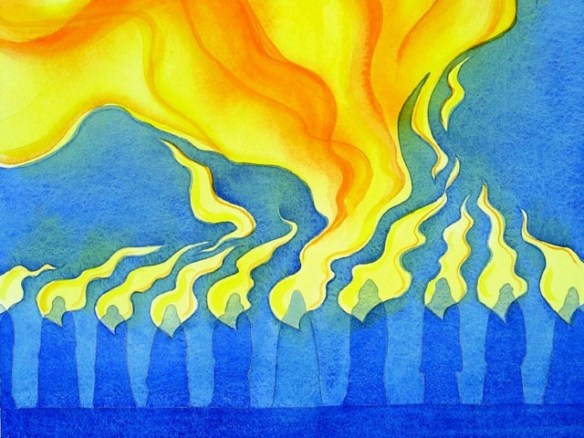
That sets the stage for our readings today. The disciples—not just the twelve, but a hundred twenty, including the Blessed Mother—were gathered in prayer, as the Lord had told them at the Ascension to do. Meanwhile, outside, people from all over the world—some Jewish, others, gentile converts, others, pagan worshipers of Israel’s God—were all gathered to celebrate the feast of Pentecost. It was a very lively moment. And into that moment, in the presence of the disciples, our first reading tells us, there was a rushing wind. In Hebrew, the word “ruah” means wind or breath or spirit. It’s the word used at Creation when it says the Spirit (ruah) of God hovered over the waters, and the ruah that God breathed into Adam. So the ruah, the wind, the divine breath, rushed through the room, and tongues of fire rested above each of the disciples.

According to Jewish Tradition, it took 10 people to establish a synagogue, a local church. They have already replaced Judas with Matthias, so the Eleven are back to Twelve Apostles, and enough other disciples to establish a synagogue under each one. At Sinai, the Lord descended with fire upon the twelve tribes of Israel. Here at Pentecost, the Lord descends with fire upon the Twelve Apostles, and their “tribes,” their churches, of the New (worldwide) Israel. James (the Less, the Son of Alphaeus, “James, the Brother of the Lord”) will stay and lead the Jerusalem church. Peter will go to Antioch and then to Rome. Andrew will go to Greece. Thomas will go to India. John will be exiled to Patmos, and so on. Yet they are all united by the Holy Spirit as the one, holy, catholic, and apostolic Church. “Catholic” comes from kata-holos, “according to the whole.” The Church taught (and was) everywhere the same truth, and the whole truth. 

Image result for pentecostAs God made the covenant at Sinai establishing Israel as the People of God, and gave them the Law of the Covenant on the stone tablets, here at Pentecost, in Jerusalem, the city of God’s presence with his people, the Holy Spirit in a similar way establishes the new covenant with the New Israel with his own divine ruah, and fire, and, as the prophets had said, he establishes the new law not carved into stone, but written into the flesh of their hearts.

In the first half of the reading, we have the experience of the Church. In the second half of the reading, we have the experience of the Church with the world. The disciples go out, and with great joy and excitement, start sharing the good news with the whole crowd gathered from everywhere for Pentecost.

And we have another connection to the Old Testament: the Tower of Babel. In Genesis, in the generations shortly after the Flood, Image result for tower of babelhumanity, still speaking a single language, decides (as fallen humanity often tries to do in different ways in different ages) to build a giant tower—a siege tower—to take heaven by force. God observes what they’re doing, and divides and confuses their language, reflecting the division and confusion in their hearts and their relationships to Him and to one another. Thus confused and confounded, they each wander off to different parts of the world. But “Babel” is the root for our term “babbling,” that is, making unintelligible sounds.  The city that opposes God is also the city of unintelligibility. Opposition to God leads to moral and intellectual confusion, the loss of truth and goodness. And we see this today among those who oppose God’s truth and his Church.  

So in Pentecost, and we have the reversal of the confusion of Babel. People of all different languages come together and understand the disciples, who are full of the Holy Spirit, the Spirit of unity and truth. We might notice the progression of responses among the crowd—first they are confused, because they understand the apostles, then they were astounded, then amazed. As we open ourselves to God working within us, first it is confusing, then as we begin to understand, we are astounded and amazed, at how he works in our life and our situations.


So that’s the event of Pentecost, but what’s the importance of Pentecost? It means that everything Jesus accomplished in his mission into the world—his life, his healing, his self-giving love, his word, his wisdom and light, his forgiveness of sins, his sacraments of grace, his life-giving body and blood, his death to separation from God and resurrection to eternal life, his ascension and holy communion with the life and power of the Holy Trinity—all that is given to us. The divine power that said “Let there be light, and bang, there was light”—that power is given to us by Pentecost. The Holy Spirit is the power of the sacraments, the fire of God’s love that changes the nature of material things into signs of sublime spiritual realities that communicate himself to us. The Holy Spirit is the lifeblood and soul that binds the Church into the mystical body of Christ, and we as members of the Body, sharing in its glory, and in its sufferings, but suffering with faith, hope, and love. The Holy Spirit is the presence of God within us, prompting us to accomplish his will for us, and through us to the world. Pentecost is the big bang of the new creation. It is the pouring out of the Holy Spirit to renew the face of the earth. For those who have eyes to see and ears to hear, this changes everything. It is the power of God in us. The holy communion of Emmanuel—God for us, God among us, God within us. And it is the mission to bring others into this holy communion of God’s love and truth. Pentecost is still a harvest festival!  

How do we respond? By putting sin behind us, by living by the inspired teaching of the Church, and not the errors and sins of the world. That’s the first and most basic response: Go and sin no more. But more than that, we respond by frequent and devout prayer, by weekly or even daily (worthy) participation in the holy liturgies and sacraments of the Church. We read and study and contemplate the Divine Word of the bible, filling our hearts and minds and uniting ourselves with his Word. We ask for the intercession of the saints in glory, especially our Blessed Mother, whose last words in Scripture are, “Do whatever he tells you.” The Blessed Mother was overshadowed by the Holy Spirit, conceiving the Divine Word in her womb, and her response was that she went with haste to minister to the needs of Elizabeth, and sharing her joy. The Church receives the Holy Spirit, and our response must likewise be that we go with haste to minister to the needs of the world, sharing our joy.

Pentecost is our invitation to continue in ourselves the life and ministry of Jesus Christ our Lord. By the Holy Spirit of his love, he gives us the power to deny ourselves, pick up our cross, and follow him, through death to everlasting life in His glory.

Related image

Horizontal Rule Cross

Homily: Jesus, the High Priest

Related image


The Seventh Sunday of Easter (Year C)
Acts 7:55-60
Psalm 97:1-2, 6-7, 9
Revelation 22:12-14, 16-17, 20
John 17: 20-26


Don’t worry this isn’t the wrong homily! Just setting the stage for the Gospel reading!

The Mass that ends the season of Lent, and begins the Easter Triduum, is the Mass of Holy Thursday, the Mass of the Institution of the Eucharist, and the Priesthood. In the homily for that Mass, I said that we can see Jesus instituting the priesthood through three aspects of the Last Supper.

First, in the Gospel of John, Jesus begins the Last Supper by washing the feet of the disciples. This hearkens back to God’s instruction to Moses for preparing Aaron and his sons to be the beginning of Israel’s priesthood. Anytime they were to offer the priestly liturgical sacrifice, they first had to bathe (which I’m sure the altar servers were thankful for). So that’s the first aspect of the last supper instituting the priesthood.

Second, At the Last Supper, Jesus said, “This is my body, and this is my blood, for the forgiveness of sins.” So Jesus is making a flesh and blood sacrifice. And anyone at that time knew that only priests can offer ritual flesh and blood sacrifice for the atonement of sins. And so when Jesus then followed his words by saying, “Do this in memory of me,” he is telling his apostles to continue offering this sacrifice. So to do that, he is instituting a new priesthood, that is like the old priesthood, but made new, and participates in his own priesthood as high priest. That’s the second aspect of the last supper instituting the priesthood.

The third aspect is Jesus offering the high priestly prayer. In Judaism, the high priest would enter into the “holy of holies,” the sanctuary of the temple where the Ark of the Covenant was kept, one day each year, the Day of Atonement. And on this day, the high priest would offer the high priestly prayer, which has three parts. First the high priest would pray for himself. Then in the second part, he would pray for all the other priests serving as an extension of his own high priesthood. Then in the third part, he would pray for all of Israel. At the Last Supper, Jesus offers a long discourse, over 3 chapters of the Gospel of John, a discourse which culminates in his offering of his High Priestly Prayer.

In this prayer, Jesus prays first for himself. He begins by saying, “Father, the hour has come. Give glory to your son, so that your son may glorify you.” Second, Jesus prays for the twelve. He begins this part by praying, “I revealed your name to those whom you gave me out of the world. They belonged to you, and you gave them to me, and they have kept your word.” And he ends this second part by praying, “Consecrate them in the truth. Your word is truth. As you sent me into the world, so I sent them into the world. And I consecrate myself for them, so that they also may be consecrated in truth.Image result for jesus high priestSo where the high priest is praying for the other priests who share in his high priesthood, Jesus, the true high priest, prays for the Apostles, and for their consecration and ministry. Then he begins the third part, which is our gospel reading today. Jesus prays, “I pray not only for them, but also for those who will believe in me through their word, so that they may all be one, as you, Father, are in me and I in you, that they also may be in us, that the world may believe that you sent me.” So where the high priest is praying for Israel, the people of God, Jesus prays for the Church, the New Israel, the New People of God. Jesus is praying for all the Christian faithful, the Church built on the foundation of the Apostles.
In the three-year cycle of the Lectionary, the gospel reading for the 7th Sunday of Easter each year is one of the three parts of this prayer. This year we’re in year C, so our reading today is this last third of the High Priestly Prayer. In the Gospel reading, Jesus prepares his Church for the sacramental liturgy of the end times—the pouring out of the grace of His Paschal Mystery into the Church, and through the Church into the world. He prays for the Church, that they may be one, as God the Son and God the Father are one; which is to say, in the perfect self-giving agape love of the Holy Spirit, the love of the Holy Trinity. It is this witness of love—within the Church, and outward toward others—that is to be the signature feature of the Church and her members, not just so that we might be one with God, but so that the world might believe.


Throughout the Easter Season, the second reading has taken us through the Book of Revelation, the last book of the Bible, today we reach the end of the book. It is said that Martin Luther wanted to omit this admittedly confusing writing from the canon of Scripture, saying “Revelation should reveal something.” Of course, it does reveal something. In simple terms, the Book of Revelation operates on two levels: First, it gives a symbolic representation of the times it was written in, expressing the experience of the early church amidst great suffering and persecution, revealing it as a reason for hope and joy in the accomplishment of the divine plan for salvation. And second, it is a mystical prophecy of the second coming of Christ in judgment at the end of time. The difficulty comes from the book using the same mystical words and images to mean both levels, both events, both times, together.

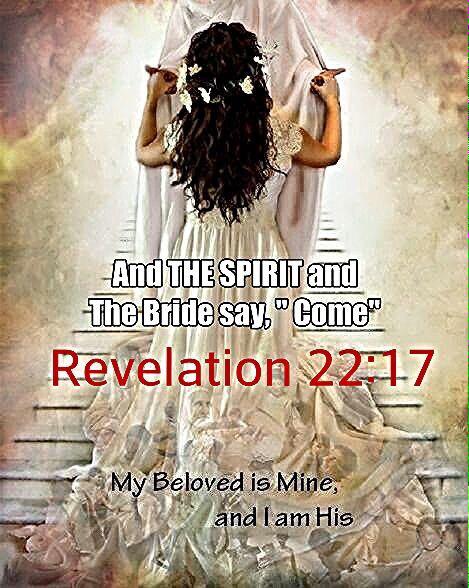
Related imageIn our second reading for today, which is the end of the book of Revelation, we have Jesus promising his return, the promise of judgment and justice on the good and the bad, a blessing for the suffering faithful, and finally, the reminder that we want this, we pray for it. The Church, the Bride of Christ, and the Spirit, the love that gives the Church unity, the Spirit and the Bride say to Jesus, “Come!” Let all who hear this say, “Come!” Then in the final verse, John as the narrator joins this chorus, saying, “Amen!  Come, Lord Jesus!” And except for one short verse of blessing, those are the final words of the bible. Not only will it be an end to the persecution and suffering, but it will be the manifestation of all that we know by hope and faith, the dropping of the veil between our world and the true eternal world, the coming of the New Jerusalem, the Heavenly City of God.


And then finally, after talking about the final end of Christian persecution in the second reading, we have the beginning of it in the first reading. Saint Stephen said he saw the heavens opened and Jesus standing at the right hand of God. Related imageThis is the only place that describes Jesus as standing, rather than being seated, at the right hand of God. A king seated on his throne would rise to greet an honored guest, and Jesus stands to welcome Stephen, whose name means “crown,” as the first after Christ to win the crown of martyrdom, of witnessing to his faith in Christ to the extent of giving his life. Stephen had been mentioned earlier as one of the men nominated to be the first “deacons” in the Church, to help the Apostles by ministering to the temporal needs of the Christian community. He was described as a man filled with faith and the Holy Spirit. After testifying to Christ against the Jews who rejected him, Stephen was stoned to death. The description of his death is meant to set a model for future Christians, of imitating (and so, participating in) Christ’s giving his life. Not necessarily by the cause of death, as Jesus was crucified and Stephen was stoned, and later Christians would be killed in a cruel variety of methods. But like Christ, and like Stephen, Christians were to follow the example, in their final moments, of commending their spirit to the mercy of God, and praying for God’s forgiveness for their persecutors.

And so next Sunday, we celebrate the feast of Pentecost, the sending of the Holy Spirit to give the Church its life, power, and unity. And with that, we will finish the season of Easter, and begin Ordinary Time—not “ordinary” in the sense of bland and unremarkable, but “ordinary” in the sense of time ordered, organized, for living out our Christian Life, toward sharing in Christ’s mystery of suffering and hope, sorrow and faith, the cross and resurrection: that through the grace of the sacraments, we are united into this mystery of God’s self-giving love, and we carry out the Church’s mission in Christ: to bring God to the world, and the world to God.

Horizontal Rule Cross

Homily: The Ascension

Ascension


The Ascension of the Lord (Year C)
Acts 1:1-11
Psalm 47:2-3, 6-7, 8-9
Heb 9:24-28; 10:19-23
Luke 24:46-53


Today’s Feast Day of the Ascension celebrates that part of the infinite mystery of Christ by which he victoriously returns, in his resurrected and transfigured flesh, to the right hand of God the Father, to rule all Creation as king, and to sanctify all Creation as high priest. The overwhelming, brilliant glory of Christ that was briefly seen in the mystery of the Transfiguration, is now forever fulfilled in the mystery of the Ascension. The Son of God took on our human flesh, which is now and forever held within the eternal glory of God himself, the Holy Trinity. Divinity shared in our humanity, so that humanity might share in His divinity.


Our gospel reading gives us the last verses of the gospel of Luke, which tell of Jesus meeting with his disciples after resurrection, giving them the confidence that all that Jesus had said of himself being the Messiah and the Son of God, and being killed on the cross and rising on the third day, was true. Jesus was victorious in his defeat over death, and now the good news was to be spread throughout all the nations by his joyful disciples, the Church—the good news of the invitation to repentance and the forgiveness of sins through Christ. But their mission wasn’t to start just yet—not until they are empowered by the coming of the Holy Spirit upon them at Pentecost. After giving them the joy of his resurrection, the mission of his Church, and the promise of his Holy Spirit, Jesus led them out of the city, raised his hands in blessing upon them, and parted from them in his Ascension. Back at the beginning of the Gospel of Luke, we saw the priest Zechariah ministering in the temple, when the angel told him of the coming of his son, John the Baptist. But Zechariah didn’t believe the angel, and he was struck mute. When he came out of the temple, the people expected to receive the priestly blessing from him, but they could not. The time of the old priestly blessings has ended. Now, at the end of the Gospel of Luke, the world once again receives the priestly blessing —not from the old covenant priesthood, but from the new covenant’s high priest Jesus Christ, as he goes up to the heavenly temple.

In the opening verses of the Gospel of Luke, he says that he has collected and re-examined all the available eye-witness accounts regarding Jesus, and is writing his gospel for a person he calls Theophilus, which may be a person’s name, or could just be a generic name to apply to any Christian reader, since it means “friend of God.” And the writing is with the intention to help Theophilus to be strengthened in his faith in Jesus Christ, and the miraculous accounts that are circulating about him.

Now, as our first reading today, we have the very first verses of the Acts of the Apostles, which begins, “In the first book, Theophilus, I dealt with all that Jesus did and taught until the day he was taken up, after giving instructions through the holy Spirit to the apostles whom he had chosen…” and then continues on with the rest of our reading of the Ascension, and then on with the rest of the story. So the Gospel of Luke and the Acts of the Apostles go together. The beginning of Acts is like the first scene of a TV episode, that begins, “Previously…”, and recaps the end of the previous episode, before continuing on with the new material.

As we celebrate the Ascension, some people may get confused by that language, “ascended up into Heaven.” Does that mean that Jesus goes up into the outer space? Does he keep going past Pluto somewhere? What does that mean? St. Paul describes a mystical vision in which he was taken up into “the third heaven.” In the ancient Jewish understanding of the world, the first heaven was the air, the domain of clouds and birds. The second heaven was the furthest that we could see, the firmament of the blue sky and stars, like a dome over the world. And then, there was the third heaven, kind of a spiritual realm in which God and the angels dwell. So the visible heaven is a kind of sacramental symbol for the invisible spiritual realm in which the Lord dwells: “The heaven of heavens.” So Jesus being lifted up, and then hidden by a cloud, is revealing that he is now passing into the invisible realm where the Father dwells. That’s what this day is celebrating.


For our second reading, we had the option to read from either the Letter to the Ephesians or the Hebrews. This section from Hebrews is a detailed reflection on the mystery of Jesus’ Ascension in the New Testament. It says that “Christ did not enter into a sanctuary made by hands, a copy of the true one, but heaven itself, that he might now appear before God on our behalf.” Christ isn’t offering himself over and over like an eternally repeating cycle. He offered himself once, for all time. His crucified and resurrected life is itself the perpetual offering of himself to the Father on our behalf. He is in the true Temple, of which the Jerusalem temple was an icon, a sacramental image of the hidden reality, based on the Tent of Meeting, which Moses built from instructions God had given him. Our modern churches, with a sanctuary, tabernacle, bread of presence, lampstand, and altar, are a copy of a copy of a copy. But what is the true, heavenly temple? We know from John’s book of Revelation that the heavenly city doesn’t have a temple. John says, “I saw no temple in it, for the Lord God the Almighty and the Lamb are its temple.” The heavenly Temple is an image of divine love: the love between the Father and the Son; and now, after the Ascension, with the Son in human flesh, it is the eternal love between Divinity and Humanity. Between the eternal Bridegroom and Bride.


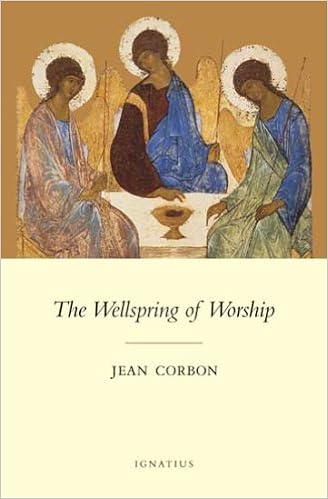
Fr. Jean Corbon, in his beautiful book on the liturgy, “Wellspring of Worship,” describes the Ascension as ongoing until the end of time, because the Ascension is the arrival of the Body of Christ into the presence of the Father, and the Body of Christ is all the members of the Church. The members of the Body continue the Ascension, as each one follows Christ, the head of the body, through death, and up into the heavenly banquet of the Father joyfully welcoming home His Son, returning from his mission of rescuing humanity, His Bride, his People, from death, and bringing them into communion with God. It is the supper of the Lamb, the wedding feast of the Lamb and the Bride, united in the Holy Spirit.

We have a taste of that here and now. That’s what the sacrament of Communion is! If our own bodies are holy because of their union with our human souls, how much more so the body of Christ, that is united to divinity, the source of life, itself!? Now this flesh is transfigured in the Paschal mystery of Christ, and, in the Ascension, shares in the Holy Trinity itself, and we unite ourselves with this divine flesh that is the real presence of Jesus in the sacrament of communion. What did Jesus say in the Bread of Life Discourse? Jesus said to them, “Amen, amen, I say to you… Whoever eats my flesh and drinks my blood remains in me and I in him…” Then he says, “Does this shock you? What if you were to see the Son of Man ascending to where he was before?

Jesus connects the Ascension with the Eucharist. We are what we eat; we become like what we eat. When we worthily receive the Sacrament of Communion, we are united to heaven, to the Lord God the Almighty and the Lamb. We are transformed by our sacramental share in the joyful banquet feast of heaven. How? By the Holy Spirit, the grace that unites the bread and wine the priest offers on the altar into Christ’s sacrament of his body and blood at the Last Supper, which is then offered as the perfect sacrifice of himself by his cross and resurrection, that we might have life with the Father, through Christ, in the Holy Spirit. That’s what we celebrate in the Ascension: our own participation in the shalom of the Holy Trinity. And then our mission is to spread the good news of the invitation into this mystery, and the necessity of repentance and the forgiveness of sins. But before we begin that mission, first we need to join the Apostles as they prayerfully prepare for the gift of the Holy Spirit at Pentecost.

Horizontal Rule Cross

Homily: Shalom…Peace

Image result for shalom peace


The Sixth Sunday of Easter (Year C)
Acts 15:1-2, 22-29
Psalm 67:2-3, 5, 6, 8
Revelation 21:10-14, 22-23
John 14:23-29


We are not at peace with others because we are not at peace with ourselves, and we are not at peace with ourselves because we are not at peace with God.” – Thomas Merton

Our gospel reading is one of the most significant revelations of God as the Holy Trinity: Father, Son, and Holy Spirit. The Trinity is implicit and hinted at all throughout scripture, even back in Genesis. When we create something, our creation reveals our own self. And the divine writing of the Holy Scriptures is no exception. That’s the point of the Scriptures: God’s revelation of Himself for our salvation—not just as the subject of the writing, but the very writing itself; the Word of God is God.

One of the great mysteries—the central mystery—of the Christian Faith is the Holy Trinity. And of course, our parish is dedicated to the honor of this central mystery. It is the mystery of who God is. Therefore, it is the mystery of existence; the mystery of the nature of everything, and the mystery of what we are called to choose to participate in, by the divine gift of our free will.

One of the aspects of divine nature is that of perfect peace, the Hebrew word, “Shalom.” Ancient languages have a relatively small vocabulary, but the words are deep in meaning. Modern languages like English have tens of thousands of words, which are particular and narrow in their scope. What thoughts come to you with the words, “peace, greeting, happiness, generosity, patience, love, wholeness, forgiveness, unity, contentment”? This cluster of words are all aspects of the Hebrew word, “Shalom,” which is simply translated, “peace.” God is this peace; He is happy, he is love, he is joyful, he is rest, he is perfect. He wants for nothing outside of himself. And he created us to have His divine peace, for all eternity. When you hear this word in the Mass, especially after the Lord’s Prayer, I want you to remember all these thoughts and feelings that are intended by that word.

In our Gospel reading, Jesus says to his Apostles, “Peace I leave with you; my peace I give to you. Not as the world gives do I give it to you. Do not let your hearts be troubled or afraid.” Jesus in his divine nature never loses the perfect peace of the Holy Trinity. But in his human nature, he experiences the lack of peace that is our limitedness, our unrelenting desire for something (for unity with something) that is not within us. In the mystery of the Ascension of the incarnation of the Son back into the Trinity, which we celebrate in the Feast of Ascension Thursday, the Holy Day of Obligation this week, this existential question in our human nature is answered by our union into divine nature.

Peace is not just absence of worry or anxiety, or absence of conflict with others. That’s the world’s peace, and it’s superficial and unstable. But God offers us an existential peace; a true peace. We as humanity cannot attain this peace of our own, but we can get moments of it. It is not within our reach, and unable to be maintained in our turbulent existence. The philosopher Arthur Schopenhauer once compared humans to Bulldog Ants. If a Bulldog Ant is split in half, the front and rear segments will enter into a savage fight. The head will bite the tail, while the tail will sting the head. That is the way we are. Always at war with ourselves. Jesus said to his disciples, “I’m not just giving you peace; I’m giving you my peace, that comes from being perfectly open and united to divine being.” One of my favorite words of scripture, especially in times of anxiety, come from Psalm 48: “Be still, and know that I am God.”

Our first reading, from the Acts of the Apostles, concerns what is often called “The Council of Jerusalem,” the first Church Council. It was called because disagreement was growing within the Church, between gentile Christians and conservative Jewish Christians over the question of whether gentiles needed to convert to Judaism in order to become Christian. The scriptures didn’t give clear instruction on this question. Jesus hadn’t given clear instruction on this question. So Paul and Barnabas led a group from Antioch to Jerusalem, where Peter and James and the other Apostles and presbyters were, to settle the matter. Our reading today skips over the Council and picks up with the conclusion of the Council being given to the church in Antioch. It says, “Since we have heard that some of our number who went out without any mandate from us have upset you with their teachings and disturbed your peace of mind” So those who were teaching on their own supposed authority did not actually have any Apostolic authority or mission. And the effect of their unsanctioned teaching was to disturb the church’s peace and confuse the faithful. “It is the decision of the Holy Spirit and of us” Church teaching is not a matter of the church deciding what to teach. It is the discernment of what God is guiding the Church to teach, by the apostolic charism of the magisterium, the teaching authority of the church.

The second reading, from the Revelation, gives us a mystical view of tensions between the church and the secular world. It would bring great peace to the hearts of the suffering Christians to know that their sufferings were part of bringing the beautiful heavenly church, the New Jerusalem, the city of God, to earth.

Jesus says, “Whoever loves me will keep my word, and my Father will love him, and we will come to him and make our dwelling with him.” This image is that of the Temple. When Moses built the Tent of Meeting, and when Solomon built the great Jerusalem Temple, the glory of the Lord filled the place with His presence, often in the form of a great cloud of glory, the Spirit of Divine Presence. We are invited into this union with God by the Sacrament of Baptism: for ourselves be the living temples of God. We often think of the Holy Spirit dwelling within us, but it is the unity of the Holy Trinity: the Father and the Son make their dwelling within us, too. So long as we avoid deadly sin, by which we would shut down our side of our communion with God. But even then, God never ceases to invite us back to reconcile with Him…because this union with divine love, peace, and truth, are what He has made us for.

I was inspired with this thought during my Friday Holy Hour of Eucharistic Adoration. I want to invite all of you to have your home blessed, even if it was done years ago. I want your homes to be holy, cleansed of the obstacles to holiness and peace that you knowingly or unknowingly invite there. I want your rooms where you spend you lives to be holy. I want your bedrooms to be holy. I want the space where you spend time as a family to be holy. I want your life to be holy. Because your human existence, in the image of God, is holy. And if there is a tension between the holiness of your existence, and a lack of holiness in your life, you will not have peace—not God’s peace. And you will look to satisfy that need for peace in disordered ways that take you away from the real peace (all the holy aspects of peace) that you are made to seek… and that can be found only in the peace of God.

Horizontal Rule Cross

Homily: Do You Love Me?

Image result for peter do you love me charcoal

The Third Sunday of Easter (Year C)
Acts 5:27-32, 40b-41
Psalm 30:2, 4, 5-6, 11-12, 13
Revelation 5:11-14
John 21:1-19


In last week’s Gospel, we had two separate appearances of Jesus to his Apostles: First, the evening of the resurrection, but Thomas wasn’t with them. And then a week later, on the Second Sunday of Easter, and this time Thomas saw and believed. And Jesus blesses those who haven’t seen, yet believe. And then we had what sounded very much like the ending of the Gospel book.

But wait—there’s more. About half way through today’s gospel reading, it says, “This was now the third time Jesus was revealed to his disciples after being raised from the dead.” The first half of the reading, before that line, and the second half after it, can be looked at separately, so that’s what we’re going to do.


At the beginning of the reading, “Simon Peter said to them, ‘I am going fishing.’” Some people read that to mean Peter had given up and decided to go back to his former way of life. That just doesn’t make sense. We should remember that they just saw the resurrected Jesus, twice. Now, they were in Galilee, waiting for Jesus, as they were told. And while they were waiting, Peter decides, “We’re just here waiting. I’m gonna go fishing.” And they all say, “Yeah, ok. We’ll go with you.”

As usual, it seems, they spend all night fishing, and catch nothing. Then this stranger on the shore shouts out, “Children, have you caught anything to eat?” That’s a weird thing, maybe a little flag. He called them, “Children,” but they just answer, “No.” He tells them to throw the net over the right side of the boat, and they immediately catch so many fish they can’t even pull the net back into the boat. And that’s when it clicks for John, who remembers something like this happening before, after fishing all night unsuccessfully, this strange man gives them a strange suggestion, and on doing so, they catch a super-abundance of fish… way back when Jesus had first stepped into Peter’s boat. John turns to the others “Duh! Guys, it’s Jesus!” (That’s a more modern translation!) Peter jumps in the water, while the rest bring the boat and the net ashore. Apparently, Jesus must have seemed different somehow, or why would it say, And none of the disciples dared to ask him, ‘Who are you?’ I don’t think it would say that if his resurrected body were exactly the same as he was before. But clearly, they knew that indeed he was himself. Then, after the miraculous catch of fish he had just given them, he gave them a meal of loaves and fishes. Yep, that’s Jesus.


Then, more importantly, we have the second half of our reading. First, notice that it very specifically says that Jesus was next to a charcoal fire. The Greek word for charcoal fire, anthrakian, appears only twice in the whole bible: here, and the charcoal fire Peter was warming himself by when he denied Christ three times. When did Jesus predict that Peter was going to deny him three times? When, at the Last Supper, Peter had said to Jesus that even if all the other disciples were to abandon him, Peter would never abandon him; that he loved him so much he would lay down his life for him. Now, next to a charcoal fire, Jesus asks Peter, “Simon, son of John, do you love me? Wow. I can’t imagine how this must have been for Peter, to have Jesus so sharply call to mind that shared moment of betrayal: both his prediction of his betrayal, and Peter’s very moment of betrayal, by a charcoal fire, just as their eyes met, as the cock crowed. 

Actually, Jesus doesn’t ask, “Do you love me.” He asks, “Simon, son of John, do you love me  more than these?” More than these what? Does Jesus mean… Do you love me more than you love these other people? (Do you love me above all other persons in your life?) Or does he mean… Do you love me more than you love these fish? (Do you love me more than your way of life, your “comfort zone,” the pleasures and comforts that this world offers?) Or does he mean… Do you love me more than these other men do? Do you have greater love for me than others do? Do you excel in Christian love, so as to be ready to excel also in Christian authority? I would say that Jesus meant all of that, in his simple question. Simon, son of John, do you “agape” me? Do you love me with the sacrificial, self-giving, love that I have shown for you?

Simon Peter answered him, ‘Yes, Lord, you know that I love you.’” I “phileo” you.” I don’t love you with your agape love, but I love you with all my phileo love. Not like God, but like my teacher, my mentor, my brother, my dearest friend. Jesus responds, “Feed my lambs.” Nourish my hungry people, give them the living water to quench their thirst, and the bread of heaven to feed their souls.

Second time, same thing: “Simon, son of John, do you love me?” Do you agape me? Simon Peter answered him, “Yes, Lord, you know that I love you.” I phileo you. Jesus said to him, “Tend my sheep.” The Greek word isn’t quite as soft and fluffy. It’s “Shepherd my sheep.” Lead them, protect them, guide them, provide for them. Teach and train them. Including the other Apostles. I’m putting you in charge. I am the Good Shepherd, but I’m telling you to shepherd my sheep on my behalf.

Now the third time: “Simon, son of John, do you love me?” But this time Jesus lowers the bar, and uses Peter’s word, “phileo.” It says, “Peter was distressed that Jesus had said to him a third time, do you love me?” Do you phileo me? And Peter said to him, “Lord, you know everything; you know that I love you.” I phileo you. Jesus said to him, “Feed my sheep.”

When Judas had seen the effect of his betrayal of Jesus, he despaired of his forgiveness, and went out and hanged himself. When Peter had seen the effect of his betrayal of Jesus, he went out and wept, for having so offended the relationship he had with Jesus.

Now, Jesus asks Peter three times, “Do you love me,” in effect, forgiving and wiping away Peter’s betrayal. Now that Peter has experienced Jesus’ divine mercy and love for him, Jesus is inviting Peter to follow him not just as a disciple, but to follow him specifically in Jesus’ place as leader of the disciples, to be the Rock on which Jesus had said he would build his church. To be a Christian leader doesn’t mean great technical skill, or great administrative skill. It means great love. Peter, do you excel in Christian love, so as to be ready to excel also in Christian authority? Will you do what ever it takes, sacrificing your life, to love my people with my love for them? Jesus says, ‘Amen, amen, I say to you, when you were younger, you used to dress yourself and go where you wanted. But when you grow old, you will stretch out your hands, and someone else will dress you and lead you where you do not want to go.’ He said this signifying by what kind of death Peter would glorify God [–crucifixion]. And when he had said this, he said to Peter, ‘Follow me.’”

Jesus is in effect saying to Peter, “For now, I will meet you where you are, and accept your love of friendship, your phileo love. But in the Holy Spirit, you will mature in your role, you will mature in your love and care for my dear little flock that I trust to your care. Peter, the Fisher of men, Peter the Shepherd of the sheep: you may not be there yet, but I will bring you to my agape sacrificial, divine love. And you willingly make good on that promise to lay down your life for love of me and my body, the Church.” That’s the Peter we see in the Acts of the Apostles.


Since I now don’t have time to get into the other readings, I’ll just end with this: that this love we’re talking about with Jesus and Peter is what we mean by the agape love between Christ and his Bride, the Church. Husbands, you are like Peter, striving to more perfectly love and honor your bride with Jesus’ love for her, and to lead her, by serving her, nourishing her, shepherding her toward heaven, stepping up as the spiritual head of the home, especially for your children. Wives, you are called—first, to choose a good man who wants your salvation more than you do (and so won’t ask you to jeopardize your salvation by sin)—and then to look to your husband as the Church looked to Peter: as an icon of Jesus, a man capable of noble character, who needs your prayers and love and encouragement to be the man that God is calling him to be for you. Husbands, you are an icon of the Bridegroom. Wives, you are an icon of the Bride. Your marriage is an icon of the faithful, forgiving, patient, abundant, unbreakable love between them. That’s the sacrament of Marriage, which is so much more than sex and companionship. It’s the agape self-giving love of the cross, by which you offer your life to each other, maturing in your love and care for each other. “My beloved, do you love me? Yes, you know that I love you.”

Horizontal Rule Cross

Homily: Easter Vigil

Image result for empty tomb

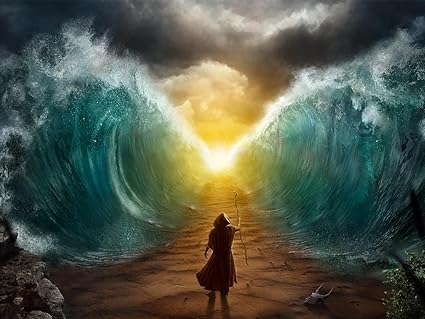
“Why is this night different from every other night? Because once we were slaves, and we are slaves no longer…” These lines are drawn from the celebration of Passover, recalling God’s mighty liberation of his people from their slavery in Egypt, and they are a fitting way to describe the mysteries we celebrate this evening.

“Why is this night different from every other night?” Tonight, we are in the midst of the great Easter Triduum, the Mass of Our Lord’s Supper on Holy Thursday, the Passion of Our Lord on Good Friday, and the most holy feast day of the Resurrection of Our Lord on Easter Sunday. The Easter Vigil—as the Church calls it, “The Mother of all Vigils”—prepares us throughout this night to enter even more joyfully into the Feast Day of the Resurrection.

“Why is this night different from every other night?” The Divine Liturgy of the Mass is made of two distinct parts: the Liturgy of the Word, and then the Liturgy of the Eucharist. In the Mass of the Easter Vigil, tonight, there are four parts to the Mass.


We started with the Liturgy of Light: Jesus Christ is the LIGHT in the DarknessImage result for easter procession candlesWe blessed the Easter Fire, making it a sign of divine glory—God’s burning heart of divine love. From the fire we blessed the Paschal (or Easter) Candle, representing Christ as the light of the world, the pillar of fire that lights our darkness, leading the People of God on our journey through the wilderness to the Promised Land. Those of us who are baptized, although not wearing the white garments of our baptism, lit our candles from the Easter Candle, as the light of faith that we have received. Christ told us that we are the light of the world, telling us to share our light, from his light, with others. It also represents our vigilance to our Lord’s warning to keep awake, with the lamps of our faith and good works lit, prepared for our Lord’s coming.

The second part of our night is the Liturgy of the Word: Jesus Christ is THE WORD and truth of God. The Easter Vigil has seven Old Testament Readings, each with their own responsorial psalm and prayer, intending to help extend the length of the liturgy from sunset until the dawning of Easter Morning. Tonight, we just had three of those readings, because we’re not trying to extend the Mass (to anywhere close to dawn).

Related imageThe Liturgy of the Word tonight helps us to focus on the mystery of baptism. In a few moments, we’ll hear the beautiful Easter blessing prayer over the water of the baptismal font, which like our readings, recalls many of the ways in which God has used water as an image of baptism and new life throughout salvation history—The water and the Holy Spirit at the beginning of creation; Israel’s passing through the waters of the Red Sea, putting their slavery behind them as they set off on their journey to the Promised Land; God’s beautiful promise through the prophet Ezekiel of a future restoration, in which God says to his people, “I will sprinkle clean water upon you to cleanse you… I will give you a new heart and place a new spirit within you… you shall be my people, and I will be your God.” From the New Testament, we heard Saint Paul’s letter to the Romans about the mystery of our death to sin, and new life in Christian baptism, as we are made into a new creation by the mystery of Christ’s death and resurrection being applied to us. And then, we heard from the Gospel of St. Luke, of the glorious empty tomb. Christ is not among the dead, but truly lives, as he promised. The power of the resurrection is given to us in baptism: our redemption from sin and death, and our new life of the grace of the risen Savior. “Why is this night different from every other night? Because once we were slaves, and we are slaves no longer…”


The third part of the Easter Vigil is the Liturgy of Initiation: Jesus Christ is THE LIFE of communion with God. In the Gospel of St. John, Jesus says, “Amen, amen, I say to you, no one can enter the kingdom of God without being born of water and Spirit.” Image result for baptismWe have two young women among us who, over this past year, have been preparing to be baptized. Baptism in a sense is the virgin womb of Mother Church, from which is born new sons and daughters of God our Father, adopted through our communion in the divine sonship of Christ, as his brothers and sisters. In another sense, baptism is the bridal bath, the ceremonial washing of the members of the Bride of Christ, the Church, in preparation for her consummation of her nuptial communion with Christ her Bridegroom, who gave himself, that she might be made clean. Then they will receive their white baptismal garment, and their baptismal candle, which we talked about a moment ago.

Then we will have three men and women called forward, who have already been baptized in different Christian traditions, who have been preparing to be brought into full communion with the Catholic Church. Then all five of our new members, the two newly baptized, and the three newly professed, will receive the second sacrament of initiation, Confirmation. They will be anointed with sacred chrism, as Christ was anointed with the Oil of Gladness, to carry out his mission to be priest, prophet, and king.


They will then return to their place, as they join us in our celebration of the fourth and final part of the Easter Vigil, the Liturgy of the Eucharist: Jesus Christ is THE FOOD of the spiritual life. Image result for eucharist mannaThe Eucharist is celebrated tonight as we do each Sunday, albeit with a few alterations to the prayers in recognition of tonight’s special and sacred role in the sacramental life of the Church. Tonight, our five newly initiated members receive the last of the Church’s three sacraments of Initiation: the Eucharist. With this sacrament, our new members will join with us in the perfect reconciliation offered to us through the Paschal Mystery: the holy communion of Saints and angels in union with God. They will join us in being spiritually fed with the new manna of Christ’s flesh, and made new in the blood of the new Covenant. With us, they will receive the grace and power of Christ, to be sent out into the world, to minister God’s mercy, to spread God’s light, and to witness to God’s love. Congratulations and welcome, Sarah and  Bobbi, Matt, Aileen, and Justin. May God’s love richly bless you.


  • The Liturgy of Light: Jesus Christ is THE LIGHT in the darkness.
  • The Liturgy of the Word: Jesus Christ is THE WORD and Truth of God.
  • The Liturgy of Initiation: Jesus Christ is THE LIFE in communion with God.
  • The Liturgy of the Eucharist: Jesus Christ is THE FOOD of the spiritual life.

My brothers and sisters, Happy—and blessed—Easter to you and your family! “He is risen! He is risen, indeed! Alleluia, Alleluia!” “Why is this night different from every other night? Because once we were slaves, and we are slaves no longer…”


Related image

Homily: Straining Forward in Hope

Image result for woman caught in adultery


The Fifth Sunday of Lent (Year C)
Isaiah 43:16-21
Psalm 126:1-2, 2-3, 4-5, 6
Philippians 3:8-14
John 8:1-11


A police officer pulls over a priest for speeding (believe me, it happens!). The priest gave the officer his license and registration, and the officer went back to his car. As the officer came back and returned the priest’s license and registration, the priest looked up and said to him, “Blessed are the merciful, for they shall receive mercy.” The police officer tore the speeding ticket out of his pad and gave it to the priest, and said, “Go, and sin no more.”

This weekend, our readings remind us of our need to recognize and fear the grave danger of our sins, and our need to respond with hope and trust to God’s invitation to restoration and freedom through His mercy.


In our first reading, the Israelites are in Exile in Babylon. Because they had abandoned fidelity to God and the covenant they had made with Him, God allowed them to degenerate back into the conditions He first rescued them from: humiliation and slavery to another nation. Israel now recognized that their Exile was because of their sin. They recovered their cultural memory of God’s mercy toward them, and their identity as His covenant people. They repented of their corruption, and re-dedicated themselves to living by the covenant of God’s Law.

God tells them through Isaiah that the great Exodus from Egypt—His splitting of the Red Sea, His mighty rescue of them from Pharaoh and his army, the many miracles of their journey—to remember these no more, because compared to those great events at the beginning of Israel’s history, God is doing something now that will make those great events that seem like nothing! The royal procession that Israel will have as they are freed from Babylon and make their way back to the Promised Land will be magnificent! It won’t be forty years of wandering around the rough wilderness, suffering, complaining, and being disciplined into shape. God will prepare a straight, level highway across the desert, and flowing rivers through the wastelands, and they will return, from the greatest to the least—restored, rejoicing, and announcing God’s praises.

Image result for exile jews

The Church, too, must do the same. We must remember (the Greek word, anamnesis— a “remembering” that makes the remembered event a present reality) what God has done for us, in making us His covenant people (collectively, in the paschal mystery, and personally, in our baptism). We must repent of our sins (individually, in the Sacrament of Reconciliation, and collectively, by praying for God’s mercy on the Church and on the world) that separate us from God and his Covenant blessings. We must remember our identity in Him, rededicate ourselves to living by God’s covenant, and prepare ourselves for the conditions of the New Exodus to the true Promised Land. 


Before our second reading, in Saint Paul’s letter to the Philippians, he was warning the community against interlopers (“Judaizers”) who would try to convince them to comply with the Law, as a condition for being Christian. He tells them, echoing Christ, that the Flesh is of no avail. That in fact, if anyone had any right to boast of their merits according to the Flesh, it was Paul himself. And he then gives his impeccable credentials, even to a fault (as his zeal had made him a persecutor of Christ). Our reading begins with Paul telling them that he considers everything that the Flesh and this world has to offer to be worthless rubbish (actually, in the Greek, it’s a word for excrement), particularly in comparison to the value and hope in the faith of Christ. He says, “not having any righteousness of my own based on the law, but that which comes through faith in Christ, the righteousness from God” It can sound like Paul is saying that just having faith confers God’s righteousness on us, and that’s partly true. But the early Christian use of the concept of “faith” doesn’t separate professing one’s faith from living out one’s faith. The Letter of James teaches us that a faith that is not accompanied by the fruit of a holy life is dead and cannot save. Paul says that he is “depending on faith to know Him and the power of His resurrection and the sharing of His sufferings by being conformed to His death…” We can’t be Christians in name only, or on Sunday mornings only, but we must be faithfully obedient to Christ in every way we live.

Saint Paul does not presume that he has attained his salvation, but rather, he says, “It is not that I have already taken hold of it, or have already attained perfect maturity, but I continue my pursuit in hope that I may possess it…” And then in an interesting connection to our first reading, Paul at the end says, “forgetting what lies behind but straining forward to what lies ahead, I continue my pursuit toward the goal, the prize of God’s upward calling, in Christ Jesus.” Like Israel freed from slavery in our first reading, Paul puts behind him the sins and errors of his past, straining forward to the rich life of grace in front of him, the wondrous, amazing things God has planned, by the grace made available by repentance and God’s perfect mercy, through Jesus.


And in our gospel reading, we have one of Christian Tradition’s favorite stories of God’s mercy. Jesus is sitting in the Temple area, teaching, and people have gathered to listen to him. And from across the square comes this crowd of scribes and Pharisees, pushing this disheveled woman in front of Jesus. They tell him, “Teacher, this woman was caught in the very act of committing adultery. Now in the law, Moses commanded us to stone such women. So what do you say?

It says, “They said this to test him, so that they could have some charge to bring against him.” So what was the test? Well, we know from the Old Testament that in the Mosaic Law (the Law of Moses), the penalty for adultery is death by stoning (not just of the woman, but of the man, too… an interesting absence in the Pharisee’s presentation; it takes two to tango). And we know from the gospels that the Jews were forbidden by Roman Law from putting a person to death (which is why they couldn’t stone Jesus for blasphemy, they had to take him to the Roman prefect Pontius Pilate and have Jesus crucified for treason). And of course, Jesus was well-loved for his mercy and ministry to the downtrodden, outcast, and sinners. So the Pharisees’ trap was clever: If, on the one hand, Jesus says that the woman should be let go, then they denounce him for conflicting with the Law of Moses, and therefore clearly not the Messiah. If, on the other hand,  Jesus says that the woman should be stoned, then they denounce him to the Romans for inciting illegal execution, as well as denouncing him to the people as a hypocrite who doesn’t really support the mercy he spouts in his teachings. They win either way.

How does Jesus respond? Jesus bent down and began to write on the ground with his finger.” Then he straightened up and said to them, “Let the one among you who is without sin be the first to throw a stone at her.” Again he bent down and wrote on the ground. And in response, they went away one by one, beginning with the elders.” So what just happened? And why oh why, was the only thing we ever know that Jesus himself wrote by his own hand, written in the dirt, and no one even wrote it down!? I mean, he wrote on the ground twice, and in the midst of this public confrontation, so it certainly seems important!

Image result for jesus writing in the ground

So what did he write? There are of course a lot of theories. Some say he wrote out the sins of the accusers. Some say he was just doodling in the dirt to show his disinterest in their accusations. We just don’t know. But being a fan of recognizing connections between the Old Testament and the New Testament, I think he wrote the names of the scribes and Pharisees, fulfilling an Old Testament image. Immediately before our gospel reading from the top of John Chapter 8, in John Chapter 7, it says, “Jesus exclaimed, “Let anyone who thirsts come to me and drink. Whoever believes in me, as scripture says: ‘Rivers of living water will flow from within him.’ He said this in reference to the Spirit...” And our Old Testament reference that ties these together is from the prophet Jeremiah, who says, (Jer 17:13) “Those who turn away from thee shall be written in the earth, for they have forsaken the LORD, the fountain of living water.” The Spirit is the outpouring of God’s life, and God’s mercy. And the Pharisees have clearly forsaken showing mercy to this woman, instead, fixating on their desire to discredit Jesus.

And then the divine brilliance of Jesus’ response: “Let the one among you who is without sin be the first to throw a stone at her.” The Pharisees thought they had trapped Jesus into one or the other of their two lose-lose options. “Yes, or No, and you lose both ways.” But with Jesus’ response, he reverses the trap back on them, forcing them to have to choose between their two lose-lose options!  Either they stone the woman, breaking Roman Law, or they don’t, breaking Mosaic Law, and admitting that they were sinners, not the righteous Pharisees they claimed to be. The elder ones figured it out first, and you can imagine them shaking their heads in frustration, as the younger ones puzzle what just happened. And they all went away, until it was just Jesus and the woman. Jesus of course, the only one there who met the criteria of being without sin.

So sometimes people ask, well, the woman did commit adulteryisn’t Jesus bending the law too far in just letting her off the hook? And that’s the cherry on top of Jesus’ brilliant reversal. In the Mosaic Law (Dt 17:6), it says, “Only on the testimony of two or three witnesses shall a person be put to death; no one shall be put to death on the testimony of only one witness.” Jesus asks the woman, Woman, where are they? Has no one condemned you? She replied, No one, sir.Jesus fulfills the law by letting her go, since now there are not enough witnesses left to condemn her. How amazing is that!? 

But he doesn’t just send her away completely vindicated. She knows she truly sinned, and she knows that he knows she truly sinned. So she’s still fearful, not sure she’s really escaped the punishment of her sin. You can imagine her anxiety level through the roof. And so Jesus responds to her, “Neither do I condemn you. Go, [and] sin no more.” And that’s when she finally breathes the huge sigh of relief.

Notice Jesus does NOT say, “What you did was ok, your sin really isn’t a big deal.” Our sin is absolutely a big deal. The precepts of the divinely revealed Law still demand the same consequences. Adultery, fornication, theft, idolatry, the occult, all the sins that in the Law carry the sentence of death, they still do, as it did for this woman, as it does for us. But Jesus fulfills the Law. Image result for jesus sacrament reconciliationJesus Himself paid the death penalty for her sin, and for our sins. That is why we meditate on the crucifix—to behold with awe and gratitude Jesus’ sacrifice of divine love for us that redeems our lives—and more than that, gives us participation in the grace of divine love itself. And that is why it is Jesus who pardons us when we acknowledge our sins to Him in His Sacrament of Reconciliation. He earned the power and the authority. And at his Resurrection, He gave that authority to the Apostles and their successors, the bishops and priests of His Church. And so, my brothers and sisters, let us eagerly strain forward toward God’s mercy, confessing our sins and receiving his forgiveness, grace, and freedom—and then let us go, and sin no more.

Horizontal Rule Cross