


1st Sunday in Lent (Year A)
Genesis 2:7-9; 3:1-7
Psalm 51:3-4, 5-6, 12-13, 17
Romans 5:12-19
Matthew 4:1-11
The Lectionary is set up on a 3-year cycle of readings. Each of the three years, we work through a different “Synoptic” Gospel book (Matthew, Mark, and Luke), and each year the first Sunday of Lent features the temptations of Jesus in the desert, from that year’s gospel. Our reading can raise certain questions: Why does Jesus go out into the desert? Why is He there for 40 days? And what is the significance of these three temptations? Are they really temptations for Jesus?
The first two of these we can take care of in quick order. When the scriptures use the number forty, it refers to a period of testing, purification, and preparation. In a similar way, the desert, too, was the place for testing, purification, and preparation. It was a reminder of the years of the Exodus, when Israel was being purified of their wounds of Egyptian slavery and paganism, tested in their obedience and faith in God, His Law, and the Covenant, and prepared to be God’s people and enter into the Promised Land. So Jesus, after his Baptism, was driven by the Spirit into the desert (wilderness), fasting for forty days and forty nights, preparing him for the challenges of his earthly ministry, purifying his will, that he would fully embrace the mission from the Father: to be the Lamb of God, who by his cross and resurrection, would take away the sins of the world.
So why these particular temptations? “If you are the Son of God, command that these stones become loaves of bread.” Jesus was human, and had been fasting for forty days. I’m hungry after forty minutes. Yes, it was a real temptation for Jesus! His natural desire would have been to satisfy his hunger with food. But he responds instead by quoting Isaiah: “It is written: One does not live on bread alone, but on every word that comes forth from the mouth of God.”
“Then the devil…made him stand on the parapet of the temple, and said to him, ‘If you are the Son of God, throw yourself down. For it is written: ‘He will command his angels concerning you and with their hands they will support you…” Interestingly the devil quotes from the Scriptures. Also interesting, this is from Psalm 91, which in Jewish tradition, was a deliverance prayer, a psalm of exorcism. So the devil knows the power of this verse. But of course he misuses it, and pulls it out context. So be careful of people who do that, too (the next line in the psalm is about trampling the serpent under foot!). Jesus is being tempted with pride: show everyone your power, and they will follow you. But Jesus again quotes Isaiah, “You shall not put the Lord, your God, to the test.” His mission wasn’t to overwhelm the people with his divine power, but to convince them by winning their free choice to follow him, by his miracles, by his parables, by his love for them.
“Then the devil…showed him all the kingdoms of the world in their magnificence, and he said to him, ‘All these I shall give to you, if you will prostrate yourself and worship me.” The devil is showing Jesus all the kingdoms—all the souls—of the world. He says, “I will give them to you; all you have to do is worship me.” It’s the temptation to save humanity without the cross. Jesus responds: “Get away, Satan! It is written: ‘The Lord, your God, shall you worship and him alone shall you serve,” again quoting Isaiah. St. Peter will a bit later repeat Satan’s temptation to bypass the cross, and Jesus will rebuke him with a similar response: “Get behind me, Satan.” Jesus will do the Father’s will, in the way the Father wills: he will lay down his life, and show us the depths of divine love.
These three temptations of Jesus are called the “triple concupiscence,” the three primal weaknesses in human nature. The 1st letter of Saint John describes this three-fold disorder: “For all that is in the world, the lust of the flesh, and the lust of the eyes and pride of life, is not of the Father but is of the world.” And they go back even to Adam and Eve before the Fall, which is our first reading. We can see how the devil tempts Eve toward the forbidden fruit. “The woman saw that the tree was good for food, pleasing to the eyes, and desirable for gaining wisdom.”
So first, the “lust of the flesh.” This is the desire for pleasure of the bodily senses, the desire for disordered pleasure, or to pursue pleasure in a disordered way, or to a disordered extent. Eve saw that the fruit was good for food. She wanted to taste it. And Jesus was tempted to turn stones into bread.
Second, the “lust of the eyes.” This is the desire for possession, to want something bad, or to want something in a disordered way, or to a disordered extent . Eve saw that the fruit was “pleasing to the eyes,” and she wanted to have it, even though it was forbidden. Jesus was tempted by the presentation of all the kingdoms of the earth. It could be his, if he would just worship the devil instead of God.
And third, “pride of life.” Eve saw that the fruit was desirable for gaining wisdom (for becoming like God, but apart from God), and Jesus was tempted to exercise power in human terms, overpowering our human freedom to choose to have faith.
Any temptation we endure, or sin we commit, is one of these three areas of temptation: pleasure, possession, or pride. The triple concupiscence. I’ve used this image before, connecting the triple concupiscence with the seven capital vices:

The Catechism (540) tells us, “By the solemn forty days of Lent the Church unites herself each year to the mystery of Jesus in the desert.” How do we do that during Lent? Well, on Ash Wednesday, the gospel reading was Jesus’ teaching on Prayer, Fasting, and Almsgiving.
Jesus calls us to fast — to strengthen our will’s power over our bodily appetites — in order to overcome our disordered desire for pleasure.
He calls us give alms, to the poor, to the church — to free ourselves from affection for our possessions, or marks of social status, and their tendency to rule over us — in order to overcome our disordered desire of possession.
And he calls us to pray — humility is the antidote to pride. When we pray, we acknowledge that God is God and we are not; we are dust and to dust we will return.
So we can unite ourselves to the mystery of Jesus in the desert… and on the cross! It’s ultimately on the cross that Jesus completely defeats these three temptations (1) his lack of pleasure, in the physical pain, thirst, and agony of the crucifixion (2) his lack of possessions, crucified naked, and even giving away his mother to the blessed disciple; (3) and his definitive defeat of pride, in the humiliations of crucifixion, exacerbated by the mocking of his persecutors. Exercising our penitential practices of Lent, we will be able to resist these three primal temptations of the devil, and of the world.
The theological virtues of faith, hope, and charity (love) also relate to the triple concupiscence. Hope requires that we trust in the Lord’s Promises if we conform ourselves to His Truth (overcoming the lust of the flesh, our pleasures). Charity requires that we selflessly give in love of our neighbor, especially the poor (overcoming the lust of the eyes, our possessions). Faith requires that we put God, and our relationship with Him, first above all (overcoming our pride).
Also, now that I think of it, we are called to deny ourselves (pleasure), pick up our cross (possession), and follow Him (pride). I’m sure many other sets of three like these could be part of the divine teaching for overcoming the triple concupiscence, the three-fold weakness of human nature.
As Jesus went into the desert to recapitulate (and redeem) Israel’s 40 years in the desert, we can participate in it, through Jesus, as well. We, too, are being purified of our wounds of slavery and false beliefs, tested in our obedience and faith in God, His Law, and the Covenant, and prepared to be God’s people and enter into the Promised Land of Heaven.
In Greek mythology, creatures called the Sirens lived on an island and, with the irresistible spell of their song, they lured sailors to their destruction on the rocks surrounding their island. When Odysseus, the hero of Homer’s Odyssey, was sailing past that place, he put wax in the ears of his sailors, so that they might not hear the sirens’ singing. But King Tharsius, who also made the journey, chose a better way. He took along with him the great musician Orpheus. Orpheus sang a song so beautiful that it drowned out the sound of the lovely, fatal voices of the sirens. The best way to break the charm of this world’s alluring voices is not trying to shut out the world, but to have our hearts and lives filled with the sweeter music of faith, hope, and love: prayer, fasting, and almsgiving. When we are enthralled by our love and desire for heaven, then the alluring voices of the lesser things of this world —pleasure, possession, and pride—will be powerless over us.
The Prayer after Communion
Renewed now with heavenly bread,
by which faith is nourished, hope increased,
and charity strengthened, (a reference to the theological virtues)
we pray, O Lord,
that we may learn to hunger for Christ,
the true and living Bread,
and strive to live by every word
which proceeds from your mouth. (a reference to the first temptation, and Jesus’ response)
Through Christ our Lord. Amen.


 The answer is, “Jesus being baptized is why our baptism forgives our sins.” We see in today’s gospel reading that all three persons of the Holy Trinity are present: the glory cloud of the Holy Spirit, the voice of the Father from the cloud, and the Father acknowledging Jesus as his beloved divine Son. The baptism of Jesus is the total will of God to provide the forgiveness of our sins.
 We know very well that God miraculously parted the Red Sea and led the people on dry land at the beginning of the Exodus. But most of don’t know that the priests carrying the Ark led the crossing of the Jordan River, which then stopped flowing, and God led the people on dry land across the Jordan at the end of the Exodus. So one of the important expectations of the Messiah was to be a sort of New Moses, who would inaugurate a new exodus, from this earthly promised land to the true heavenly Promised Land, and that this new exodus would launch from the same point the original exodus ended: at the Jordan River. By the way, Moses didn’t finish the exodus and lead the people across the Jordan…he died just before that. It was Joshua who led the people into the Promised Land, and in Hebrew, Joshua and Jesus are the same name. So, Jesus, as the New Moses and New Joshua, is going to lead his people all the way from the beginning threshold of the New Exodus (the Jordan) to the threshold of its fulfillment (the gates of heaven).
 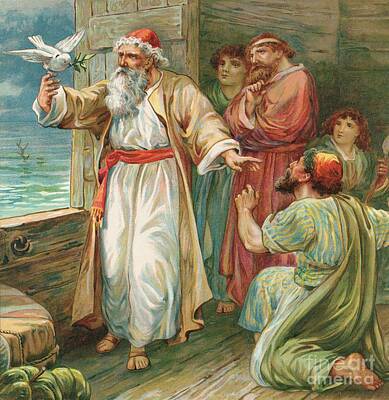 God flooded the world because it had turned from God, and become proud and corrupt, except for the family of Noah. God washed the infection of sin away by the waters of the flood and recreated the world anew. When the rain stopped, Noah sent a dove out, and it came back with an olive branch, and the olive branch is a symbol of the new creation—that creation has been restored, that new life has sprung up out of the waters of death that were the flood. In the Church’s blessing of the water for the sacrament of baptism, it makes reference to the importance of water in salvation history. It says, “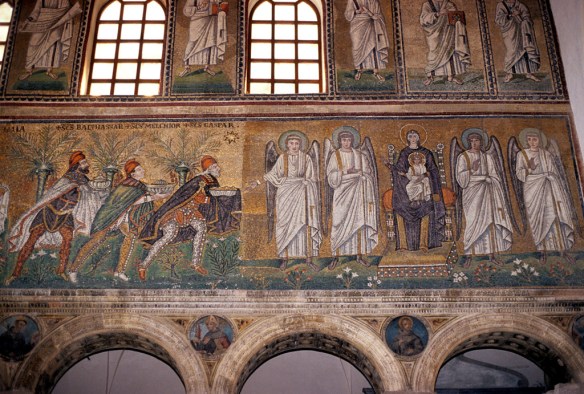
 So that, of course takes us to another point of our reading: the gifts. Matthew doesn’t say what the gifts mean, but scholars generally agree that gold represented Jesus as the great King. Frankincense, an incense used in the sanctuary, represented Jesus as High Priest, and the myrrh could mean that Jesus was anointed as the True Prophet, or it could also point to the anointing of Jesus for his death for the forgiveness of sins. Also, Matthew doesn’t say how many magi there were, or if it was just men. It could have been any number, and possibly men or women. We might remember the Queen of Sheba being a great admirer of King Solomon, and she brought him gifts in honor of his wisdom, and there is something much greater than Solomon here. So following the precedent set by the Queen of Sheba and Solomon, the magi could very well have been wise kings (but again, probably not, as Matthew probably would have said they were kings, rather than magi).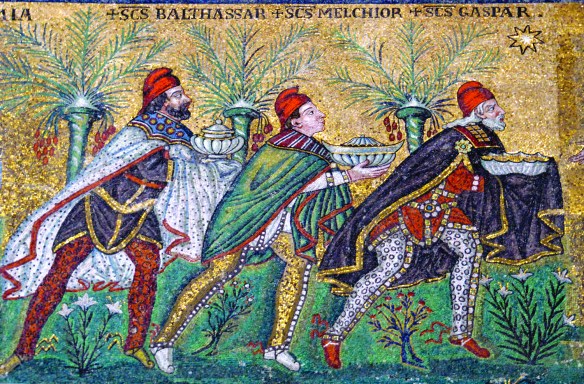

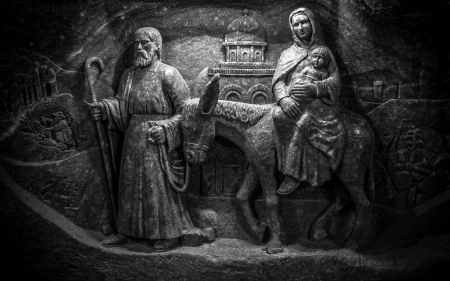

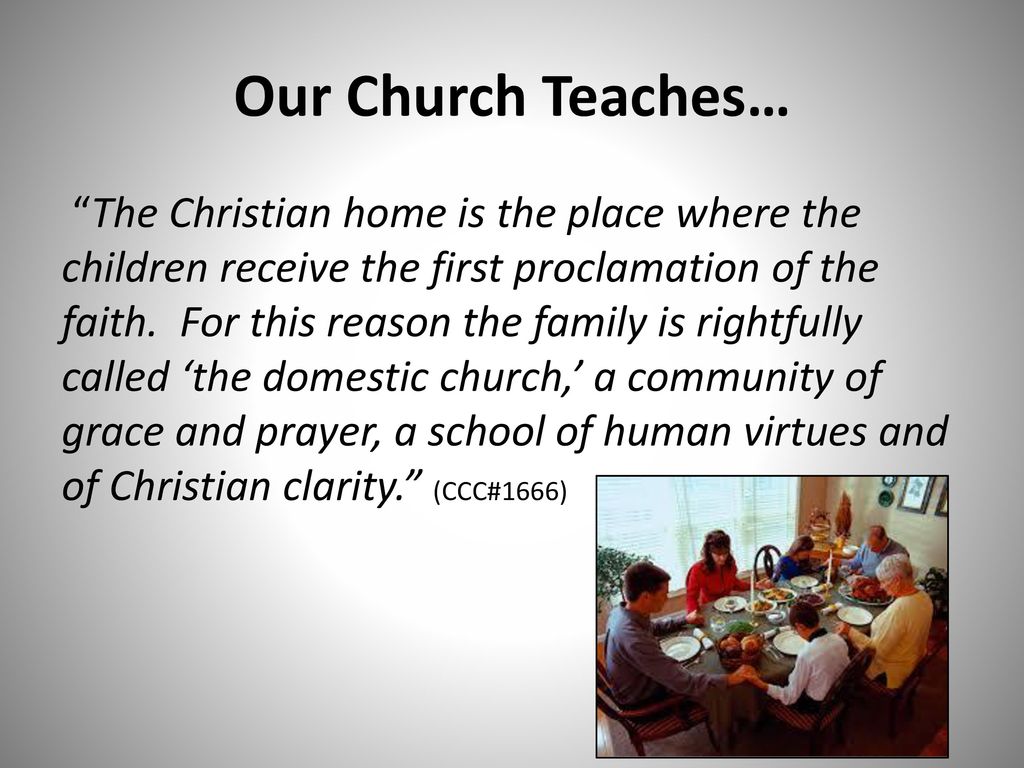 In today’s society, there are many sinister attacks on God’s plan for the family, both the holy family in the home, and the holy family of the Church (in other words, the hierarchical church, and the domestic church). Those sinister attacks come in the same form as the Enemy has always used: abuse, broken trust, lust, greed, and pride. If we are going to resist these attacks on the family, we need to increase our devotion to the Holy Family, especially to Saint Joseph, and ask for his intercession.







 The Jesse Tree in modern times is a beautiful Advent tradition, especially for children. Each day, a symbol from Old Testament history is put on the tree, starting from the bottom, starting with images from Genesis, and a little reflection is shared about the image. Each day another symbol is added, with the reflection about its importance, all the way up to Christmas eve, and the fulfillment of the Old Testament with the arrival of Jesus, the Son of David, Christ the newborn King.
 The Snarky Vicar