Unknown's avatar

About Fr. Steve Kelley

...is a happy Catholic Priest, ordained 2013 for the Diocese of Harrisburg. He is currently assigned as the pastor of Holy Trinity Parish in Columbia, PA. He started this blog to provide personal opinions, speculative theology, and commentary on various theological and social issues. "I ask that if you find anything edifying, anything consoling, anything well presented, that you give all praise, all glory and all honor to the Blessed Son of God Jesus Christ. If on the other hand, you find anything that is ill composed, uninteresting or not to well explained, you impute and attribute it to my weakness, blindness, and lack of skill." - St. Anthony of Padua

Homily: The Two Become One

the-sacrament-of-marriage

With gratitude to Christopher West, and his talk, “Marriage and the Eucharist.”

The question is asked, “Is there anything more beautiful in life than a boy and a girl clasping clean hands and pure hearts in the path of marriage? Can there be any thing more beautiful than young love?” And the answer is given. “Yes, there is a more beautiful thing. It is the spectacle of an old man and an old woman finishing their journey together on that path. Their hands are gnarled, but still clasped; their faces are seamed but still radiant; their hearts are physically bowed and tired, but still strong with love and devotion for one another. Yes, there is a more beautiful thing than young love: Old love.”


The crowds flocked to Jesus to be given healing and saving truth. The Pharisees made sure that they were there, too, to challenge Jesus’s credibility in the eyes of the people. John the Baptist had been imprisoned for criticizing Herod for his invalid marriage to his wife, and the Pharisees set up Jesus with a trap: either conflict with the Law of Moses or conflict with John the Baptist. “The Pharisees approached Jesus and asked, ‘Is it lawful for a husband to divorce his wife?’ They were testing him.So Jesus, knowing the point he was going to make, played them into the position of the losing side: “He said to them in reply, ‘what did Moses command you?’ They replied, ‘Moses permitted a husband to write a bill of divorce and dismiss her.’”

“For when Moses brought the children of Israel out of Egypt, they were indeed Hebrews in race, but Egyptians in manners. And it was caused by the Gentile manners that the husband hated the wife; and if he was not permitted to put her away, he was ready either to kill her or ill-treat her. Moses therefore suffered the bill of divorcement, not because it was a good practice in itself, but was the prevention of a worse evil.” (Pseudo-Chrysostom)

“Moses, however, was against a man’s dismissing his wife, for he interposed this delay, that a person whose mind was bent on separation, might be deterred by the writing of the bill, and desist; particularly, since, as is related, among the Hebrews, no one was allowed to write Hebrew characters but the scribes. The law therefore wished to send him, whom it ordered to give a bill of divorcement, before he dismissed his wife, to them, who ought to be wise interpreters of the law, and just opponents of quarrel. For a bill could only be written for him by men, who by their good advice might overrule him, since his circumstances and necessity had put him into their hands, and so by treating between him and his wife they might persuade them to love and concord. But if a hatred so great had arisen that it could not be extinguished and corrected, then indeed a bill was to be written, that he might not lightly put away her who was the object of his hate, in such a way as to prevent his being recalled to the love, which he owed her by marriage, through the persuasion of the wise. For this reason it is added, For the hardness of your heart, he wrote this precept; for great was the hardness of heart which could not be melted or bent to the taking back and recalling the love of marriage, even by the interposition of a bill in a way which gave room for the just and wise to dissuade them.” (St. Augustine)

So Jesus then plays his hand, which was to trump Moses’ concession to the hardheartedness of the Israelites with God’s revealed plan from the beginning: “Jesus told them, ‘Because of the hardness of your hearts he wrote you this commandment. But from the beginning of creation, God made them male and female. For this reason a man shall leave his father and mother and be joined to his wife, and the two shall become one flesh.‘”

Jesus is quoting from Genesis Chapter 2, which was our first reading. God formed Adam from the earth, and blew the breath of life into him. Adam, in his original solitude as the first human, recognized his existence, and his human dignity, and his relationship with God, all as gratuitous gift. However, he also recognized that, sharing in the image of God, his desire for love—to fully give himself and receive the other in return—could not be had with God, because God is infinitely more than Adam. And he also recognized that he could not completely give himself to any of the animals and receive all of themselves to him, because they were less than him. So when he awoke from his sleep and beheld Eve, he finally recognized another person like himself, with whom he could enjoy a true union of love—one whose nature and dignity and even physical form matched and complemented his own, and to whom he could give all of himself as a gift, and she could reciprocate and give all of herself as gift in return. Adam and Eve enjoyed the primordial nuptial relationship of pure selfless love, seeing each other as gift, naked and unashamed, because their hearts and eyes were pure. “Blessed are the pure of heart, for they shall see God.” They saw each other not as someone to possess, but as God’s gift of someone to give themselves to and receive the other in pure love.


It would be easy here to go into expounding on the Church’s rejection of divorce, which is rooted in the words of scripture—in this gospel, and in Luke, and Paul—and then soften that with the Church’s teaching on annulments, which is based on the exception found in the parallel sections in Matthew. The Church’s rejection of divorce is well-known, even if not well-followed. Instead of talking about what the Church is against, I want to explore what the Church is for—what is often called the Theology of the Body, based on the 5-year series of 129 homilies by Pope Saint John Paul II. The Theology of the Body is sometimes called the Church’s answer to the sexual revolution—the Church’s affirmation of the human person’s call to (and need for) profound love and affirmation and self-gift in the depths of his or her being.

Note: there is debate as to whether John Paul II was teaching the Theology of the Body magisterially—whether he was giving a reflection on Church teaching in his expertise as a theologian, or imparting this teaching as the office of pope. You will often see it presented as the teaching of John Paul II, but will stop short of calling it the teaching of the Church. Because it was presented in the usual place where all the faithful gather to hear the pope—the Wednesday audiences and Sunday angelus at St. Peter’s Plaza—and the audience that the pope had intended to receive these homilies was gatherings of the faithful from all over the world—it is reasonable to hold that Pope John Paul II intended to impart the Theology of the Body as a magisterial teaching of the Church. 


Human beings have a physical and spiritual nature. God and angels are not by their nature corporeal (having a physical body). Animals and plants are not by their nature rational and transcendent. We are the link between the physical world and the spiritual world. Our human nature is, in the general sense, sacramental—visible, physical signs of invisible spiritual realities. The human body makes visible the invisible mystery of who we are as persons, but because we are made in the image of God, our bodies also make visible something of the invisible mystery of God. What is the invisible mystery of God? God… is… LOVE. We often think that God is love because he loves us. That’s part of it. But God is love in the very relationship of the Father, the Son and the Holy Spirit. God is the living eternal exchange of love. We image God as individuals, through our rational soul, our understanding, our free will. But the union of man and woman in the intimacy of the marital embrace itself is the image of the eternal exchange of the Holy Trinity. The sexual union itself, properly understood, is an icon of the inner life of God.

The most widely used image the bible uses to help us make sense of God’s love for us, the favorite analogy of the great mystics of the Church? Not father and son, or shepherd and sheep, but as husband and wife—the bridegroom and bride. It begins with the creation of man and woman and their nuptial call to become one flesh. Throughout the Old Testament, God speaks of his love for his people as the love of a husband for his bride. In the New Testament, the love of the eternal bridegroom is literally embodied when the Word became flesh. Christ comes as the eternal bridegroom to give up his body for his bride, so that we might become one flesh with him. St. Paul, in Ephesians Ch. 5, quotes from our first reading, “For this reason a man leaves his father and mother and clings to his wife, and the two of them become one flesh.” And then he adds, “This is a profound mystery, and it refers to Christ and the Church.” Christ left his heavenly Father, he left his earthly mother, to give his body for his bride, so that we, his bride, might become one flesh him. Where do we become one flesh with Christ? In the Eucharist. “Take this and eat of it, this is my body.” Pope John Paul II says that “Christ in instituting the Eucharist, in some way wished to demonstrate to us the meaning of masculinity and femininity.” A guy’s masculine body—which is not merely a biological, incidental thing—it concerns the innermost being of his person—doesn’t make sense by itself. A woman’s feminine body doesn’t make sense by itself. But seen in the light of each other, we see a call to Holy Communion. What is the Eucharist? It is the Holy Communion of the Bride with Christ the bridegroom. It is the sacrament of the bridegroom and the bride.

“The Liturgy of the Eucharist has three important parts: the Offertory, the Consecration, and the Communion. In the order of human love, these correspond to the Engagement, the Wedding, and the Consummation of the marriage.” (adapted from Ven. Fulton Sheen)

Every time we worthily receive the Eucharist, we are given an invitation to unite ourselves to Christ. The minister of communion says, “the body/blood of Christ”, and we make our free consent, “amen.” We are consummating the nuptial union of the Bride and the Bridegroom! The consummation of that union by Christ was on the cross, when he said, “Consummatum est,” “It is consummated/accomplished/finished,” and fulfilled his words, “This is my body given up for you.” We receive and accept Christ’s offer of consummation in receiving communion in the Mass—when we unite ourselves to His body; when we consummate our participation (as bodily members of the Bride) and unite ourselves to the temporal, earthly celebration of the eternal, heavenly Wedding Feast of the Lamb and the Bride! 

Sexual union itself is meant to express the very love of God. How does God love? God’s love has 4 markers: It’s on the Cross, and it’s in the Eucharist.

  1. It is FREE. Jesus says, “no one takes my life from me. I lay it down of my own accord.” We know for love to be love it has to be free. One who is bound by sexual addiction, one whose consent is forced by circumstances, these are not free. If love is to be love and image God, it must be freely given.
  2. It must be TOTAL, unconditional. Jesus gives us everything that he is. He says to his disciples, “all that the father has given to me I have given to you.” Love requires trust, transparency, honesty, and selfless generosity.
  3. It must be FAITHFUL. I am with you to the end of the age.” “I will never leave you. I will never forsake you.” “The Lord says to his people, I have espoused myself to you forever.” The true freedom to be trustingly vulnerable—naked without shame—requires confidence in the unbreakable promise of the unconditional love of the other. Then the flower of deepest personal love has the security to blossom.
  4. FRUITFUL. Christ said, “I came into the world that my bride might have life, and have it abundantly.” Not every conjugal act, nor even every marriage, will necessarily be blessed with procreation, but the nuptial embrace itself as a total exchange between spouses is oriented toward the procreation of new life.

The nuptial union is not the only way to live the call to free, total, faithful, fruitful love. Priests and consecrated religious live this out in a more sublime but less visible way. Human marriage points as an icon to the heavenly reality of marriage—the wedding feast of the Lamb and His Bride—which itself is an outward expression of the inner exchange of love in the Trinity. Priests and consecrated religious don’t witness to us that marriage isn’t necessary—they witness to us that by forsaking the good of marriage in this life, by their ordination or consecration, they are living in this life the ultimate spiritual union of the saints in heaven. The heavenly communion of saints, a communion bound by the nuptial love of the Lamb (Christ) and his Bride (the communion of saints) is more perfectly united than even the most heroic human married couple on earth. Priests and religious strive to live that perfect spiritual communion out in this life, by the commitment and grace of their ordination or consecration. 

And if you know priests or consecrated religious, you can see those marks of divine love! They freely chose to respond to their vocation, and their vocation allows them to be radically free to follow the spirit unencumbered by duties to an earthly family. They live a total commitment to divine love, a life of profound prayer and service and availability to God. They remain steadfast in their promises and vows, bearing the cross of sexual abstinence and not having a human spouse, but glorying in their rich spiritual union with God, which has its own graces. And they are spiritually fruitful, pouring themselves out in the corporal and spiritual works of mercy, inspiring holiness and generosity, and inspiring in others a desire for the joy of their life, to those also called to priesthood and religious life.

Note: There is much more that can be said about the theology of the body, and about the nature of marriage and sexuality. With every homily, I get tormented with the question, “Of course you can’t say everything, but how could you fail to talk about  _______.”  In this broad topic, there is much that could culpably be put in that blank. But this is a homily in the Mass, it’s already too long, and some things are less appropriate to the Mass and more appropriate to a classroom setting, where the faithful may grow more intensely of their knowledge in a particular area of God’s Truth. 

The wedding vows are the commitment to love your spouse as God loves. This spousal love, this participation in divine love by the spouses, is meant to be expressed most concretely when the two become one flesh in celebrating their spousal covenant. If someone engages in sexual activity not in the spousal covenant (not in the sacrament of marriage)—or with artificial barriers to the full nature of the spousal exchange—then the act is to use the language of the body to speak a lie. The unitive faculty of the human body is designed to say to another, “I renew my love and my vow to give myself as gift to you, freely, totally, faithfully, fruitfully.” This is what the Church’s teaching of sexual morality is all about: speaking the divine truth through the language of the body: participating in the mystery of God’s love. Not only in the individual person, but in the union of husband and wife. The meaning of the human body is theological—it speaks of God, it makes visible the invisible mystery of God.

Horizontal Rule Cross

Homily: If it causes sin…

127-hours-tlr255b1255dIn 2003, in the beautiful mountains of Utah, a twenty-seven-year-old mountain climber named Aron Ralston made a desperate decision. Aron was rock-climbing when his right arm became trapped under an 800-pound boulder. He knew that he was in deep trouble. Unable to move the rock, Aron used his pocketknife and chipped away at the rock for 10 hours, with no success. His family and friends were used to his going off for days, so they weren’t looking for him. After days with no food or water, Aron decided to amputate his arm. And that’s what he did, using only a pocket knife. After he was freed, he applied a tourniquet to his arm and rappelled nearly 70 feet to the floor of the canyon. Then he hiked five miles where he encountered some other hikers and was rescued. Aron Ralston made the excruciating decision to cut off his arm to save his life. It reminds us, perhaps, of Jesus’ words from our Gospel reading for today, “If your hand causes you to sin, cut it off. It is better for you to enter life maimed than with two hands to go into hell.” Aron Ralston made a choice to leave a valuable part of himself behind, in order that he might survive.

Our gospel reading today has four related parts. The story we just heard relates to the fourth part. But our first reading gives us the lens for understanding the first part.

In our first reading, Moses complained to God that he was worn out from carrying the responsibility of leading God’s people through the Exodus, and arbitrating their disputes, and keeping up their spirits. Then we have our reading. The two men who began to prophesy apart from Moses were a scandal to Aaron. Moses responded that it was good that these two men also prophesied, and that this is not an occasion to be alarmed, but to rejoice—not just that these two received the gifts of the Spirit, but to hope and ask for all God’s people to receive and manifest the gifts of the Spirit.

In the Gospel, it’s similar, but a bit different. Someone not associated with Christ or his chosen disciples is casting out demons by the name of Jesus. The disciples are concerned—scandalized. If this stranger is proclaiming Jesus’ name in casting out demons, what else might he be claiming in His name? How do they know this man isn’t undermining Jesus’ truth and authority by false teaching? What right does he think he has to use Jesus’ name?

But like Moses, Jesus calms their fear, and tells them not to see this man as a threat. It’s not just the name of Jesus that casts out demons, but the faith of the one proclaiming the name. And if this man is able to cast out demons by his faith in Jesus’ name, then this man is not an enemy. He is one who has faith in Jesus, but has not yet received the fullness of His truth. But that will be fixed. Because Jesus knows that His death and resurrection are coming, and after that, the pouring out of the Holy Spirit at Pentecost. Jesus says, “When I am lifted up, I will draw all men to myself” (Jn 12:32). The faith that allows this stranger to be casting out demons in Jesus’ name will draw the man by that same faith to the ministry of His Apostles, given their own charism to discern and direct the gifts of the Spirit in service to the Body of Christ, for the glory of God and the salvation of souls. In connecting this story with our first reading, the lectionary is emphasizing this as a foreshadowing of the outpouring of the gifts of the Holy Spirit… and… the importance of knowing that the Spirit will not act as we expect. It requires the discernment by the Church to distinguish between the work of the Holy Spirit, which propels the church and the world forward in God’s plan, and the work of some other spirit, which brings chaos and confusion. Jesus, as the New Moses, wants all the people of God to manifest the gifts of the Holy Spirit; not just Church leaders, but all the faithful who profess and believe in the Holy Name of Jesus.

Imagine the Church—all Christians—so on-fire with the Holy Spirit that even just a passing encounter with the Church—a small kindness like a drink of water—would be enough to plant the seed of conversion in someone. We are afraid to let that power of the Holy Spirit run loose in our lives. But as Pope Saint John Paul often repeated the most repeated phrase throughout the scriptures: “Do not be afraid!”

The third part of our Gospel reading is quite relevant to our modern situation. “Whoever causes one of these little ones who believe in me to sin, it would be better for him if a great millstone were put around his neck and he were thrown into the sea.” Little ones doesn’t just mean children, but spiritual children—innocent disciples, new Christians, the simple faithful who can be easily scandalized, panicked, and can be scattered like startled sheep. The Church provides what is necessary for salvation. And so those, who by the scandal they create, cause the faithful to wander from the Church and jeopardize their salvation, Jesus uses a very strong and memorable image for us to keep in mind. If having a giant millstone tied around your neck and being cast into the sea doesn’t sound like fun, that’s the better alternative to what awaits those who cause scandal to the little ones of the Church.

The fourth part of the gospel: “And if your eye causes you to sin, pluck it out. Better for you to enter into the kingdom of God with one eye than with two eyes to be thrown into Gehenna, where ‘their worm does not die, and the fire is not quenched.’” We don’t like to hear about hell. But no one in the Scriptures mentions hell more often than the Word of God himself, Jesus. So it’s important, of eternal consequence. So we should talk about it.

“Many centuries ago, the Canaanites used to perform their liturgies of human sacrifice, their infanticidal devotions, to the devil (in the personage of Moloch) in the valley of Gehenna, or Gehinnom, just outside Jerusalem. It was a vast abortuary. When the people of God entered the Promised Land, God commanded them to kill the supernatural cancer of the Canaanites. Even after that was done, the Jews dared not to live in that valley, and barely even set foot there. They used it to burn their garbage. So the devil’s promised land became God’s garbage dump. And the fires never went out, day or night. Jesus chose this place, Gehenna, as his image for hell. And he told many of the leaders of his Chosen People that they were headed there, and that they were leading many others there with them.” (Peter Kreeft)

I am the target text.

First, I think it would be helpful to talk about the dominant religion in Western society. It’s called, “Moralistic Therapeutic Deism.” This term comes from a 2005 report called “Soul Searching: The Religious and Spiritual Lives of American Teenagers.” No one would identify themselves as adherents to this, but it is functionally the belief system of a large swath of our culture. The five central beliefs are: (1) a god exists who created and ordered the world and watches over human life on earth; (2) God wants people to be good, nice, and fair to each other, as taught by most world religions; (3) the goal of life is to be happy and feel good about oneself; (4) God does not need to be particularly involved in one’s life except when needed to resolve a problem; and (5) Good people go to heaven when they die.

It’s called moralistic because it places high value on “being good.” But “good” is defined by the opinion of secular culture and by not the revealed truth of Christian Faith. So tolerating things the Church calls sin can be seen as “good,” if it makes people feel good about themselves; while calling those things “sinful” is seen as bigoted or intolerant, which is bad.

It’s called deism because God is little more than cosmic roadside-assistance—you can call Him when you’re stuck, but it would be awkward to get too familiar with him. (Technically, it’s “theism” and not “deism,” as deism is a rationalistic belief in a “watchmaker” god who set everything in motion and does not interfere.)

And it’s called therapeutic because the most important thing is to be a basically good, nice person, and you go to heaven. Everyone goes to heaven, all your uncles and mothers and friends; everyone who isn’t literally Hitler.

So (1) there’s no point in talking about hell, (2) all religions are basically the same, (3) 40 years of promoting self-esteem means everyone sees themselves as basically destined for heaven, and (4) the teenagers at the time of this 2005 report are now in their late twenties and thirties, with children of their own, who don’t see the urgency in baptizing their children, or going to confession, or just going to church; and if they go to church, see themselves as good enough people to take communion, regardless of church teaching, which, if it makes you feel bad, is bad. That’s the dominant religious perspective of Western society, even among many of those who go to Church on Sunday.

Combine that with the relativism, hedonism, and narcissism of modern culture, and you have what older people are complaining about when they compare today with the world they grew up in. It’s not that there wasn’t sin. But it was acknowledged as sin, treated as sin, and feared as the real possibility of losing one’s soul to eternal damnation.

It’s not that God created hell to punish people. People have the free will to reject humility and forgiveness, even to the very end—to refuse to acknowledge their sin as sin. We can create habits of willfully choosing other things over God. And we can lead others—little ones—to do the same.

Nobody talked about hell more than Jesus Christ. Because he knows what hell is, and he wants us to avoid the eternal spiritual and physical pains of hell—the chief of which is eternal separation from God, who is love, light, truth, goodness, and beauty.

Of course, lopping off your foot or your hand or your eye won’t help, if it’s your heart—your soul—that is diseased and disordered. It’s not your eye, but how you look at others, and what you look at. It’s not your hand, but what you do (or fail to do) with it. If Jesus, through the Scriptures, and the Sacred Tradition of the Church, says sin matters, then I for one choose to live like it matters.

Horizontal Rule Cross

Homily: Spiritual Greatness

jesus-suffers-the-little-children-to-come-unto-himIn last week’s gospel, Jesus gave his disciples the first real insight into his mission as a messiah—not to overthrow the Romans by his victorious army of angels, but to overthrow Satan by his victorious crucifixion and resurrection. Peter rebuked Jesus for predicting his crucifixion and resurrection, and Jesus in turn rebuked Peter for thinking not as God does, but as the Flesh does.

In today’s gospel reading, Jesus gives his second prediction of the cross. It says “He was teaching his disciples and telling them, ‘The Son of Man is to be handed over to men and they will kill him, and three days after his death the Son of Man will rise.’ But they did not understand the saying, and they were afraid to question him.” So after two out of the three predictions of His death and resurrection, and they still don’t understand. As St. Bede says, you can kind of feel for them, because Jesus often speaks in ways difficult to understand, and he speaks in parables and figures, so maybe this is a metaphor. But they’re afraid to ask.

I’ll point out here that when Jesus predicts his death, he always follows it with the prediction of his resurrection. Many people like to focus only on the resurrection—the empty cross—but in the mind of the Church, the two are inseparable. The cross by itself does not necessarily communicate the crucifixion, but the crucifixion absolutely leads to the resurrection. So we venerate the crucifix; first, as a sign that Jesus shares in our suffering, in our calling out when we feel abandoned in our darkness; and second, as the hope and promise that our suffering leads us, with Him, to the resurrection, and the grace of redemption, joy, and new life.

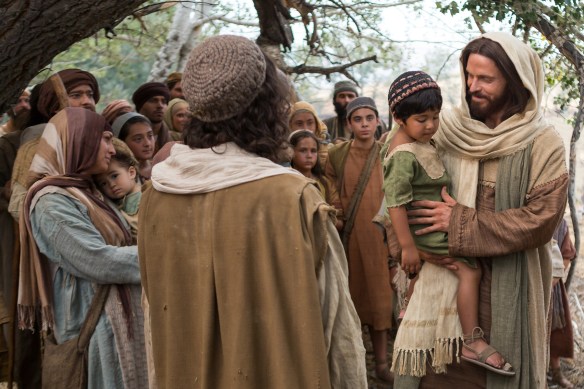
It seems in our Gospel reading that the disciples didn’t understand Jesus’ teaching about the death and resurrection, and so they just changed the subject and started talking about something else. And maybe in their minds, that was true. But Jesus uses it to further explain what kind of Messiah he is, and what he’s ultimately trying to teach them. Jesus said to them: “‘if anyone wishes to be first, he shall be the last of all and the servant of all.’ Taking a child, he placed it in their midst, and putting his arms around it, he said to them, ‘whoever receives one child such as this in my name, receives me; and whoever receives me, receives not me but the One who sent me.’”

[The Greek word being used there for “child” (paidion) literally means “little child.” However, there is reason to suggest that the person Jesus drew their attention to was a new disciple, a “little child” in the faith; one whose faith was still young and innocent and impressionable; one who was very aware of their humble dependence on the more experienced disciples to guide them, to invite and include them; one who could be easily confused and scandalized; one who recognized their need to be helped a great deal in continuing to develop their faith to bear fruit in the challenging situations of life.

Whether Mark was referring to a little child in the flesh or a little child in the Spirit,] the point Jesus is making is that greatness in spiritual terms is different than greatness in worldly terms. If you want to be great, seek out the needy, the vulnerable, the wounded, and the lowly, show them God’s abundant love for them, and you will be great.

Of course, there’s the old proverb, “You cannot give what you do not have” (“Nemo dat quod non habet.“) You cannot show them God’s abundant love, if you don’t know what that feels like; if you haven’t experienced it yourself. And that you can only experience by seeking his love first and above all things; to put your time of scripture and contemplative prayer at the top of your list, each day, and make sure you do it, each day. And, if possible, participate in the Mass, each day. And then, with your heart filled with gratitude for God’s love for you, fill every moment and every encounter with others in your life with bringing that love to others—especially those who most need help in the way of encouragement, hope, and meaning in their present difficulties.

Reading Sacred Scripture is not about covering a lot of territory–a mile long and a half-inch deep. It’s about plummeting the infinite depths of the mystery of the Inspired Word, which speaks to every soul in every generation, for those who have eyes to see, and ears to hear, and hearts to understand (Mt 13:15).


At this point in writing my homily, I still had about three pages left of white space. And I decided, instead of talking about the other readings as usual, we’re going to walk through an ancient approach to contemplative prayer with scripture, called lectio divina (divine reading), using the first half of the second reading, which is a good length of text for this kind of approach. Hundreds of years of Benedictines and Carmelites and many others have used and refined this approach to contemplative prayer with the Sacred Scriptures.

Lectio divina has four main steps.

1. LECTIO (TO READ)

The first step is lectio (reading), and so we read through the text, ask, “What does the text says in itself? What is its literal meaning as a text?” So we read our text: “Where jealousy and selfish ambition exist, there is disorder and every foul practice. But the wisdom from above is first of all pure, then peaceable, gentle, compliant, full of mercy and good fruits, without inconstancy or insincerity. And the fruit of righteousness is sown in peace for those who cultivate peace.” So you would take a few minutes, five or ten (or fifteen if you’ve got a lot of patience), and ask, what is being said on the literal level?

For example, we might look at a commentary to give us the context of the letter, and some textual notes that help us understand any particular phrases or references. James (who is probably not one of the disciples named James, but another James) is giving correction to the Christian community (perhaps a particular city community, or to all the communities generally, who might be) torn by sins of jealousy and prideful ambition, which lead to disorder, distress, and tension in the community. But James reminds them that divine wisdom grants firstly purity of heart, then secondarily peace, gentleness, and mercy; and yields good fruit in those who consistently promote peace. So seeking and following divine wisdom in humility, respect, and order, is what will heal the division and tension that the community is suffering. That’s an example of the first step.

2. MEDITATIO (TO MEDITATE)

The second step is meditatio (meditation), and we ask, “What does the biblical text say to me? What jumps out at me from my experience, my perspective, my personality, my life, right now?” and we read through the text again: “Where jealousy and selfish ambition exist, there is disorder and every foul practice. But the wisdom from above is first of all pure, then peaceable, gentle, compliant, full of mercy and good fruits, without inconstancy or insincerity. And the fruit of righteousness is sown in peace for those who cultivate peace.”

Looking over the text, I might say, among other things, that I want to be peaceable, gentle, full of mercy and good fruits, so for that I need to receive wisdom from above, which is first of all pure, and constant, and sincere. So I need to practice these virtues if I want to bear those fruit in my soul.

You might read this and see the word, “compliant,” and that might stir up some resistance in you. I’ll give you a great piece of wisdom: if you encounter something in the scriptures that really rubs you the wrong way, or really goes against what you think or feel, that is a great part of the text to zero in on. I’ve found that something in the divine word that is most not like me is often where I can score a lot of growth—in understanding the scriptures, in growing in virtue, or growing in humility, and for having a piece of scripture rattling around in my head for a good bit of time while I wrestle with it. So, for example, if seeing that word “compliant” stirred up something in you like, “nah, that’s not me,” then here’s your sign.

3. ORATIO (TO PRAY)

The third step of lectio divina is oratio (prayer), and we read through the text again, with the question, “What do I say to the Lord, in response to His Word?” “Where jealousy and selfish ambition exist, there is disorder and every foul practice. But the wisdom from above is first of all pure, then peaceable, gentle, compliant, full of mercy and good fruits, without inconstancy or insincerity. And the fruit of righteousness is sown in peace for those who cultivate peace.”

Maybe I say, Lord, you have revealed that it is the gift of your wisdom from above that grants these qualities—and so the gift is first from you, and so I ask you to grant me the gift of your wisdom, and then help me to respond to it fruitfully, and be a good steward of it. You know I get angry quickly, and I’m reminded that I need your help to be gentle, which is more of the kind of person I want to be.

4. CONTEMPLATIO (TO CONTEMPLATE)

And the fourth and last step in the traditional lectio divina is contemplatio (contemplation). Now we ask, “What conversion of mind, heart, and life is the Lord asking of me?” And we read the text again, building on all that we’ve picked up through the previous steps, and listening for our call to deeper conversion: “Where jealousy and selfish ambition exist, there is disorder and every foul practice. But the wisdom from above is first of all pure, then peaceable, gentle, compliant, full of mercy and good fruits, without inconstancy or insincerity. And the fruit of righteousness is sown in peace for those who cultivate peace.” We sit with the text, and chew on it, listening and discerning, zeroing in on God’s personal and particular guidance to us in this present moment in our lives.

And this is contemplative prayer—we’re not rambling with our words, but listening with discipline and desire in our hearts for God speaking to us through his Word, inviting us more deeply into relationship with Him, helping us to be more like Him, inviting us into a greater share in His life.

When we reach this step, we can simply sit, wordlessly basking in God’s love for us, and our communion with Him, growing in love for Him, and our experience of His love for us. It won’t necessarily happen every time, especially at the beginning. But that’s an unmerited gift—contemplative prayer—and the goal of the spiritual life.

I might be receiving the word, “gentle” in a special way. That God, who is the gentle, Good Shepherd, is calling me to chew on that word, “gentle,” as God reveals to me his desire for me to share in his virtue of being gentle, patient, and peaceful; slow to anger. What would that look like in my life? What change(s) do I need to make? How do I avoid failing to be gentle, reacting with my habitual, hair-trigger temper? What upcoming conversations might I go into preparing and reminding myself to work on being gentle? I ask God to help me to remember to ask for His intervention, especially when I most need it.

[I purposely used the phrase of “chewing on the Word,” to make reference to the “Bread of Life Discourse of the Gospel of John, chapter 6. One of the things that Catholics will often point out (but which I don’t believe is a strong argument), is that Jesus says, “whoever eats (phago) this bread will live forever; and the bread that I will give is my flesh for the life of the world.” (John 6:51). Here, Jesus uses the common Greek word for “eat.” It’s also the word used in the Greek for Ezekiel 3:1 and Revelation 10:9 for “eating the scroll” and then prophesying. But phago can be taken loosely, like we use the word, “eat” (e.g., “eat your heart out”). Then Jesus goes deeper: “Whoever eats (trogon) my flesh and drinks my blood has eternal life, and I will raise him on the last day.” (John 6:54). Jesus changes the word for eat from the common phago to the very explicit trogon—to gnaw, crunch or chew. The argument is made that this proves Jesus means to eat his flesh, and thus his real presence in the Eucharist.

I don’t think this argument is as effective as many Catholics think it is (and clearly most Protestants don’t either). Now don’t get me wrong—I absolutely believe in the real presence of Jesus in the Eucharist! But lectio divina is a great example of taking the time and “chewing, gnawing” on the Word of God, and diving deeply into God’s truth for our salvation and abundant life. Jesus is both the Word on the altar and the Word on paper. We eat Him with both our minds and our bodies, by the Truth of Heaven in our ears and the by the Bread of Heaven in our mouths (the Liturgy of the Word and the Liturgy of the Eucharist).] 

5. ACTIO (TO ACT)

Some approaches to lectio divina add a fifth step, actio, action, in which we ask, “How can I put this into practice in my life, in love of God and my neighbor?” And we would read through the text again, and pray about it the rest of the day, asking for God’s guidance in incarnating in our flesh the spiritual growth he has granted to us.

  1. Read – What does the text say in itself?
  2. Meditate – What does the text say to me?
  3. Pray – What do I say to the Lord in response to His Word?
  4. Contemplate – What conversion of mind, heart, and life is the Lord asking of me?
  5. Act – How can I put this into practice in my life, in love of God and my neighbor?

So this (lectio divina) is probably the most common way for beginning the practice of contemplative prayer, for growing in gratitude and joy for his blessings and his call to you as his beloved child. Grow in the discipline of doing this every day, and there is no measure to how it will change your life, because there is no measure to God’s love for you, and for the path of holiness.

You cannot show them God’s abundant love, if you don’t know what that feels like; if you haven’t experienced it yourself. And that you can only experience by seeking his love first and above all things; to put your time of scripture and contemplative prayer at the top of your list, each day, and make sure you do it, each day. Acquire this habit of contemplative prayer (particularly if it is united with the habit of daily communion), and you will be brimming over with God’s love to share joyfully with others. Do this, and you will be great.


Image result for lectio divina

Horizontal Rule Cross

Homily: Pick up Your Cross

PickUpCrossImage

We continue through this year’s [Year B of the Lectionary] journey through the Gospel of Mark, with occasional side-trips into the gospel of John. Today in the gospel of Mark we have some difficult themes—difficult for those first disciples, and difficult for us current disciples.


In the first part of the gospel reading we have the dialogue we all know pretty well: Jesus asks his disciples who the people say that he is. They said in reply, “John the Baptist, others Elijah, still others one of the prophets.” So there is this common impression that Jesus is more than just an ordinary person; that he is perhaps the incarnation of some great person of Israel’s history. And that’s not completely wrong. He is the incarnation of some great person of Israel’s history—he’s the incarnation of the God of Israel!

Image result for The Jesus Question (CD)

So Jesus asks the disciples to put it on the line. And he asked them, “But who do you say that I am?” The people know that Jesus is something special, but they’re not sure what. So he turns to those who he has hand-picked and trained and taught and spent time with, and he wants them to put their faith into words: “Who do you say that I am?” Matthew Kelly calls this, “The Jesus Question,” one of the most important questions we might grapple with, and we all have to answer it: Who do you say that Jesus is? Peter says in response: “You are the Christ.” We’re more familiar with the version in Matthew, in which Peter says, “You are the Messiah, the Son of the living God.” And in Matthew, Jesus affirms Peter’s faith, and says that Peter is the Rock, and on this rock he will build his church. But here in Mark, the call to faith (the call to answer “The Jesus Question,” and respond to it) is more brief and urgent.

In the second part of the gospel reading, Jesus makes his first prediction of the cross. In the Gospel of Matthew, also, Peter’s confession of faith in Jesus as the Messiah is immediately followed by Jesus explaining what that means. It doesn’t mean that he’s going to be the messiah-king who leads the angelic army to vanquish the Romans and liberate Israel. Jesus is here to defeat a much more powerful enemy than the Romans. Jesus is here to defeat Satan, the enemy of human nature and the ultimate plan for humanity, which is communion into the life of God. Satan’s evil plan in Eden had the effect of introducing suffering and death (mortality) into humanity. And in a plan of divine brilliance, God is going to pull off the perfect reversal: becoming human, enduring suffering and death, and defeating Satan using the effects of his own evil plan against him. Satan thinks that the cross and the death of Jesus is his ultimate victory, when it’s truly his perfect and ultimate defeat!

Peter thinks this is not a good plan, and so he pulls Jesus aside and rebukes him. I don’t know if I’d call that courage, but it’s something. And, “at this [Jesus] turned around and, looking at his disciples,” Jesus rebukes him back: “Get behind me, Satan. You are thinking not as God does, but as human beings do.” Peter is acting out of our human nature–to see suffering as something always to be avoided whenever possible. Remember, Satan is the great Tempter. The temptations Jesus endured from Satan in the wilderness were about accomplishing his mission while avoiding the cross, avoiding God’s plan for humanity’s salvation. And now Peter tempts Jesus away from the way of the cross. Peter echoes Satan’s temptation. But Jesus is not following his own plan. He’s following the Father’s plan, and Jesus is perfectly obedient to the Father. The cross is the way, the only way, for Jesus to accomplish the fullness of his mission, his purpose. He must—and will—endure the cross.

And that transitions us into the third part of the gospel reading. Jesus had been talking to the Twelve, and then, “He summoned the crowd with his disciples and said to them,Whoever wishes to come after me must deny himself, take up his cross, and follow me.” We ALL must endure—not just endure, but embrace—the cross. If we try to avoid the suffering of the cross, the suffering will come to us anyway, but without any salvific value: sterile, fruitless suffering. But… if we embrace the suffering with the cross, then we unite our suffering to the suffering of Christ on the cross, and then it becomes the instrument of uniting us to the source of life and grace. A faith tradition cannot survive long (certainly not thousands of years) without offering a meaningful way to grapple with suffering. If there’s no meaning to suffering, it makes perfect sense to avoid it at all costs–like Peter tried to get Jesus to do. But Jesus understands that his suffering is going to be universally meaningful–and that through it, he is going to make all human suffering meaningful. The door to the healing and joy of paradise has a cross-shaped key-hole. You have to accept the cross of death to receive the promise of resurrection. You have to go through Good Friday to get to Easter Sunday. And that, my friends, is the scandalous, challenging, humble, beautiful heart of the Christian faith. Deny yourself, pick up your cross, and follow Him.


Deny yourself….

How should we deny ourselves? Well, Peter found out God’s plan, took him aside and said, “No, that’s not a good plan, here’s how it’s going to happen instead.” Do we ever do that? Do we overrule God’s instructions, and law, and plan, and instead choose our own desire, our own law, and our own plan? That’s not denying ourselves, that’s denying Him, and setting ourselves up against Him. Denying ourselves is accepting God’s laws, communicated to us through Sacred Scripture and Sacred Tradition. It is saying “no” to the attachments, addictions, and actions that are sinful, or that we want in a sinful, disordered way. It is putting our plans for our busy day on hold, and taking time to pray. It is accepting the truth we don’t want to. It is doing the things we know are right but don’t want to. It is meeting our responsibilities, our debts, our obligations—as parents, as students, as employees, as spouses, as Catholics. It is the virtuous habits of humility, self-gift, generosity, and piety.

Deny yourself… Pick up your cross…

How do we pick up our cross? During Christ’s Passion, Peter denied even knowing Jesus. But in his ministry after Pentecost, then filled with the Holy Spirit, Peter accepted the importance of his role as a Christian leader, and was filled with the selfless love for God and for His people. Then he willingly accepted the cross. Picking up our cross is the many ways in which we accept not getting our way, and not doing what we want. To borrow a phrase from Fr. Thomas Richter, in his brilliant message on Trust in the Lord, picking up the cross is where ever, if we had a magic wand, we would wave it and change something about ourselves or our life. (NOTE: That doesn’t mean an abdication where we can rightfully act to improve the situation; it means an act of the will to accept where God’s will is different than ours.) We can take up our suffering, and invite Jesus into our lives through that union of the same suffering, and we–struggling with our weakness–are filled with the power of his divinity. Our suffering is our portal into union with God, if we pick up our cross and suffer with and for Him, as he did for us. Picking up our cross is also accepting our mission to be a confusing contradiction, a foolishness, to worldly wisdom, and to embrace the life of grace, and the suffering–persecution, mockery, rejection–that comes from living one’s faith in Jesus Christ.

Deny yourself… Pick up your cross… and Follow Him.

How do we follow Him? Look at our first reading, from St. James, who says: “If a brother or sister has nothing to wear and has no food for the day, and one of you says to them, ‘Go in peace, keep warm, and eat well,’ but you do not give them the necessities of the body, what good is it? So also faith, of itself–if it does not have works, [what good is it? It] is deadDemonstrate your faith to me, without works, and I will demonstrate my faith to you from my works.” The Scriptures repeatedly emphasize that however you are able to do so, in the context of your life, your faith must bear good fruit–in your choices, in your words, in your love toward God and toward others.


Image result for amazing loveThat’s the key: love at work in us. When people are in love, they go to ridiculous lengths to show it! When we give ourselves over to the inspirations of love, we will deny ourselves all kinds of things, and give generously of ourselves in all sorts of ways. We will endure and embrace all sorts of suffering for love. As crazy full of love as we can be as young people, we are called to be infinitely more so for God, and for everyone (that’s the love–the communion of saints–of heaven!) So, completely overfilled with love, we follow Christ. How? By following his example—as priest, prophet and king.

  • as priest, to embrace our royal/common priesthood to offer sacrifice and prayer for the praise and glory to God, and for the salvation of souls; being a living witness to the universal call to holiness;
  • as prophet, to speak the truth, in season and out of season (whether it’s a message that may be accepted, or a message that may be criticized); to live, share, defend, and suffer for the truth that sets us free;
  • as king, to lead through serving others; to be great by being small, to perform the corporal and spiritual works of mercy:

works of mercy


A faith without these fruits of good works will not save us.
These good works done without faith will not save us.
These good works as the fruit of our life of faith and love for God through Jesus Christ: that is the faith that bears fruit and that saves.

Deny yourself, pick up your cross, and follow Him.

Horizontal Rule Cross

Homily: Jesus and Tradition

Catholic Tradition

“Tradition is not the worship of ashes, but the preservation of fire.” Gustav Mahler

Tradition is essential for any family, community, or society to survive. Tradition literally means, “to hand on,” to hand on to the next generation the wisdom, culture, resources, and knowledge from the previous generation. This is of course extremely important for the survival of the group and its members: you have to know where to find food, where the dangers are, what works and what doesn’t, and then, what’s good, true, and beautiful that makes life meaningful and more enjoyable. It also means handing on traditions of great inspiring figures of the past, the stories that bind us together: of where we come from, and why we’re here, who we are, why things are the way they are, and where we believe we’re going. Tradition helps us to understand our role in the great drama of the story of the world, and what might be beyond it.

But each generation also has the task of discerning the value of particular traditions, if something should be added, changed or dropped. Dr. Jordan Peterson, a Canadian psychologist, and author of Twelve Rules for Life, has a 15-part lecture series on the psychological wisdom of the stories in the Book of Genesis. Such things as man’s courageous venturing from the known to the unknown, living by the rules of the world, the importance of sacrifice, being prepared for the looming potential disaster, why the great enemy in tradition is a dangerous serpent, and the practical effects of the Fall from Eden. Peterson, who doesn’t publicly identify himself as a Christian (although he says he was brought up as one), strongly warns against dismissing the biblical stories as  simplistic superstition, but rather (whatever else they might also be) they are fundamental wisdom handed on through highly developed stories, which have the power to teach the most important truths of humanity.

So tradition is important, but not the most important thing. Tradition is a means to an end, and the most important thing, the end, is the overall success of human flourishing, individually and communally. Not just the biblical stories of Genesis, but also the biblical law in the other early books, were understood as the instruction book for human life, given by the author of life. Moses says to the people in our first reading, “Israel, hear the statutes and decrees which I am teaching you to observe, that you may live… In your observance of the commandments of the LORD, your God, which I enjoin upon you, you shall not add to what I command you nor subtract from it. Observe them carefully, for thus will you give evidence of your wisdom and intelligence to the nations, who will hear of all these statutes and say, ‘This great nation is truly a wise and intelligent people.’”

Tradition is important, but not the most important thing. Tradition is a means to an end, and the most important thing, the end, is the overall success of human flourishing, individually and communally.

And so that sets the stage for our theme today: the role of Tradition in relation to the Law. As a little background to the Gospel Reading, the Pharisees were a popular subset (a sect) within Judaism whose intent was to promote the holiness of the people of Israel. They took the ritual holiness codes in the Law that applied to priests preparing to enter the Temple to offer worship, and then they applied those codes to everyone in everyday life. You can see the good in that—because you can see the hypocrisy of living one way on the Sabbath and then a life inconsistent with that the rest of the week, or the hypocrisy of those who appeared to be good holy men on the outside, but their interior life was disordered, abusive, and selfish. The intent of the Pharisees was to set up a protective barrier around the Law, so that even if you sinned against the traditions of the elders (the Pharisees), you won’t necessarily have broken the Law of God. The problem was that eventually the traditions of the elders became detached from (and more important than) the Law of God, and traditions developed which even contradicted the requirements of the Law, because the spiritual heart of the traditions of the elders was not the same as the spiritual heart of the Law of God. The result was the very pharisaic hypocrisy the traditions were supposed to prevent.

One difference between these two sets of laws concerned ritual washing of hands. The law only required ritual hand washing of the priests going into the temple. But the tradition of the elders required ritual hand washing of everyone in all sorts of circumstances. The Pharisees asked Jesus, ‘Why do your disciples not follow the tradition of the elders but instead eat with unclean hands?’ Jesus responded, ‘Well did Isaiah prophesy about you hypocrites, as it is written: ‘This people honors me with their lips, but their hearts are far from me; in vain do they worship me, teaching as doctrines human precepts.’ You disregard God’s commandment but cling to human tradition.’”

Now, the lectionary skips a section here. Jesus gives an example of what he’s talking about, and he refers to the tradition of “quorban.” Quorban meant a thing that was dedicated to God. The Pharisees were using this tradition to claim their possessions and property were reserved for God, and therefore could not be used as resources to support and take care of their mother and father in their old age. So the Pharisees had added this human law, quorban, to subtract from the law of God, the fourth commandment to honor father and mother.

Jesus ends that section by saying, “You nullify the word of God in favor of your tradition that you have handed on. And you do many such things.” And then our gospel reading picks up with the next verse, “He summoned the crowd again and said to them, “Hear me, all of you, and understand. Nothing that enters one from outside can defile that person; but the things that come out from within are what defile.” And then in the end of the reading, Jesus gives a rather impressive list of the things that defile.

[Not part of the Sunday Homily: Our English translation renders these:  evil thoughts, unchastity, theft, murder, adultery, greed, malice, deceit, licentiousness, envy, blasphemy, arrogance, folly. Courtesy of Dr. Brant Pitre (on whose reflection much of this homily is based) and Dr. John Bergsma, I would like to give a brief unpacking of these things that defile the heart, based on the Greek words as given in the Scriptures:

  • hoi dialogismoi hoi kakoi  “evil thoughts” or “evil deliberations.” It doesn’t mean an involuntary thought. It means evil plans or evil designs. This is something that is voluntary; hatching an evil plan.
  • porneiai, “sexual immoralities,” any intentional use of one’s sexual nature (in thought, word, or deed) apart from the nuptial act in the context of the nuptial, matrimonial covenant. Obviously there’s a lot more that can be said here, perhaps we’ll talk about that later.
  • klopai, “thefts,” from the same root from which we derive “kleptomaniac.” 
  • phonoi, “murders,” intentional killing of an innocent person. 
  • moicheiai, “adulteries,” specifically sex (or more generally, a tempting relationship) between two people not married to each other, when one or both of them is married to someone else. This is more grave than fornication, because it is fornication that also sins against the promise of faithfulness in the marriage promises.
  • pleonexiai, “greeds, avarices,” ‘a strong desire to acquire more and more material possessions or to possess more things than other people have, all irrespective of need’ This is not a condemnation of wealth, but the disordered lust for wealth that leads one into other sins
  • poneriai, “evils,” a general term, related to the term for the Devil, ‘o poneros, the “Evil One.”
  • dolos, “lying, deception, trickery, falsehood.”
  • aselgeia, “perversion, godlessness,” living without any prayer, worship, or thought of God, living in a (depraved) manner oblivious or rebellious to God’s goodness
  • ophthalmos poneros, “evil eye,” in this context, looking upon the goods (personal qualities or possessions) of another with evil intent (related to greed, also related to uncharitable thoughts toward those who have what one is envious of)
  • blasphemia, “blasphemy,” a verbal attack on a person’s reputation, name, or dignity, whether a human or divine person. (rash judgment, detraction, calumny, slander)
  • huperephania, “pride, arrogance, haughtiness,” self-aggrandizement, self-centeredness, narcissism
  • aphrosune, “foolishness,” thoughtlessness, imprudence, rashness, recklessness]

What makes a person clean and righteous is not a matter of exterior washing of hands, but a matter of interior cleansing of the heart.

We sometimes fall into the popular error that Jesus came and abolished all those impossible-to-keep requirements of righteousness, and streamlined it all into the simple, Love God and Love One Another, and it’s so much easier now. But over and over we see that Jesus didn’t make it easier—he gives us the difficult, narrow way. It’s a lot easier to wash your hands than to cleanse your heart. It’s a lot easier to show justice to your neighbor than love for your enemy. It’s a lot easier to shout for the crucifixion of others than to deny yourself and embrace your own cross.

Ok, so last thing. Sacred Tradition. This is often a sticking point between Protestants vs. Catholics, between “sola scriptura” vs. “Sacred Scripture and Sacred Tradition.” Clearly Jesus does not condemn human tradition per se, or even Jewish tradition. More than once Christians are exhorted to follow oral tradition, and to obey those who teach from the Chair of Moses. Jesus condemns human tradition that gets in the way of following the law of God. Catholic Tradition doesn’t presume to create an additional protective boundary around the law of God, the way that the tradition of the Pharisees did, more demanding than the law itself. Catholic Tradition is the practical living out of the New Covenant Law of God, which includes the Sacred Scriptures. The Tradition develops as the Church encounters new questions and challenges to faithfully living the Christian life, both as the communion of the Body of Christ, and as individual members of it. The Discipline of the Sacraments, the difficult moral questions, the rubrics of liturgy and worship, the spiritual writings of the saints, the dialogue with new cultures and ideas, and the development of philosophy, science, and technology.

Sacred Tradition is the culture that feeds the Catholic imagination, inspires thousands of years of art, music, sculpture, architecture, schools, hospitals, and saints; Catholic tradition and culture allows us to stand on the shoulders of spiritual giants, that our lives might be filled with the faith, hope, and love for what awaits those who love God and walk in his ways.

[Not part of the Sunday Homily: A particularly difficult question someone might be wrestling with is, if Sacred Tradition is administered by the clergy, and right now I’m having a hard time trusting the clergy, how do I trust Sacred Tradition?

A reasonable question. Sacred Tradition is not primarily the work of the clergy, it is also the work of the Church, the saints, the mystics, and the sense of the faithful. But it is primarily the work of the Holy Spirit. Jesus gave us the Advocate, and the promise that the Church would withstand even the gates of hell, until the end of the world. The clergy have always been sinful, even Peter, Judas, Andrew, John, and the rest of the Twelve, and every ordained man ever since. It was Peter who ruled that gentiles did not need to be circumcised, and that the prohibition on unclean foods was no longer applicable. Based on what? Based on the grace of his episcopal office, the grace of the Holy Spirit, working through sinful men. “‘Twas always thus, and always thus t’will be.” Even the most egregiously corrupt popes did not change Church teaching to accommodate their sinfulness. One (I forget who) is noted for saying, “I know the good I should do, I just can’t do it.”

While sinful clergy might be able to enact unworthy legislation in the fiefdom of their own jurisdiction, there’s a huge difference between that and the deposit of faith of the one, holy, catholic, and apostolic church. It’s not that we hold church documents (encyclicals and such) to be divinely inspired. But we hold that whatever Christ meant when he gave us His promise of divine protection and guidance for His Church, it means that we can have confidence and faith in the Church because we have confidence and faith her Lord and Protector. We might struggle with aspects of the teaching of the Church, but that’s different than popes and bishops putting forward their own sinfulness as the basis for changes in Church teaching. The teaching of the Church is trustworthy not because we trust in the clergy, but because we trust in Jesus Christ.

The Sacraments convey grace, no matter how sinful the minister, because Christ is the primary agent of grace in all the celebrations of the Church’s sacraments. As St. Augustine said in his commentary on the Gospel of John: “When Peter baptizes, it is Christ who baptizes… When Judas baptizes, it is Christ who baptizes.” The Church could hardly have survived if it depended on sinless members, or sinless clergy. The perennial challenge of the sinfulness of the clergy is in a way a testament to the life of the Church not relying on its clergy for its life. It gets its life from Christ, the true head and fount of the Church.

Lastly, as an aside. The Catholic Church differentiates between Sacred Tradition, and human traditions. That the clergy is male is repeatedly affirmed as part of Sacred Tradition. That the clergy is celibate is a tradition–it is not part of divine revelation. That Christ was born of the perpetually-virgin Mary, who was immaculately conceived, and at the end of her earthly life was assumed body and soul into heaven, is part of Sacred Tradition. That Jesus was born December 25 is a tradition. Not everything that Catholics do is Sacred Tradition: fish on fridays, Mardi Gras, house blessings, Catholic schools, and bingo, these are wonderful Catholic traditions, but they are ancillary, not essential. They do not belong to Sacred Tradition (well, bingo, maybe…). The “development of doctrine,” is the application of the principles found in Sacred Scripture, informed by the wisdom of Sacred Tradition, which has accompanied the Sacred Scriptures from the beginning. There is a harmony among the writings of the Early Christian Church that does not rely on the Scriptures, but rather on the common Christian culture (spanning many human cultures) handed down along with the Scriptures. This Tradition was, and continues to be, essential for the sensus fidelium, the sense of the faithful, in what is authentically Christian. It is, in a sense, the Spirit of the Church. And since the Church is the Body of Christ, and His Spirit is the Holy Spirit, the Holy Spirit. our trust in the Church is our trust in God: Father, Son, and Holy Spirit.]

Homily: The Conclusion of John 6

Image result for bread of life blood

(with gratitude to Brant Pitre and Mike Aquilina)

Two weeks ago, we were unfolding the Bread of Life Discourse, in the Gospel of John, Chapter 6, which finishes in today’s Gospel Reading. I described John Chapter 6 as basically having four parts (as far as our Lectionary readings go): The miraculous feeding of the 5000, then the first half of the Bread of Life Discourse, then the second half of the Bread of Life Discourse, and ending with the reaction of the people.

We saw that Jesus’ emphasis in that first half was “believe”: “whoever believes has eternal life.” And the second half of the discourse, here, Jesus’ emphasis is “eat”: “I am the living bread that came down from heaven; whoever eats this bread will live forever, and the bread that I will give is my flesh for the life of the world.”

You might remember also that in the first half of the discourse, the focus of Jesus is to establish faith in his divinity, as the foundation of the second half, in which Jesus establishes that his flesh and blood are real food and drink.

Another parallel: in the middle of the first half, it says, “The Jews murmured about Jesus because he said, ‘I am the bread that came down from heaven,’ and they said, ‘Is this not Jesus, the son of Joseph? Do we not know his father and mother? Then how can he say, ‘I have come down from heaven’?’ Jesus answered and said to them, “Stop murmuring among yourselves. and then Jesus further drives home the truth of his divinity.

Then, in the middle of the second half, it says, “The Jews quarreled among themselves, saying, ‘How can this man give us his flesh to eat? and then Jesus further drives home the truth of his flesh and blood being real food and drink. “Jesus said to them, ‘Amen, amen, I say to you: unless you eat the flesh of the Son of Man and drink his blood, you do not have life within you.”

So… those who do not consume flesh and blood; they have biological life, but not his life; they have temporal life, but not eternal life. Jesus says, “Whoever eats my flesh and drinks my blood has eternal life, and I will raise him on the last day. For my flesh is real food, and my blood is real drink.” So you are what you eat, right? If we eat natural food, we attain and preserve our natural life. And if we eat supernatural, spiritual, eternal food, we attain and preserve our supernatural, spiritual, eternal life. Our human substance is united into communion with his divine substance, because he is the one mediator between God and man, the one in whose nature humanity and divinity are in communion. “Your ancestors ate the manna in the desert, but they died; this is the bread that comes down from heaven so that one may eat it and not die.The Manna was bread from heaven, but it was not heaven itself. Those who ate that bread still died. But we who eat the bread that God gives which is God himself, “whoever eats this bread will live forever.” Not naturally, but supernaturally. We will still endure natural death, but we live eternally, in communion with God.

And now at the end, the people respond... “Many of Jesus’ disciples who were listening said, ‘This saying is hard; who can accept it?’” Why would they say, this teaching is hard? Does Jesus clarify for them that the bread is just a reminder, a symbol, of his love for them? No. He says, “Does this shock you? What if you were to see the Son of Man ascending to where he was before? It is the spirit that gives life, while the flesh is of no avail. The words I have spoken to you are Spirit and life.”

Now this is the verse that creates all the problems. What Jesus says is not to soften the previous 60 verses, but rather, he ties it to the resurrection, the ascension, and the power of the Holy Spirit.

He doesn’t say, “my flesh is of no avail,” especially after he just said repeatedly and emphatically that his flesh is real food. He says the flesh is of no avail.” What does “the flesh” mean everywhere in scripture? It means appearances, the fallen, natural, material world. It means that he’s not referring to eating the natural flesh of a dead man, but that the Bread of Life is the divine transfigured flesh of the resurrected Christ. And by the power of the Holy Spirit, which gives life, it will be his flesh. Since when does “spiritual” mean “just symbolic, less than real?” A spiritual reality, a sacrament, is not less than what it appears to be, but infinitely more. The Eucharist is not made less by calling it spiritual: it is a more profound reality. The manna, the bread from heaven in the New Testament cannot be less than the manna of the Old Testament. That’s not how biblical (typology) fulfillment works: it’s always more real (sacramentally) in the New Testament. So the bread from heaven of the New Testament must be more than the bread from heaven in the Old Testament, and in the Old Testament, it was physical bread, which was given by God, and gave (at least temporal) life to God’s people during the Exodus. So the New Testament manna, the new bread from heaven, must be more. Indeed, it is more! Jesus is “the living bread that came down from heaven; whoever eats this bread will live forever; and the bread that I will give is my flesh for the life of the world.

But by appearances, which is of no avail it will appear to the senses to be bread. Even his disciples said, “This saying is hard; who can accept it?’” Is that because they understood Jesus incorrectly? Well, what happens next?

Chapter 6, verse 66 (John 6:66): “As a result of this, many of his disciples returned to their former way of life and no longer accompanied him.” These disciples understood exactly what Jesus meant, and it was too hard for them. They left. And Jesus watched them leave, because he, too, understood exactly what he meant, and he knew it was hard, but it was the truth. He didn’t correct their misunderstanding, because they didn’t misunderstand. Rather, he turned and said to the Twelve. “‘Do you also want to leave?’ Simon Peter answered him, ‘Master, to whom shall we go? You have the words of eternal life. We have come to believe and are convinced that you are the Holy One of God.’”

I’ll end with this final thought. This past week I was listening to a podcast by Catholic speaker Mike Aquilina on this topic, and he made this observation: At the beginning of the chapter, there is a crowd of 5,000. Then it was Jesus’ disciples and the Jews (the religious leaders). Then, as Jesus continues, it was just the disciples. Then by the end, it was just the Twelve. And finally, it comes down to just two, besides Jesus, being referred to directly: Peter, who we just heard from, and Judas, about whom it says, “Jesus knew from the beginning the ones who would not believe, and the one who would betray him.” As the chapter unfolds, Jesus’ teaching on his real presence in the Eucharist becomes more intense, and the choice of responding to that teaching become more focused. In the end there are two options: Peter or Judas.

This is perhaps where Judas spiritually left Jesus: on the teaching of the Eucharist. When did Judas outwardly leave Jesus? At the Last Supper, when Jesus took the bread and wine, and said, “This is my body” and “This is the chalice of my blood.”

Jesus knew Judas’ heart, that he had inwardly rejected this essential truth, but outwardly remained, hung on, as one of the Twelve. And we know the rest of the story of Judas, and we know the damage that is caused by duplicity among believers. Those disciples who did not accept the real presence of Jesus in the Eucharist and left Jesus showed more integrity than one who outwardly pretends to believe in Jesus, but inwardly rejects the truth of his word. Peter or Judas. To whom shall we go? 

What do you and I do now?

25084-2

Homily for the Sunday after
the Grand Jury Report
on Child Abuse by Priests

August 19, 2018

Once again, “it’s been a rough week to be a Catholic in the Diocese of Harrisburg.” I said that a few weeks ago, when the diocese came out with its internal list of priests with allegations of improper sexual behavior. This past Tuesday, the Grand Jury Report came out, with the horrific details of 300 priests in almost every diocese in Pennsylvania– priests whose grotesque depravity in their repeated abuse of the children of the families of the Church inflames the mind and heart. And then to read about how Church leaders who knew of allegations, and sometimes even confessions from the priests, repeatedly moved the priests into new communities of unsuspecting families. This makes a lot of people understandably frustrated, and angry, including myself, and also my brother priests, who work hard to be good shepherds; we are frustrated and angry along with you.

I’ve been thinking a lot about what to say. Two things keep coming back to the forefront. First is that it is understandable that there are those who have reached their limit of patience with the Church and its clergy, and they will leave the Church. Yes, I understand that reaction. As Catholics, as human beings, our hearts sympathize with the ongoing suffering of the victims and their families.

As Catholics, as human beings, our hearts sympathize with the ongoing suffering of the victims and their families.

Even those who don’t leave might be asking, as one parishioner asked me, “Am I supporting, and materially cooperating, in all this sin, by giving my offering to the Church?” The short answer is no; Our collections support our parish ministering to our people, our schools, and our community. Our weekly collection does not provide for the expenses of the diocese. It’s a good question.

Note: The less short answer is still no, but soon we will have the Bishop’s Annual Lenten Appeal, which provides for the ministries and programs and operating expenses at the diocesan level, and at that time, some of those costs (not covered by the diocese’s liability insurance) will be part of the diocesan financial obligations. Perhaps, in addition to providing for the operation and ministries of the diocese, a better way to consider the question of “cooperating in the sin” is that of providing for justice to the victims who have suffered, and have been judged deserving of compensation for their suffering. 

But a question that I have struggled with is, as I read articles and talk to people, if the people of the Church are crying out for strong shepherds to stand in the breach against the abuse and corruption, what should I do, who desires to be a good shepherd for you, the people entrusted to my care? And the answer I have found is that people want to be helped to understand what to do with this. How to respond in light of this corruption in the Catholic Church that we love and believe in.

That is the second thing: our possible way forward… not as a diocese, not even necessarily as a parish, but you and I as faithful Catholics, in the midst of this mess. A big part of the answer comes in next week’s Gospel reading, when it says, “Many of his disciples returned to their former way of life and no longer accompanied him. Jesus then said to the Twelve, ‘Do you also want to leave?’ Simon Peter answered him, ‘Master, to whom would we go? You have the words of eternal life” (Luke 6:66-68).

Now, I would love to dedicate this whole homily to the beautiful teaching of the Bread of Life Discourse, and so perhaps the timing is the work of Satan; that this is distracting us from this cycle of readings on the Eucharist, the Bread of Life, the substance of the communion and unity of the Church. Or, perhaps it’s the work of the Spirit: that these readings are what is being proclaimed as the backdrop of what is going on in the Church. Another parishioner said in response to the scandal being addressed during the homily, “Father, we don’t come to Church to hear about this ‘garbage.’” (Although she didn’t say garbage!)

The way through this is that our faith is not in priests, not in bishops, not in the pope, but in the Master who has the words (and is the Word) of eternal life; the One who gives His flesh for the life of the world; Whose flesh is real food, and Whose blood is real drink; Who is the Truth that sets us free. I’m not saying that we should just continue with business as usual; that what’s going on shouldn’t affect us. If we have a conscience that can share in the suffering of victims of abuse, then not being affected is not a possibility.

So what do we do with this?

First, we must pray. We pray for the healing of victims, and that there be no more victims. Our prayers guide our hearts and our actions; our prayers inspire hearts and minds to change. Our prayers are a real weapon against real evil. We pray, with great devotion. Prayer is necessary, but not enough.

We believe that the Catholic Church is the true Church founded by Jesus Christ Our Lord. The Catholic Church serves more people, feeds more people, heals more people, houses more people, educates more people, than any institution in human history could ever dream of, and it will continue to do so. The Catholic Church might not be popular in the United States. But in a hundred years, five hundred years, a thousand years, there may not be a United States, but there absolutely will be the Catholic Church, until the end of the age. Jesus Christ promised us this.

To whom would we go? This is the Church in which we eat His flesh and drink His blood and receive eternal life; it is through the ministry of the Church that God gives us pardon and peace and absolves us of our sins; it is the Church of the Communion of Saints, in heaven and in our midst; it is the Church that calls Mary blessed for all generations; it is the Church of sublime beauty and supernatural truth, even if in the flesh it is subjected to grievous sin and need for constant conversion. To whom would we go?

So what do we do with this?

We continue on the mission we received at our baptism: the mission to make Jesus Christ present in our lives, and in the world, by continuing His mission as priest, prophet, and king.

We continue on the mission we received at our baptism: the mission to make Jesus Christ present in our lives, and in the world, by continuing His mission as priest, prophet, and king:

  • As priest, He offers prayer and sacrifice, He glorifies the Lord and intercedes for the needs of the people, He blesses the world by His example of virtue and wisdom, and He calls the world to repentance and conversion …and we follow Him.
  • As prophet, He speaks the divine truth, in season and out of season, He invites others into life in the Truth, into life in relationship with the Father; He suffers, He endures ridicule and shame, He turns the other cheek to those who insult Him …and we follow Him.
  • As king, He shows us that divine power becomes poor that we might become rich; as One who is great He becomes the least and the servant of all; He lifts up the lowly, He feeds the hungry, He welcomes the stranger, He clothes the naked, He cares for the sick, He gives to the poor; as the greatest He becomes the smallest, and concerned about the smallest, the weakest, and most vulnerable. We pick up our cross daily, we deny ourselves …and we follow Him.

After these recent events, there will be more people who leave the Church. There will be more people who reject their call into a deeper participation in the life of Jesus Christ, or will look elsewhere, like wandering, lost, and scattered sheep. We heard a few weeks ago, God say through the prophet Jeremiah, “Woe to the shepherds who mislead and scatter the flock of my pasture… You have not cared for them, but I will take care to punish your evil deeds. I myself will gather the remnant of my flock… and bring them back… I will appoint shepherds for them who will shepherd them so that they need no longer fear and tremble” (Jer 23:1-4).

The God we love and serve is a God of mercy. He is the God of healing, and consolation, of hope, and love, of nourishment, and bounteous generosity.

Where is Jesus in all this? He is close to the brokenhearted, and blesses those who mourn, those who are poor in spirit, those who hunger and thirst for righteousness. He is the one who transforms the felix culpa (the happy fault) of Adam’s sin into the victory of the resurrection of the Son of Man; He is the one who transforms our human sinfulness into his victory in us, for when we admit we are weak and wounded, then we can be healed and be strong, for His grace is sufficient. He calls us to walk on the water toward Him (which we cannot do on our own) and to focus on Him, and not on the storm raging around us.

What do we do with all this? We unite our suffering, our anger and frustration, our fear and distress, to Jesus on the cross. He draws us to himself, so that as He embraces us in his agony and death, so He also brings us through to the victory of the resurrection and the life of grace. We pick up our cross, and we follow Him.

He calls us to pray for (and provide help for) those in need, including our enemies and persecutors. Let us indeed pray for victims, let us pray for priests; let us pray for us all.

  • Saint Patrick, patron saint of our diocese, pray for us.
  • Saint John Vianney, patron saint of priests, pray for us.
  • Saint Germain Cousin, patron saint of abused children, pray for us.
  • Saint Joseph, protector of families and of the Church, pray for us.
  • Jesus, the Good Shepherd, and the bread of life: I trust in you.


My Exit from the Gun Arguments

Image result for nickel mines school shooting
I recently read the book, Amish Grace, the response of the Amish Community in Lancaster County to the 2006 school shooting in the West Nickel Mines Amish school. As soon as the event became known, in which several of the children of the community were shot by a mentally ill gunman who was not Amish, who then killed himself, the community went to the family of the gunman and offered support and forgiveness for the shame and difficulty they must feel, and for losing their husband, and father, and main source of family income.

The Amish struggled with living out that forgiveness perfectly in their feelings, but their will, their chosen response, was to offer forgiveness, and did so automatically, as part of their cultural identity. They were amazed, they said, that we were amazed, at their immediate response to show forgiveness. To them, that was what it meant to be  Christian. Many who lost children, or whose children were permanently scarred or disabled from the event, continue to will forgiveness against their occasional feelings of anger, but they also have the support of their families and community in their struggles. There continues to be a healthy, joy-filled, and love-filled relationship between the Amish community and the family of the gunman.


Many critics in the media (because that’s what they do) said that forgiveness came easier because the gunman was killed, and they didn’t have to deal with his fate. But in other crimes against the Amish community, they took great pains to go to court to plead for mercy for the perpetrators, especially when the death penalty was a consideration.

Forgiveness does not mean that the wrong-doer escapes any and all consequences for their actions; that itself would be injustice, and would not help to reform the wrong-doer. But it does mean that those who have been wounded refuse to nurture their anger and right to vengeance, in favor of seeking the reform of the wrong-doer, and a restoration, or even increase, of peace in the community.

We could learn something from the Amish in their response to wrong-doing, even egregious wrong-doing like a school shooting. We can offer forgiveness to Nikolas Cruze. We can seek his healing and salvation. We can choose not to nurture and expand our emotional response of wrath and vengeance, but ask God to heal our unforgiveness, and heal Cruze of the mental illness and wounds of his childhood that brought him to this situation. Yes, he chose to do this act, and he is accountable to the just and fair consequences of the act. But it is not just and fair to bring down on him our anger for being part of a larger rash of school shootings, and the failure of our society to serve and protect our children, and our mentally ill among us. (There is also the question about whether true justice, which includes mercy, ought to rightfully include killing the guilty, but that’s a separate discussion.) This forgiveness is not to suppress and sublimate our negative feelings, but to let them die of starvation, to let go of them, and turn our hearts back to the response we have chosen, instead of the feelings. I disagree with the Amish on many issues, but I think they have a lot to teach us about grace and forgiveness.


This is my last post and comment on the guns and school shooting topic. I don’t have the solution, except for the long-term solution of righting the host of deprivations and depravities which our society has tolerated and even celebrated. The ultimate solution is the conversion of hearts and minds to love and truth. But that will not stop those whose hearts and minds are deformed. And that—the concrete, short-term, urgent (before our next school shooting attempt) aspect of the solution—is where I bow out of the conversation. My expertise is neither guns nor law. My expertise is forgiveness, and the call to holiness, to divine truth and love, and that’s the long hard, narrow, uphill way, to ultimately solving this (and everything else). But to come up with the urgently needed solution that will protect our kids from the *next* shooter? I humbly defer to those with more wisdom in this matter. God bless you and protect you, and your families.

On Thoughts and Prayers

Image result for florida school shooting 2018

I’m writing this (ok, starting this) on February 15, the day after Ash Wednesday, as marked by the poignant picture of this woman, waiting in the parents’ and students’ area outside Marjory Stoneman Douglas High School in Parkland, Florida, still with her ashen cross emblazoned on her forehead. Social Media is, not unexpectedly, aflame with frustration over expressions of “thoughts and prayers for the victims” while, cynically and probably not incorrectly, another mass shooting fails to inspire any legislative response. This post isn’t about what political or legislative response we should hope for. It’s about the thoughts and prayers. And why people are frustrated with the expression.

We believe in the God who is Love, the God of Compassion, and of infinite Might and Power. But also a God who did not prevent His Son from being executed for political and religious motives, by those who should have rushed to worship Him rather than kill Him. He loved His Son perfectly, divinely, and with all the fullness of his own infinite nature. Sure, His Son was going to be resurrected after three days. But God isn’t three days ahead, He’s fully present to the reality of the present moment. And we cannot fathom or understand His experience at the agony and suffering and death of His Son incarnate.

We humans, whose love is hampered by our sinfulness and limitedness, still love others, most especially our children, with incredibly profound depths of love, self-sacrificing love. Which tells you something about God’s love, the perfect source of our imperfect love. As members of the Body of Christ, we share one another’s grief and pain, their joy and hope. When one member suffers, the other members of the Body share in that suffering. Even beyond the Body of Christ, our shared human identity connects us together in a natural bond. Our imagination tries to simulate what it must feel like to experience what they are experiencing. It allows us to empathize. And we can imagine what it might be like for those people whose children were killed or injured yesterday in Florida. Those who have children can empathize better than those who do not. Those who have lost children can perhaps empathize even better, but not perfectly.

Most of us “ordinary people,” meaning those without any significant and immediate capacity to directly respond to the events and people personally affected by this tragedy, we have this sense of sorrow for them, our empathy for them, our compassion for (suffering+with) them, and seemingly nothing productive to do with it. So we post on social media, “Our thoughts and prayers are with the victims of this tragedy.” And it is right and good to do so. We do believe in the power of prayer, and of the unity of all of us as beloved creatures (or Sons and Daughters) of the Most High God, made in His image (of Love) and likeness (of Holiness).

Fr. Mike Schmitz over at Ascension Press has an awesome video on the Power of Prayer and why we are called to pray, even though God’s already going to do what is best. We are called by our faith (and nature) to participate in the will of God the Father, and thus learn better the heart of the Father, and conform our hearts to His. God is with the brokenhearted, with the suffering and those who mourn, and so in prayer, we are, too. Our thoughts and prayers are with the victims. Jesus did not come to end suffering, but to be with us through every suffering of ours, to let us know we are never abandoned or alone, especially when we most feel like we are. To post to social media our identifying with the pain and suffering of the victims is (at least remotely) to have the chance that we are among the many who are surrounding them as a cloud of support and encouragement in their dealing with their suffering. For the most of us, the “ordinary people” without any significant and immediate capacity to directly respond to the events and people personally affected by this tragedy, that is noble and compassionate.

Prayer is a gesture of solidarity by those who can do little more than such a gesture. It’s an expression of mercy. But mercy is more than compassion. It’s also a desire to end the suffering of the other, if that is within the person’s power. Ah, there’s the rub. “Thoughts and prayers” are good and holy, if that’s all the person can offer to the victim of a man-made tragedy, like a school shooting. But they are perhaps not quite so good and holy if they are an empty offering by those in a position to address the situation, both for the victim of this tragedy, and to prevent future similar tragedies with future victims. Political and social leaders of faith are certainly entitled to extend gestures of thoughts and prayers. But they are not entitled to hide behind that gesture when they do have the power, and therefore the duty, to do more.

Image result for thoughts and prayers

“Thoughts and prayers” have been offered to the victims of tragedies for many, many years. And again, rightly so. But as it became clear that these were code words by politicians for “but although we’re responsible for fixing this problem, we’re going to use these words to avoid fixing this problem,” then the phrase “thoughts and prayers” took on a very negative connotation. As cynicism, distrust, and frustration with politicians has grown, and especially as the political divide in our culture has widened, “thoughts and prayers” has come to embody the willful ineffectiveness of government to pass legislation our country needs (besides immigration reform, healthcare reform….). Of course, rushing to pass policy riding on the wave of national outrage is not likely to be the right path, either, even though it satisfies the sentiment that at least something was done, even if it was the wrong thing.

Image result for thoughts and prayers

Thoughts and prayers are not a substitute for doing one’s duty in pursuing the right and true solution to the gun-violence problem we have, particularly as it manifests in school shootings. Yes, politicians of faith should offer their thoughts and prayers, but the point is that (if they mean it, and want to avoid an accusation of religious hypocrisy) they cannot stop there. Again, this post isn’t about what politicians should do. It’s about why politicians offering their “thoughts and prayers” elicits such bitter response.

However, for you and me, we offer our thoughts and prayers. We’re not politicians, we’re not local Floridians. Sure, we might send a card or online message. But while we send our thoughts and prayers to the victims of yesterday’s school shooting, and the victims of all the past mass shootings, it would perhaps be more noble to actually offer prayers rather than just a vague promise to do so.

“May God heal the broken-hearted and comfort the sorrowing as we once again face as a nation another act of senseless violence and horrifying evil.” – Archbishop Thomas Wenski of Miami

Eternal rest grant unto them, O Lord. And let the perpetual light shine upon them.

And perhaps it would be more noble to actually think of what we might do. Certainly many parents hugged their children tighter last night. Hopefully they also told them to play with the lonely kid at school, and to be kind to the classmate that everyone picks on. Hopefully teachers and classmates and even other parents know what kids are having difficulties at home, and venture to offer support and love, and reminding them of their dignity and gifts. And hopefully school staff are also vigilant of students displaying signs of emotional and psychological illness, signs of destructive, violent, and angry impulses, and aggressively seeking for them the help and attention that they need. Perhaps they can be rescued in all the ways in which past shooters have been failed in getting them the care and concern that their dignity deserved, before the unthinkable happened.

Image result for ask for it in the most unloving of ways

Perhaps also this will be the catalyst to begin concrete initiatives to do what can be done, not just to get the mentally ill the help they need, but to prevent them from having the opportunity to repeat what happened yesterday in Florida. What can we do before the next potential school shooting? We don’t need more children victims, or mourning and grieving parents. My thoughts and prayers are with them. May the Lord Jesus, who wept at the death of his friend Lazarus, and the Mother of Jesus, who stood at the foot of the cross of her son, bring consolation to the parents, families, and friends of those who died, and ease the suffering as they prepare to lay their children to rest. May God guide us in truth, wisdom, and grace to prevent future tragedies like this one.

On Communion and Happiness

engagement-1718244_1920Last week I was going to share an article on ecumenism and the resentment some (many?) people have toward the Catholic Church’s traditional practice of “closed communion” (meaning the Church restricts licit reception of communion to only Catholics, and only those Catholics that are not conscious of any mortal sin on their soul). The comment I was typing to share the article was approaching the length of the article itself, and I deleted the whole thing and moved on, without sharing either comment or article (which is how I spend a lot of time on Facebook, to be honest).

It was the Plan, apparently, because this morning I was about to type a new post about happiness, and in my mind it immediately connected with that prior post I didn’t post.

What’s the connection? It’s about what we seek, and that much of what we seek is not what we should seek, but should be the fruit of what we should seek.

First, I’ll go back to that prior post about the Catholic Church’s teaching on closed communion. To begin with, we have to remember the early beginnings of the Church. There were the Apostles and close, faithful followers of Christ, who stayed with Him despite His difficult messages and despite the persecution and fear. They “were of one mind and one heart,” truly in communion with one another–and most importantly–with God through the grace of the sacrament of communion and the witness of how they lived their lives. There was truly an integrity and communion between their lives, their faith, their community, and their Lord. When there was a rupture in this communion, it was obviously a point of distress. It created a scandal (“stumbling block”), both within the community, and in the witness of the community to outsiders, to have such a rupture. St. Paul is very direct in addressing such a scandal:

It is actually reported that there is immorality among you, and of a kind that is not found even among pagans; for a man is living with his father’s wife. And you are arrogant! Ought you not rather to mourn? Let him who has done this be removed from among you.

And then came others who wanted to be part of this little community of “the Way.” Well, to do that, they needed a sponsor in good standing in the community to vouch for them, and to help them learn about how to live, what to believe, what communion is between the believer and the community and the believer and God (hence, sacramental sponsors have to be more than just “Catholic,” they have to live the faith with integrity). This became even more important when persecutions meant that infiltrators might betray the members of the group to the public authorities. And then splinter groups started forming who had theological opinions different than the sense of the faithful of the apostolically-formed communities (who, though they were geographically separate, were united in a single faith, as attested to, for example, by the writings of St. Irenaeus of Lyons). Of course, one of the key beliefs of the Church was the reality of Christ’s presence in the Eucharist. Although the formulation of just *how* Christ was present in the Eucharist wasn’t pursued as a question at the time, the belief that he *is* present was essential. Even St. Paul, writing to the Corinthians, made it clear:

For I received from the Lord what I also delivered to you, that the Lord Jesus on the night when he was betrayed took bread, and when he had given thanks, he broke it, and said, “This is my body which is for you. Do this in remembrance of me.” In the same way also the cup, after supper, saying, “This cup is the new covenant in my blood. Do this, as often as you drink it, in remembrance of me.” For as often as you eat this bread and drink the cup, you proclaim the Lord’s death until he comes. Whoever, therefore, eats the bread or drinks the cup of the Lord in an unworthy manner will be guilty of profaning the body and blood of the Lord. Let a man examine himself, and so eat of the bread and drink of the cup. For any one who eats and drinks without discerning the body eats and drinks judgment upon himself.

The Church through her holy Tradition maintains this early disposition about receiving communion: that only those in full communion of FAITH and WITNESS–of believing all that the Church teaches as true (especially about the Eucharist), and having nothing scandalous on their conscience that would separate them from the community–are admitted to the celebration of communion.


That’s the background for my point. As I often lament, “God has blessed me with many gifts, but being succinct is not one of them.”

I would propose (I think without much disagreement) that there is much more “unworthy” (or in technical terms, “illicit”) reception of the Eucharist in the Catholic Church than any previous time; “unworthy reception” meaning that communion is sought and received by those who are not in full communion with the Church, either by a break in faith, or a break in witness (mortal sin). And my point of all this is that this is why: the general pulling apart of the internal and external of everything.

The most commonly encountered example of this is our relativist modern society:
it doesn’t matter what you believe, as long as you’re a basically good person. (see: Moralistic Therapeutic Deism). Of course, what a “basically good person” is, we don’t completely agree on, but for the most part, it’s that you leave everyone else to believe and live however they wish, and keep what you believe to yourself. If what you believe infringes on anyone else believing and living however they wish, then there is a problem with what you believe. You can go to what church (or synagogue, or mosque, or temple, or whatever) you want, and have in your heart whatever you want, and whatever you believe ends with you. Outside you, it’s not your church or beliefs that matter, it’s social and government policy that matters. That’s how we all get along (unless your beliefs try to get out into society). On this topic I HIGHLY recommend Matthew Leonard’s podcast with Andrew West on “Church and State.” (You can ignore his over-hyped title, just listen to the interview).

So you would reasonably think that at least within the Church–within the Church building itself, within the liturgy itself–that this would be a “safe space” where the Catholic Church has the authority to say to her own children (and guests): this is the truth of what we believe, and this is what we should do with it. That at least here in church, among our own people, we would honor the Church’s own teaching, that if you are not in full communion with the Church (community) in what the Church believes and teaches, and/or if you are not in full communion with the Church (community) because of mortal sin, do not approach to receive and celebrate the sacrament of communion (because you are not *in* communion).

Instead of people taking the integrity of inward reality and outward sign (that is at the heart of what a sacrament is) and bringing an increase of integrity to their life, they bring the dis-integrity of the separation of inward and outward, from life in our society, and apply it to receiving communion. What do I mean? I mean that we bring into our liturgical celebration the worldly mentality that our interior life is irrelevant to our exterior life. As long as we are a “basically good person,” we’re good enough (to be allowed to do what we want, including receiving communion); and that whatever interferes with that (especially if it makes us feel bad) is bad.

But here’s where it ties into the beginning, on the potential post on happiness. Why do people *want* to receive communion? Because it feels awkward and vulnerable (and judged) to *not* receive communion. What will people think of me? (“me” should be a rare thought during the liturgy anyway.) It just makes everything more difficult with people having to pass by me in these narrow pews, and my reason for not receiving communion is not that bad anyway. I’ll just go. (Noooo!)

My Spanish teacher told me it was quite a culture shock when he went to church in the US, compared to Mexico. In Mexico, most people do not receive communion, because they know they shouldn’t. Unfortunately, there is no burning desire for communion that drives them to repent of their sins and come into communion with the Church. In the US most people receive communion, worthy or not. This teacher said when his mother first went to church in the US, she was amazed at how holy everyone must be to all be receiving communion. He had to give her the bad news. Maybe it’s because in Mexico, there’s a strong cultural aspect of Catholic guilt, and in the US, there’s an even stronger cultural aspect of self-esteem (if you want it, go get it).

So we want the outward appearance, the fruit, of communion (approaching and receiving the sacrament of communion), without the inward reality of in fact being in communion. The outward appearance of the Church is as a hierarchical social organization of people who come together to hear bible readings and share in the distribution of bread and wine. But the inward reality of the Church is the Body (and Bride) of Christ; an organic whole, of which all the baptized are sacramental body parts, each with a divinely-appointed and provided-for role in the life of the Body. And the appearance of bread and wine are in (sacramental) reality the nourishing and healing of the spiritual life we received at baptism–He whose life we have received and live nourishes us repeatedly with his Body and Blood to become ever more (because we live in material and passing time, we need continually renewed and returned to the source) in communion with Him and with the other members of His mystical body, as an organic communion of a whole, of which He is the Head. (In the Catholic faith, it’s SO MUCH MORE than just a symbol! But if you’ve detached yourself from the communion of the Body, by a break of faith or a break of witness, it’s a fatal break, as you’ve detached yourself from HIM who is the source of life!)

We go after the shiny wrapper and throw away the valuable contents. We want the wrong thing. Our want is too superficial, and God calls us to the deep reality of which we only want the outward sign. We shouldn’t want just the sacrament of communion (although it is itself no small thing: it is the source and summit of the Christian life); we should want *communion itself*, profound unity in self-giving (kenotic) love with our community (the Church in this world, and in purgatory, and in heaven, all members of one Body!) and with our Lord, and even within ourselves: intra-personal and interpersonal divine peace, which we can only truly have through the divine gift of the sacramental grace and living according to (and outward from) that grace.

And therein lies the rub.

We want to receive communion, and we want it on our terms, defiant that it has its own nature which does not submit to our terms. We want to receive communion and ignore the invitation to the deeper reality that the outward fruit of communion truly means and relies on.

We want happiness, and we want it on our terms, defiant that it (and the human person) has its own nature which does not submit to our terms. Happiness is actually the fruit of holiness, which is a participation in the divine life. When we experience friendship, love, joy, pleasure, peace, comfort, in any measure, we seek these as happiness; and they are: they are “passing participations” in what God is. But happiness is not the goal: holiness is the goal, an *abiding* and profound (and ultimately, eternal) participation in the divine, the “happiness of the saints.” These things make us happy because they are what we are made for. But when we seek happiness itself, we miss, or worse: we seek happiness in anti-divine ways that ultimately bring us (and often others with us, since we are all connected) profound unhappiness. At worst, our grasping at some improper way of pursuing happiness costs us (and perhaps others) the eternal happiness for which we were made. But if we seek holiness, we get happiness thrown in, because happiness is the fruit of holiness.


Ultimately, we as human beings are called to participate in God’s divine life. He didn’t make us because he needed worshipers for his frail ego. He didn’t make us to spend eternity in this passing world. He didn’t make us to lose ourselves by merging into Him. He made us to be in enduring, intimate (“nuptial”) relationship with Him, as He is in Himself: to be drawn in, through His Son, into the very exchange of divine love that is the Holy Spirit: the Spirit of Truth, the Spirit of Unity, the Spirit of Divine Love. The Holy Spirit is a Person of the Trinitarian God, and we are called into the fullness of that Spirit. That fullness is the fullness of happiness, the fullness of love, the fullness of communion, the fullness of friendship, joy, pleasure, peace, comfort (and all the rest) which truly satisfies the longing of the human heart, because it was for this that we were made: perfect communion, perfect happiness–the image and likeness of God.

Let us not prefer the wrappers to the reality. Let us not prefer the illusion (or lie, or redefinition) of communion for the authentic reality of divine communion. Let us not prefer the appearance of goodness for the authentic reality of divine goodness. Let us not prefer the consequence of happiness for the cause, which is the authentic reality of divine holiness. We want the wrong thing, and we were made for more. “Be holy, for the Lord your God is holy.” And you will be happy.