Homily: “Hail, Full of Grace”

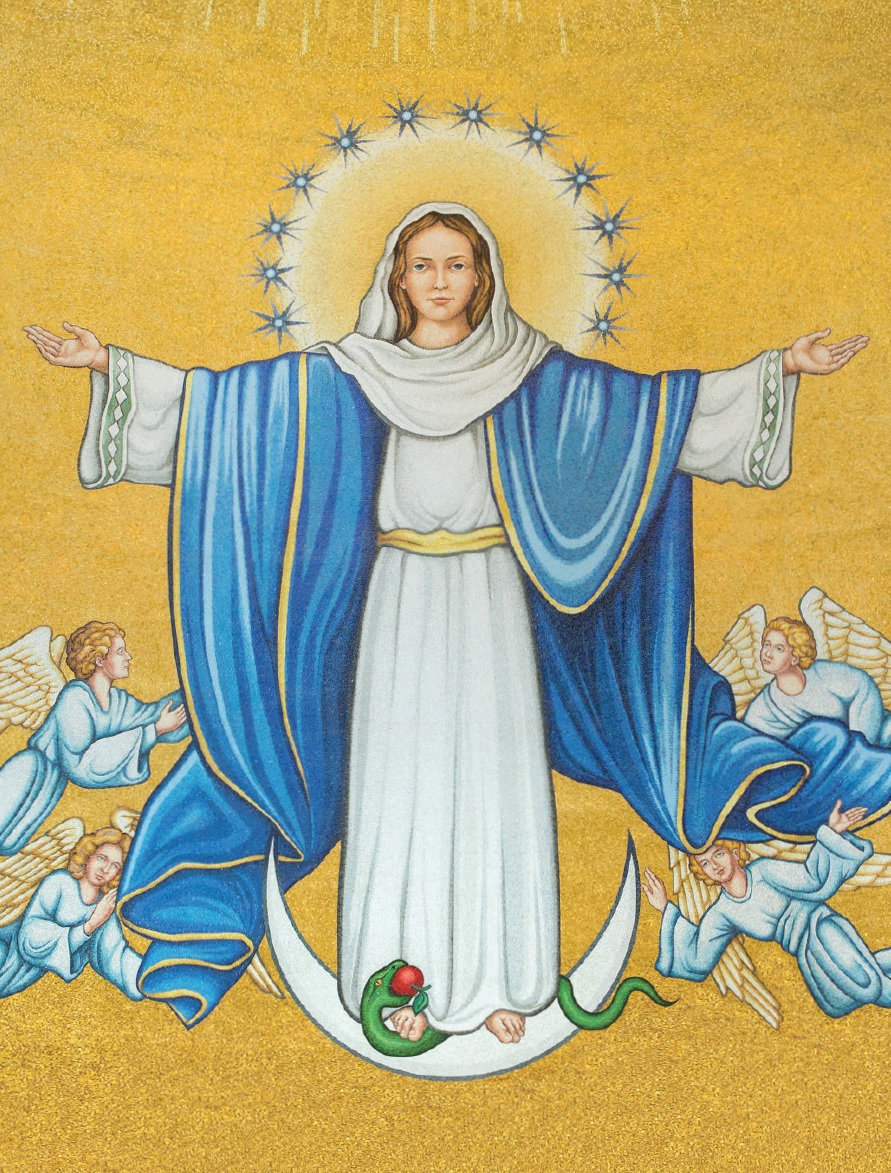
from the Trinity Dome of the National Basilica of the Immaculate Conception

Homily for the Solemnity of the Immaculate Conception (go to readings)


The Immaculate Conception is a dogma of the Christian Faith rooted in the scriptures and developed by Christian tradition and theological reasoning. In a paradox, The “most Blessed Virgin Mary, in the first instance of her conception, by a singular grace and privilege granted by Almighty God, in view of the merits of Jesus Christ, the Savior of the human race, was preserved free from all stain of original sin.” In other words, the grace of the paschal mystery of Christ saved his mother from sin not only before he was born, but before she was born. You can do that when you’re God.

The Immaculate Conception is an article of faith well-established in Christian tradition. Monks in Palestinian monasteries celebrated the Feast of the Conception of Our Lady by the 7th century. The feast spread as the Feast of the Immaculate Conception in Italy (9th c.), England (11th c.), and France (12th c.). In 1854 (19th c.), Pope Pius IX declared the Immaculate Conception to be a long-held doctrine, and now an infallible dogma of Faith.

In 1858, just four years later, in a grotto near the village of Lourdes, France, a young peasant girl named Bernadette Soubirous saw a mystical vision of a beautiful woman in a heavenly white dress and veil. When Bernadette asked who she was, the woman responded, “I am the Immaculate Conception.” Bernadette understood that it was the Blessed Mother; but didn’t understand the title. But the bishop did. As he was questioning Bernadette, he understood that because Bernadette didn’t understand, that this was not something she made up, and was a confirmation that it came from the vision of the woman herself, confirming the recently declared dogma of faith.

We know that there is precedence from the Scriptures. God purified the prophet Jeremiah in the womb of his mother: “Before I formed you in the womb of your mother, I knew you, and before you were born, I consecrated you” (Jer 1:5). The angel saluted Mary as “full of grace,” (we’ll come back to that). And we can recall the words from God to the serpent in Genesis: “I will put enmity between you and the woman, and her seed shall crush your head” (Gen 3:15). It is universal in Catholic Tradition to connect the woman in this prophecy in Genesis with Jesus’ prophetic words at the Wedding Feast of Cana, “Woman, what is this to us? My hour has not yet come,” and the prophetic vision in Revelation 12 of the woman clothed with the sun, with the moon under her feet, and on her head a crown of twelve stars; who is often portrayed in statues and images as standing on a serpent.

Also, from the standpoint of Holy Tradition and human reason, Our Lord was able to, one might say, stack the deck in favor of what he wanted his mother to be like: holy, beautiful, contemplative, kind, faithful, and free from sin. Some might say that this elevates Mary beyond our reach, and it would be easier to relate to her if she also shared in our burden of sinfulness. But the All-Holy God cannot be born incarnate from a woman who was a slave of the serpent, even for a moment in her life. There was enmity—perfect opposition—between the woman and sin, according to the promise of Genesis.

To use a common analogy, sin is like a mud puddle. Each of us at that moment of conception in our fallen human nature, we fall into the mud puddle, and we have original sin, the effects of which then lead us into personal sin, for which we need the sacraments of baptism and reconciliation. Mary, on the other hand, by a unique grace and gift of God, was guided around the mud puddle of sin, and she was conceived without sin, and never had sin. Whereas Jesus was free of sin by his divine nature, Mary was saved from sin by the grace of Christ, not by her own doing. But by that grace in her life (with her understanding and will not being diminished by sin), she was able to see sin for what it is and never choose it. Or perhaps put more accurately, it is not that Mary did not have the stain of sin that all humanity acquires at our conception, but rather that Mary was given at her conception the beautiful divine gifts of grace and holiness, which humanity has lacked since the Fall.

One notable 16th century theologian said, “It is a sweet and pious belief that the infusion of Mary’s soul was effected without original sin; so that in the very infusion of her soul she was also purified from original sin and adorned with God’s gifts, receiving a pure soul infused by God; thus from the first moment she began to live she was free from all sin.” That was a quote from Martin Luther.

“Hail, full of grace.” The words are beautiful, angelic, and rich in meaning. They are also a centuries-long fault line between Protestants and Catholics. Everything, it seems, hangs upon what is meant by “full of grace,” or whether full of grace is even the correct translation of Luke’s words. In Latin, the phrase becomes two words: plena gratia. In the original Greek, it’s just one, the phonetically unwieldy but potent in meaning: “kecharitōmenē” (κεχαριτωμένη). (Keh-car-ee-toe-MAY-nay)

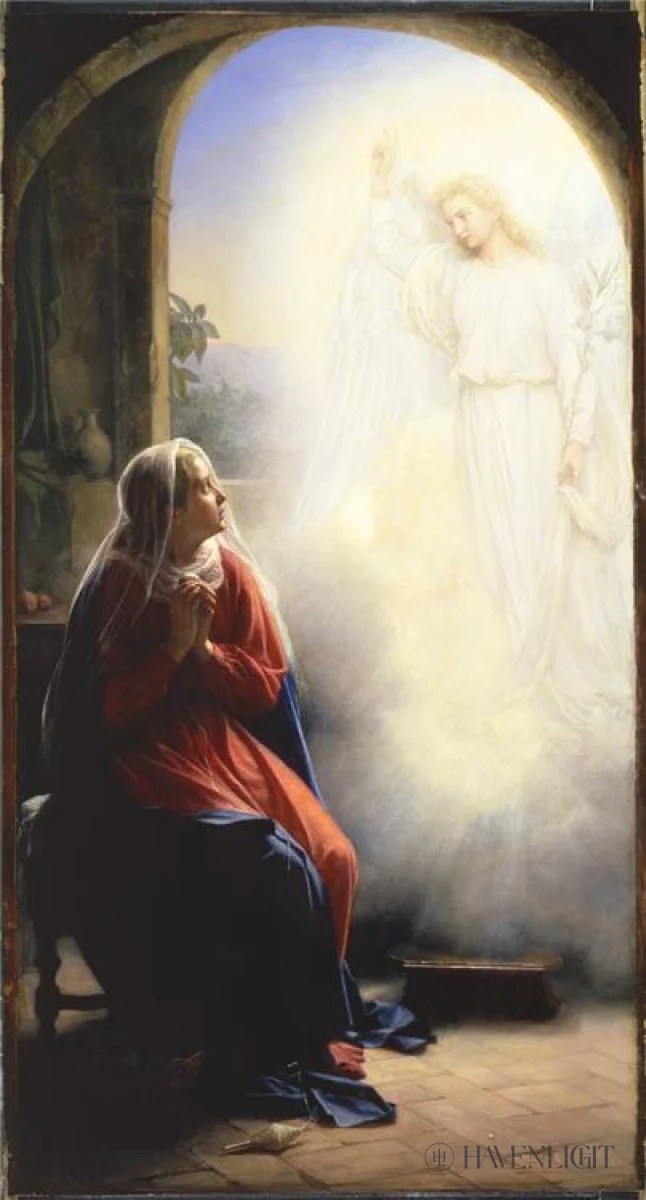
Under the influence of the Holy Spirit, St. Luke (who wrote his Gospel in Greek) documented the Archangel Gabriel’s words to Mary for posterity. St. Luke states that Gabriel referred to the Blessed Virgin Mary (Luke 1:28). Chaire, kecharitōmenē, ho kyrios meta sou! (Hail, “Full of Grace,” the Lord is with you!) The word that Luke uses—kecharitōmenē—is used nowhere else in the Scriptures or in any other Greek literature. It is a one-of-a-kind word for a one-of-a-kind person. No one else in human history is kecharitōmenē. I want to look carefully at what is clearly a very important word. The root is “charis,” which is translated as “grace,” or “gift,” and sometimes “favor.” But the root is a passive verb form, so it is more like being “graced, gifted, favored.” But it’s also present perfect, so it’s “having been graced, gifted, favored.” But also, because of the unique Greek tense that English doesn’t have, it denotes a completed action, the effects of which still continue in the present. It’s an enduring past action. Mary is from her beginning and forever one whose unique essence and disposition is to be perfectly filled with grace. The bible uses the Greek phrase “pleres charitos” (“plena gratia”) which literally means “full of grace” in some other places, such as St. Stephen at his martyrdom. But Luke didn’t use pleres charitos to refer to Mary. Pleres charitos is an adjective—it describes St. Stephen. But kecharitōmenē is a noun. It is a person who is, was, has been, and is being graced, as fundamental to the way of their existence.

What the Archangel Gabriel wants to communicate to Mary (and to us) in the word kecharitōmenē is that Mary has a unique name, a unique title, a unique role, and that she—though human—is a unique being in salvation history. Mary is she whose very name, whose very title, whose very person is to actively, perpetually receive grace in anticipation of, and in honor of, her role as Mother of God Incarnate, Jesus. That’s one reason why using “full of grace” does not go far enough. It is remarkable—in fact it is of utmost importance—that kecharitōmenē is clearly used by the angel Gabriel—the messenger of the most High God—as a proper noun, as Mary’s heavenly name. Kecharitōmenē is who Mary is, what Mary is, and not only what she has. She is the Kecharitōmenē,because of that “singular privilege and grace granted by God, in view of the merits of Jesus Christ, the Savior of the human race,” as Piux IX put it in the dogmatic definition.

That “singular privilege” requires a “singular word,” and Mary has such a word. Mary receives her heavenly name from the angel, which she then reveals as her identity to St. Bernadette. And what is revealed at the Annunciation, “Hail, kecharitōmēne,” is confirmed by Mary herself, at Lourdes. With great humility and grace she accepts the title bestowed on her by God through Gabriel, then later affirmed by the Church, identifying herself: “I am the Immaculate Conception.”

Homily: Repent and Accept the Offer of Pardon

Homily for the 2nd Sunday of Advent (Year A readings) (go to readings)
Isaiah 11:1-10
Psalm 72:1-2, 7-8, 12-13, 17
Romans 15:4-9
Matthew 3:1-12


In 1830, George Wilson was convicted of robbery the U.S. Mail and endangering the life of the carrier in Pennsylvania and was sentenced to be hanged. At the request of George Wilson’s friends, President Andrew Jackson issued a pardon for Wilson. But he refused to accept it. The matter went to the Supreme Court. Chief Justice Marshall wrote in the court’s decision that Wilson would have to be executed. “”A pardon is a deed, to the validity of which delivery is essential, and delivery is not complete without acceptance. It may then be rejected by the person to whom it is tendered; and if it be rejected, we have discovered no power in this court to force it upon him.” If it is refused, it is no pardon. Hence, George Wilson must be hanged.


Last week we talked about the preparation of our hearts for the Advent, the coming to us, the arrival of Jesus. We join in the generations of anticipation experienced by ancient Israel. We as the Church want to always be prepared for his final coming, whatever day and hour that might be. We prepare our hearts to receive him every day in the Eucharist, and in his presence within us in the Holy Spirit. In today’s gospel reading for the second Sunday of Advent, we are being prepared for the arrival, the beginning in the world, of the earthly ministry of Jesus, the message of Jesus.

Saint John the Baptist is preparing people for the most important event in the history of existence. In the long history of Israel, there was a promise at the very start. The promise from the moment of the Fall of Humanity in the Garden of Eden, and our expulsion from Paradise. And that promise begins back “in the beginning”–in Genesis 3–that despite humanity’s disobedience to God, that God would fix it. That this condition of separation of humanity from God would be healed, and we could repent and be reconciled to God, at long last, restored to Paradise. God said in Genesis 3 that there would be an offspring of the woman who would crush the head of the offspring of the serpent. That God would prepare humanity in a “school of trust” to learn that God is for us, that God wants us to have happiness and fulfillment, and that we do not need to go outside of God’s will to take care of ourselves and our deepest needs.

[Note: The “school of trust” is a reference to the work, “The Second Greatest Story Ever Told” by the Marian priest, Fr. Michael Gaitley, about the Divine Mercy devotion.]

This promise was the hope of the “Anointed One,” the “Messiah” in Hebrew, the “Christos,” in Greek. Throughout Israel’s history, other promises got braided together with this one.

King David was promised that a Son of David, the Davidic dynasty, would sit on the throne of Israel in glory forever. But when Israel returned from the Babylonian Exile, the new king was not of David’s line, nor was any king afterward. And so, the promise of the long-awaited true King of Israel, the promised Son of David, was added to the Messianic hope, the one who would be anointed to fulfill God’s plan and God’s promise.

After the decline of Israel from its glory during the reign of King David and King Solomon, Israel broke into two kingdoms. The powerful Assyrian Empire destroyed the ten tribes of the northern kingdom, dispersing them throughout all the nations of the world, leaving only the two tribes of the southern Kingdom of Judah (or “Judea,” in Greek/Latin). And so, another part of the hope for the Messiah was that he would restore Israel’s greatness and the unity of the twelve tribes into a single kingdom, and all the world would worship the one true God of Israel.

And lastly, although it was more subtle, God himself had said, in condemning the wicked “shepherds” of Israel who mistreated the flock of God’s people, that God himself would come and shepherd his people, that he would search for the lost sheep and bring them back, that he would bind up those who were wounded, and feed those who were hungry, and gather them to have them graze in green pastures in their own land. And so, there was also the revelation that the Messiah would also, in fact, be divine, be God himself.


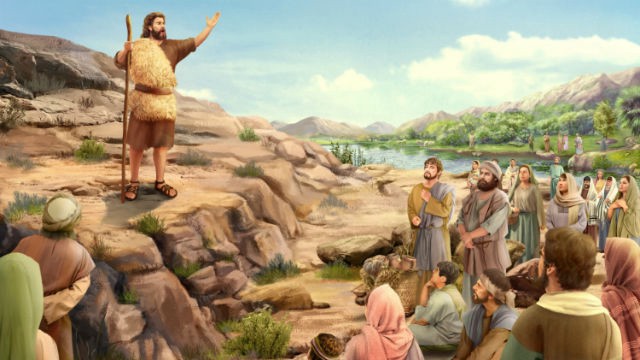
And so, St. John the Baptist, looking and acting a lot like the Old Testament Prophet Elijah, who was prophesied to return to herald the coming of the Messiah, was out in the wilderness by the Jordan River, proclaiming “Repent, for the kingdom of heaven is at hand!” The Messianic age, the promised return to paradise, as we see in the strange images of the First Reading from the Prophet Isaiah. “On that day,” Isaiah, says, “a shoot shall sprout from the stump of Jesse, and from his roots a bud shall blossom.” And this is where we get the traditional list of the seven gifts of the Holy Spirit (wisdom, understanding, counsel, fortitude, knowledge, piety, and fear of the Lord, or reverence), which will rest on this long-awaited bud, who would grow from the stump of Jesse, the father of King David. Isaiah is affirming the promise of the Son of David, the Messiah, the Good Shepherd. And one of the marks of the Messianic age, again, apparently missed by the Israelites (based on the events in the synagogue in Nazareth), but we can see more clearly from our perspective looking back, is that the Messiah will draw the gentiles to himself as well. Which makes sense. If the ten northern tribes, dispersed among all the nations of the world, are to be restored by the Messiah, then the new covenant of the Messiah would have to include all the nations, the whole world. It would be one, holy, and catholic (“universal,” from the Greek, “katholikos”) covenant family.

John not only proclaims the Messiah is near, to “Prepare the way of the Lord,but he proclaims how we are to do that. “Repent, for the kingdom of heaven is at hand!” Why? Because the Messiah is promising mercy, healing, forgiveness, and reconciliation. We desire the wrong things, we love the wrong things, we say and do the wrong things. Our heart is all messed up. He’s promising a new heart. The proclamation of the good news is that God is offering everyone a free heart transplant. But that’s only good news to someone who knows they need a new heart. The invitation of mercy is only good news to those who are aware they need mercy.

Later in the Gospel of Matthew, the Pharisees are going to ask the disciples of Jesus, “Why does your teacher eat with tax collectors and sinners?” And Jesus will answer them, “Those who are well do not need a physician, but the sick do… I did not come to call the righteous but sinners.” Jesus is not saying that the Pharisees are righteous, but that because they believe they are righteous, they are failing to seek out the physician for themselves. They believe their heart is fine, and so are refusing the freely available heart transplant. They are refusing (like George Wilson) the pardon for the death sentence for their wrongdoing, and so the consequences of their wrongdoing remain upon them.

John is not offering a baptism for the forgiveness of sins, which will only come later with Jesus and the gift of the Holy Spirit for the forgiveness of sins. John is merely offering them a baptism of repentance. A humble, contrite confession that they need a savior, a messiah, a spiritual physician, a pardon, a heart transplant. So that, with them being so urgently and painfully aware of their need, they will hear of the good news of the arrival of the long-awaited Messiah, the Christ, and they will rejoice at the good news, they will seek to find him, and all will be made new.

Homily: Memento Mori

Homily for 33rd Sunday of Ordinary Time (Year C) (go to readings)
Malachi 3:19-20a
Psalm 98:5-6, 7-8, 9
2 Thessalonians 3:7-12
Luke 21:5-19


“MEMENTO MORI.” Remember that you will have to die. This wisdom from Greek Stoic Philosophy is captured in the psalms as, “Teach us to count our days aright, that we may gain wisdom of heart” (Ps 90:12). And this wisdom can be found in the liturgy of Ash Wednesday, as each of the faithful is marked with a cross of ash on their forehead, with the words, “Remember you are dust, and to dust you shall return.” The author of the book of Sirach tells us why this wisdom is important: “in all thy works be mindful of thy last end and thou wilt never sin” (Sir 7:36).

The bulletin column this week is a reflection on the readings as reflections on the end of the world, as we approach the end of the liturgical year. There’s a certain aesthetic, considering our mortality, as the brown autumn leaves leave the trees bare and cover the green grass. We start with our first reading, from the Prophet Malachi, the last book of the Old Testament. “Lo, the day is coming.” What day? The day of the coming of the Lord. The later prophets of the Old Testament were highly critical of the injustices and corruption of Israel, and you think Israel would have learned their lesson by now. But no. The corruption of the temple priesthood, of worship, of the political leaders, corruption that caused the poor and vulnerable to suffer cruel injustices and struggle in poverty. When these Old Testament prophets proclaimed, “Israel, prepare to meet your God,” it was something like, “You wait till your father gets home!” It was the day of reckoning. Or in more Catholic tradition terms, the “Dies Irae,” the Day of Wrath. We must remember that “it is a fearful and terrifying thing to fall into the hands of the living God,” it says in the New Testament letter to the Hebrews. So, this is not just “Old Testament angry God” rhetoric. God is indeed merciful. But let us not forget what condemnation of our sins his mercy is saving us from, if we repent in faith.

…blazing like an oven, when all the proud and all evildoers will be stubble, and the day that is coming will set them on fire, leaving them neither root nor branch, says the LORD of hosts.” When the fire of God comes, those who have not repented and called upon his mercy will be condemned to eternity without the God of life. As Jesus says in the parable of the twelve virgins, those who are not vigilant and prepared will be locked outside where there will be wailing and gnashing of teeth, according to sweet and gentle Jesus.

There’s a false dichotomy that God in the Old Testament is wrathful and vengeful, and God in the New Testament is merciful and gentle. And some claim that it seems like they’re two different gods. But most of the Scripture’s verses about God’s mercy and care are in the Old Testament. And no one talks about the reality and danger of hell more than Jesus himself. For example, the last line of our first reading from Malachi turns a corner: “But for you who fear my name, there will arise the sun of justice with its healing rays.” So a carrot and a stick. God uses both, whatever it takes to get us to choose life in him: the carrot to help us to choose goodness and faithfulness, which win the blessings of the covenants God has made with his people, or the stick to help us to avoid the curses of breaking the covenant by unfaithfulness and sin. For those who remain faithful, and fear his name, or show reverence for him as our God, he will heal our imperfections and take us to himself in eternal joy. Not a hard choice, in theory. But if it were that easy in reality, no one would ever sin.

But that’s the point of “Memento Mori.” It can happen in an instant, and we know not the day nor the hour. It could be on your way home, in your sleep; the Lord could come in a million years, or the Lord could come tomorrow. You can think about that and live in fear, but that’s not a great way to live, and it’s not the way God wants you to live. A much better idea is to live the right way, to live simply, honestly, faithfully, virtuously, and you never need to fear the day or the hour, because you’re always ready. The first letter of John says, “Love casts out fear” (1 John 4:18). If you consider the image of dying unexpectedly and having someone you love going through every bit of your life, cleaning out drawers and closets and basements and boxes, internet history, files, and everything, do you fear what they might find? Do you have secrets and shame? What if, instead, you remember, “Memento Mori,” and live with simplicity and integrity, what you see is what you get, no secrets, no shame, no fear. Just living 100% pure divine love (or if you’re of a certain age, 99+44/100ths % pure, clean as Ivory).


Our second reading, finishing up weeks of going through Saint Paul’s second letter to the Thessalonians, matches up with today’s theme as things are getting wrapped up at the end (the end of the liturgical year, and the end of the world). Paul is instructing the Christian community not to sit back and waste time waiting for the return of the Messiah, getting into other people’s business and not minding one’s own need to be found being a good and prudent servant.

Paul and his co-workers could have required of the community a sort of stipend for their ministry, which would have been just and a normal expectation. But instead, they worked their trades as tentmakers in their off hours, to give a better example, as the Thessalonians needed. “…we instructed you that if anyone was unwilling to work, neither should that one eat.” This does not mean refusing to give alms to the poor, which Jesus explicitly requires of us. This is to be prudent in our almsgiving, not enabling those fully able to work to be unproductive, which is often destructive to virtue and salvation, and the whole community, especially the truly needy.


And finally, in our gospel reading, Jesus and his apostles were on the Mount of Olives, looking over the valley at the Temple Mount in Jerusalem. We are finishing up the Mount Olivet Discourse in the Gospel of Luke, the last part of Jesus’ teaching before he begins Palm Sunday and Holy Week, which we covered back in the spring (at Palm Sunday and Holy Week). And his apostles, a bunch of country bumpkins from up north in Galilee, are marveling at the majesty of the Jerusalem Temple across the valley. And Jesus says, yes, it’s great and beautiful, and “All that you see here–the days will come when there will not be left a stone upon another stone that will not be thrown down.

So they ask him, really? when will that happen? How will we know it’s about to happen? And here we have, let’s say four, important teachings from our gospel reading.

One. “See that you not be deceived, for many will come in my name, saying, ‘I am he,’ and ‘The time has come.’ Do not follow them!” Jesus said in our daily Mass reading on Thursday, “For just as lightning flashes and lights up the sky from one side to the other, so will the Son of Man be in his day.” When the day comes that Jesus returns, no one will mistakenly miss it. It will be a global event, a cosmic event, that will not be mistaken. So until then, just keep doing the holiness thing, and don’t worry about what people are saying about the end of the world.

Two. “When you hear of wars and insurrections, do not be terrified; for such things must happen first, but it will not immediately be the end… Nation will rise against nation, and kingdom against kingdom. There will be powerful earthquakes, famines, and plagues from place to place…” So basically, human world history as usual. And these will not be cause for fear, as terrible as they seem. So just keep doing the holiness thing, and don’t worry about what people are saying about the end of the world.

Just as an aside, Dr. Brant Pitre, in his notes on this weekend's readings, mentions that he has a presentation, "Jesus and the End Times: A Catholic View of the Last Days". While (as I say below) focusing excessively on the "end times" can serve as a distraction from focusing on the good we are called to do here and now, the scriptures do tell us about the end times, and so it's good that we understand it, particularly as it can help us keep faith against incorrect things we might hear about the end times. It's a set of five hour-long presentations, and I've only listened to the first one so far, but it is excellent!

Three. “…they will seize and persecute you, they will hand you over to the synagogues and to prisons, and they will have you led before kings and governors because of my name… You will even be handed over by parents, brothers, relatives, and friends, and they will put some of you to death. You will be hated by all because of my name…” Oh, persecution of Christians. Right, So basically, human history as usual. This has happened in the past and will likely happen again, perhaps in the near future. They’re not going to prevent us from going to Mass, from having a church, from celebrating Christmas. They’re going to make it offensive, if not also illegal, to speak against society’s views on gender, marriage, sex, abortion, and whatever else is coming down the pipeline we can’t even imagine yet. And not all the public condemnation and suffering, as we now know, will be legal persecution. It could be vigilante violence.

Four. “Remember, you are not to prepare your defense beforehand, for I myself shall give you a wisdom in speaking that all your adversaries will be powerless to resist or refute.” There’s an old phrase in Catholic tradition, “grace builds on nature.” What good you have naturally, grace makes greater. Jesus is not saying, “Don’t learn your faith. Don’t study the bible. Don’t worry about having to understand and explain your faith.” The bible does say, “sanctify Christ as Lord in your hearts. Always be ready to give an explanation to anyone who asks you for a reason for your hope, but do it with gentleness and reverence, keeping your conscience clear” (1 Pet 3:15-16). So the more we learn our faith, the more we pray, the more we equip the Holy Spirit to pull out of us what is the perfect response for the moment of necessity. Joan of Arc was asked in her trial, “Do you know whether or not you are in God’s grace?” Her response, filled with faith, was, “If I am not, may God put me there; and if I am, may God so keep me.” That brilliant response didn’t come out of thin air. That was inspired from her deep life of faith. She didn’t sit in her cell preparing to give that answer. But it came from deep within her, and was her response inspired by the Holy Spirit. But also the story of St. Joan of Arc can remind us that just because “your adversaries will be powerless to resist or refute” your wisdom doesn’t necessarily mean your persecutors will admit they were wrong and you’ll be free to go.


And lastly, I saw a quote the other day, “If the devil can’t destroy you, he’ll distract you.” (Alternatively, “If the devil can’t make us bad, he’ll make us busy.” – Corrie Ten Boom). A lot of people waste a lot of time uselessly speculating about the end times. Don’t get caught up that game. It is (or can be) a distraction from the present moment, this moment in which we are called to be present and holy and give glory and thanks to God, and to love our neighbor as ourselves. Let us use this and every present moment to be holy, to be prepared. “Memento Mori” is not a call to live in fear. It’s simply a reminder (memento) always to be ready, so that we need not dread death with fear, but to pass through death to our long-awaited embrace of our Lord whom our heart has faithfully loved.

Homily: “O God, be merciful to me, a sinner”

Thirtieth Sunday of Ordinary Time, Year C (go to readings)
Sirach 35:12-14, 16-18
Psalm 34:2-3, 17-18, 19, 23
2 Timothy 4:6-8, 16-18
Luke 18:9-14


Who were the Pharisees? We often get the sense from the bible that they were an arrogant, self-righteous, judgmental group. And part of that may have been the disciples of Jesus holding a grudge against the group that not only argued against and were often criticized by Jesus, and they conspired to crucify Jesus, but also they continued to harass and torture Christians. So, they were easily portrayed by the Christian community, including the gospel writers, as the evil oppressors.

But according to Jewish historians of the time, the Pharisees were a well-respected religious group. Their name, “Pharisee,” is from the Hebrew, “Pərūšīm,” meaning, “separated ones.” They were known for their piety and faithfulness to the requirements of the law. When Israel returned from the Exile, they recognized that their exile was caused by their corruption, and their return permitted by God because of their repentance and return to righteousness. The Pharisees believed that this legal righteousness was the way for Israel to return to its golden age. Israel was God’s holy people, a nation of the priestly people of God, set apart, to be a light to the nations, as the scriptures say. And so, the Pharisees took the priestly purity code of the law, required for preparation and conduct for serving God in the Temple, and extended it to apply to all Israelites at all times. As we see in the gospels, while some, perhaps many, might have been corrupt, in which their outward show of piety cloaked their inward attitude of arrogant self-interest, some, perhaps many, were honest, devout, and holy, such as Nicodemus and Joseph of Arimathea. So the Pharisees, in general, then, were the heroes of most stories, calling sinners back to righteousness to the Lord, distancing themselves from pollution and sin, and so, wise and holy guides for the people.

Who were the tax collectors? They were despised as corrupt and greedy traitors to the nation of God’s people. They took an exorbitant cut for themselves as agents of the Roman oppressors, who already required high taxes, and collected them without mercy. Historians suggest that tax collectors would have to bid on a certain territory or neighborhood, and pay the Romans in advance for the taxes due to Rome from that area, and then the tax collectors could collect however much above that they wanted for themselves, and live very well. However, they were despised by the Romans for being Jews, and despised by the Jews for cooperating with the Romans. So, they often were not welcome in public places such as temple and synagogue, for being unclean and immoral and strongly disliked. So in most stories, they would obviously be the bad guy, the scoundrel, the proud and rich weasel who would always get their comeuppance. Always.

So, all that is to really help you see how shocking it would have been to hear Jesus’ parable in our gospel today. Jesus often would have surprises and twists in his parables to help people to remember them and think about them. He was, of course, a master storyteller. So if you were hearing a story that starts with, “Two people went up to the temple area to pray; one was a Pharisee and the other was a tax collector,” you might not yet know the story, but you knew that the Pharisee was going to be the good guy, and the tax-collector was going to be the bad guy. But what does Jesus do? He reverses the roles.


Last week, we heard Jesus tell the story of the widow and the corrupt judge, and our need to be persistent in prayer. Today we hear the story of our need to be humble, or “poor in spirit” in prayer. Jesus says, “The Pharisee took up his position and spoke this prayer to himself.” Who is he praying to? Right. “O God, I thank you that I am not like the rest of humanity—greedy, dishonest, adulterous—or even like this tax collector.” So, the only thing he gets right so far is gratitude. But gratitude for what? For being better than the rest of humanity. Just wow. And then he starts praying about the flaws of this other person behind him in the temple: “greedy, dishonest, adulterous, like this tax collector.” A great lesson in how not to pray. I’ll often hear people confess being judgmental. [I can tell if someone’s judgmental just by looking at them. (That’s a joke)]. I think that often in our society, we feel so judged, so unworthy, such a hot mess, so aware of our flaws and failures, that it’s very tempting to compare ourselves with someone who seems to be a worse mess than us, just to feel better about ourselves. “At least I’m doing better than that loser.” So not only does Jesus condemn that in today’s gospel, but it also then makes that other person feel judged, because we are judging them, and then they have to go find someone more miserable than them to judge, and now everyone feels judged and like garbage, and that’s not the way to be the kingdom of God.

And so, this Pharisee doesn’t stop there. “I fast twice a week, and I pay tithes on my whole income.” So the Pharisee prays by praising himself and his good deeds. Now, it is good to fast twice a week and pay tithes on our whole income. But we don’t bring it to prayer boasting about it, expecting God to pat you on the head like a good boy. Forget the good that you do, and come to God as a beggar, poor in spirit, humble, and asking for God’s mercy and help. Not like this Pharisee, boasting about how close he is to God, how holy he is, like they’re besties. Remember what Jesus said about the slave who had to serve his master before taking care of himself. “When you have done all that you have been commanded, say, ‘We are unprofitable servants; we have done what we were obliged to do.’” We can’t do anything that puts God in debt to us for our good deeds. We can’t earn our entitlement to holiness. Everything we do is less than what we ought to be doing if we were perfect. But by coming to God, asking for mercy and help, he accepts our lowly offerings as a parent lovingly praises a child for their crayon art, which the parent happily puts on the refrigerator. Look what you did, isn’t that cute?

So, the good and holy Pharisee is not so good and holy. Let’s look to see how wicked and heartless the wicked and heartless tax-collector is. “But the tax collector stood off at a distance and would not even raise his eyes to heaven but beat his breast and prayed, ‘O God, be merciful to me a sinner.’” Oh come on Jesus, we want to hate the tax collector! He’s supposed to be the villain! But the tax collector humbly confesses how far he is from the holiness and goodness he is called to, how lowly he is to not even be able to raise his eyes to heaven, but is filled with repentance, and the scandal of his own life, and simply prays to God, “Be merciful to me, a sinner.” I think it’s beautiful that half of his prayer is in his bodily posture. I’m reminded a bit of Pope Saint John Paul II’s, “Theology of the Body,” which teaches us that since our actions, like our words, can communicate the glory of God and the goodness and truth we as humanity are called to express, that the tax-collector says as much with how he prays as what he prays.


Two footnotes to this description of the pharisee. First, a good act of contrition for the Sacrament of Reconciliation requires three elements: An element of repentance, an element of asking for mercy, and an element of intent to sin no more. Any good act of contrition has these three elements, except for one, which is called “The Jesus Prayer: “Lord Jesus Christ, Son of God, have mercy on me, a sinner.” It’s adapted from this part of the gospel, through the mediation of Jesus to God the Father.

The second thing is that if Catholics love and have internalized any part of the gospel, it’s the part about sitting at the back of the church. If I put out chairs outside across the street, I’m pretty sure people would sit there. No. God became incarnate to be intimate with us, to draw us closer to himself, to share himself, his life, with us. Sitting up front does not mean you think you’re holier, that you’re exalting yourself, or that you’re the nerd who always sits in the front row at school, taking things way too seriously. Our response to God drawing close to us is for us to draw close to him. Yes, his divine splendor and majesty inspire awe and fear, if we were to enter his divine presence with any imperfection. But here he comes to us hidden in signs and sacraments and mystery, accessible to us. And we need to lean into how he wants to improve our life, to heal our hearts, to unite ourselves with him. And for that, we acknowledge any false humility. The truly humble know all the more how much we need God. And we sit at the feet of the Master, as Mary did while her sister worked, or as Saint John at the last supper, resting his head on the sacred heart of our Lord. So next week, don’t go to the back. Get a little closer, don’t be shy. Move forward, respond to the call to draw near. The front of the church should fill up first, with us all eager to receive from the Lord. I promise you, if you sit up front, there’s like “almost zero” chance you’ll be struck by lightning.


To wrap this up, Jesus says, “I tell you, the latter went home justified, (the tax collector), not the former (the Pharisee), for whoever exalts himself will be humbled, and the one who humbles himself will be exalted.” If we exalt ourselves, how high can we really reach, to lift ourselves up? A great among sinners? But if we come before God as poor in spirit, needy, a beggar, aware of our many faults, and pray, “O God, be merciful to me, a sinner,” he exalts us to heaven with his grace, affirming that we are good, and we are infinitely loved, and we are forgiven, and helped by his care for us to go out in peace and joy, serving him and serving him in our neighbor, pouring ourselves out spreading the good news of God’s incredible love for each of us. That we might be able to say, with St. Paul, at the end of our journey, “I am already being poured out like a libation, (emptied as a sacrificial offering) and the time of my departure is at hand. I have competed well; I have finished the race; I have kept the faith… the Lord stood by me and gave me strength, so that through me the proclamation might be completed… To him be glory forever and ever. Amen.

Homily: The Thankful Samaritan Leper

Homily for the 28th Sunday of Ordinary Time, Year C (go to readings)
2 Kings 5:14-17
Psalm 98:1, 2-3, 3-4
2 Timothy 2:8-13
Luke 17:11-19


The first king of Israel, a thousand years before Jesus, was King Saul. He wasn’t a good king, and God instructed the prophet Samuel to anoint David to succeed him. Saul’s family was from the north, and David’s family was from the south, in Bethlehem, although David made Jerusalem the capitol city. When David decided to build the Jerusalem Temple, his prophet Nathan said it would not be him but his son Solomon who would build the Temple. King David started amassing resources, his son King Solomon built the Temple, and his son King Rehoboam repeatedly raised taxes and other funds to pay for the Temple.

But by this time, the tensions between north and south had gotten so heated that Israel split into two kingdoms, the ten northern tribes of Israel in the North, with its capitol, Samaria, and the two southern tribes of Judah, or Judea, in the South, with it’s capitol, Jerusalem. By a few hundred years later, the North, tired of seeing their money taken south and given to the Jerusalem Temple, set up their own shrines in the North, and they grew financially, morally, and religiously corrupt. For their unfaithfulness, the north was attacked and invaded by the great empire Assyria, with its capital, Ninevah. And the Assyrians wiped out most of the 10 northern tribes, dispersing them among the nations of the world, and Assyria replaced them with 5 different other groups that they had also conquered, each with their own religion and gods (remember the 5 previous husbands of the Samaritan woman!). Some poor areas of Israelites were left, mostly in Galilee, surrounding the Sea of Galilee, or Lake Tiberias.

A few hundred years after that, the southern kingdom of Judah was attacked by the Babylonians, or Chaldeans, and they marched the Judeans, or what was left of Israel, off to exile in Babylon, until the Babylonians were conquered by the Persians and then the Medes, who released Israel to go back to their land, and they resettled Judah and Galilee, while Samaria was still largely occupied by the foreigners who had been put there by the Assyrians, and who had intermixed with the Israelites who were left behind. And so the Israelites who returned from exile, having realized that the exile was their own fault for their corruption, had repented, and had, as they saw it, been released because they had returned to righteousness, now came back to find in their land these mongrels of corrupt breeding and corrupt religion, and these would be the Samaritans. So, by the time of Jesus, you had three geographic groups: the southern area around Jerusalem, under the rule of the Romans, the very northern area around the Sea of Galilee, kind of like Israel’s red-neck country, and in between you had the Samaritans, these half-breeds, who were an abomination. And it didn’t help that the Samaritans and Israelites constantly pushed each other’s buttons and kept the mutual hatred and tension high. And of course there were neighboring kingdoms such as Syria, Aram, Edom, Moab, etc, with whom Israel was at peace or at war with, depending on the day.

Also in the background of our readings today is the Mosaic Law in Leviticus that covers skin conditions. A fun read. The law really kind of groups a lot of skin diseases under the umbrella term, “leprosy,” although some were temporary, like an allergic rash, some were genetic, like psoriasis, and some were contagious, like fungus, bacteria, or what we now call Hanson’s disease, which is a bacterial infection that progressively kills the nerves, which numbs the skin, and leads to terrible infections and what we think of as leprosy specifically. So, in Leviticus, anyone with a skin disease is instructed to present themselves to the priest, who is not only usually the most-well educated in a village, but also the one whose office it is to protect the integrity and safety of the community, and the priest would declare you clean or unclean. If you were unclean, you had to isolate out of the community, stay far away from anyone else, shout “unclean” when anyone was approaching, and basically if it wasn’t something that cleared up, it was a life-sentence of isolation and despair, separated from family, friends, employment, temple or synagogue worship, and was often considered a divine punishment. It was a living death.


In our first reading, we meet the great Syrian warlord Namaan. Namaan had everything, but unfortunately, he also had leprosy. But he also had a slave girl from Israel, who informed him that there was a prophet, Elisha, in Israel, who could cure him. So Namaan set out for Israel with a letter from his king to give him safe passage to the King of Israel, asking for Namaan to be healed. Apparently, the letter didn’t mention the prophet, because when the King of Israel read the letter, he tore his garments and exclaimed, “Am I a god with power over life and death, that this man should send someone for me to cure him of leprosy? Take note! You can see he is only looking for a quarrel with me!” So Elisha the prophet hears about this, and sends a message to the king to send Namaan to him. And so Namaan, in all his splendor and gravitas and entourage arrives at Elisha’s house. And Elisha sends out a message to Namaan to wash seven times in the Jordan River, and he will be clean.

This is not the kind of treatment Namaan was used to. He was a very important person. Not only did this humble prophet not come out to greet him, just sending a messenger out, but go down into the sad dumpy mudhole that was the Jordan River, and do it seven times? There are much more beautiful rivers in Syria. And so, he’s angry and ready to go back home. But his servants talk him out of it. So then we pick up our first reading, “Naaman went down and plunged into the Jordan seven times at the word of Elisha, the man of God. His flesh became again like the flesh of a little child, and he was clean of his leprosy.” So not only was he healed, but you can imagine the rough, ruddy and calloused skin of a warrior. But it says his flesh became again like the flesh of a little child. We could say he was recreated, restored, to the original perfection that was lost. So that’s important. But what’s more important comes next. This foreigner, Namaan says to Elisha, “Now I know that there is no God in all the earth, except in Israel… please let me, your servant, have two mule-loads of earth, for I will no longer offer holocaust or sacrifice to any other god except to the LORD.

You might remember that when Jesus started his ministry in Galilee, in the synagogue of Nazareth, he read from the scroll of Isaiah, and then he said, “there were many lepers in Israel during the time of Elisha the prophet; yet not one of them was cleansed, but only Naaman the Syrian.” And when the people in the synagogue heard this, they were all filled with fury. Why? Because that part of the scroll was a reference to the Messiah, they had heard of the signs and wonders he had done, and Jesus had just identified himself as the Messiah. But they were looking for a Messiah that was Israel’s Messiah, their long-awaited hero, who would free them from the oppression of the Romans. They weren’t interested in a Messiah whose attention was to those outside of Israel. They didn’t understand the full depth of the meaning of the Messiah, and that this was a spiritual rescue mission for eternal liberty, not a political mission for Israel. Their understanding of God’s gift was too small, or perhaps God’s gift was greater than they really wanted. They weren’t interested in those around them, just their own experience of suffering.

But again, as Jesus pointed out, they rejected him because they didn’t really know the scriptures. Look at our psalm, which of course is also from the Old Testament: “Sing to the LORD a new song, for he has done wondrous deeds; in the sight of the nations, he has revealed his justice. Sing joyfully to the LORD, all you lands!

And so we end with seeing Jesus put his words into his works in the Gospel Reading from Luke. It starts off by saying, “As Jesus continued his journey to Jerusalem, he traveled through Samaria and Galilee. As he was entering a village, ten lepers met him. They stood at a distance from him and raised their voices, saying, ‘Jesus, Master! Have pity on us!’ And when he saw them, he said, ‘Go show yourselves to the priests.’”

So Jesus was in a sort of unsettled neutral territory between Galilee and Samaria, and he encounters these ten lepers, a mix of the two. Because suffering is kind of a great equalizer. They were banished from both their own communities and came together as the island of misfit toys, Israelites and Samaritans together. And they shout from a distance, as they’re required to do, but they don’t shout, “Unclean!” They shout, “Lord have mercy,” just as we always do at the beginning of Mass. “Kyrie, eleison!” in Greek.

And Jesus doesn’t approach them, he just instructs them, “Show yourselves to the priest,” As they were going, they were cleansed, so that when they would arrive at the priest, he would declare them clean, he would declare them not only healed and restored bodily, but restored as part of the body of the community. He healed their despair, their isolation, but he also healed their bonds of love, and their capacity to worship God in the temple, which they lost when they became unclean.

Now, a nice-intentioned modern person might have told them, “Well, you can go do what you want. Don’t listen to those rigid, exclusion-minded people.” But that’s “cheap grace.” It compromises truth to feel nice. But it robs people of the great joy of healing and reconciliation and thanksgiving experienced, after who knows how long of conversion, and praying and hoping for real healing and reconciliation. And God knows that the longer and deeper that suffering and longing is experienced, the greater and more complete is the joy and gratitude when that suffering is healed by the great mercy of God.

While I’m sure all the lepers in our gospel reading were joyful at their healing and restoration, only the Samaritan had the thanksgiving to return to Jesus. And it says, “And one of them, realizing he had been healed, returned, glorifying God in a loud voice; and he fell at the feet of Jesus and thanked him.” Not only did he thank him, he bowed, he prostrated—which you would only do in worship of God—at the feet of Jesus. He clearly understood that Jesus had power of God. Remember what the King of Israel had said, “Am I a god with power over life and death, that this man should send someone for me to cure him of leprosy?”

Nothing earthly could cure leprosy, the only hope was God, and here, God had healed, reconciled, and restored. Thanks be to God! And for the scriptures to point out that only this Samaritan, this foreigner, recognized Jesus’ divine power, was testimony, like Elisha healing Naaman, that God is calling all people—you, and me, and all the world—to recognize how we have been healed, how we are called to be restored and reconciled to God and to each other, and how we are called to offer our eucharistia, our thanksgiving praise to God. To “sing to the LORD a new song, for he has done wondrous deeds!

Homily: Increase Our Faith

Homily for the 27th Sunday of Ordinary Time (Year C) (go to readings)
Habakkuk 1:2-3; 2:2-4
Psalm 95:1-2, 6-7, 8-9
2 Timothy 1:6-8, 13-14
Luke 17:5-10


You’ve heard of the 20th century Catholic social activist Dorothy Day, a woman many considered a living saint. Many admirers came to visit her, to have a look at her, to speak to her, to touch her, if possible. Sometimes they would tell her, “You are a saint,” or she would overhear others saying of her, “She is a saint.” She would get upset, turn to them, and say, “Don’t say that. Don’t make it too easy for yourself. Don’t escape this way. I know why you are saying, ‘she is a saint.’ You say that to convince yourself that you are different from me, that I am different from you. I am like you. You could do what I do. You don’t need any more than you have; get moving!” While that might be a good introduction to our readings, I think a good summary might be a quote from the Old Testament prophet Zechariah: “Do not despise small beginnings, for the Lord rejoices to see the work begin. (Zec 4:10).

We’re blessed with a short gospel reading this week, and in the gospel of Luke it follows right after the parable of Lazarus and the rich man which we heard last week, and then there’s a few verses about radical forgiveness and the danger of leading others astray. And then we have the first part of our gospel reading. The disciples ask Jesus, “Increase our faith,” and he responds “If you have faith the size of a mustard seed, you would say to this mulberry tree, ‘Be uprooted and planted in the sea,’ and it would obey you.” Mustard seeds are like black ground pepper, they’re very small, but they yield a surprisingly large bush, which is actually rather invasive like a weed, it spreads very fast. So Jesus more than once has taught his disciples that their faith should be like a mustard seed. A seed of a little faith received by a heart that’s fertile ground can change a person’s whole life, and even those around them! And a little seed of a community of believers can spread and lead to the conversion of the Roman Empire!

So, the mulberry tree is a tree with an expansive underground root system. Ancient Israel actually had regulations that planting trees had to be 30 feet from a well or a building or a road so their roots wouldn’t expand out and ruin the foundations or the well, but mulberry trees couldn’t be planted within 50 feet of anything to allow for their huge root system. They were very firmly planted trees, and they could be moved only with great difficulty. But Jesus says that with faith like a mustard-seed you could say to a mulberry tree to uproot itself and be planted in the salty sea, in sand, and it would do it. So, we might say that when we live by our faith, we should expect God to yield unbelievable outcomes to our prayers and our obedience to faith. We are called to cooperate with grace, and grace will produce results that could never have been anticipated, that defy what we could imagine.

But also, the disciples ask for this gift of increase of faith after Jesus challenges them. And so, another thing we can get out of this image of the mustard seed is that we shouldn’t procrastinate being bold in living out our faith because we don’t think we’re ready. We don’t need big faith, we need little faith, in fact, we need whatever faith we have, and to act on it, and let God yield the increase. To say we need to wait until we have more faith is to say that it depends on us instead of on God. You can’t wait until you’re ready, because you’ll wait the rest of your life, because you’ll never feel ready. You have to just do the thing, to launch, and course correct along the way, like learning to ride a bike. You can’t ride if you’re not moving forward.

On my blog where I post many of my homilies, I have one of my favorite quotes from G. K. Chesterton, “Anything worth doing is worth doing badly.” The meaning is that some things are so important that we cannot put off doing them simply because we’re not the best person, or we don’t have enough time or ability, or all the proper preparations. The simple importance of the thing requires it to be done, and the simple fact of having done it is more important than whether we have done it as well as we would have liked. The problem with mustard-seed sized faith isn’t that our faith isn’t even as big as a mustard seed, it’s that we’re too big. Our faith is too much about what we have to do, or what we have to be. Just say yes to God and start out, get some momentum, and let God show you what he does with that. That will make you humble. Keep going, and he will keep you going the right way.

So then there’s the second part of our gospel reading, about the slave that worked all day, then has to make dinner, before he or she can have dinner themselves. And we might get a little grumpy toward the master there, but remember the master’s an image of God, so get yourself back down to a mustard seed, and try to see what he’s trying to teach you. What he’s saying is that you can never do so much for God that God owes you anything. You can’t do so much good that you have one up on God, or you can manipulate God into your debt. We are unworthy servants. So, the good that we get from God is out of his goodness and his love toward us, not because he owes us. And our work should not be motivated out of trying to get anything out of God.

How many times does our prayer just sound like making wishes we want God to fulfill, like he’s a genie, instead of a dialogue of love with God? Often, we look at prayer as trying to convince God to give us the good things we want. The thing is, God already wants to give us good things, but he’s trying to get us to want to receive the good things he wants to give us. Often the problem is that what we think we really want is far too small compared to what God wants to give us. So God has to wait while he guides and prepares us to receive his superabundant gifts. And it seems in that time that he’s just not answering our prayers, it might seem like he’s not even listening.

Part of the above paragraph is inspired by (ok, taken from) my absolute favorite of the Lighthouse Media CDs and MP3s, given by Msgr. Thomas Richter of the Diocese of Bismarck, entitled, “Trust in the Lord.” I’ve listened to it countless times, and I cannot recommend it enough. I’d link it here for free, but the only online free copy has poor quality. So get the MP3, and tell me what you think!

That’s where the Old Testament prophet Habakuk is in our first reading. It’s a very small book, only three chapters, and Habakuk is complaining that God is allowing his people to see such destruction and suffering. “How long, O LORD? I cry for help, but you do not listen! I cry out to you, ‘Violence!’ but you do not intervene.” This is a terrible experience, and we’ve all been there, and depending on what we’re asking, it seems like forever. And many people lose their faith in suffering and grief, and it seems like prayers are useless and God is not even there listening.

But God responds to Habakuk, “Then the LORD answered me and said: ‘Write down the vision clearly upon the tablets, so that one can read it readily. For the vision still has its time, presses on to fulfillment, and will not disappoint; if it delays, wait for it, it will surely come, it will not be late. The rash one has no integrity; but the just one, because of his faith, shall live.” The vision is of course the rescue of Israel from their oppression and suffering. And Habakuk is to write it down clearly because it is not only for him, but for all to see that God has been preparing this vision and will fulfill it, and all will see how God has made and fulfilled his promise of redemption for his people. And of course, the ultimate fulfillment of this promise is in Christ, the true and perfect redemption of God’s people from the oppression of sin, their call to conversion, and the lasting peace through the open gates of heaven.

And this ties back to our gospel reading, teaching the kind of faith we are to have. It cannot be a demanding faith, or a weak faith, but a powerful faith. Paul tells Timothy in our second reading, “For God did not give us a spirit of cowardice but rather of power and love and self-control. So do not be ashamed of your testimony to our Lord…” and then he says, “but bear your share of hardship for the gospel with the strength that comes from God.” So, God is working and preparing his gifts, even when we cannot sense it. So yes, we do have to suffer, as Christ our Lord suffered, with great faith in God. And God gives us the grace and strength to persevere in waiting in confident faith, in sure and certain hope. God said to Habakuk, “if it delays, wait for it… The rash one has no integrity; but the just one, because of his faith, shall live.”

So, the one who is impatient loses their faith, but the one who perseveres, who relies on God to supply his grace and an increase of faith, shall live and see the goodness of God. There’s a very loose but beautiful interpretation of this that says, “There will come a time when your tears will fall not because of your troubles, but because God has answered your prayers.”

And so, we can end on the high note of our responsorial psalm, Psalm 95, which, if you pray the liturgy of the hours, you pray at the beginning of every day. “If today you hear his voice, harden not your hearts. Come, let us sing joyfully to the LORD; let us acclaim the Rock of our salvation. Let us come into his presence with thanksgiving; let us joyfully sing psalms to him. Come, let us bow down in worship; let us kneel before the LORD who made us. For he is our God, and we are the people he shepherds, the flock he guides.” How beautiful is the life God invites us to, even redeeming our suffering, our tears, our patient waiting on him, and our privilege to eagerly to serve him in love and joy.

Homily: The Main Thing

Twenty-fifth Sunday of Ordinary Time (Year C) (go to readings)
Amos 8:4-7
Psalm 113:1-2, 4-6, 7-8
1 Timothy 2:1-8
Luke 16:1-13


A recent article about an interview with Pope Leo XIV summarizes his message, “My priority is the Gospel, not solving the world’s problems.” In the interview, Pope Leo says, “I don’t see my primary role as trying to be the solver of the world’s problems. I don’t see my role as that at all, really, although I think that the Church has a voice, a message that needs to continue to be preached, to be spoken and spoken loudly.”

In today’s social and political climate, it’s too easy to get pulled away from what should be our main mission. In the words of Stephen Covey, “The main thing is to keep the main thing the main thing.” And the main thing for the Church is to carry forward the message of the gospel of Jesus Christ, in how we think, how we see the world, how we speak, and how we live.

In a recent parish meeting we were talking about the call to evangelization, and how Catholics seem to be notoriously shy about stepping up as messengers of the gospel. And the comment was made that the last few generations of Catholics feel very underequipped to talk about our faith. And there is so much that the Catholic Church has taught and done across two thousand years, it’s difficult for anyone to feel comfortable with their understanding of all this and to have what feels like an awkward conversation about the faith.

Fair enough. But is that what evangelization is? Teaching theology and Church history? How many people have seen the Lord of the Rings movies? Did you like them? Were they amazing? Inspiring? Did you tell anyone that? Did you suggest that they watch them? Maybe even suggest that they read the books? That’s the basic idea of evangelization. We’re not sharing the good news about the Church teachings or history. That’s important, but not the main thing. The main thing is how much we love Jesus, how inspired we are by him, by our relationship with him, by his words in the scriptures and in our hearts, how our lives have more joy, hope, beauty, and love, because our faith in Jesus enriches our life. It can even be our story of how we once were so lost, and the effect of our encounter and putting our faith in him to work in our lives, and how that has been a risk that has paid unbelievable dividends. Saint Paul made his conversion story the basis of all his ministry (“I was once a blasphemer and a persecutor and an arrogant man, but I have been mercifully treated because I acted out of ignorance in my unbelief. Indeed, the grace of our Lord has been abundant, along with the faith and love that are in Christ Jesus.” he says in 1 Tim 1:13). Or the beautiful line of Mary Magdalene which she says to Nicodemus in the Chosen, “I was one way, and now I am completely different. And the thing that happened in between was Him.” And then we ask if they might like to see if coming to Church and hopefully having an encounter with Christ might help them, and we tell them we’ll meet them at Church.

I think Catholics sometimes use our poor catechesis (which indeed is a tragic reality) about our faith as a delay tactic. After I take some bible courses or join this prayer group, or this catechesis class, and maybe after that, I’ll feel comfortable sharing the gospel. First, please do learn more about our faith (to learn it more is to love it more). Do keep growing your relationship with Jesus (such as spending time in the Adoration Chapel) and sharing with others the peace and joy that comes from that quality time with the Lord. Your own words flowing from your heart shining with the love of Christ are your best tools of evangelization! But second, that will not make you comfortable sharing the gospel. The only thing that will make it comfortable is to keep doing it, like other things that feel awkward at first, but you get better at it.

But it’s easy to get caught up in the world. To have a strong opinion, the right opinion, and get fixated on correcting the other side for their errors of judgment, facts (or ignorance of facts), and beliefs. It’s easy to get caught up in defending one side or the other, or a particular figure, perhaps one villanized or silenced by the machinations of political opponents. And of course we know of the rash of shocking tragedies that have rocked our society, especially the police officers shot near Spring Grove. We thank them for their service, pray for the three who died, and the two recovering in the hospital, and their families and fellow officers and other first responders, and for an end of violence and the taking of innocent human life. This is an important thing, but not the main thing.


Our Old Testament reading from the prophet Amos harshly criticizes those caught up in the values of the world, particularly the greed and selfishness that gives God the minimum while being impatient to get back to “real life” and making money, even to the extent of being dishonest in business. “When will the new moon be over,” you ask, “that we may sell our grain, and the sabbath, that we may display the wheat?” How much longer is Mass going to last? Why do I have to go to Mass on Holy Days of Obligation? These get in the way of work and my schedule, “my time.”  Maybe I can sneak out before it’s over, especially if it means I don’t have to deal with other people in the parking lot. Why does the Church say we have to do this or that, or it says we can’t do this or that? Everyone else seems more free to do what they want.

God has given us everything, he gave the maximum sacrifice, he gives the maximum revelation, the maximum grace, he even made the best possible most beautiful world, which he then entrusted to our stewardship in our free will. God is perfect in all things, including his generosity. And our response should not only be what is required of us, but it should be with joy and thanksgiving, and to return the maximum to him in his glory and goodness. If we made our entire life, our maximum offering, to him, with the same family, job, vocation, and gifts that he has given us, how would our life look different? Not only staying for all of the Mass, but having read and prayed on the readings as our preparation, arriving early to focus our hearts, being as engaged as possible during the liturgy and our spoken and sung participation, receiving the Eucharist with maximum reverence, and staying a few minutes after Mass to give thanks and ask for his blessings throughout the upcoming week. Giving intentionally and generously a portion of our material resources to the support of the Church and to various charitable opportunities. Praying with the scriptures daily, driving with patience and safety, working our best at our jobs (or at school) with maximum virtue, kindness, preparation, and wisdom, living out the various teachings of the Church in their intent to sanctify and open every moment of our lives to glorify God and receive the grace of God available to us, that we might “pray without ceasing” by making our every moment, every aspect of our humanity and our time, talent, and treasure, an offering to him. Would your life be more or less holy? More or less successful? More or less happy? God’s way is always the best way. But that’s just the fruit of keeping the main thing the main thing—making our life about loving and serving God, including serving him in our neighbors. And if our neighbors don’t know him, inviting them into that relationship and inviting them to church.


Our gospel reading has long been considered one of Jesus’ most difficult parables to understand. Why does he tell of the rich master (usually an image of God in the parables of Jesus), praising a dishonest thief? Without getting into the weeds on the parable, I want to just take a few lines out of it in the time we have here.

For the children of this world are more prudent in dealing with their own generation than are the children of light.” The people committed to worldly life are better at being worldly than the people of faith are at being commited to living like people of faith. The life of faith is meant to be transformative. And a lot of times, people of faith are more like the worldly than we are at living like we are set apart from it. I recently heard a quote that said, “Jesus called us to be salt and light. What do salt and light have in common? They change the environments they come in contact with. They don’t conform, they don’t affirm, they transform what they come in contact with. Are you transforming the environment you are coming in contact with? …We must challenge people to be greater, to reach higher, to be biblical, to be Christlike, as we continue to be salt and light.” That was quoting Charlie Kirk. He may have talked about politics and social issues, but he always kept the main thing the main thing: bringing people to Christ. And in the wake of his death, young adults are checking out church, some for the first time, in a way they haven’t in generations (especially at that stage of life when most Christians drift away from church).

Then one of the difficult phrases of this parable, maybe made even harder with the translation, “I tell you, make friends for yourselves with dishonest wealth, so that when it fails, you will be welcomed into eternal dwellings.” Jesus is using the phrase dishonest wealth to mean the things of this world, passing material things, earthly money. And by making friends with it he means use it to wisely invest it in spiritually beneficial ways, in holy ways, knowing how unimportant it really is in terms of eternity, so that when you leave this world and you can’t take it with you, that you have made yourself into a spiritually rich person, having been a good and holy steward of what was entrusted to your care.

If you are not trustworthy with what belongs to another, who will give you what is yours?” If you are a good and virtuous steward of God’s gifts entrusted to your care, investing them to become rich in what matters to God, you will receive the reward of your responsible care of those gifts: the greatest gift, your eternal life, the perfect fulfillment of your humanity in God, what you were created for. Because you kept the main thing the main thing. You kept your focus on God, on your eternal soul, and the eternal souls of those around you, which you have a responsibility for, to the extent that you have a potential impact on them. Read C. S. Lewis’ essay, “The Weight of Glory,” it’s a beautiful reflection on that topic, of the weight of obligation we have of being a holy influence on others for the sake of their eternal heavenly glory.


And so, it’s easy to think that what is most important is what the world is telling us to be emotionally invested in, or even the worldy effects of the gospel and the Church teachings that flow from it. Yes, there are political, social, and moral dimensions of Church teaching—care for the poor, the environment, for peace, for morality, for human rights, which have their source in God’s generous Creation and our God-given image and dignity.  And as Christians we do need to be involved in the public dialogue, and in voting wisely for what the gospel requires of us. But these are indirect ways of serving the gospel. Secondary things. Not the main thing. The main thing is not solving the problems of the world. The main thing is the gospel. The Church has a prophetic role in the world, the voice of conscience, reminding us of good and evil, life and death, and we should understand, share, and live the prophetic truth of the gospel in our lives. Is it Jesus that comes out of our mouth? That comes out in our actions? Is it Jesus alone that sits on the throne of our heart? He has given us everything. Everything we do is by his generosity poured upon us. Do we respond by serving him as generously in return? Do we praise him, glorify him, serve him, share him, speak to others of him, and keep him as the center of our life?

Because that’s the main thing.

Homily: Exaltation of the Cross

Feast of the Exulatation of the Holy Cross (Sept 14) (go to readings)
Numbers 21:4b-9
Psalm 78:1bc-2, 34-35, 36-37, 38
Philippians 2:6-11
John 3:13-17


Last week in the gospel reading we heard Jesus tell his disciples, “Whoever does not carry his own cross and come after me cannot be my disciple.” Today we celebrate the Feast of the Exaltation of the Cross. So let’s look at the mystery of the cross.

Our first reading is from one of the first books in the bible, the book of Numbers. It presents the people of Israel on their exodus from Egypt to the promised land, and this book picks up after they enter into the covenant and set out from Mount Sinai.

All along the journey, the Israelites have been murmuring against Moses and against God. Just a note, my friends, the people murmuring among themselves is never a good thing in the bible. Always a temptation; never a good thing. In response to their complaining that they would rather go back to Egypt to full bellies and slavery, than embraces the invitation to the challenges to purify their hearts from slavery and become truly free as the people of God, God had given them the encouragement of the miracle of the manna, the miraculous bread of heaven that covered the land each morning, except for the Sabbath, and which would finish with their first Passover in the Promised Land. And each evening God sent quail into the camp and people ate them. And to slake their thirst, God provided water from the rock in the wilderness. And that kept them content, for a moment. Then we pick up with our reading today: “With their patience worn out by the journey, the people complained against God and Moses, ‘Why have you brought us up from Egypt to die in this desert, where there is no food or water? We are disgusted with this wretched food!’” Their response to the miraculous bread of heaven is “we are disgusted with this wretched food!?” Now, to borrow from the Hebrew language, that’s some chutzpah. Or to say it in English, “the audacity!”

God, in punishment, overruns their camp with seraph serpents. Seraph is from the Hebrew word for “burning.” The highest choir of angels are the “seraphim,” the “burning ones,” the ones closest and who most intimately participate in the burning furnace of divine love. So presumably the bite of these seraph serpents caused inflammation, a burning reaction, and many of the people died. And this divine punishment on Israel had its intended effect. “Then the people came to Moses and said, ‘We have sinned in complaining against the LORD and you. Pray the LORD to take the serpents from us.’” Holy punishment is always out of love, and with the hope of conversion, reconciliation, and salvation. The same with the regulations taught by the Church. It’s not intended to exclude but given out of love for the integrity of the person and the faith, and with the hope of conversion, reconciliation, and salvation. How people respond to it is up to their free will, and their choice of humility or pride.

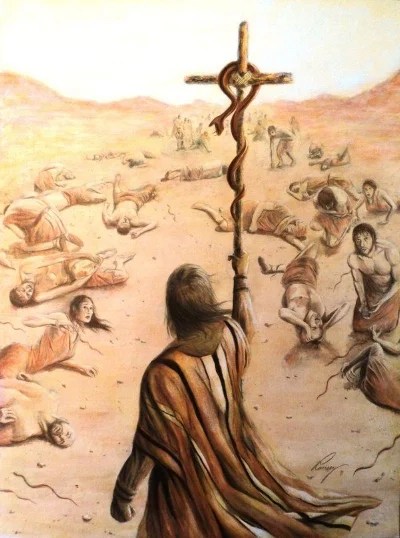
So now we get to why this reading was chosen for today’s feast: “So Moses prayed for the people, and the LORD said to Moses, ‘Make a seraph and mount it on a pole, and if any who have been bitten look at it, they will live.’ Moses accordingly made a bronze serpent and mounted it on a pole, and whenever anyone who had been bitten by a serpent looked at the bronze serpent, he lived.” Now, while the psalm and second reading are important for today’s feast, I want to skip to the gospel reading, with these words fresh in our minds.

Jesus said to Nicodemus… ‘And just as Moses lifted up the serpent in the desert, so must the Son of Man be lifted up, so that everyone who believes in him may have eternal life.’” Why does Jesus make a reference to the serpent on the pole? I’ve heard people say that the serpent is one of the Old Testament images of Jesus. I’m sorry, I don’t think so. The biblical image of a serpent is usually the opposite of Jesus. So, what is it then? It’s an image of the cost of our rebellion against God. Think about what Jesus looked like on the cross. Scourged at the pillar, crowned with thorns, carried and was nailed to the cross (bloody, beaten, and naked). Now, some people rightly say that thousands of people were crucified by the Roman Empire; Jesus wasn’t unique in being crucified. True. But Jesus was unique in carrying the enitre weight of humanity’s rebellion against God, our sin and anger and resentment and pride and infidelity and disobedience against God, bearing all that in his humanity, held together by his divinity. His appearance on the cross was horrific to behold. Like the Israelites being instructed to look at the bronze serpent, the consequence of their rebellion against God, we can look at a crucifix and see the consequence of our rebellion against God. And we can see the love of God in that he accepted the consequence of our sin to save us. The word “salvation” and the word “healing” come from the same root. Something that is “salutary” is both for our salvation and for our healing. So, it isn’t just that Jesus was crucified to save us, like he wrote a check to cover our debt to let us off the hook. He was crucified also to heal us, to root out from within us the poisonous spirit of sin and death, that he might put in us his Holy Spirit of light and eternal life.

We have the obligation to live out, in this life and in this world, this holy spirit of light and eternal life. I often say at funerals that we often say that our dearly departed has recently entered eternal life. In a way, yes, but that’s not really accurate. They entered eternal life at their baptism (when they die to the spirit of fallen humanity, and take on the spirit of Christ). And hopefully that person had discerned and lived out this new spiritual life, by how they exercise their free will, live out their vocation to holiness, and fulfill their particular mission in the Body of Christ for God’s plan of salvation for the world. That’s what all of us are called to, obligated to. It’s what every human being is created for, and where we find our deepest joy, peace, and fulfillment. And so it is our obligation of love to share that message and call people to this truth, that they, also, would know the deep joy, peace, and fulfillment of living out their vocation.


This week, as we were just recovering from all the media coverage and reactions to the shooting at Annunciation Catholic School in Minneapolis two weeks earlier, then on the eve of remembering how September 11, 2001 rocked our American society with shocking tragedy, on Wednesday, September 10 our American society was again rocked with shocking tragedy at the killing of Charlie Kirk in the middle of a conversation with an opponent about mass shooters and gun violence.

Mass media and social media have been flooded with messages of his noble and friendly character, his strong Christian faith, and how they informed his well-defended political and social values, but most especially, how he saw it as his mission to talk, to engage, to listen, to ask questions, to be truly open to the joy of meeting other people, even (or maybe especially) if they disagreed with him, and doing what he could, as he saw it, to lead them more deeply into truth. Of course many people, especially on the college campuses where he did much of his public debates, disagreed with his Christian or conservative views, and many saw him as a dangerous voice promoting what they saw as hate. But to his core, even publicly acknowledging that he had received death threats against himself and his family, Charlie led his life courageously, engaged opponents with genuine openness, and fully giving God the credit for any of his success, professionally or personally, including the virtues of his character, and the beautiful gift of his family. He saw and accepted the inherent danger and vulnerability of his public events as the cross he was called to carry for his personal vocation to spread the gospel and speak the truth.


And this then is the final part of our reflection. The area in our life where we know we are most weak, where we are most tempted, where we most sin, where know we need God’s grace to help us, requires the cross of our humility, to acknowledge we need God, and to reach up, like a little child, to ask God for his help. And because we know God will give us his help, and that this area of weakness is where we will experience his love and grace poured into our life, we can exalt in the cross of our weakness, because asking God into our life is what will save us, and that area of weakness is where we are most of aware of our need for that. St. Paul was never ashamed to speak about his weakness, “I will rather boast most gladly of my weaknesses, in order that the power of Christ may dwell with me.”, “I was once a blasphemer and a persecutor and an arrogant man, but I have been mercifully treated…Indeed, the grace of our Lord has been abundant,” and “It is not I who live, but Christ who lives within me.” And in our gratitude we lift up our praise to Jesus, we lift up Christ, who came into our humanity with his divinity. That’s the meaning of our incarnation. We lift up Christ as our hope in God. Jesus is our perfect offering of prayer and worship of the Father. Jesus said, “When I am lifted up, I shall draw all men to myself.” That means a number of things. It means when he is lifted up on the cross for our repentance, and to pay the cost of the salvation of all humanity. It means when he is lifted up in the resurrection in victory over death. It means when he is lifted up in the ascension and crowned with glory. It means when he is lifted up in our hearts and acknowledged, worshiped, and obeyed as our Lord and our God. The Greek for that “lifted up”, also means exalted, hupsoó. It is similar to what we find in our second reading from the letter to the Philippians, “God highly exalted him, hyper-hupsoó, for his obedient, faithful, incomprehensible sacrifice in love in embracing his part in the plan of salvation, his death and resurrection to save us.

So, in our feast we celebrate today we lift up, we exalt, the cross, because by his holy Cross he has redeemed the world. We lift up the cross we carry of our own weakness, because in entrusting our weakness to Christ as an offering to be transformed by his grace, we are made strong in Him.”For God so loved the world that he gave his only Son… [not] to condemn the world, but that the world might be saved through him.

Homily: “The beauty remains; the pain passes.”

‘Landscape at Beaulieu’, Pierre-Auguste Renoir, 1893

Twenty-Third Sunday of Ordinary Time, Year C (go to readings)
Wisdom 9:13-18b
Psalm 90:3-4, 5-6, 12-13, 14 and 17
Philemon 9-10, 12-17
Luke 14:25-33


French artists Henri Matisse and Auguste Renoir were close friends and frequent companions, even though Renoir was twenty-eight years older than Matisse. During the last several years of his life, Renoir was virtually crippled by arthritis; nevertheless, he painted every day, and when his fingers were no longer supple enough to hold the brush correctly, he had his wife, Alice, attach the paintbrush to his hand in order that he might continue his work. Matisse visited him daily. One day, as he watched his older friend wincing in excruciating pain with each colorful stroke, he asked, “Auguste, why do you continue to paint when you are in such agony?” Renoir’s response was immediate, “The beauty remains; the pain passes.” Passion for his art empowered Renoir to paint until the day he died. Those who continue to admire the enduring beauty of his smiling portraits, his landscapes, his still-life studies, will find no trace therein of the pain required to create them. Most will agree that the temporary cost was worth the enduring result.


Our readings today give us the theme of putting what is eternal over what is temporal, what is true, good, and beautiful, what endures forever, over what will pass away, like dust in the wind. But the problem is that this is very difficult for us. The power of what is visual, what is seen, what is pleasing to the physical senses, what is urgent (regardless of whether it is important) and short term, immediately in front of us, claims a great, even overwhelming, demand on our attention.

But our readings are trying to pull us out of this materialistic, temporal mindset and fix our attention on what is higher, of higher reality, higher importance, higher dignity, and requires a higher level of priorities to understand, believe, and practice.

In our gospel reading, Jesus is giving us the true understanding of what it costs to be his disciple. People want to call themselves Christian, and claim the reward of being Christian, without wanting to understand the cost, consider the cost, and pay the cost. They want Christianity on their own terms, and that’s not at all how Christianity works. As someone said, “All are welcome, but on Christ’s terms, not on their own.” And it’s not that Christ’s terms have become more strict, more out of touch with society, but rather that society has become more out of touch with Christ’s terms, the cost of what takes to make our lives about what is above, resplendent with divine wisdom, rather than the dust on the wind that is what the world wants us to focus on.

In the first part of our gospel reading, Jesus teaches that he has a greater calling on his disciples than even the relationships of family. In ancient Israel, family was everything, who your family is was who you are, your role in society, how you were related to Israel, the ancient hereditary Father of the Israelites. This is why genealogies were so important in the bible and in Israel. And the only thing more important than one’s family was God himself. So for Jesus to teach that “He who loves father or mother more than me, is not worthy of me; he who loves son or daughter more than me, is not worthy of me” is to say that Jesus is the one thing more important than family; Jesus is revealing his divine identity, by taking this divine prerogative of being the one thing more important than family. In fact, in other places of the gospels (“ For whoever does the will of my Father in heaven is my brother and sister and mother” Mt 12:50), Jesus teaches that one’s spiritual family of the Church is more important than one’s blood family of the flesh; and its no wonder why he attracted attention, both positive and negative.

Jesus then teaches “Whoever does not carry his own cross and come after me cannot be my disciple.” We’ve heard this many times. In the time of the early Church, when Christians were persecuted and executed for their faith, this could have been taken literally. To be a disciple, you had to accept that you have to hold to this faith all the way. At many times during the Church’s history, we see Christians not only executed, but their property confiscated, their professional credentials and opportunities disappear, their public reputation and privileges destroyed. And we see this script being replayed today, not only in other countries where Christians are literally executed, but even in our own society. Christian bakers and venue owners are targeted for refusing to cooperate in supporting same-sex marriage, medical staff are persecuted for refusing to participate in (or even criticize) abortion or transgender affirmation, and the Little Sisters of the Poor are being sued by the Pennsylvania attorney general for the seventh time (after they’ve been exonerated in 6 previous lawsuits) for refusing to include contraception in their employee healthcare packages. To be Christian is to lay all of what we are and all that we have on the altar of God, to be sacrificed if called to do so for the sake of faithfulness to the kingdom of heaven.

But since many of us will hopefully not be called to such explicit examples of carrying the cross of the faith, we can also understand this requirement as crucifying those things in our life—our evil habits, our unhealthy attachments, our disordered attractions—that are incompatible with the call to holiness and the teaching of the Church. That doesn’t mean that these things aren’t good. Families are good. Our reputation, our businesses we have built up, our money and resources and security, these are all good—even some of our attachments and attractions, although they might be wounded and distorted, and need to be healed to be healthy and holy. But nothing else is the ultimate good, which is God. We have to put first things first, and other things afterward. If we put secondary things in the place that only God should be, we lose everything.

Jesus then teaches his disciples that this is a high calling, the very highest demand, and before deciding to be a Christian, it is foolish to start if you’re not going resolve to take it all the way to the finish, come what may (as a man considering building a tower, or a general considering engaging in battle). If you quit, or compromise, what it means to be Christian, what the Christian faith teaches and requires, you lose the only thing that matters, and you also become a stumbling block for others. As Yoda said to Luke Skywalker, “Do, or do not; there is no try.” If we tell ourselves we are merely trying, it’s a preparation to have an excuse for failing, instead of fully committing everything to what is required.

Dietrich Bonhoeffer, the Lutheran minister who died resisting against the Nazi’s, talked about cheap grace: “Cheap grace is the preaching of forgiveness without requiring repentance, baptism without church discipline, Communion without confession, absolution without personal confession. Cheap grace is grace without discipleship, grace without the cross, grace without Jesus Christ… Costly grace is the treasure hidden in the field; for the sake of it a man will go and sell all that he has. It is the pearl of great price to buy which the merchant will sell all his goods. It is the kingly rule of Christ, for whose sake a man will pluck out the eye which causes him to stumble… It is costly because it costs a man his life, and it is grace because it gives a man the only true life. It is costly because it condemns sin, and grace because it justifies the sinner.” So, what we might call the “bad news” is that there is a high cost to identifying oneself as a Christian, and only those who are all-in deserve the name. But the good news is that we receive the grace to do exactly that, if we surrender ourselves completely to it, to allow God to work on us, perfect us, and unite us to the incredible heavenly beauty and joy of his own divine life.

Our first reading expounds on the beauty of the heights of divine wisdom and truth we are called to center our life on, and the utter difficulty, or rather impossibility, of this without God. “For the deliberations of mortals are timid, and unsure are our plans. For the corruptible body burdens the soul and the earthen shelter weighs down the mind that has many concerns. And scarcely do we guess the things on earth, and what is within our grasp we find with difficulty; but when things are in heaven, who can search them out? Or who ever knew your counsel, except you had given wisdom and sent your holy spirit from on high?

Again, not that our physical nature is evil, but it distracts us from what is most important. Our bodies are good. God gave us our bodies. And Jesus even united himself to our bodily nature to restore the goodness of our human nature, which is body and soul as a unity of a human person. Fr. Robert Spitzer wrote a beautiful book called, “Finding True Happiness,” which, among other things, outlines four levels of happiness we pursue and enjoy, from the lowest and most immediate gratification that flees as soon as the act is completed, to the highest and most abstract levels of happiness, which give us an enduring, fulfilling happiness. But to attain the higher, more spiritual levels, we often have to say “no” to the lower, more physical levels.


Our psalm today has the beautiful line, “Teach us to number our days aright, that we may gain wisdom of heart.” When we contemplate the reality that we have a limited amount of time to become what we will be forever, either holy or hell-bound, it should inspire us to always be moving upward. Blessed Carlo Acutis, a young person who is being canonized as a saint this weekend by Pope Leo XIV, said, “I die serene because I have not wasted even a minute of my life in things God does not like.” He had a great devotion to young saints, and now he is one of them.

And lastly, our second reading from one of the shortest books in the bible, Saint Paul’s letter to Philemon. It is one of the letters written by Paul while in prison. And in prison, Paul meets and converts a man named Onesimus, who was a slave who fled from his master Philemon, who Paul knows, as he was a prominent Christian in the community of the Colossians. And so Paul is writing to Philemon not only to tell him, “Hey, I just found your escaped slave,” but also, “Hey, I’m sending your escaped slave back to you as a member of the church, a brother in Christ, who is dear to my heart, so treat him as you would treat me.” Obviously, this is going to make for an awkward reunion. Ordinarily, Onesimus would be flogged and branded. But Paul is reminding Philemon that our spiritual relationships, such as brothers and sisters in the family of Christ, as children of God our Father, take a higher place than our relationships in the flesh. Also, note that Paul says, “I appeal to you for my child, Onesimus, whose father I have become…” for those who condemn Catholics for calling priests their spiritual “father.”

And so again, to end with this example from Saint Paul, we must put the high demand, even sacrificial demand, of the Christian faith, first in our lives, the solid rock foundation of our lives. We must be Christian first, and everything else we are, we do, and we have in our lives is to serve, witness, and reinforce our Chrisitan identity, over all the things of this fallen world, and our temporary existence as part of it. We are called to be in the world, but not of the world, witnessing to the world by the faith, hope, and love of our Christian life.

Homily: Humility and Children (and Minneapolis)

22nd Sunday of Ordinary Time (Year C) (go to readings)
Sirach 3:17-18, 20, 28-29
Psalm 68:4-5, 6-7, 10-11
Hebrews 12:18-19, 22-24a
Luke 14:1, 7-14


Christian Herter was the governor of Massachusetts, and later the Secretary of State. While he was governor of Massachusetts, he was running hard for a second term. One day, after a busy morning without lunch, he arrived at a church barbecue. It was late afternoon and Herter was famished. As he moved down the serving line, he held out his plate to the woman serving chicken. She put a piece on his plate and turned to the next person in line. “‘Excuse me,” Governor Herter said, “do you mind if I have another piece of chicken?” “‘Sorry,” the woman told him. “I’m supposed to give one piece of chicken to each person, because you’re going to get other items further down the line.” “‘But I’m starved, and I love chicken,” the governor said. “‘Sorry,” the woman said again. “Only one to a customer.” Governor Herter was a modest and unassuming man, but he decided that this time he would throw a little weight around. “‘Do you know who I am?” he said. “I am the governor of this state!” “‘Do you know who I am?” the woman retorted. “I’m the lady in charge of the chicken. Move along, mister.”  

Clearly the theme shared by readings this weekend is humility. We have sort of a love-hate relationship with humility, in that we can simultaneously think we’re the worst person in the room and look down on everyone else as better than them, at the same time. Humility comes from the Latin word for ground, or dirt. A humble person is grounded in reality, their feet on the ground, and living with their mind in the real world. That doesn’t mean without faith in the invisible and supernatural and holy, but not in a fantasy world that isn’t real. God is truth, and so we can only encounter God if we’re also accepting and living the truth, about ourselves, about the world, and about God.

Humility doesn’t mean trying to make ourselves small. Mother Teresa says, “True humility is truth. Humility comes when I stand as tall as I can, and look at all my strengths, and the reality about me, and then put myself alongside Jesus Christ. And it’s there, when I see how my greatness is so little in the light of his greatness, and I stop being fooled about myself and impressed with myself, that I begin to learn humility.

In our gospel reading Jesus gives two separate messages about humility. First, he speaks to invited guests at a banquet. He sees that they’re taking the best seats, trying to cultivate powerful friendships and influence, presuming upon their reputation to take places of honor. But Jesus admonishes them not to be presumptuous, which incurs the risk of being humiliated by being sent downward in the social ladder. Rather, Jesus says, presume the lowest place as your proper place, not with a false humility of expecting to be moved higher, but a true humility. If you can be genuinely happy in the lower place, you will be even more happy when you are given a higher place, not because you believe you deserve it, but because you believe you don’t, and you appreciate the gift of your host’s esteem.

And then Jesus gives a second message to the hosts of such celebrations: don’t just invite those who will just return the favor, but also invite those who cannot, those who are the weak, powerless, poor, and outcast in society, that your celebration would truly be virtuous and generous. And of course, you would be their host, like Martha, waiting on them, and in that you would truly learn humility. Whoever wishes to be great must be the servant of all, Jesus says elsewhere.

Remember from the beginning of the gospel reading that this is at the house of a pharisee, on a Sabbath. So, while they should be praising the Lord, they’re praising themselves and each other. And while they should be good and caring shepherds, they’ve allowed themselves to get disconnected from the sheep and think they’re better than them. But Jesus is trying to restore that connection, that order of communion, and that virtue, in the hearts and ministry of the pharisees. The pharisees are a well-respected religious group that tried to take the prescriptions in the law for the priests, and apply them to everyone, in the effort to set Israel apart as a kingdom of priests, a holy people set apart, and thus to restore Israel to its greatness. But this would also tempt them to take pride in their attentiveness to legalistic details, and miss the greater call of the weightier things of the law, such as mercy and the humility to walk with the weak and vulnerable.


So to use that as something of a segue, speaking of the beloved children of our heavenly father, I want to clarify something. I had said at one of the Masses a few weeks ago that I, like many of us, are joyful and appreciative of the little interpolations and contributions to our celebration of the least among us, the babies and toddlers who enjoy exploring the acoustics of their little voices in our church. Sometimes people complain that there aren’t any children, then people complain that the noise of children is an obstacle to hearing what’s being said. I think part of the solution has been worked out as it seems our sound system has been successfully adjusted to make it easier to hear. And in my humility, in which I invite you to join with me, I’m going to say that I would rather have the sound of children drowning out my voice, than to have you hear me easily because we have made families with children feel like they are unwelcome. Because I think it’s far more important that we have a church of engaged young parents whose young children are unpredictable in their being young children, than to have a church that is dying because young families instead went where they were better welcomed, appreciated, and supported. So that’s a sacrifice I think we should offer to make as a parish community, because we, too, are called to be little ones in the kingdom, and perhaps it’s a good constant reminder of what little ones are like. I will trust that the parents of our little ones will do their best, and I will trust that those around them will be welcoming and compassionate.

And unfortunately, speaking of children in church, we heard of the evil tragedy at Annunciation Catholic Church and School in Minneapolis this week, when a mentally ill person shot into the church during the all-school Mass, killing an 8 and a 10 year old, and injuring 17 others in the church, and then took their own life. More information is coming out about the situation, and a lot of things are being said in the media and social media. But one of the important things that is coming out is a frustration at the phrase, “thoughts and prayers.” I actually re-released a blog article I had written in 2018 after the Parkland, Florida school shooting on this phrase. Long story short: for those of us who have little connection to the incident, and little power to do anything else about the incident, we do certainly offer our thoughts and prayers to the school and parish families, to all school families, especially in Catholic school, whose anxiety level has been raised this week because of this incident. And as followers of Christ, who instructed us to pray for our enemies and our persecutors, we also pray for those who caused this tragedy. If they could not get the support they needed in this life, perhaps we can contribute to the support they may need in the next life. But for those who do have the power to do something more to prevent tragedies like this from happening again, politicians, statesmen, the medical community, and others, then their response has to go beyond “thoughts and prayers.” This isn’t a substitute for a real corrective response. Some prominent people have ridiculed or denied the importance or effectiveness of prayer in the wake of this tragedy. And to be fair, it is not just a denial of faith and the powerful love of God, but more basically it is a response of frustration at those who have the power to effect change to potentially prevent these kinds of tragedies, but instead just offer “thoughts and prayers” instead of the work that they can do and are obligated to do.

In our parish here, a thousand miles away from our spiritual brothers and sisters at Annunciation Catholic Church in Minneapolis, we do heavily and sadly unite our hearts with their broken hearts, their grieving hearts, in their parish family. That same day, Wednesday, our parish was hosting a silver rose, a  program of the Knights of Columbus of Canada, the United States, and Mexico, under the patronage of Our Lady of Guadalupe, to commend the lives of all children, particularly those in the womb, to the protection of Our Lady. After our Mass the silver rose was processed over to Saint Mary’s. There are 8 silver roses, which started in various places in Canada, Hawaii, Florida, and the Caribbean, and their pilgrimage journeys will unite at the Shrine of Our Lady of Guadalupe on her feast day, December 12. So I thank our Knights of Columbus for this and the many things you do to promote the pro-life message of Catholic Church teaching.

And I mentioned at that Wednesday Mass that perhaps we can use this tragedy to add some important devotion into our recitation of the prayer for the help of Saint Michael, the prayer written by Pope Saint Leo XIII after a mystical vision of the Church under demonic attack, and the call for protection by the archangel Saint Michael, the protector of God’s people. As Pope Leo had required the prayer to be said after all Masses until it was discontinued after the Second Vatican Council, many bishops, including Bishop Gainer, again required it in all the parishes of the diocese since 2016. So, this prayer at the end of Mass is not an opportunity to go out to the parking lot ahead of the crowd, it’s a requirement for each of us to pray for the spiritual defense of the Church, and her members, from the deadly enemy.

The world is indeed a beautiful place. God created it and called it very good, especially his final creation, humanity. Yes, there are evils in the world, evil spirits, perhaps evil people, evil groups of people, evil inventions, evil use of things. But we know that evil does not win in the end. God wins, and his people win with him. Let us rejoice in him, and, with humility, trust in him, and follow him.