

This is the homily I offered at the 2019 Diocesan Respect Life Mass at Good Shepherd Parish in Camp Hill. I am grateful for the opportunity. I hope it bears fruit, and that the horror of abortion is outlawed in our lifetime. Even more so, I hope that every single baptized Christian might be as consumed with the fire of divine love as St. Francis, St. Catherine, and St. Teresa of Calcutta.
As usual, what is in grey was for the most part the original homily as delivered, plus the dark blue parts, as references to the readings, green parts, as external quotes, and bright red as just really important. The dark red text is what has been added for the online post, but couldn’t be included in the homily.
Mother Teresa (Saint Teresa of Calcutta) once said, “At the end of life we will not be judged by how many diplomas we have received, how much money we have made, how many great things we have done. We will be judged by, ‘I was hungry, and you gave me something to eat, I was naked and you clothed me. I was homeless, and you took me in.’” Mother Teresa had spent her life allowing God to shape her heart to be like his, and her heart was full of his divine love. And since God’s love is inseparable from God’s truth, those who are very holy with God’s divine love, tend also to be very holy with God’s divine truth, and wisdom.
Mother Teresa’s reference to Our Lord’s words in Matthew 25, in the parable of the sheep and the goats (often called “The Judgment of the Nations”), sheds light on one of my favorite quotes from Dr. Peter Kreeft, which is that, the moral teaching in the Scriptures makes more sense when you think of it, not as a set of rules that we must obey to get into heaven, but rather as a school of formation. Because for us to get to heaven (that is, for us to want what heaven is), we need to be a certain kind of person. And God has given us the truth of moral law to shape us into that kind of person, the kind of person He created us to be in the first place. As C.S. Lewis said it, “We may think God wants actions of a certain kind, but God wants people of a certain sort.”
To bring it closer to our readings, Dr. Brant Pitre, in his book, Jesus the Bridegroom, points out that of all the images that God gives us to help us understand the deep relationship he seeks to have with us, the most fundamental is that of the nuptial love of a Bridegroom for His Bride, the two becoming one, surrendering to each other in self-giving love. God already loves us as his Bride. It is our task to love God as our divine Bridegroom, in all the ways that biblical marriage is often criticized: He is our provider, He is our protector, He is our head; and we serve Him, we honor Him, and love Him, because He lays down His life on our behalf, His love poured out for us, that we might flourish and have life. For us to respond to that invitation to be members of God’s mystical Bride, we must allow God to form us into His people of a certain sort.
In our first reading, Isaiah is prophesying to a nation suffering as a result of their own actions: they had sought security in human ways instead of in God. They were full of corruption, greed, indifference toward the poor and suffering, sins of every sort. They had forsaken their call to be God’s holy people. (The Northern Kingdom of Israel had already been occupied by the powerful Assyrian Empire, and Southern Kingdom, where Jerusalem is, was a vassal state. But rather than pay their tribute, they joined Egypt and their coalition in waging war on Assyria. Assyria responded by mowing down the Mediterranean coast, taking city after city, right to the walls of Jerusalem, to which they laid siege. The people of Jerusalem flocked to the Temple to try to appease God, whom they finally acknowledged they had offended. King Hezekiah pleaded with Isaiah to intercede with God to preserve Jerusalem, and God did.) Isaiah had warned them, he had chastised them, he had given them the bleak picture of what they would suffer unless they repented. But Isaiah’s words were not just of punishment and wrath. He also gave them words of encouragement and hope. Jerusalem’s time of desolation, of being forsaken, will end, and she will be more than restored: “You shall be a glorious crown in the hand of the LORD,” (deities were often depicted as having the image of their city on their crown; the God of Israel, the One True God, will have the image of Jerusalem as His glorious crown). …”a royal diadem held by your God.” Jerusalem—the mother (city) of the people of God—is being described as a royal bride, because she’s going to marry the divine king! He will call her “My Delight,” and “Espoused.” “For the LORD delights in you and makes your land his spouse. As a young man marries a virgin, your Builder shall marry you.” But we know by history, that Israel would never again be a united, independent kingdom. This divine promise given through Isaiah will have to wait. And so it was added to Israel’s hopes for the long-awaited age of the Messiah.

“Wedding Feast at Cana” Stained Glass Window in St. Patrick Cathedral in Harrisburg
As we just heard, the Gospel reading is the Wedding Feast at Cana. Isaiah had prophesied that when the Messiah comes, he will provide “a feast of… juicy rich food, and pure choice wines,” (Isa 25:6) and that all the nations will come to this feast, and their sins will be forgiven. In Jewish tradition it became the “messianic banquet”, which would be particularly characterized by super-abundant wine. Where are Jesus and Mary? At a Wedding Feast. Mary says to Jesus, “They have no wine.” Who is responsible when the wedding feast runs out of wine? The bride and bridegroom. Who fixes the problem? Mary and Jesus. Do we see anyone else named as the Bride and Bridegroom? Jesus responds that “It’s not time for that banquet just yet. My hour has not yet come.” Jesus provides the wedding with a superabundance of wine, for sure! But the real wedding feast of the Messiah, is not 180 gallons of wine in jugs (6 jugs, 30 gallons each, filled to the brim), but an infinite supply of his own Precious Blood in chalices throughout the world until the end of time.
There, at a wedding, Jesus— who is himself the wedding of humanity and divinity—performs his first Messianic sign, and his disciples begin to believe in him.
Jesus is the fulfillment of Isaiah’s messianic prophesy. In revealing his role as the Bridegroom, he reveals not just that he is the Messiah, but that he is divine. The Bridegroom (“Your Builder shall marry you“) is God Himself. The Bride, which we know by the Scriptures is the Church, is (the New) Jerusalem, the mother (city) of the children of God. And here at Cana, Mary plays the role of the Bride, the Church, for she, too, is the mother of the children of God (she who is mother of Jesus is also mother to the brothers and sisters of her Son). In the Eucharist, Jesus sacramentally provides himself, the Passover Lamb, as the “feast of… juicy rich food” and his Precious Blood as “pure choice wines,” to which all the nations come, and their sins are forgiven them.
This event begins Jesus’ trajectory toward “his hour” of glory, his Paschal mystery. Perhaps this is why the Church puts these readings here before us at the very beginning of the Season of Ordinary Time, this holy time ordered toward our Spiritual growth and hope for salvation; this time of God forming us into people of a certain sort.
Mother Theresa once said, “Any country that accepts abortion is not teaching its people to love, but to use violence to get what they want.” What kind of people are we? What kind of people should we be? Should we be people who love sacrificially, who accept suffering for the sake of love, or should we be people who use violence to get what we want? What kind of world is that? Again, to quote Mother Theresa, “We must not be surprised when we hear of murders, killings, of wars, or of hatred… If a mother can kill her own child, what is left but for us to kill each other?”
Our country has from its founding been abundantly blessed. “God shed his grace on thee.” But like every country, it has had its moral problems. Slavery, racism, corruption, greed, indifference toward the poor and suffering, sins of every sort. Abortion. Euthanasia. Capital Punishment.
The Magisterium of the Catholic Church forms our conscience well, in teaching that, “From the time that the ovum is fertilized, a life is begun which is neither that of the father nor of the mother, it is rather the life of a new human being with his own growth. It would never be made human if it were not human already.” (1) Again, she says, “…no one, not even the father or mother, can act as its substitute—even if it is still in the embryonic stage—to choose in the child’s name, life or death. The child itself, when grown up, will never have the right to choose suicide; no more may his parents choose death for the child while it is not of an age to decide for itself.”(2) The Church also teaches us that even the most revolting criminal, who completely corrupts his moral character by his evil choices, can do nothing that affects the good of his inherent human dignity, and therefore, “in the light of the Gospel, that ‘the death penalty is inadmissible because it is an attack on the inviolability and dignity of the person’…”(3) Are we the kind of people who use violence to get what we want? Or can we help our nation to remember our role as the light of opportunity and hope we have been for the world? Our call to be God’s “certain sort of people”?
Note:
(1) Sacred Congregation for the Doctrine of the Faith (CDF), “Declaration on Procured Abortion,” 11/18/1974, paragraph 12 (emphasis added).
(2) ibid, paragraph 14.
(3) CCC 2267, as updated Aug 2, 2018.
I was invited to offer this Diocesan Respect Life Mass because of my privilege of working with the incredible people who offer Rachel’s Vineyard retreats, and the post-abortive men and women who are served and loved through that beautiful ministry. And I applaud Tom O’Neill, our diocesan Director of Family and Respect Life Ministries, for bringing the whole kit and caboodle of Project Rachel, the overarching response of the Catholic Church to the need for post-abortion ministry, into our diocese.
The Church will always be here to help people wounded by abortion. We will accept the broken pieces of men and women, and participate in God’s work of healing them back together again. But wouldn’t it be better to stop the thing that’s shattering people into broken pieces the first place? God love Abby Johnson! I mean, we’re working with men and women who have had one or two, maybe a couple of abortions. She’s working with former abortion industry workers, many of whom not only had abortions themselves, but participated in thousands of abortions. The level of suffering and guilt she handles in her ministry, “And Then There Were None,” is unfathomable. Her autobiography “Unplanned” was just made into a movie by the people that made “God’s Not Dead,” and is being released to theaters this spring.
The second reading, which I didn’t use in my homily, is actually very appropriate to the pro-life message! “To each individual the manifestation of the Spirit is given for some benefit. To one is given through the Spirit the expression of wisdom; to another, the expression of knowledge according to the same Spirit…” Not every human “procreatve act” actually results in a new life. It takes more than man and woman. It also takes God putting a soul into the fruit of their act. And every soul God puts into a newly conceived human person, is given “the manifestation of the Spirit for some benefit.” Every conceived human being is a unique set of divine gifts to the world, with a mission to pour themselves out in divine love for others. Most of you know this apocryphal story: “Two women several years ago in Washington DC were attending the national prayer breakfast. One of the women, Hillary Clinton, said, ‘You know, I wonder why we have never elected a woman president?’ The other woman, Mother Teresa, said, ‘Maybe it is because you aborted her.’” There is an ancient Jewish phrase, which says in essence, “To save a human life is to save a world; to destroy a human life is to destroy a world.” Each person has the world of their own experiences, their own perceptions, their own thoughts, relationships, feelings, dreams, ambitions, their own destiny, their future accomplishments. Each of the millions of victims of abortion is a destroyed world. Those worlds came into existence, they were here, even if they never got to be greatly fulfilled.
I also love Dr. Peter Kreeft’s (almost Chestertonian) comment connecting the words of Jesus’ self-giving sacrificing of himself for the sake of others, in diabolic contrast with the words of abortionists’ self-focused sacrificing of others for the sake of themselves:

Ben Shapiro had an amazing speech at Friday’s March for life. Watch it on YouTube. It will be the best 6 minutes you’ll spend today besides receiving Jesus in the Eucharist. He said, “Just this week, Canadian Prime Minister Justin Trudeau said that pro-lifers were not in line with ‘where we are as a society.’ To which I say, GOOD. So were the abolitionists. So were the Civil Rights marchers. So were the martyrs in Rome and the Jews in Egypt. Righteousness doesn’t have to be popular, it just has to be righteous.”
(The first video I used was taken down by YouTube. Let me know if they remove this one, and I’ll try to find a new one!)
The time of being lukewarm Catholic has to end. The time of punching the clock for the minimum required time in church has to end. Saint Catherine of Siena said, “Be who God meant you to be, and you will set the world on fire.” My brothers and sisters, we need to set the world on fire. Not to destroy, but to give life. Not with violence, but with the transforming power of divine love. Only light can scatter darkness. Only God’s love poured out can heal sin. We are the Church. We are the Bride of Christ. Not just to receive God’s love, but to receive it and pay it forward into the world. Christian life is so much deeper than just not committing sins. “We may think God wants actions of a certain kind, but God wants people of a certain sort.” And His people of a certain sort are those molded by his truth, responsive to his will, and on fire with his love. God bless you.

 This is a shorter homily than usual, because our parish was honored to have a guest from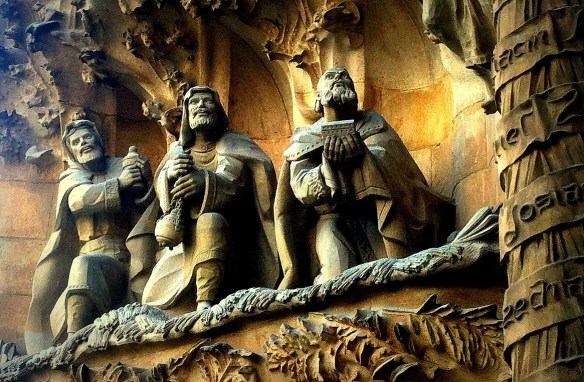

 The third was Herod Agrippa I, nephew of Herod the Great (so cousin of Herod Antipas), who executed St. James the Greater (the Apostle, brother of St. John) and imprisoned St. Peter. And the fourth was his son Herod Agrippa II, who St. Paul went before in Caesarea to be interrogated by Jewish accusers. Back to biggest and baddest, Herod the Great. He was at best half-Jewish, being an Arabian Idumite, descended from Esau (instead of Jacob, who was renamed Israel). Herod was chummy with the Romans, who installed him as a vassal king in Jerusalem. But he was excessively cruel, and excessively paranoid. He executed anyone who he perceived as a possible threat to his power and position, including his wives and children (He was played to the hilt by Ciarán Hinds in the 2006 Nativity movie!). So when it says “
 A pastor with a poor memory was watching the Mass on TV one day, and the priest in the Mass started his homily by saying, “Yes, I have spent some of the happiest moments of my life in the arms of another man’s wife!” The pastor could see the shocked reaction of the congregation. Then, the priest on the TV continued his homily, “That woman was my mother!” The audience exploded into laughter. A few weeks later this pastor thought that he would surprise his parishioners with this shocking sermon starter. So he started his preaching on Mary, the Mother of God. He began, “My dear brothers and sisters in Christ, I have to tell you, I have spent some of the happiest days of my life in the arms of another man’s wife!” The people, as he expected, were spellbound at the shocking confession of their holy pastor. Then after a long pause, the pastor muttered meekly, “…but for the life of me, I can’t remember who she was!”
 He is Israel’s God, their deliverer from slavery, their protector, their way, their truth, and their life. In the Holy Scriptures, in ancient human culture in general, names are not just arbitrary, but revelations of the nature of the person. Many times in the Scriptures, God provides or changes the name of a person, to reflect that person’s significant role (or changing role) in salvation history. The name participates in the reality of the person. How holy then, is the name God reveals as his own! So just as the first commandment sets apart the people’s reverence for God, the second commandment sets apart reverence for his Holy Name. After Israel’s reconversion to God during the Exile in Babylon, from that time on, they practiced such reverence for God’s name that they not only avoided using it in vain, they avoided using it all (except for Yom Kippur, the Day of Atonement, when it was pronounced by the High Priest). They would substitute “Adonai,” which translated into Greek as “Kyrios,” and into English as “Lord.”
 To greet someone (or bid them farewell) with the wish of shalom is to wish them wholeness, completeness, the satisfaction and fulfillment of the holy desires of their heart. Someone said something along the lines of (that’s how quotes work in my brain!) “Human nature is a question… and God is the answer.” Shalom is to have the yearning question within you answered by God. That is peace. The answer to our longing, the satisfaction of our desires, the satiation of our appetites, the pieces within us falling into place, with no additional need but to have ever more of God’s infinite love.
 You might remember the story of Samuel as a young boy sleeping near the ark, and hearing the Lord’s voice call his name, and twice, he got up and went to Eli, saying, “Here I am. You called me.” And Eli realized it was the Lord, and told Samuel, if he hears the voice again, to respond, “Speak, LORD, for your servant is listening.” According to Jewish Tradition, Samuel was 12 when this happened. And you might also remember that it was Samuel, the priest and the last of the judges of Israel, who was the prophet who anointed Saul as king, and later, David as king. So in making this reference to Samuel, our gospel is saying that Jesus as a young boy, or young man, has likewise gone to the Temple to begin his service to the Lord God, to speak the word of the Lord in the house of the Lord, and whose life is going to be totally dedicated to God’s will, totally dedicated to the priestly sacrifice that he’s going to ultimately offer in himself. And to reinforce this connection, it says that he increased in wisdom and in stature and in favor with God and man, which is almost a direct quotation from the Book of Samuel.
 In wedding homilies, I often bring up the example of ballroom dancing. It’s the man who leads the couple, providing structure and direction. But it’s the woman that captivates everyone’s attention, with the beautiful flowing dress and graceful movement. The man’s protection, structure, and leadership allows the grace and beauty of the woman to unfold. When she feels secure, her gifts will flower and flourish, because she trusts in his protection (that’s why marriage is for life: for the provision and protection of the mother and her children!)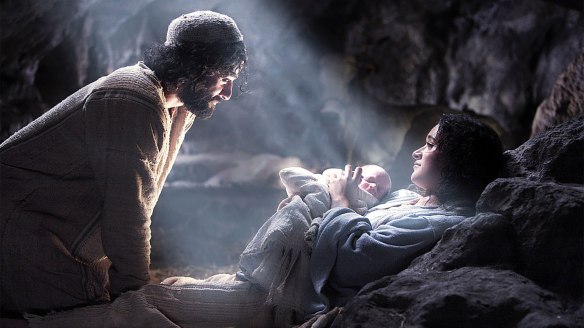


 Galilee, in the low-lying farm-land of the north. Elizabeth lives in the mountainous hill country of Judea, in the south. It took a week or so for Mary to make the journey, where she stayed for three months. This means that when these two holy children encountered each other—the unborn infant John, in his mother Elizabeth’s womb, and the unborn Lord Jesus, the fruit of his mother Mary’s womb—John was about 24 weeks old, and Jesus was barely more than 10-14 days old—neither of whom are considered persons with the dignity of human life by our own country’s laws. But we’re not going in that direction today… that’s a homily for later.


 In 1858, a few years after Pope Pius’ proclamation of this dogma, the Blessed Mother
 Pope Leo then composed and added the Saint Michael Prayer to the celebration of the Mass, to ask his intercession for the protection of the Church and her people, built on this Old Testament image of Michael as the prince and protector of the People of God.
 The Snarky Vicar