
22nd Sunday of Ordinary Time (Year C) (go to readings)
Sirach 3:17-18, 20, 28-29
Psalm 68:4-5, 6-7, 10-11
Hebrews 12:18-19, 22-24a
Luke 14:1, 7-14
Christian Herter was the governor of Massachusetts, and later the Secretary of State. While he was governor of Massachusetts, he was running hard for a second term. One day, after a busy morning without lunch, he arrived at a church barbecue. It was late afternoon and Herter was famished. As he moved down the serving line, he held out his plate to the woman serving chicken. She put a piece on his plate and turned to the next person in line. “‘Excuse me,” Governor Herter said, “do you mind if I have another piece of chicken?” “‘Sorry,” the woman told him. “I’m supposed to give one piece of chicken to each person, because you’re going to get other items further down the line.” “‘But I’m starved, and I love chicken,” the governor said. “‘Sorry,” the woman said again. “Only one to a customer.” Governor Herter was a modest and unassuming man, but he decided that this time he would throw a little weight around. “‘Do you know who I am?” he said. “I am the governor of this state!” “‘Do you know who I am?” the woman retorted. “I’m the lady in charge of the chicken. Move along, mister.”
Clearly the theme shared by readings this weekend is humility. We have sort of a love-hate relationship with humility, in that we can simultaneously think we’re the worst person in the room and look down on everyone else as better than them, at the same time. Humility comes from the Latin word for ground, or dirt. A humble person is grounded in reality, their feet on the ground, and living with their mind in the real world. That doesn’t mean without faith in the invisible and supernatural and holy, but not in a fantasy world that isn’t real. God is truth, and so we can only encounter God if we’re also accepting and living the truth, about ourselves, about the world, and about God.
Humility doesn’t mean trying to make ourselves small. Mother Teresa says, “True humility is truth. Humility comes when I stand as tall as I can, and look at all my strengths, and the reality about me, and then put myself alongside Jesus Christ. And it’s there, when I see how my greatness is so little in the light of his greatness, and I stop being fooled about myself and impressed with myself, that I begin to learn humility.”
In our gospel reading Jesus gives two separate messages about humility. First, he speaks to invited guests at a banquet. He sees that they’re taking the best seats, trying to cultivate powerful friendships and influence, presuming upon their reputation to take places of honor. But Jesus admonishes them not to be presumptuous, which incurs the risk of being humiliated by being sent downward in the social ladder. Rather, Jesus says, presume the lowest place as your proper place, not with a false humility of expecting to be moved higher, but a true humility. If you can be genuinely happy in the lower place, you will be even more happy when you are given a higher place, not because you believe you deserve it, but because you believe you don’t, and you appreciate the gift of your host’s esteem.
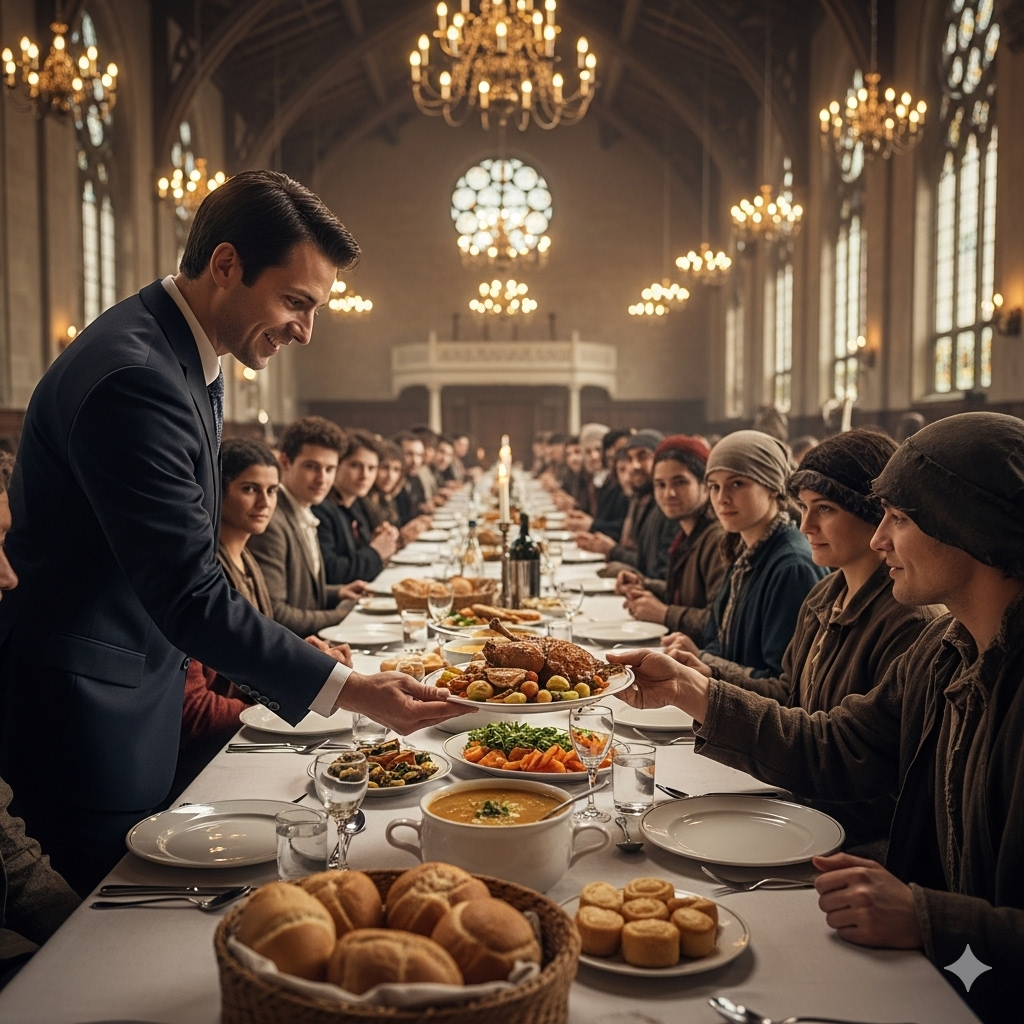
And then Jesus gives a second message to the hosts of such celebrations: don’t just invite those who will just return the favor, but also invite those who cannot, those who are the weak, powerless, poor, and outcast in society, that your celebration would truly be virtuous and generous. And of course, you would be their host, like Martha, waiting on them, and in that you would truly learn humility. Whoever wishes to be great must be the servant of all, Jesus says elsewhere.
Remember from the beginning of the gospel reading that this is at the house of a pharisee, on a Sabbath. So, while they should be praising the Lord, they’re praising themselves and each other. And while they should be good and caring shepherds, they’ve allowed themselves to get disconnected from the sheep and think they’re better than them. But Jesus is trying to restore that connection, that order of communion, and that virtue, in the hearts and ministry of the pharisees. The pharisees are a well-respected religious group that tried to take the prescriptions in the law for the priests, and apply them to everyone, in the effort to set Israel apart as a kingdom of priests, a holy people set apart, and thus to restore Israel to its greatness. But this would also tempt them to take pride in their attentiveness to legalistic details, and miss the greater call of the weightier things of the law, such as mercy and the humility to walk with the weak and vulnerable.

So to use that as something of a segue, speaking of the beloved children of our heavenly father, I want to clarify something. I had said at one of the Masses a few weeks ago that I, like many of us, are joyful and appreciative of the little interpolations and contributions to our celebration of the least among us, the babies and toddlers who enjoy exploring the acoustics of their little voices in our church. Sometimes people complain that there aren’t any children, then people complain that the noise of children is an obstacle to hearing what’s being said. I think part of the solution has been worked out as it seems our sound system has been successfully adjusted to make it easier to hear. And in my humility, in which I invite you to join with me, I’m going to say that I would rather have the sound of children drowning out my voice, than to have you hear me easily because we have made families with children feel like they are unwelcome. Because I think it’s far more important that we have a church of engaged young parents whose young children are unpredictable in their being young children, than to have a church that is dying because young families instead went where they were better welcomed, appreciated, and supported. So that’s a sacrifice I think we should offer to make as a parish community, because we, too, are called to be little ones in the kingdom, and perhaps it’s a good constant reminder of what little ones are like. I will trust that the parents of our little ones will do their best, and I will trust that those around them will be welcoming and compassionate.

And unfortunately, speaking of children in church, we heard of the evil tragedy at Annunciation Catholic Church and School in Minneapolis this week, when a mentally ill person shot into the church during the all-school Mass, killing an 8 and a 10 year old, and injuring 17 others in the church, and then took their own life. More information is coming out about the situation, and a lot of things are being said in the media and social media. But one of the important things that is coming out is a frustration at the phrase, “thoughts and prayers.” I actually re-released a blog article I had written in 2018 after the Parkland, Florida school shooting on this phrase. Long story short: for those of us who have little connection to the incident, and little power to do anything else about the incident, we do certainly offer our thoughts and prayers to the school and parish families, to all school families, especially in Catholic school, whose anxiety level has been raised this week because of this incident. And as followers of Christ, who instructed us to pray for our enemies and our persecutors, we also pray for those who caused this tragedy. If they could not get the support they needed in this life, perhaps we can contribute to the support they may need in the next life. But for those who do have the power to do something more to prevent tragedies like this from happening again, politicians, statesmen, the medical community, and others, then their response has to go beyond “thoughts and prayers.” This isn’t a substitute for a real corrective response. Some prominent people have ridiculed or denied the importance or effectiveness of prayer in the wake of this tragedy. And to be fair, it is not just a denial of faith and the powerful love of God, but more basically it is a response of frustration at those who have the power to effect change to potentially prevent these kinds of tragedies, but instead just offer “thoughts and prayers” instead of the work that they can do and are obligated to do.

In our parish here, a thousand miles away from our spiritual brothers and sisters at Annunciation Catholic Church in Minneapolis, we do heavily and sadly unite our hearts with their broken hearts, their grieving hearts, in their parish family. That same day, Wednesday, our parish was hosting a silver rose, a program of the Knights of Columbus of Canada, the United States, and Mexico, under the patronage of Our Lady of Guadalupe, to commend the lives of all children, particularly those in the womb, to the protection of Our Lady. After our Mass the silver rose was processed over to Saint Mary’s. There are 8 silver roses, which started in various places in Canada, Hawaii, Florida, and the Caribbean, and their pilgrimage journeys will unite at the Shrine of Our Lady of Guadalupe on her feast day, December 12. So I thank our Knights of Columbus for this and the many things you do to promote the pro-life message of Catholic Church teaching.

And I mentioned at that Wednesday Mass that perhaps we can use this tragedy to add some important devotion into our recitation of the prayer for the help of Saint Michael, the prayer written by Pope Saint Leo XIII after a mystical vision of the Church under demonic attack, and the call for protection by the archangel Saint Michael, the protector of God’s people. As Pope Leo had required the prayer to be said after all Masses until it was discontinued after the Second Vatican Council, many bishops, including Bishop Gainer, again required it in all the parishes of the diocese since 2016. So, this prayer at the end of Mass is not an opportunity to go out to the parking lot ahead of the crowd, it’s a requirement for each of us to pray for the spiritual defense of the Church, and her members, from the deadly enemy.
The world is indeed a beautiful place. God created it and called it very good, especially his final creation, humanity. Yes, there are evils in the world, evil spirits, perhaps evil people, evil groups of people, evil inventions, evil use of things. But we know that evil does not win in the end. God wins, and his people win with him. Let us rejoice in him, and, with humility, trust in him, and follow him.

 The Snarky Vicar