Homily: Humility and Children (and Minneapolis)

22nd Sunday of Ordinary Time (Year C) (go to readings)
Sirach 3:17-18, 20, 28-29
Psalm 68:4-5, 6-7, 10-11
Hebrews 12:18-19, 22-24a
Luke 14:1, 7-14


Christian Herter was the governor of Massachusetts, and later the Secretary of State. While he was governor of Massachusetts, he was running hard for a second term. One day, after a busy morning without lunch, he arrived at a church barbecue. It was late afternoon and Herter was famished. As he moved down the serving line, he held out his plate to the woman serving chicken. She put a piece on his plate and turned to the next person in line. “‘Excuse me,” Governor Herter said, “do you mind if I have another piece of chicken?” “‘Sorry,” the woman told him. “I’m supposed to give one piece of chicken to each person, because you’re going to get other items further down the line.” “‘But I’m starved, and I love chicken,” the governor said. “‘Sorry,” the woman said again. “Only one to a customer.” Governor Herter was a modest and unassuming man, but he decided that this time he would throw a little weight around. “‘Do you know who I am?” he said. “I am the governor of this state!” “‘Do you know who I am?” the woman retorted. “I’m the lady in charge of the chicken. Move along, mister.”  

Clearly the theme shared by readings this weekend is humility. We have sort of a love-hate relationship with humility, in that we can simultaneously think we’re the worst person in the room and look down on everyone else as better than them, at the same time. Humility comes from the Latin word for ground, or dirt. A humble person is grounded in reality, their feet on the ground, and living with their mind in the real world. That doesn’t mean without faith in the invisible and supernatural and holy, but not in a fantasy world that isn’t real. God is truth, and so we can only encounter God if we’re also accepting and living the truth, about ourselves, about the world, and about God.

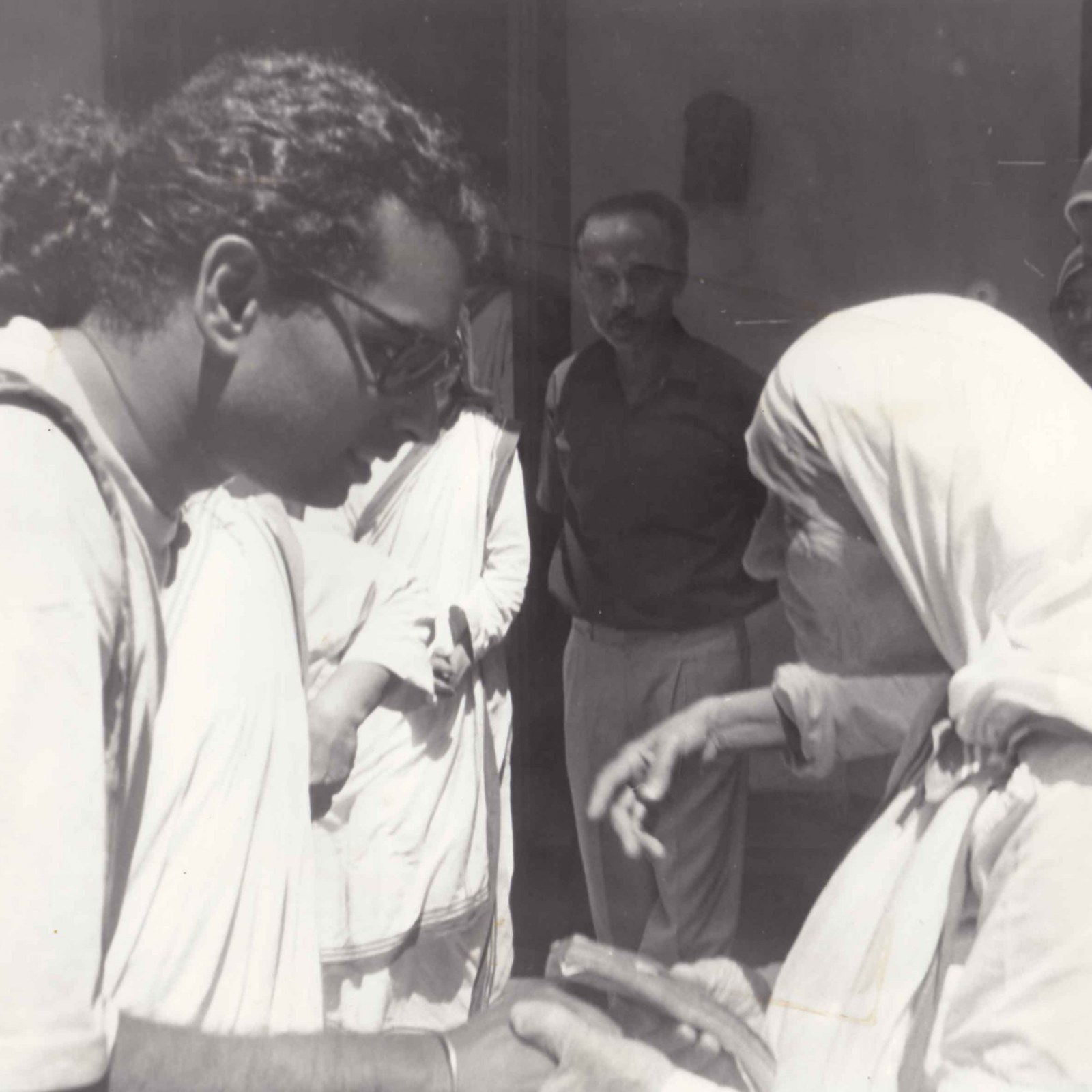
Humility doesn’t mean trying to make ourselves small. Mother Teresa says, “True humility is truth. Humility comes when I stand as tall as I can, and look at all my strengths, and the reality about me, and then put myself alongside Jesus Christ. And it’s there, when I see how my greatness is so little in the light of his greatness, and I stop being fooled about myself and impressed with myself, that I begin to learn humility.

In our gospel reading Jesus gives two separate messages about humility. First, he speaks to invited guests at a banquet. He sees that they’re taking the best seats, trying to cultivate powerful friendships and influence, presuming upon their reputation to take places of honor. But Jesus admonishes them not to be presumptuous, which incurs the risk of being humiliated by being sent downward in the social ladder. Rather, Jesus says, presume the lowest place as your proper place, not with a false humility of expecting to be moved higher, but a true humility. If you can be genuinely happy in the lower place, you will be even more happy when you are given a higher place, not because you believe you deserve it, but because you believe you don’t, and you appreciate the gift of your host’s esteem.

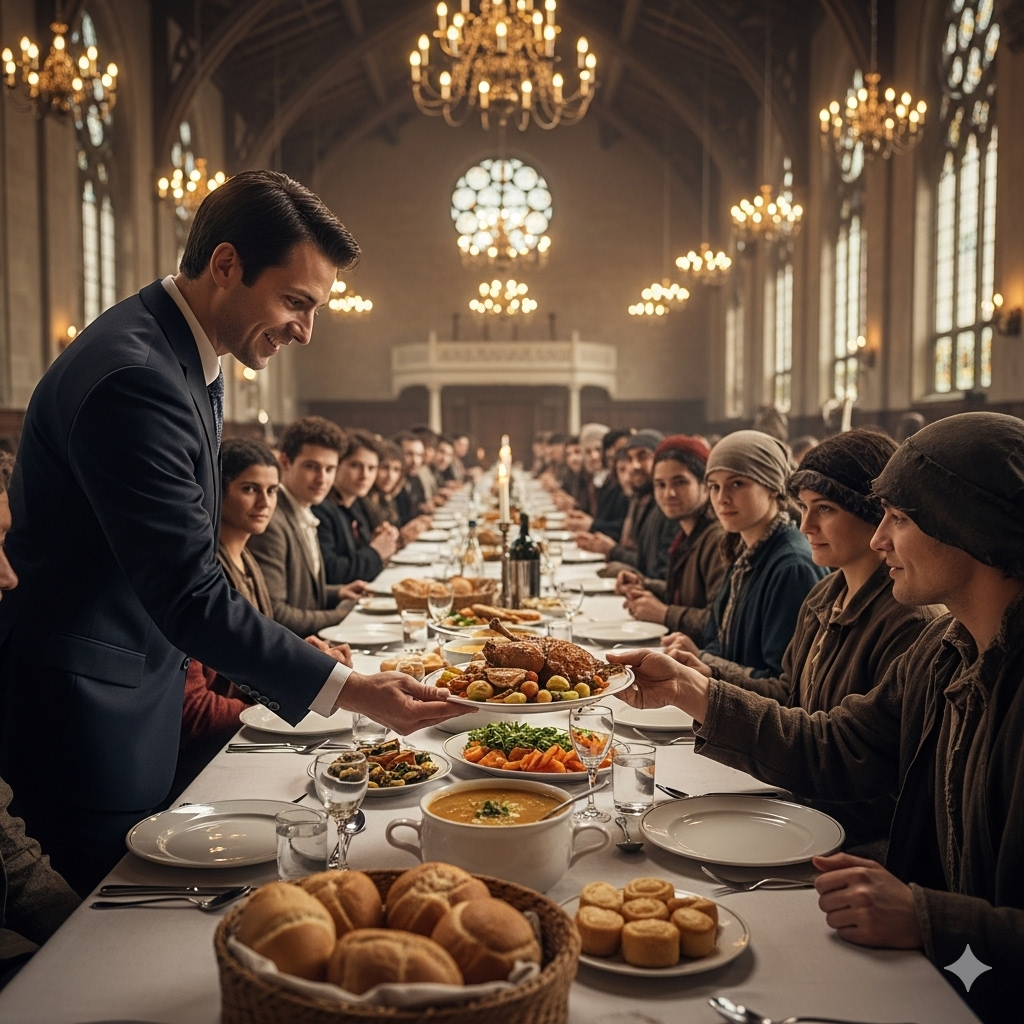
And then Jesus gives a second message to the hosts of such celebrations: don’t just invite those who will just return the favor, but also invite those who cannot, those who are the weak, powerless, poor, and outcast in society, that your celebration would truly be virtuous and generous. And of course, you would be their host, like Martha, waiting on them, and in that you would truly learn humility. Whoever wishes to be great must be the servant of all, Jesus says elsewhere.

Remember from the beginning of the gospel reading that this is at the house of a pharisee, on a Sabbath. So, while they should be praising the Lord, they’re praising themselves and each other. And while they should be good and caring shepherds, they’ve allowed themselves to get disconnected from the sheep and think they’re better than them. But Jesus is trying to restore that connection, that order of communion, and that virtue, in the hearts and ministry of the pharisees. The pharisees are a well-respected religious group that tried to take the prescriptions in the law for the priests, and apply them to everyone, in the effort to set Israel apart as a kingdom of priests, a holy people set apart, and thus to restore Israel to its greatness. But this would also tempt them to take pride in their attentiveness to legalistic details, and miss the greater call of the weightier things of the law, such as mercy and the humility to walk with the weak and vulnerable.


So to use that as something of a segue, speaking of the beloved children of our heavenly father, I want to clarify something. I had said at one of the Masses a few weeks ago that I, like many of us, are joyful and appreciative of the little interpolations and contributions to our celebration of the least among us, the babies and toddlers who enjoy exploring the acoustics of their little voices in our church. Sometimes people complain that there aren’t any children, then people complain that the noise of children is an obstacle to hearing what’s being said. I think part of the solution has been worked out as it seems our sound system has been successfully adjusted to make it easier to hear. And in my humility, in which I invite you to join with me, I’m going to say that I would rather have the sound of children drowning out my voice, than to have you hear me easily because we have made families with children feel like they are unwelcome. Because I think it’s far more important that we have a church of engaged young parents whose young children are unpredictable in their being young children, than to have a church that is dying because young families instead went where they were better welcomed, appreciated, and supported. So that’s a sacrifice I think we should offer to make as a parish community, because we, too, are called to be little ones in the kingdom, and perhaps it’s a good constant reminder of what little ones are like. I will trust that the parents of our little ones will do their best, and I will trust that those around them will be welcoming and compassionate.

And unfortunately, speaking of children in church, we heard of the evil tragedy at Annunciation Catholic Church and School in Minneapolis this week, when a mentally ill person shot into the church during the all-school Mass, killing an 8 and a 10 year old, and injuring 17 others in the church, and then took their own life. More information is coming out about the situation, and a lot of things are being said in the media and social media. But one of the important things that is coming out is a frustration at the phrase, “thoughts and prayers.” I actually re-released a blog article I had written in 2018 after the Parkland, Florida school shooting on this phrase. Long story short: for those of us who have little connection to the incident, and little power to do anything else about the incident, we do certainly offer our thoughts and prayers to the school and parish families, to all school families, especially in Catholic school, whose anxiety level has been raised this week because of this incident. And as followers of Christ, who instructed us to pray for our enemies and our persecutors, we also pray for those who caused this tragedy. If they could not get the support they needed in this life, perhaps we can contribute to the support they may need in the next life. But for those who do have the power to do something more to prevent tragedies like this from happening again, politicians, statesmen, the medical community, and others, then their response has to go beyond “thoughts and prayers.” This isn’t a substitute for a real corrective response. Some prominent people have ridiculed or denied the importance or effectiveness of prayer in the wake of this tragedy. And to be fair, it is not just a denial of faith and the powerful love of God, but more basically it is a response of frustration at those who have the power to effect change to potentially prevent these kinds of tragedies, but instead just offer “thoughts and prayers” instead of the work that they can do and are obligated to do.

In our parish here, a thousand miles away from our spiritual brothers and sisters at Annunciation Catholic Church in Minneapolis, we do heavily and sadly unite our hearts with their broken hearts, their grieving hearts, in their parish family. That same day, Wednesday, our parish was hosting a silver rose, a  program of the Knights of Columbus of Canada, the United States, and Mexico, under the patronage of Our Lady of Guadalupe, to commend the lives of all children, particularly those in the womb, to the protection of Our Lady. After our Mass the silver rose was processed over to Saint Mary’s. There are 8 silver roses, which started in various places in Canada, Hawaii, Florida, and the Caribbean, and their pilgrimage journeys will unite at the Shrine of Our Lady of Guadalupe on her feast day, December 12. So I thank our Knights of Columbus for this and the many things you do to promote the pro-life message of Catholic Church teaching.

And I mentioned at that Wednesday Mass that perhaps we can use this tragedy to add some important devotion into our recitation of the prayer for the help of Saint Michael, the prayer written by Pope Saint Leo XIII after a mystical vision of the Church under demonic attack, and the call for protection by the archangel Saint Michael, the protector of God’s people. As Pope Leo had required the prayer to be said after all Masses until it was discontinued after the Second Vatican Council, many bishops, including Bishop Gainer, again required it in all the parishes of the diocese since 2016. So, this prayer at the end of Mass is not an opportunity to go out to the parking lot ahead of the crowd, it’s a requirement for each of us to pray for the spiritual defense of the Church, and her members, from the deadly enemy.

The world is indeed a beautiful place. God created it and called it very good, especially his final creation, humanity. Yes, there are evils in the world, evil spirits, perhaps evil people, evil groups of people, evil inventions, evil use of things. But we know that evil does not win in the end. God wins, and his people win with him. Let us rejoice in him, and, with humility, trust in him, and follow him.

Homily: Praise the LORD, all you nations

21st Sunday in Ordinary Time, Year C (go to readings)


We know from rabbinic sources from around the time of Jesus that one of the big questions they were wrestling with was, “who will be saved?” You hear it a number of times in the New Testament, including in our Gospel reading today. Rabbis leaning toward the conservative side were saying that not all of Israel would be saved. The generation of Noah, the people of Sodom, the rebellious generation that left Egypt in the Exodus, the ten lost tribes of the Northern Kingdom. They were excluded. Other rabbis, leaning toward a more liberal interpretation, were saying that God would restore the lost tribes, and perhaps show mercy to all who had sinned, and perhaps all of Israel might be saved. But on both sides, the scope of who would be saved was still limited to Israel, God’s chosen people. Even the more liberal suggestion was that being an Israelite, a Jew, was a guarantee of salvation. And so, with this question circulating around Israel, someone finally asks the Messiah, the one who perhaps would know for sure, this burning question. And Jesus, being typical Jesus, doesn’t answer the question. In fact, he answers a whole different question, which wasn’t asked. In response to this one person’s question, he said to the crowd, “Strive to enter through the narrow gate, for many, I tell you, will attempt to enter but will not be strong enough.” So a few things in that important sentence: First, the narrow gate seems to favor the narrow interpretation of the question that was asked. Second, we might picture a crowd trying to get through a pass that narrows down to one person at a time. Like an amusement park gate or sports venue gate. The entrance seems wide, but as you get close, you see it’s rather narrow and guarded. And if there were a big rush trying to pass through that narrow gate, the strong would seem to have an advantage. But for this gate, it’s not the physically strong, but the spiritually strong. Those who have disciplined themselves and their appetites to be virtuous, because they have battled against their vices in prayer and surrender to God to grow in holiness. These are the ones who will be strong enough to pass through this gate. And third and most important about this, is that Jesus doesn’t answer the question of whether there will be few or many, but rather the instruction to make sure that no matter how many there are, you make sure that you are among them. Your call is not to be holier than the next person, but to be as holy as you can possibly be.

You stand outside knocking and saying, ‘Lord, open the door for us.’ He will say to you in reply, ‘I do not know where you are from. And you will say, ‘We ate and drank in your company, and you taught in our streets.’ Then he will say to you, ‘I do not know where you are from. Depart from me, all you evildoers!‘”

There’s a difference between “knowing about Jesus” and “knowing Jesus.” When Pope Leo XIV was elected, a lot of people got to know a lot about him. But not like his family knows him. It’s not enough to know about Jesus, to hear the bible stories, to say daily prayers, go to Mass, even receive communion, and be done with it until next time. We have to intentionally enter into spiritual communion with Jesus, give him permission to change our hearts, our lives, and then prayerfully respond to his invitation to these changes he’s leading us through, becoming closer to him, conforming our heart to his sacred heart, hearing his voice and obeying in love.

God makes each of us with great care. He is our heavenly father. But we can make ourselves into something else, we can distort ourselves, distort our humanity, our goodness, by sin, by rejection of God’s discipline, and then fearfully hear God say, “I do not know you. I do not know where you are from” as the gates of heaven are locked against us, and we are outside wailing in eternal sorrow, or even eternal anger, railing against God for having the audacity to exclude us.

It can apply to us in the church as much as it applied to the Jews hearing Jesus say, “when you see Abraham, Isaac, and Jacob and all the prophets in the kingdom of God and you yourselves cast out. And people will come from the east and the west and from the north and the south and will recline at table in the kingdom of God.” Jesus doubles down on that personal message: not just saying directly, “Strive to enter through the narrow gate,” but “you yourselves cast out.” The Greek word for strive there is “agonizomai,” where we get the word “agony” and “agonize,” which also appears in Paul’s first letter to the Corinthians, when he is talking about athletes exercising discipline, “agonizomai”, struggling, striving, with all their might, their mind, their heart, for their little reward, and how much more should we strive for salvation, which we could lose by vice, sin, and distraction?

We’re going to end with the last part of that quote: “And people will come from the east and the west and from the north and the south and will recline at table in the kingdom of God.” In this, Jesus is confirming Old Testament passages like our first reading in which Israel will be restored not for its own sake, but for the sake of the whole world. The Jews were angry with Jesus for being a Messiah that claimed to be not just Israel’s own private savior from the oppression of the Romans, but the universal savior of humanity from the oppression of sin. I love irony, but sometimes irony can be dark. Just as Eve in the Garden of Eden fell to the serpent’s lie that eating the fruit would make her like God, when she was already more like God than she would be after eating the fruit, the Jews were unhappy with Jesus, as we just said, but it was in being the Messiah, the Savior of the World, by which he would restore Israel to its special privileged place of being God’s holy city. And because of their angry rejection of Jesus, they crucified him just outside of Jerusalem, and fulfilled what Jesus had promised, the Messianic Age, but now in a way in which the Jews’ relationship to this fulfillment is difficult, and the city of the glory of the New Covenant people, the Church, is no longer Jerusalem, which was destroyed, as Jesus said would happen if they killed him. “If you destroy this temple, I will rebuild it in three days.”

But we’re going to sum all this up to two points Jesus gives us. First, we should focus more on our personal commitment to striving for our personal holiness without the distraction of asking if it will be many or few, or comparing ourselves to other people. There are places in the scriptures where it seems like a few, such as our gospel reading, and there are places where it seems like many, such as the numberless multitude in the book of Revelation.

Our faith teaches us that God has given humanity through the Catholic Church all the necessary means of salvation, which is to say the Sacred Scriptures, sacred Tradition, sacred Liturgy, and sacred sacraments, particularly the grace which protects the integrity of the Church and its Faith. The downside for us of course is not only are we more under attack by the enemy who wants to destroy the Church and its members, but that we are held to a higher standard. “To whom much is given, of them much is expected.” As Israel should have been the beacon of holiness to the ancient world, guided by the gift of the divine law, the Church ought to be even more so to the modern world, guided by the grace and truth of the New Covenant.

The Catholic Church teaches that although God instructs us about what is necessary for salvation, and we must take that with absolute seriousness, God himself is not limited to what he has given us. He is God, and he can freely choose to save whom he wills, how he wills, but he willed to reveal to us the way he intended to save us, and so we would be wise to obey, and foolish to be presumptuous.

Those who were raised outside the faith or with an immature faith will be judged less harshly, as we heard a few weekends ago. To the extent that they do good and avoid evil as they perceive it in their fallen and limited human nature, the good that they do outside the state of grace will not be salvific, but will help conform them and open them up more to goodness, and help them to more easily hear the call of God in them toward Jesus and his Church. However, even though whatever evil they choose is in greater ignorance, while their sinfulness is not as grave, they still must suffer the consequences of the evil of their actions. While those outside the Church have a hope of salvation by the mystery of God’s mercy beyond what he has instructed for the Church, it is still a great act of love to evangelize lost souls, because not only does it help them avoid sin and the consequences of evil choices, but more importantly it invites them to the joy of the life of grace, the beauty of the Church temporally and spiritually, the spiritual blessings of the sacraments, and the fuller blossoming of their particular gifts. While many consider the Catholic Church to be their enemy, the Church does not consider them to be her enemy. They are her lost children, her mission field, and those yet to be reborn to her in the womb of baptism and brought into full communion in her spousal relationship with the Lord.

Jesus was and is the Messiah, sent to restore Israel, including the expectation of reuniting the ten lost tribes who had been dispersed among the nations of the world. And so, if the Messianic covenant is going to include the descendants in all the world, then all the world, those who are outside the covenant, must be invited. And so, after Pentecost until the end of the age, in the gift of the Holy Spirit, Jesus sends out his Apostles to north, south, east, and west, inviting all to enter into the New Covenant: responding to grace by living the life of love, faith, and obedience, striving for holiness as God has revealed it to us, including sharing the fullness of truth we have received. Although God loves all and calls all to accept the invitation, not all will humbly submit themselves to his discipline and formation, to be able to answer the call to the banquet. His love is unconditional, and our response is up to us. We can be those warned about being shut out. Or we can be the beneficiaries of our readings today: the ones invited from all the nations, north, south, east, and west. Blessed are those called to the supper of the Lamb.

Homily: The Assumption of Mary, our Co-Redemptrix

Solemnity of the Assumption of the BVM
Vigil Readings: Go to readings

1 Chronicles 15:3-4, 15-16; 16:1-2
Psalm 132:6-7, 9-10, 13-14
1 Corinthians 15:54b-57
Luke 11:27-28
Feast Day Readings: Go to readings
Revelation 11:19A; 12:1-6A, 10AB
Psalm 45:10, 11, 12, 16
1 Corinthians 15:20-27
Luke 1:39-56


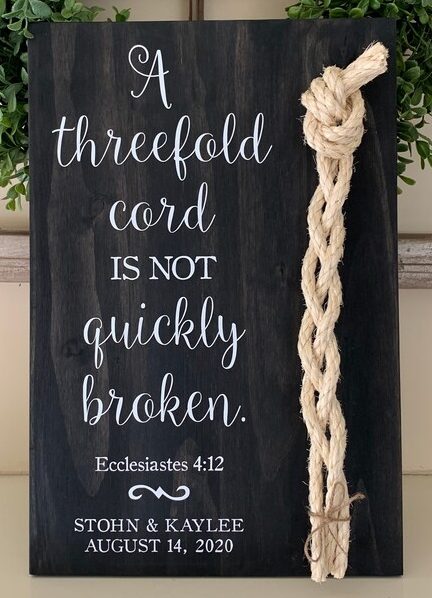
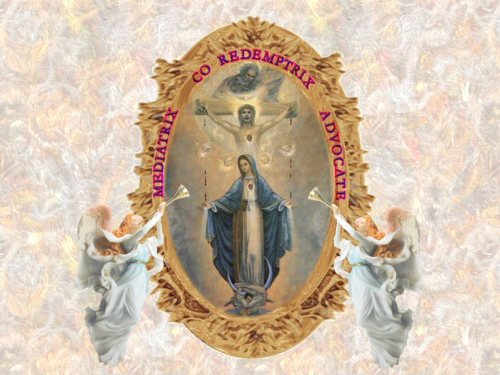
The Wisdom literature of the Bible says, “A three-ply cord is not easily broken” (Eccl 4:12). So, we are going to braid together three cords: the readings for the Vigil and for the Feast of the Assumption, and a timely article that just came out about Pope Leo XIV’s Marian devotion as displayed in his first 100 days as pope. The article is an interview with Dr. Mark Miravalle, a Catholic professor, on the topic of the Blessed Mother’s beautiful title as “Co-Redemptrix, Mediatrix of all graces, and Advocate for humanity.”

Pope Leo was elected on a Marian Feast Day, the Feast of Our Lady of Pompeii. Many popes across the centuries have prayed at this Marian shrine in Italy. It was from Pompeii that popular devotion began the call for the dogma of the Assumption. Our Lady of Pompeii is associated with the story of Blessed Bartolo Longo, a 20th century satanic priest who converted to the Catholic faith, became a Dominican tertiary, and had a deep, authentic devotion to Mary and the rosary. He became a friend of Pope Leo XIII (the first pope to approve the title for Mary as “coredemptrix”), and it was from Blessed Bartolo’s writings that Pope John Paul II developed the Luminous Mysteries of the Rosary. This feast of Our Lady of Pompeii, May 8, was previously the feast of Mary the Mediatrix of All Graces. So already just on day one, a lot of Marian connections for Pope Leo. He has not hesitated to make reference to Our Lady in the first moments of his papacy, calling us to pray with her, identifying her as our mother. It is his habit as pope to go to the basilica of Saint Mary Major to see the revered Byzantine icon Our Lady of Salus Populi Romani, held by Tradition to have been painted by the evangelist Saint Luke. His coat of arms has at the top of it the Fleur-de-lis, a heraldic symbol associated with Mary.


One of the difficulties between Catholics and Protestants regarding the Catholic devotion to Mary is that while the New Testament gives a few clues to Mary’s importance to the life and faith of Christians and the Church, the real revelation of Mary’s special importance lies in the Old Testament images she fulfills.

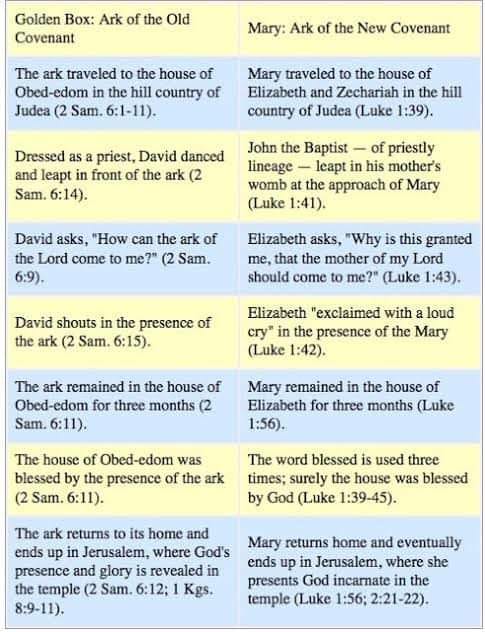
One of the best examples is the Marian title “The Ark of the New Covenant,” which we can see with first reading from the vigil with the first reading from the Feast Day, along with parts of the gospel reading from the Feast Day. The ark had been lost in battle and found, and King David was bringing it to Jerusalem. However, after a tragic accident, they postponed the procession, temporarily storing the ark in the home of Obed-edom whose home in the Judean hill country was blessed for the three months it stayed there. Then resuming the procession, David danced and shouted with joy before the Ark of the Lord as it was triumphantly enthroned in the sanctuary. David cried out, “Who am I, that the Ark of the Lord should come to me?” Remember the contents of the ark: it the staff of Aaron, a royal symbol of God’s power, a jar of mana, the bread of heaven, the answer to Moses’ priestly prayer on behalf of the people in the wilderness, and the broken tablets of the ten commandments, the prophetic word of God to guide his people in wisdom and righteousness (symbols of priest, prophet, and king). The ark was crowned with the mercy seat, on which the glory cloud of the Lord would overshadow and rest, the presence of the Lord with his people. We also see references to this in our psalm for this feast, “Lord, go up to the place of your rest, you and the ark of your holiness… Let us enter his dwelling, let us worship at his footstool.” The ark was lost again at the time of the Babylonian Exile and has never been found, and so the anticipation of the return of the ark was part of the hope of the Messianic fulfillment.

Putting that together with the gospel reading for the feast day, Mary had been, like the ark, overshadowed by the glory cloud, the Holy Spirit, and became the vessel of the Messiah, the Son of God, priest, prophet, and king, the presence of God amidst his people. When Elizabeth heard Mary’s voice, John the Baptist leapt in her womb, and Elizabeth shouted with joy, and said, “Who am I, that the Mother of my Lord should come to me” as David had leapt and shouted joyfully in the presence of the Ark. And their house, like that of Obed-edom, in the hill country of Judea, was blessed for the three months Mary was with them.

We see the ark again in the reading from the Book of Revelation of St. John, where he sees the Ark in the heavenly temple, and then goes on to describe this vision, “a woman clothed with the sun, with the moon under her feet, and on her head a crown of twelve stars. She was with child… She gave birth to a son, a male child, destined to rule all the nations…” John doesn’t change subjects, here—he’s saying that the ark is the woman with the crown of twelve stars. The figure of the ark has at last appeared again, in its fulfillment in Mary. Now we’re getting closer to our feast day.

Another helpful Old Testament connection is in the psalm for the feast day, “The queen stands at your right hand, arrayed in gold.” In the Kingdom of David, the queen wasn’t the king’s wife, he had many wives. The queen was the king’s mother. And she would sit at the right hand of the king, receiving the requests of the people and interceding on their behalf with her son, the king. So with Jesus being the new “Son of David”, whose kingdom will have no end, who would be the queen in this kingdom, but Mary, the king’s queen mother, who is a mother to all the children of the kingdom, and intercedes with her son on their behalf.


Now, the mystery of the Assumption is a fruit of the mystery of the Immaculate Conception. And the Immaculate Conception is a fruit of the mystery of the Annunciation. When the angel greeted Mary, he used a word in Greek that appears nowhere else: kecharitomēnē (κεχαριτωμένη). It refers to something, a person, whose very nature of existence is the act of receiving (being filled with) grace, and of course the definition of grace is “the life of God within us.” This word, kecharitomēnē, means more than “full of grace.” It is spoken only about this one special person, and the word is so special that the one time it is used it is said by an angel. So there’s something about Mary. Not only is she going to be the one to receive the life of God within her in the mystery of the Incarnation, but her whole life is a sinless response to this annunciation, as her whole life up to this moment has been a sinless preparation for it. God will receive his humanity from her (thus making her truly mother of God incarnate, Jesus), and she will have the role as queen intercessor of her people, as she showed at the Wedding Feast of Cana (Jn 2:2-11). This maternal care of Mary for the Church is further evidenced at the cross, as Jesus commends Mary, the woman, the mother, to John, the blessed disciple whom Jesus loved, which by extension is all of us.

Our gospel reading for the vigil has a woman calling out of the crowd to Jesus, “Blessed is the womb that carried you and the breasts at which you nursed.” He replied, “Rather, blessed are those who hear the word of God and observe it.” Some will say that this is Jesus distancing himself from Mary. But no one has heard the word of God and observed it better, with more purity of heart, than Mary. So indeed, blessed is the woman whose womb carried him, but not because of the physical bond of motherhood, but because of her spiritual role of motherhood and her spiritual role as the first and greatest disciple, the immaculately conceived, preserved, and protected vessel of grace. Mary herself confirms the immaculate conception when, 4 years after Pope Pius IX declares it as one of the Marian dogmas of the Christian faith in 1854, Mary says to Saint Bernadette at Lourdes, “I am the Immaculate Conception.”

But that begs the question, if Mary is the Immaculate Conception, perpetually without sin, did she suffer death, which is the consequence of sin? Adam and Eve, as the original parents of all humanity, introduced sin into humanity and propagated it to all their descendants. One of the titles of Mary is “The New Eve,” whose children live not unto death, but by the paschal mystery of the New Adam, who redeems and recreates humanity, live unto eternal life. The June 9th homily by Pope Leo, one of the clearest references to Our Lady’s co-redemption, says that Mary’s motherhood took an unimaginable leap to the cross where she becomes the new Eve and that Jesus has associated her in his redemptive death. That’s what the title co-redemptrix means: that Mary uniquely participates with Jesus, the new Eve with the new Adam, in the redemption of humanity. But the fact that Pope Leo brought the new Eve to Calvary is very significant. Jesus, who won infinite grace for our redemption, defers to the Blessed Mother in the distribution of those graces according to her maternal care of the children of God. She who loved with a perfect sinless heart could perfectly join herself in love to the sufferings of others, most especially her son, and then also all those who humbly call upon her intercession.


And so, we have our second reading from the feast day, Paul’s first letter to the Corinthians, quoting the prophet Hosea: “Death is swallowed up in victory. Where, O death, is your victory? Where, O death, is your sting?” And Paul continues, “The sting of death is sin, and the power of sin is the law. But thanks be to God who gives us the victory through our Lord Jesus Christ.”

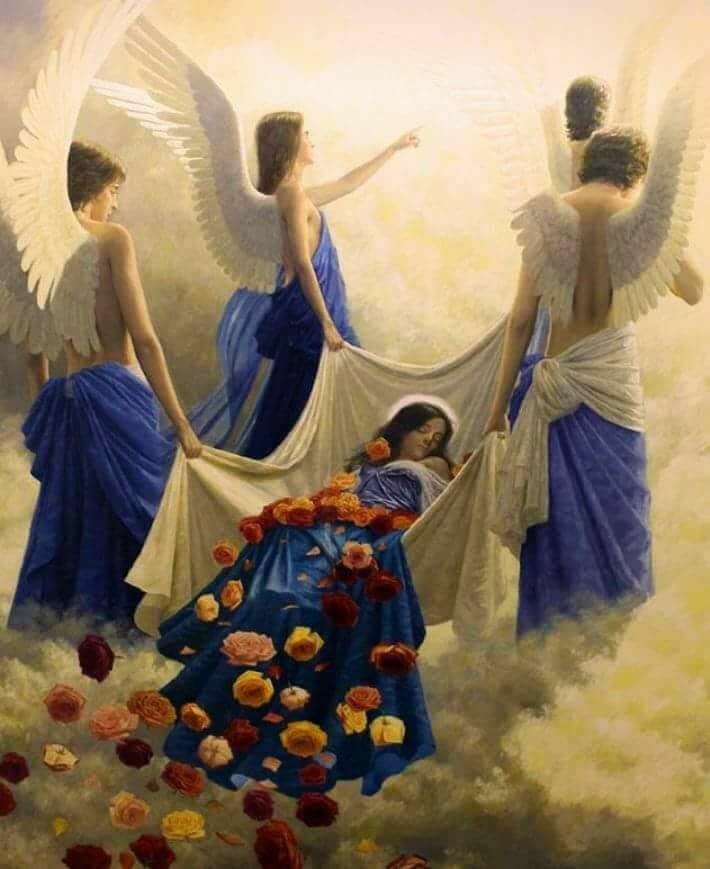
Mary perfectly lived the law, was not stung by sin, and so would not suffer death as a consequence. The Church carefully worded the dogma of the Assumption to not clearly resolve this question of whether Mary died. The definition of the dogma says, “that the Immaculate Mother of God, the ever Virgin Mary, having completed the course of her earthly life, was assumed body and soul into heavenly glory.” Jesus, by his divine nature, ascended to heaven by his own power. Mary, in her human nature, like ours, does not have that power, and was assumed into heaven by the power of God. There is a legend that Mary seemed to die, what the Eastern Church calls the mystery of the Dormition of Mary, and all the apostles buried her, except Thomas, who was working in India. When Thomas arrived, they re-opened the tomb and it was empty. Hence the seed planted in the apostolic tradition, nursed and developed over the centuries, until it was proclaimed by Pope Pius XII in 1950, not as something new, but as something whose time had come. In the face of the many modern human attempts that came after World War II and the rise of atheistic humanism to redefine humanity and our perfection, the Church puts forth in the Assumption the truth that God has defined the nature of humanity, and in God is the only real perfection of humanity; and the humble, prayerful, obedient Blessed Virgin Mary is the perfect image and example of how God exalts the soul that trusts in him, that he lifts up the lowly and glorifies the humble forever in eternal life.

Pope Leo XIV revealed his papal name to be a call-back to Leo XIII, who not only had a great Marian devotion, as we said earlier, but also a mission to protect the understanding of genuine human dignity in a time of global tension and injustice, just as Pope Pius responded to similar tensions in 1950, and also as Pope Leo XIV has in our time, against global tensions, injustice, and the potentially anti-humanistic threats latent in artificial intelligence: that he might safeguard what it means to be authentically human in an increasingly digital, virtual, and artificial world, but also to protect against a kind of digital idolatry, as people turn to AI to ask the profound questions of meaning, truth, good, and love, for which they should properly turn to God with prayer and dialogue, not to AI with a command prompt. Pope Leo gave a message to 50,000 young people at a youth festival in Rome, and said to them: “No algorithm can ever substitute an embrace, a glance, a true encounter, neither with God, nor our friends, nor our family. Think of Mary.” I think it revealed, in the mind of the Pope, that Our Lady has that ability of bringing back what is authentically human.

The truth of the importance of Mary is like Saint Augustine’s quote about scripture: the new is hidden in the old, and the old is revealed in the new. As we look at the mystery of the Blessed Mother, we are assured that our personal human nature was intentionally and personally designed with our body and soul, which is destined with meaning and for perfection. Mary as co-redemptrix is her privilege to participate in distributing the graces won by her son in his Paschal Mystery, as she was so painfully united to him in his suffering. He is the one mediator between God and humanity, but he generously shares the joy of distributing this grace, for those who call upon him in faith, especially through the intercession of the Blessed Mother, who for her humble faith and obedience in her special role in salvation history, was assumed body and soul into heaven, the sign of God’s promise of the fulfillment of our humanity and our eternal life.  

Homily: SUDS

Homily for the 19th Sunday of Ordinary Time, Year C (go to readings)
Wisdom 18:6-9
Psalm 33:1, 12, 18-19, 20-22
Hebrews 11:1-2, 8-19
Luke 12:32-48


Something that came across my social media feed this past week was an article called, “Principles of Neuroscience Embedded in the Spirituality of St. Francis de Sales – A Pastoral Approach to Addictive Behaviors.” This is the kind of thing some of us priests read for fun. But one of the concepts new to me brought up in the article was the acronym, “SUD”s, which stands for “Seemingly Unimportant Decisions” Examples might include a recovering alcoholic joining co-workers after-hours, and finding out their plan is to meet at a local bar, and still agreeing to go with them. Or taking a detour that goes past the home of someone with whom one committed adultery. Or spending time with an old friend who is a catalyst for risky, dangerous behaviors. Saint Francis de Sales might call all of these “occasions of sin.” Not sinful in themselves, but they present threats to sinful or dangerous behavior.

The idea of SUD’s in my mind, as I was also thinking about our weekend’s readings, is that seemingly unimportant decisions might be applied in the other direction, too. Seemingly unimportant decisions of virtue. Holding the door for the person behind you. Paying for the person after you at a store. Stopping to help someone fix a flat tire.

Our Lord speaks often about mercy: “Forgive us our trespasses, as we forgive those who trespass against us.” “Blessed are the merciful, for they will receive mercy.” The parable of the Good Samaritan. Why? Because the Lord wants to show us mercy, and he does show us mercy, but we can be unperceiving of it, not seeing, not being aware of it. How do we fix that? We have to attune our heart to the virtue of mercy. To God’s radio frequency. We can be on the wrong channel, listening to themes of revenge, pride, and anger. And we’re missing the important broadcast. We have to change the dial, turn to the channel that God’s message is going out on. And to hear God’s message of mercy, we have to change the frequency of our heart to the channel of mercy. We have to sensitize ourselves to the theme of mercy. And we do that by showing mercy to others. The more we get into that groove of living a life of mercy; the more we’re sensitized to opportunities of showing mercy, the more we will hear God’s message of how he is showing mercy to us. And, of course, even better, we will see more opportunities to show God’s mercy to others, and become his instrument of mercy. So sometimes these little SUDs, little seemingly unimportant decisions, can have big dividends in changing our heart little by little.

In the Old Testament reading, from the Book of Wisdom recalling the night of Passover, it says, “For in secret the holy children of the good were offering sacrifice and putting into effect with one accord the divine institution.” And so by this decision, they had disposed themselves to be sensitive to hearing God’s voice, and they were ready to respond when he gave the command to pack up and flee Egypt.

In our psalm it says, “See, the eyes of the LORD are upon those who fear him, upon those who hope for his kindness, to deliver them from death and preserve them in spite of famine. Our soul waits for the LORD, who is our help and our shield.” That listening closely for the voice of the Lord, hoping and trusting in the Lord, come what may, training the ear of faith to be attuned for that still small voice of the Lord among the loud voices around us, allows us to respond because we were ready. That image of our soul waiting for the Lord is not just one of being motionless, poised like runners on the starting blocks, but more like servants watching for the subtle gestures and signals of those they wait on, to be immediately responsive to the call to move.

Skipping over our second reading for a moment to go to the Gospel, Jesus is, as always, encouraging us to have that attentive yet active waiting on the Lord. If we practice that listening for the Lord, we can get a sense of what he is instructing us to do, not just in the word of the Scripture, but in the word of the Holy Spirit speaking to us in particular situations of our life.

There was a man who spent a month working at the House of the Dying in Calcutta with Mother Teresa. He said that on the first morning, she asked him, “And what can I do for you?” He asked her to pray for him. “What do you want me to pray for?” He voiced the request he most desired for his discernment in God’s plan for his life. He asked her, “Pray that I have clarity.” She said “No.” That was that. When he asked why, she answered that clarity was the last thing he was clinging to and had to let go of. When he commented that she herself had always seemed to have the clarity he longed for, she laughed: “I never have had clarity; what I’ve always had is trust. So, I will pray that you have trust.”

Sometimes we can procrastinate following God’s will because we want more proof. We want a clearer instruction. We want the path marked out with lights and arrows. Believe me, I know, that was the story of my discernment for the priesthood. I was waiting for the divine 2’x4′ to remove any doubt of what I was supposed to do. But I came to understand I wasn’t going to have that removal of all doubt. It was going to take faith and trust. And the more I walked that path, praying and listening intently, the stronger my faith and trust got, and the assurance came later.

God willing, a soul becomes so attuned and responsive to the smallest whisper of the Holy Spirit that the will of the soul becomes united to the will of God. In the highest level of the spiritual life, Saint John of the Cross describes it this way: “The tenderness and truth of love by which the immense Father favors and exalts this humble and loving soul reaches such a degree… that the Father himself becomes subject to her for her exaltation, as though he were her servant and she his lord. And he is as solicitous in favoring her as he would be if he were her slave and she his god. So profound is the humility and sweetness of God.” We see that in our gospel reading where Jesus says, “Blessed are those servants whom the master finds vigilant on his arrival. Amen, I say to you, he will gird himself, have them recline at table, and proceed to wait on them.” Of course, that’s exactly what Jesus did as he took the role of a humble slave and washed the feet of the disciples at the Last Supper. Saint John of the Cross also says of the beautiful soul, “As she stretches heroically toward God, her love and trust in God explodes in strength. Her longing for God is spiritually all-consuming. And her will is achingly obedient to his slightest prompting. Her works of mercy and charity are heroic by normal standards.” This is the soul doing the Master’s will even when it feels he is absent. Those “seemingly unimportant decisions” to dispose the soul to the voice of God become the habitual life and radiant joy of the virtuous soul, and help her to hear his voice even more clearly, and respond even more generously. Peter asks, “Lord, is this parable meant for us or for everyone?” Jesus applies it universally. Everyone is called to be a steward of the spiritual, natural gifts they have received, the truth of the gospel they have received, and to share them generously in love as a participation in God’s generous unconditional love.

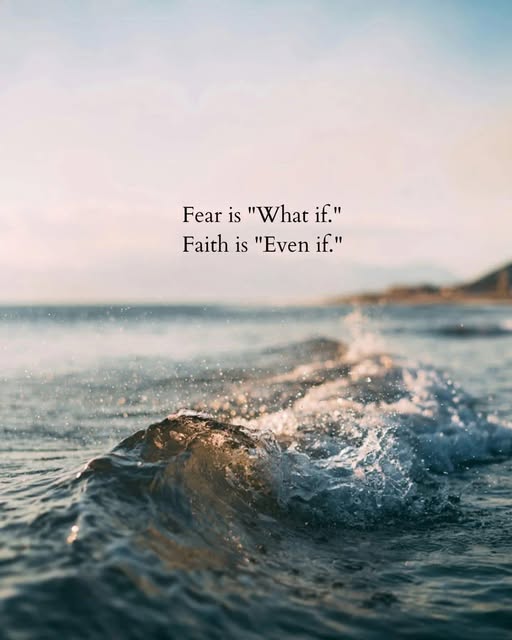
The end of the gospel reading I address in the bulletin column, but let’s wrap up here by going back to the second reading. I saw a Christian T-shirt some time ago, and I was very tempted to buy it, because in big letters it just said, “Even if.” Some of you might immediately get that reference. It’s a call-back to the book of Daniel when the three young men were threatened with being burned in the white hot furnace for being faithful Israelites. They respond to the king, “There is no need for us to defend ourselves before you in this matter. If our God, whom we serve, can save us from the white-hot furnace and from your hands, O king, may he save us! But EVEN IF he will not, you should know, O king, that we will not serve your god or worship the golden statue which you set up.” A few weeks ago I saw the next level of that, in a social media image, one of my favorites now, that says, “Fear says, ‘What if.’ Faith says, ‘Even if.’” Also related to our reading is the great quote by Saint Augustine, “Faith is to believe in what cannot be seen, and the reward of faith is to see that in which you have believed.” Saint Paul in our reading uses the beautiful example of the Old Testament mystics and prophetic figures who put their faith in God and were led through beautiful, sometimes excruciatingly difficult, acts of faith. They had listened to that voice that didn’t always tell them what they wanted to hear, but told them what they needed to do. And responding to that, they grew into the person they were called to be. They looked for and longed for the fulfillment of the great covenantal promises of God, when God would be all in all, and the world would be full of his glory and love. But these promises were not fulfilled in their time.

Paul says, “All these died in faith. They did not receive what had been promised but saw it and greeted it from afar.” They saw it through faith, and even if they didn’t see it fulfilled in their own time, they had so grown in faith in God by being obedient to his voice that they knew by faith that God was working all things toward that fulfillment. We have that fulfillment now, through Christ, however we have it only veiled in faith and mystery, signs and sacraments, awaiting the beautiful manifestation of the divine plan, even if we don’t see it in this life.

By our eager listening, waiting, and responding to the Word of God, and the whisper of the Holy Spirit within us, may we grow in our longing and love for him. May his will be done, through us, on earth as it is in heaven, through our “seemingly unimportant decisions,” which in faith are really our following the loving and beautiful will of God.