
Homily for the 28th Sunday of Ordinary Time, Year C (go to readings)
2 Kings 5:14-17
Psalm 98:1, 2-3, 3-4
2 Timothy 2:8-13
Luke 17:11-19
The first king of Israel, a thousand years before Jesus, was King Saul. He wasn’t a good king, and God instructed the prophet Samuel to anoint David to succeed him. Saul’s family was from the north, and David’s family was from the south, in Bethlehem, although David made Jerusalem the capitol city. When David decided to build the Jerusalem Temple, his prophet Nathan said it would not be him but his son Solomon who would build the Temple. King David started amassing resources, his son King Solomon built the Temple, and his son King Rehoboam repeatedly raised taxes and other funds to pay for the Temple.

But by this time, the tensions between north and south had gotten so heated that Israel split into two kingdoms, the ten northern tribes of Israel in the North, with its capitol, Samaria, and the two southern tribes of Judah, or Judea, in the South, with it’s capitol, Jerusalem. By a few hundred years later, the North, tired of seeing their money taken south and given to the Jerusalem Temple, set up their own shrines in the North, and they grew financially, morally, and religiously corrupt. For their unfaithfulness, the north was attacked and invaded by the great empire Assyria, with its capital, Ninevah. And the Assyrians wiped out most of the 10 northern tribes, dispersing them among the nations of the world, and Assyria replaced them with 5 different other groups that they had also conquered, each with their own religion and gods (remember the 5 previous husbands of the Samaritan woman!). Some poor areas of Israelites were left, mostly in Galilee, surrounding the Sea of Galilee, or Lake Tiberias.
A few hundred years after that, the southern kingdom of Judah was attacked by the Babylonians, or Chaldeans, and they marched the Judeans, or what was left of Israel, off to exile in Babylon, until the Babylonians were conquered by the Persians and then the Medes, who released Israel to go back to their land, and they resettled Judah and Galilee, while Samaria was still largely occupied by the foreigners who had been put there by the Assyrians, and who had intermixed with the Israelites who were left behind. And so the Israelites who returned from exile, having realized that the exile was their own fault for their corruption, had repented, and had, as they saw it, been released because they had returned to righteousness, now came back to find in their land these mongrels of corrupt breeding and corrupt religion, and these would be the Samaritans. So, by the time of Jesus, you had three geographic groups: the southern area around Jerusalem, under the rule of the Romans, the very northern area around the Sea of Galilee, kind of like Israel’s red-neck country, and in between you had the Samaritans, these half-breeds, who were an abomination. And it didn’t help that the Samaritans and Israelites constantly pushed each other’s buttons and kept the mutual hatred and tension high. And of course there were neighboring kingdoms such as Syria, Aram, Edom, Moab, etc, with whom Israel was at peace or at war with, depending on the day.
Also in the background of our readings today is the Mosaic Law in Leviticus that covers skin conditions. A fun read. The law really kind of groups a lot of skin diseases under the umbrella term, “leprosy,” although some were temporary, like an allergic rash, some were genetic, like psoriasis, and some were contagious, like fungus, bacteria, or what we now call Hanson’s disease, which is a bacterial infection that progressively kills the nerves, which numbs the skin, and leads to terrible infections and what we think of as leprosy specifically. So, in Leviticus, anyone with a skin disease is instructed to present themselves to the priest, who is not only usually the most-well educated in a village, but also the one whose office it is to protect the integrity and safety of the community, and the priest would declare you clean or unclean. If you were unclean, you had to isolate out of the community, stay far away from anyone else, shout “unclean” when anyone was approaching, and basically if it wasn’t something that cleared up, it was a life-sentence of isolation and despair, separated from family, friends, employment, temple or synagogue worship, and was often considered a divine punishment. It was a living death.
In our first reading, we meet the great Syrian warlord Namaan. Namaan had everything, but unfortunately, he also had leprosy. But he also had a slave girl from Israel, who informed him that there was a prophet, Elisha, in Israel, who could cure him. So Namaan set out for Israel with a letter from his king to give him safe passage to the King of Israel, asking for Namaan to be healed. Apparently, the letter didn’t mention the prophet, because when the King of Israel read the letter, he tore his garments and exclaimed, “Am I a god with power over life and death, that this man should send someone for me to cure him of leprosy? Take note! You can see he is only looking for a quarrel with me!” So Elisha the prophet hears about this, and sends a message to the king to send Namaan to him. And so Namaan, in all his splendor and gravitas and entourage arrives at Elisha’s house. And Elisha sends out a message to Namaan to wash seven times in the Jordan River, and he will be clean.
This is not the kind of treatment Namaan was used to. He was a very important person. Not only did this humble prophet not come out to greet him, just sending a messenger out, but go down into the sad dumpy mudhole that was the Jordan River, and do it seven times? There are much more beautiful rivers in Syria. And so, he’s angry and ready to go back home. But his servants talk him out of it. So then we pick up our first reading, “Naaman went down and plunged into the Jordan seven times at the word of Elisha, the man of God. His flesh became again like the flesh of a little child, and he was clean of his leprosy.” So not only was he healed, but you can imagine the rough, ruddy and calloused skin of a warrior. But it says his flesh became again like the flesh of a little child. We could say he was recreated, restored, to the original perfection that was lost. So that’s important. But what’s more important comes next. This foreigner, Namaan says to Elisha, “Now I know that there is no God in all the earth, except in Israel… please let me, your servant, have two mule-loads of earth, for I will no longer offer holocaust or sacrifice to any other god except to the LORD.“

You might remember that when Jesus started his ministry in Galilee, in the synagogue of Nazareth, he read from the scroll of Isaiah, and then he said, “there were many lepers in Israel during the time of Elisha the prophet; yet not one of them was cleansed, but only Naaman the Syrian.” And when the people in the synagogue heard this, they were all filled with fury. Why? Because that part of the scroll was a reference to the Messiah, they had heard of the signs and wonders he had done, and Jesus had just identified himself as the Messiah. But they were looking for a Messiah that was Israel’s Messiah, their long-awaited hero, who would free them from the oppression of the Romans. They weren’t interested in a Messiah whose attention was to those outside of Israel. They didn’t understand the full depth of the meaning of the Messiah, and that this was a spiritual rescue mission for eternal liberty, not a political mission for Israel. Their understanding of God’s gift was too small, or perhaps God’s gift was greater than they really wanted. They weren’t interested in those around them, just their own experience of suffering.
But again, as Jesus pointed out, they rejected him because they didn’t really know the scriptures. Look at our psalm, which of course is also from the Old Testament: “Sing to the LORD a new song, for he has done wondrous deeds; in the sight of the nations, he has revealed his justice. Sing joyfully to the LORD, all you lands!”
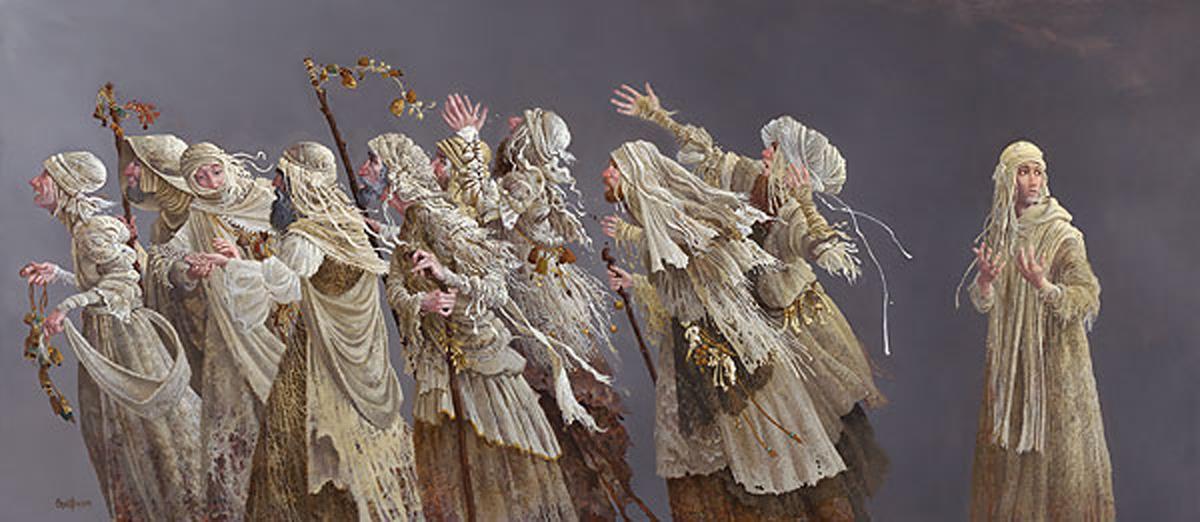
And so we end with seeing Jesus put his words into his works in the Gospel Reading from Luke. It starts off by saying, “As Jesus continued his journey to Jerusalem, he traveled through Samaria and Galilee. As he was entering a village, ten lepers met him. They stood at a distance from him and raised their voices, saying, ‘Jesus, Master! Have pity on us!’ And when he saw them, he said, ‘Go show yourselves to the priests.’”
So Jesus was in a sort of unsettled neutral territory between Galilee and Samaria, and he encounters these ten lepers, a mix of the two. Because suffering is kind of a great equalizer. They were banished from both their own communities and came together as the island of misfit toys, Israelites and Samaritans together. And they shout from a distance, as they’re required to do, but they don’t shout, “Unclean!” They shout, “Lord have mercy,” just as we always do at the beginning of Mass. “Kyrie, eleison!” in Greek.
And Jesus doesn’t approach them, he just instructs them, “Show yourselves to the priest,” As they were going, they were cleansed, so that when they would arrive at the priest, he would declare them clean, he would declare them not only healed and restored bodily, but restored as part of the body of the community. He healed their despair, their isolation, but he also healed their bonds of love, and their capacity to worship God in the temple, which they lost when they became unclean.
Now, a nice-intentioned modern person might have told them, “Well, you can go do what you want. Don’t listen to those rigid, exclusion-minded people.” But that’s “cheap grace.” It compromises truth to feel nice. But it robs people of the great joy of healing and reconciliation and thanksgiving experienced, after who knows how long of conversion, and praying and hoping for real healing and reconciliation. And God knows that the longer and deeper that suffering and longing is experienced, the greater and more complete is the joy and gratitude when that suffering is healed by the great mercy of God.
While I’m sure all the lepers in our gospel reading were joyful at their healing and restoration, only the Samaritan had the thanksgiving to return to Jesus. And it says, “And one of them, realizing he had been healed, returned, glorifying God in a loud voice; and he fell at the feet of Jesus and thanked him.” Not only did he thank him, he bowed, he prostrated—which you would only do in worship of God—at the feet of Jesus. He clearly understood that Jesus had power of God. Remember what the King of Israel had said, “Am I a god with power over life and death, that this man should send someone for me to cure him of leprosy?”
Nothing earthly could cure leprosy, the only hope was God, and here, God had healed, reconciled, and restored. Thanks be to God! And for the scriptures to point out that only this Samaritan, this foreigner, recognized Jesus’ divine power, was testimony, like Elisha healing Naaman, that God is calling all people—you, and me, and all the world—to recognize how we have been healed, how we are called to be restored and reconciled to God and to each other, and how we are called to offer our eucharistia, our thanksgiving praise to God. To “sing to the LORD a new song, for he has done wondrous deeds!”

 The Snarky Vicar