Homily: “Hail, Full of Grace”

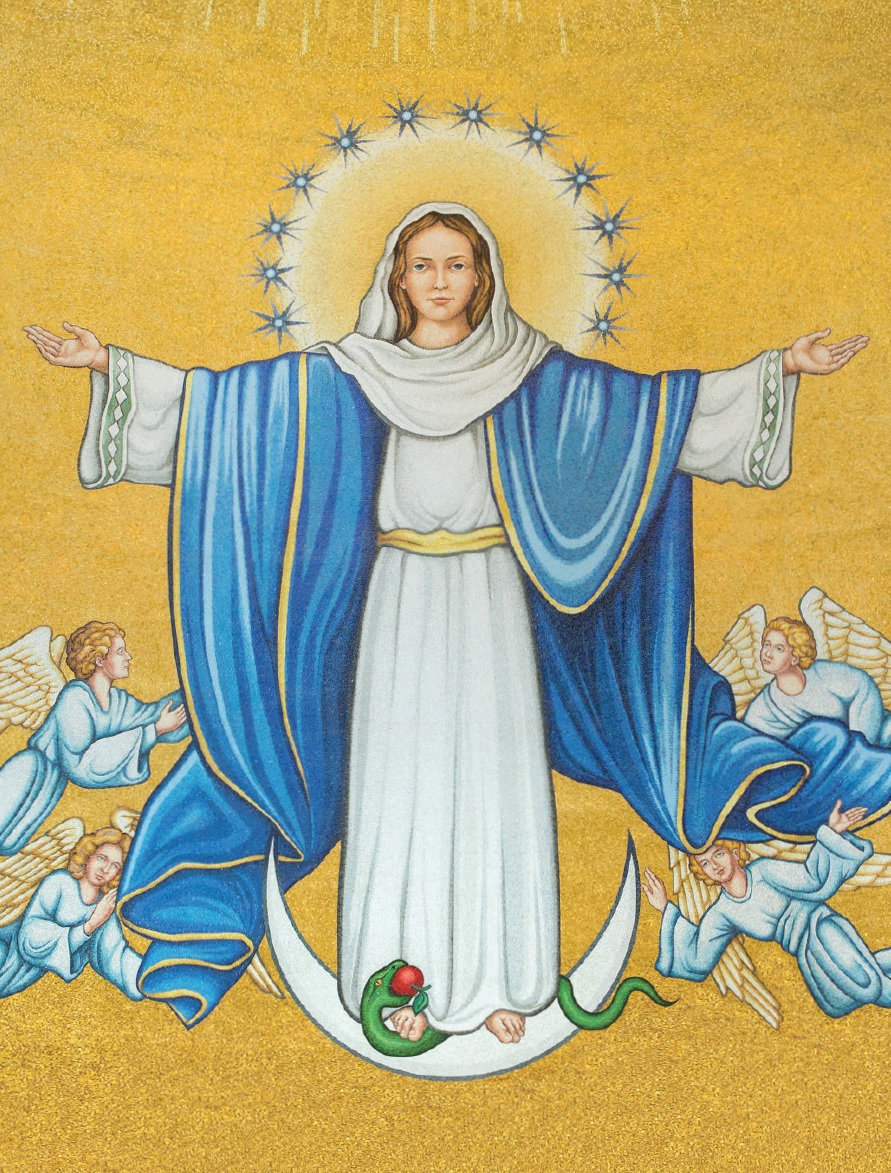
from the Trinity Dome of the National Basilica of the Immaculate Conception

Homily for the Solemnity of the Immaculate Conception (go to readings)


The Immaculate Conception is a dogma of the Christian Faith rooted in the scriptures and developed by Christian tradition and theological reasoning. In a paradox, The “most Blessed Virgin Mary, in the first instance of her conception, by a singular grace and privilege granted by Almighty God, in view of the merits of Jesus Christ, the Savior of the human race, was preserved free from all stain of original sin.” In other words, the grace of the paschal mystery of Christ saved his mother from sin not only before he was born, but before she was born. You can do that when you’re God.

The Immaculate Conception is an article of faith well-established in Christian tradition. Monks in Palestinian monasteries celebrated the Feast of the Conception of Our Lady by the 7th century. The feast spread as the Feast of the Immaculate Conception in Italy (9th c.), England (11th c.), and France (12th c.). In 1854 (19th c.), Pope Pius IX declared the Immaculate Conception to be a long-held doctrine, and now an infallible dogma of Faith.

In 1858, just four years later, in a grotto near the village of Lourdes, France, a young peasant girl named Bernadette Soubirous saw a mystical vision of a beautiful woman in a heavenly white dress and veil. When Bernadette asked who she was, the woman responded, “I am the Immaculate Conception.” Bernadette understood that it was the Blessed Mother; but didn’t understand the title. But the bishop did. As he was questioning Bernadette, he understood that because Bernadette didn’t understand, that this was not something she made up, and was a confirmation that it came from the vision of the woman herself, confirming the recently declared dogma of faith.

We know that there is precedence from the Scriptures. God purified the prophet Jeremiah in the womb of his mother: “Before I formed you in the womb of your mother, I knew you, and before you were born, I consecrated you” (Jer 1:5). The angel saluted Mary as “full of grace,” (we’ll come back to that). And we can recall the words from God to the serpent in Genesis: “I will put enmity between you and the woman, and her seed shall crush your head” (Gen 3:15). It is universal in Catholic Tradition to connect the woman in this prophecy in Genesis with Jesus’ prophetic words at the Wedding Feast of Cana, “Woman, what is this to us? My hour has not yet come,” and the prophetic vision in Revelation 12 of the woman clothed with the sun, with the moon under her feet, and on her head a crown of twelve stars; who is often portrayed in statues and images as standing on a serpent.

Also, from the standpoint of Holy Tradition and human reason, Our Lord was able to, one might say, stack the deck in favor of what he wanted his mother to be like: holy, beautiful, contemplative, kind, faithful, and free from sin. Some might say that this elevates Mary beyond our reach, and it would be easier to relate to her if she also shared in our burden of sinfulness. But the All-Holy God cannot be born incarnate from a woman who was a slave of the serpent, even for a moment in her life. There was enmity—perfect opposition—between the woman and sin, according to the promise of Genesis.

To use a common analogy, sin is like a mud puddle. Each of us at that moment of conception in our fallen human nature, we fall into the mud puddle, and we have original sin, the effects of which then lead us into personal sin, for which we need the sacraments of baptism and reconciliation. Mary, on the other hand, by a unique grace and gift of God, was guided around the mud puddle of sin, and she was conceived without sin, and never had sin. Whereas Jesus was free of sin by his divine nature, Mary was saved from sin by the grace of Christ, not by her own doing. But by that grace in her life (with her understanding and will not being diminished by sin), she was able to see sin for what it is and never choose it. Or perhaps put more accurately, it is not that Mary did not have the stain of sin that all humanity acquires at our conception, but rather that Mary was given at her conception the beautiful divine gifts of grace and holiness, which humanity has lacked since the Fall.

One notable 16th century theologian said, “It is a sweet and pious belief that the infusion of Mary’s soul was effected without original sin; so that in the very infusion of her soul she was also purified from original sin and adorned with God’s gifts, receiving a pure soul infused by God; thus from the first moment she began to live she was free from all sin.” That was a quote from Martin Luther.

“Hail, full of grace.” The words are beautiful, angelic, and rich in meaning. They are also a centuries-long fault line between Protestants and Catholics. Everything, it seems, hangs upon what is meant by “full of grace,” or whether full of grace is even the correct translation of Luke’s words. In Latin, the phrase becomes two words: plena gratia. In the original Greek, it’s just one, the phonetically unwieldy but potent in meaning: “kecharitōmenē” (κεχαριτωμένη). (Keh-car-ee-toe-MAY-nay)
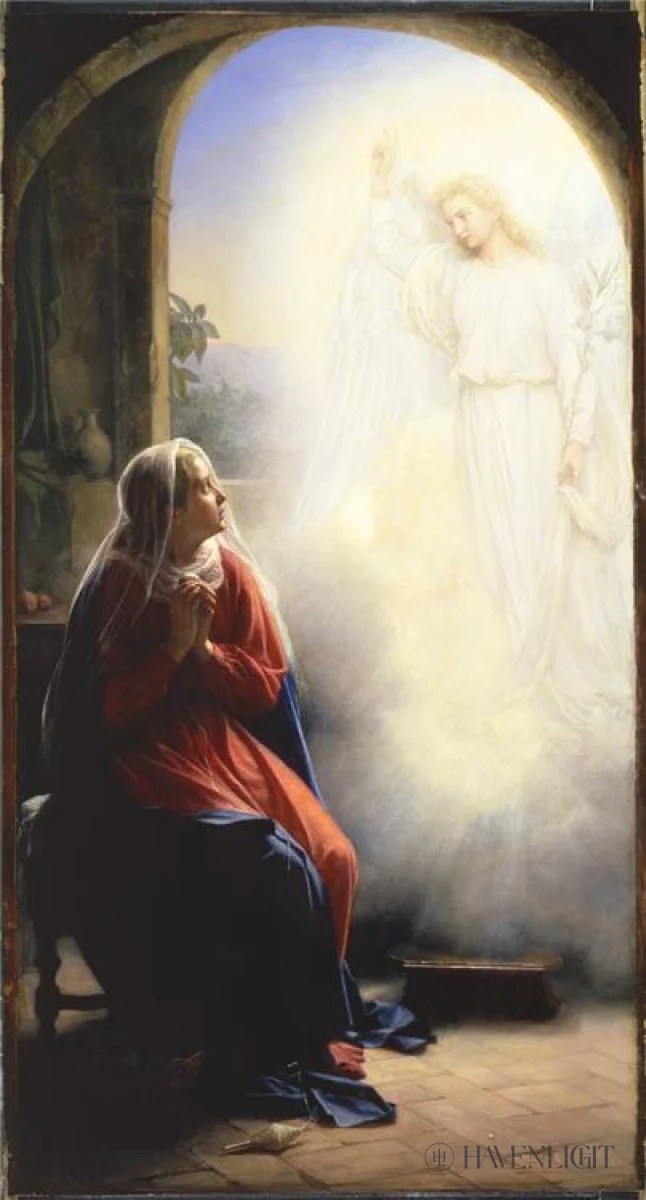
Under the influence of the Holy Spirit, St. Luke (who wrote his Gospel in Greek) documented the Archangel Gabriel’s words to Mary for posterity. St. Luke states that Gabriel referred to the Blessed Virgin Mary (Luke 1:28). Chaire, kecharitōmenē, ho kyrios meta sou! (Hail, “Full of Grace,” the Lord is with you!) The word that Luke uses—kecharitōmenē—is used nowhere else in the Scriptures or in any other Greek literature. It is a one-of-a-kind word for a one-of-a-kind person. No one else in human history is kecharitōmenē. I want to look carefully at what is clearly a very important word. The root is “charis,” which is translated as “grace,” or “gift,” and sometimes “favor.” But the root is a passive verb form, so it is more like being “graced, gifted, favored.” But it’s also present perfect, so it’s “having been graced, gifted, favored.” But also, because of the unique Greek tense that English doesn’t have, it denotes a completed action, the effects of which still continue in the present. It’s an enduring past action. Mary is from her beginning and forever one whose unique essence and disposition is to be perfectly filled with grace. The bible uses the Greek phrase “pleres charitos” (“plena gratia”) which literally means “full of grace” in some other places, such as St. Stephen at his martyrdom. But Luke didn’t use pleres charitos to refer to Mary. Pleres charitos is an adjective—it describes St. Stephen. But kecharitōmenē is a noun. It is a person who is, was, has been, and is being graced, as fundamental to the way of their existence.

What the Archangel Gabriel wants to communicate to Mary (and to us) in the word kecharitōmenē is that Mary has a unique name, a unique title, a unique role, and that she—though human—is a unique being in salvation history. Mary is she whose very name, whose very title, whose very person is to actively, perpetually receive grace in anticipation of, and in honor of, her role as Mother of God Incarnate, Jesus. That’s one reason why using “full of grace” does not go far enough. It is remarkable—in fact it is of utmost importance—that kecharitōmenē is clearly used by the angel Gabriel—the messenger of the most High God—as a proper noun, as Mary’s heavenly name. Kecharitōmenē is who Mary is, what Mary is, and not only what she has. She is the Kecharitōmenē,because of that “singular privilege and grace granted by God, in view of the merits of Jesus Christ, the Savior of the human race,” as Piux IX put it in the dogmatic definition.

That “singular privilege” requires a “singular word,” and Mary has such a word. Mary receives her heavenly name from the angel, which she then reveals as her identity to St. Bernadette. And what is revealed at the Annunciation, “Hail, kecharitōmēne,” is confirmed by Mary herself, at Lourdes. With great humility and grace she accepts the title bestowed on her by God through Gabriel, then later affirmed by the Church, identifying herself: “I am the Immaculate Conception.”

Homily: The Assumption of Mary, our Co-Redemptrix

Solemnity of the Assumption of the BVM
Vigil Readings: Go to readings

1 Chronicles 15:3-4, 15-16; 16:1-2
Psalm 132:6-7, 9-10, 13-14
1 Corinthians 15:54b-57
Luke 11:27-28
Feast Day Readings: Go to readings
Revelation 11:19A; 12:1-6A, 10AB
Psalm 45:10, 11, 12, 16
1 Corinthians 15:20-27
Luke 1:39-56


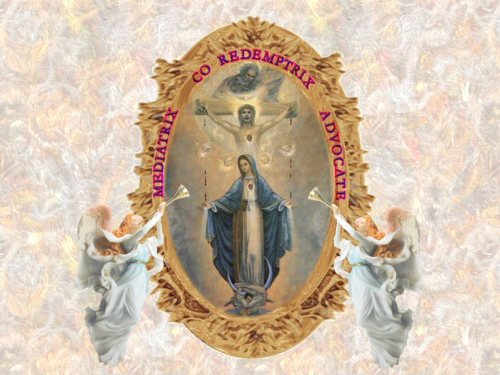
The Wisdom literature of the Bible says, “A three-ply cord is not easily broken” (Eccl 4:12). So, we are going to braid together three cords: the readings for the Vigil and for the Feast of the Assumption, and a timely article that just came out about Pope Leo XIV’s Marian devotion as displayed in his first 100 days as pope. The article is an interview with Dr. Mark Miravalle, a Catholic professor, on the topic of the Blessed Mother’s beautiful title as “Co-Redemptrix, Mediatrix of all graces, and Advocate for humanity.”

Pope Leo was elected on a Marian Feast Day, the Feast of Our Lady of Pompeii. Many popes across the centuries have prayed at this Marian shrine in Italy. It was from Pompeii that popular devotion began the call for the dogma of the Assumption. Our Lady of Pompeii is associated with the story of Blessed Bartolo Longo, a 20th century satanic priest who converted to the Catholic faith, became a Dominican tertiary, and had a deep, authentic devotion to Mary and the rosary. He became a friend of Pope Leo XIII (the first pope to approve the title for Mary as “coredemptrix”), and it was from Blessed Bartolo’s writings that Pope John Paul II developed the Luminous Mysteries of the Rosary. This feast of Our Lady of Pompeii, May 8, was previously the feast of Mary the Mediatrix of All Graces. So already just on day one, a lot of Marian connections for Pope Leo. He has not hesitated to make reference to Our Lady in the first moments of his papacy, calling us to pray with her, identifying her as our mother. It is his habit as pope to go to the basilica of Saint Mary Major to see the revered Byzantine icon Our Lady of Salus Populi Romani, held by Tradition to have been painted by the evangelist Saint Luke. His coat of arms has at the top of it the Fleur-de-lis, a heraldic symbol associated with Mary.


One of the difficulties between Catholics and Protestants regarding the Catholic devotion to Mary is that while the New Testament gives a few clues to Mary’s importance to the life and faith of Christians and the Church, the real revelation of Mary’s special importance lies in the Old Testament images she fulfills.

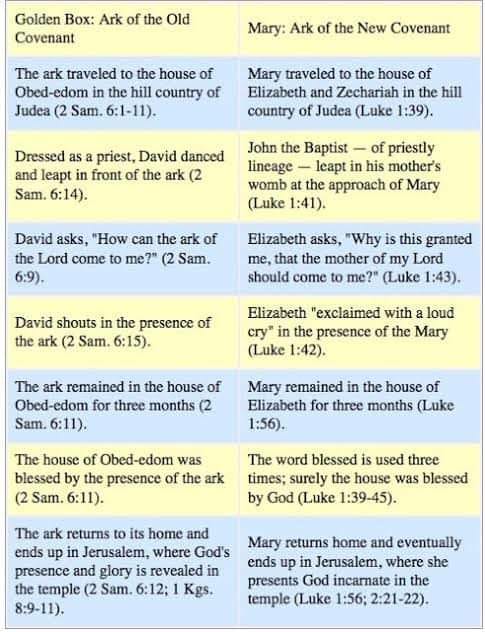
One of the best examples is the Marian title “The Ark of the New Covenant,” which we can see with first reading from the vigil with the first reading from the Feast Day, along with parts of the gospel reading from the Feast Day. The ark had been lost in battle and found, and King David was bringing it to Jerusalem. However, after a tragic accident, they postponed the procession, temporarily storing the ark in the home of Obed-edom whose home in the Judean hill country was blessed for the three months it stayed there. Then resuming the procession, David danced and shouted with joy before the Ark of the Lord as it was triumphantly enthroned in the sanctuary. David cried out, “Who am I, that the Ark of the Lord should come to me?” Remember the contents of the ark: it the staff of Aaron, a royal symbol of God’s power, a jar of mana, the bread of heaven, the answer to Moses’ priestly prayer on behalf of the people in the wilderness, and the broken tablets of the ten commandments, the prophetic word of God to guide his people in wisdom and righteousness (symbols of priest, prophet, and king). The ark was crowned with the mercy seat, on which the glory cloud of the Lord would overshadow and rest, the presence of the Lord with his people. We also see references to this in our psalm for this feast, “Lord, go up to the place of your rest, you and the ark of your holiness… Let us enter his dwelling, let us worship at his footstool.” The ark was lost again at the time of the Babylonian Exile and has never been found, and so the anticipation of the return of the ark was part of the hope of the Messianic fulfillment.

Putting that together with the gospel reading for the feast day, Mary had been, like the ark, overshadowed by the glory cloud, the Holy Spirit, and became the vessel of the Messiah, the Son of God, priest, prophet, and king, the presence of God amidst his people. When Elizabeth heard Mary’s voice, John the Baptist leapt in her womb, and Elizabeth shouted with joy, and said, “Who am I, that the Mother of my Lord should come to me” as David had leapt and shouted joyfully in the presence of the Ark. And their house, like that of Obed-edom, in the hill country of Judea, was blessed for the three months Mary was with them.

We see the ark again in the reading from the Book of Revelation of St. John, where he sees the Ark in the heavenly temple, and then goes on to describe this vision, “a woman clothed with the sun, with the moon under her feet, and on her head a crown of twelve stars. She was with child… She gave birth to a son, a male child, destined to rule all the nations…” John doesn’t change subjects, here—he’s saying that the ark is the woman with the crown of twelve stars. The figure of the ark has at last appeared again, in its fulfillment in Mary. Now we’re getting closer to our feast day.

Another helpful Old Testament connection is in the psalm for the feast day, “The queen stands at your right hand, arrayed in gold.” In the Kingdom of David, the queen wasn’t the king’s wife, he had many wives. The queen was the king’s mother. And she would sit at the right hand of the king, receiving the requests of the people and interceding on their behalf with her son, the king. So with Jesus being the new “Son of David”, whose kingdom will have no end, who would be the queen in this kingdom, but Mary, the king’s queen mother, who is a mother to all the children of the kingdom, and intercedes with her son on their behalf.


Now, the mystery of the Assumption is a fruit of the mystery of the Immaculate Conception. And the Immaculate Conception is a fruit of the mystery of the Annunciation. When the angel greeted Mary, he used a word in Greek that appears nowhere else: kecharitomēnē (κεχαριτωμένη). It refers to something, a person, whose very nature of existence is the act of receiving (being filled with) grace, and of course the definition of grace is “the life of God within us.” This word, kecharitomēnē, means more than “full of grace.” It is spoken only about this one special person, and the word is so special that the one time it is used it is said by an angel. So there’s something about Mary. Not only is she going to be the one to receive the life of God within her in the mystery of the Incarnation, but her whole life is a sinless response to this annunciation, as her whole life up to this moment has been a sinless preparation for it. God will receive his humanity from her (thus making her truly mother of God incarnate, Jesus), and she will have the role as queen intercessor of her people, as she showed at the Wedding Feast of Cana (Jn 2:2-11). This maternal care of Mary for the Church is further evidenced at the cross, as Jesus commends Mary, the woman, the mother, to John, the blessed disciple whom Jesus loved, which by extension is all of us.

Our gospel reading for the vigil has a woman calling out of the crowd to Jesus, “Blessed is the womb that carried you and the breasts at which you nursed.” He replied, “Rather, blessed are those who hear the word of God and observe it.” Some will say that this is Jesus distancing himself from Mary. But no one has heard the word of God and observed it better, with more purity of heart, than Mary. So indeed, blessed is the woman whose womb carried him, but not because of the physical bond of motherhood, but because of her spiritual role of motherhood and her spiritual role as the first and greatest disciple, the immaculately conceived, preserved, and protected vessel of grace. Mary herself confirms the immaculate conception when, 4 years after Pope Pius IX declares it as one of the Marian dogmas of the Christian faith in 1854, Mary says to Saint Bernadette at Lourdes, “I am the Immaculate Conception.”
But that begs the question, if Mary is the Immaculate Conception, perpetually without sin, did she suffer death, which is the consequence of sin? Adam and Eve, as the original parents of all humanity, introduced sin into humanity and propagated it to all their descendants. One of the titles of Mary is “The New Eve,” whose children live not unto death, but by the paschal mystery of the New Adam, who redeems and recreates humanity, live unto eternal life. The June 9th homily by Pope Leo, one of the clearest references to Our Lady’s co-redemption, says that Mary’s motherhood took an unimaginable leap to the cross where she becomes the new Eve and that Jesus has associated her in his redemptive death. That’s what the title co-redemptrix means: that Mary uniquely participates with Jesus, the new Eve with the new Adam, in the redemption of humanity. But the fact that Pope Leo brought the new Eve to Calvary is very significant. Jesus, who won infinite grace for our redemption, defers to the Blessed Mother in the distribution of those graces according to her maternal care of the children of God. She who loved with a perfect sinless heart could perfectly join herself in love to the sufferings of others, most especially her son, and then also all those who humbly call upon her intercession.


And so, we have our second reading from the feast day, Paul’s first letter to the Corinthians, quoting the prophet Hosea: “Death is swallowed up in victory. Where, O death, is your victory? Where, O death, is your sting?” And Paul continues, “The sting of death is sin, and the power of sin is the law. But thanks be to God who gives us the victory through our Lord Jesus Christ.”

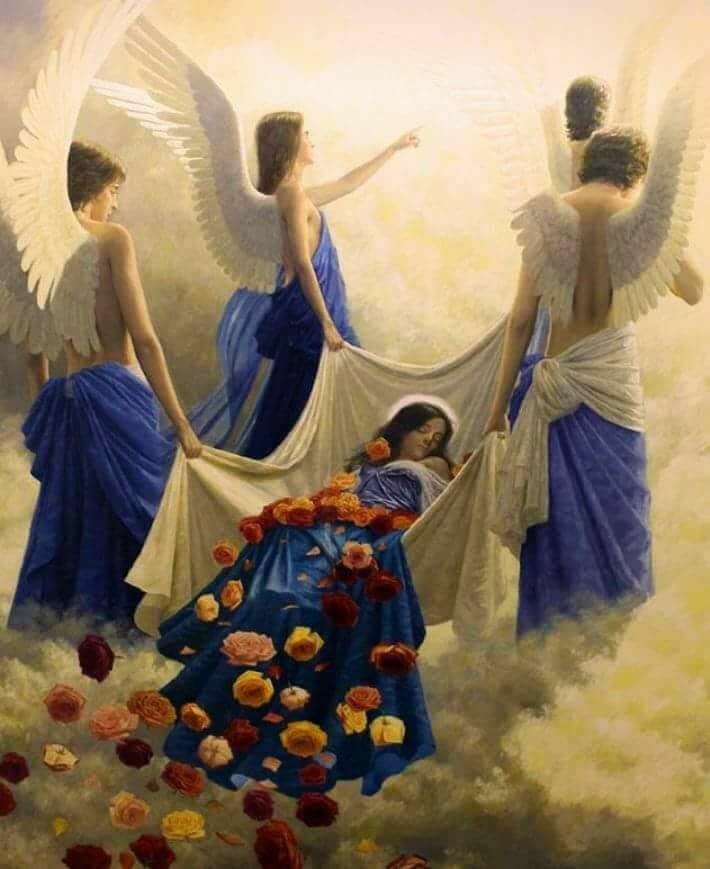
Mary perfectly lived the law, was not stung by sin, and so would not suffer death as a consequence. The Church carefully worded the dogma of the Assumption to not clearly resolve this question of whether Mary died. The definition of the dogma says, “that the Immaculate Mother of God, the ever Virgin Mary, having completed the course of her earthly life, was assumed body and soul into heavenly glory.” Jesus, by his divine nature, ascended to heaven by his own power. Mary, in her human nature, like ours, does not have that power, and was assumed into heaven by the power of God. There is a legend that Mary seemed to die, what the Eastern Church calls the mystery of the Dormition of Mary, and all the apostles buried her, except Thomas, who was working in India. When Thomas arrived, they re-opened the tomb and it was empty. Hence the seed planted in the apostolic tradition, nursed and developed over the centuries, until it was proclaimed by Pope Pius XII in 1950, not as something new, but as something whose time had come. In the face of the many modern human attempts that came after World War II and the rise of atheistic humanism to redefine humanity and our perfection, the Church puts forth in the Assumption the truth that God has defined the nature of humanity, and in God is the only real perfection of humanity; and the humble, prayerful, obedient Blessed Virgin Mary is the perfect image and example of how God exalts the soul that trusts in him, that he lifts up the lowly and glorifies the humble forever in eternal life.

Pope Leo XIV revealed his papal name to be a call-back to Leo XIII, who not only had a great Marian devotion, as we said earlier, but also a mission to protect the understanding of genuine human dignity in a time of global tension and injustice, just as Pope Pius responded to similar tensions in 1950, and also as Pope Leo XIV has in our time, against global tensions, injustice, and the potentially anti-humanistic threats latent in artificial intelligence: that he might safeguard what it means to be authentically human in an increasingly digital, virtual, and artificial world, but also to protect against a kind of digital idolatry, as people turn to AI to ask the profound questions of meaning, truth, good, and love, for which they should properly turn to God with prayer and dialogue, not to AI with a command prompt. Pope Leo gave a message to 50,000 young people at a youth festival in Rome, and said to them: “No algorithm can ever substitute an embrace, a glance, a true encounter, neither with God, nor our friends, nor our family. Think of Mary.” I think it revealed, in the mind of the Pope, that Our Lady has that ability of bringing back what is authentically human.

The truth of the importance of Mary is like Saint Augustine’s quote about scripture: the new is hidden in the old, and the old is revealed in the new. As we look at the mystery of the Blessed Mother, we are assured that our personal human nature was intentionally and personally designed with our body and soul, which is destined with meaning and for perfection. Mary as co-redemptrix is her privilege to participate in distributing the graces won by her son in his Paschal Mystery, as she was so painfully united to him in his suffering. He is the one mediator between God and humanity, but he generously shares the joy of distributing this grace, for those who call upon him in faith, especially through the intercession of the Blessed Mother, who for her humble faith and obedience in her special role in salvation history, was assumed body and soul into heaven, the sign of God’s promise of the fulfillment of our humanity and our eternal life.