
Homily for the Solemnity of the Immaculate Conception (go to readings)
The Immaculate Conception is a dogma of the Christian Faith rooted in the scriptures and developed by Christian tradition and theological reasoning. In a paradox, The “most Blessed Virgin Mary, in the first instance of her conception, by a singular grace and privilege granted by Almighty God, in view of the merits of Jesus Christ, the Savior of the human race, was preserved free from all stain of original sin.” In other words, the grace of the paschal mystery of Christ saved his mother from sin not only before he was born, but before she was born. You can do that when you’re God.
The Immaculate Conception is an article of faith well-established in Christian tradition. Monks in Palestinian monasteries celebrated the Feast of the Conception of Our Lady by the 7th century. The feast spread as the Feast of the Immaculate Conception in Italy (9th c.), England (11th c.), and France (12th c.). In 1854 (19th c.), Pope Pius IX declared the Immaculate Conception to be a long-held doctrine, and now an infallible dogma of Faith.

In 1858, just four years later, in a grotto near the village of Lourdes, France, a young peasant girl named Bernadette Soubirous saw a mystical vision of a beautiful woman in a heavenly white dress and veil. When Bernadette asked who she was, the woman responded, “I am the Immaculate Conception.” Bernadette understood that it was the Blessed Mother; but didn’t understand the title. But the bishop did. As he was questioning Bernadette, he understood that because Bernadette didn’t understand, that this was not something she made up, and was a confirmation that it came from the vision of the woman herself, confirming the recently declared dogma of faith.
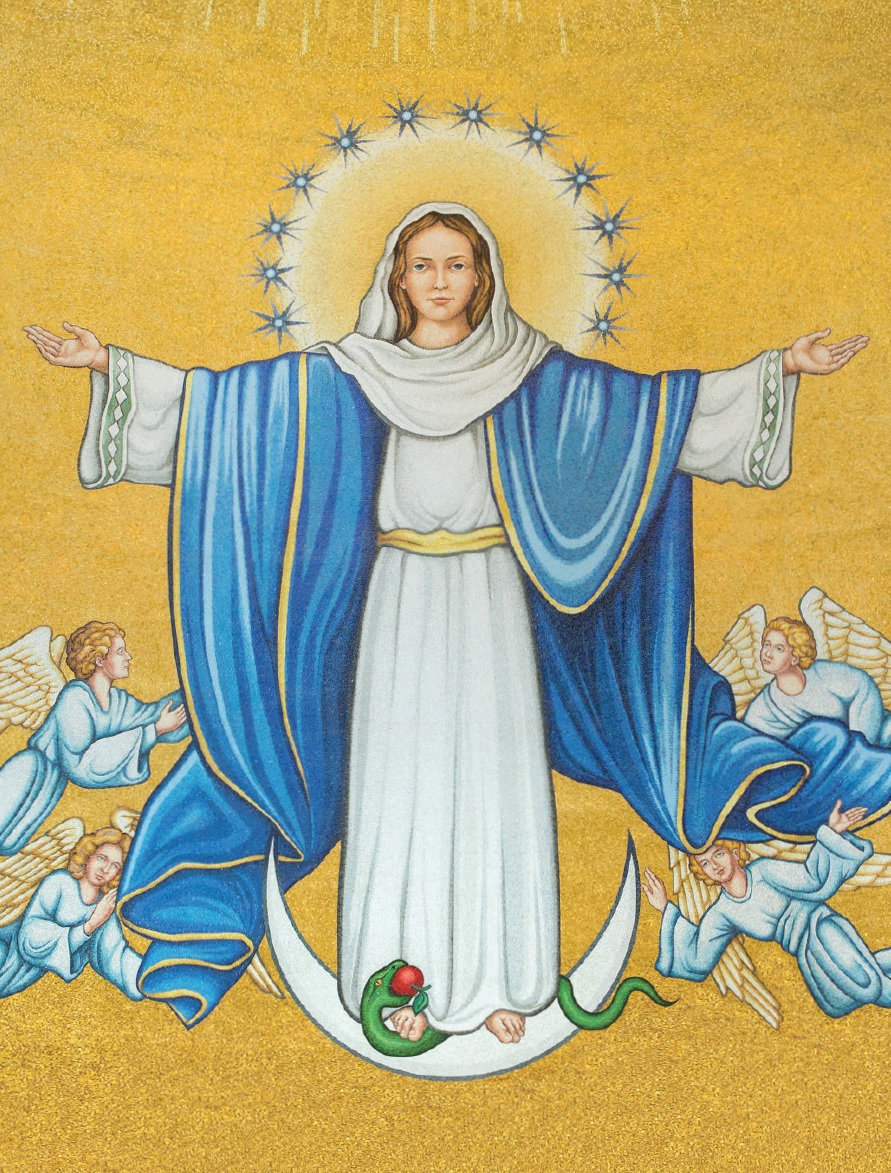
We know that there is precedence from the Scriptures. God purified the prophet Jeremiah in the womb of his mother: “Before I formed you in the womb of your mother, I knew you, and before you were born, I consecrated you” (Jer 1:5). The angel saluted Mary as “full of grace,” (we’ll come back to that). And we can recall the words from God to the serpent in Genesis: “I will put enmity between you and the woman, and her seed shall crush your head” (Gen 3:15). It is universal in Catholic Tradition to connect the woman in this prophecy in Genesis with Jesus’ prophetic words at the Wedding Feast of Cana, “Woman, what is this to us? My hour has not yet come,” and the prophetic vision in Revelation 12 of the woman clothed with the sun, with the moon under her feet, and on her head a crown of twelve stars; who is often portrayed in statues and images as standing on a serpent.
Also, from the standpoint of Holy Tradition and human reason, Our Lord was able to, one might say, stack the deck in favor of what he wanted his mother to be like: holy, beautiful, contemplative, kind, faithful, and free from sin. Some might say that this elevates Mary beyond our reach, and it would be easier to relate to her if she also shared in our burden of sinfulness. But the All-Holy God cannot be born incarnate from a woman who was a slave of the serpent, even for a moment in her life. There was enmity—perfect opposition—between the woman and sin, according to the promise of Genesis.
To use a common analogy, sin is like a mud puddle. Each of us at that moment of conception in our fallen human nature, we fall into the mud puddle, and we have original sin, the effects of which then lead us into personal sin, for which we need the sacraments of baptism and reconciliation. Mary, on the other hand, by a unique grace and gift of God, was guided around the mud puddle of sin, and she was conceived without sin, and never had sin. Whereas Jesus was free of sin by his divine nature, Mary was saved from sin by the grace of Christ, not by her own doing. But by that grace in her life (with her understanding and will not being diminished by sin), she was able to see sin for what it is and never choose it. Or perhaps put more accurately, it is not that Mary did not have the stain of sin that all humanity acquires at our conception, but rather that Mary was given at her conception the beautiful divine gifts of grace and holiness, which humanity has lacked since the Fall.
One notable 16th century theologian said, “It is a sweet and pious belief that the infusion of Mary’s soul was effected without original sin; so that in the very infusion of her soul she was also purified from original sin and adorned with God’s gifts, receiving a pure soul infused by God; thus from the first moment she began to live she was free from all sin.” That was a quote from Martin Luther.
“Hail, full of grace.” The words are beautiful, angelic, and rich in meaning. They are also a centuries-long fault line between Protestants and Catholics. Everything, it seems, hangs upon what is meant by “full of grace,” or whether full of grace is even the correct translation of Luke’s words. In Latin, the phrase becomes two words: plena gratia. In the original Greek, it’s just one, the phonetically unwieldy but potent in meaning: “kecharitōmenē” (κεχαριτωμένη). (Keh-car-ee-toe-MAY-nay)
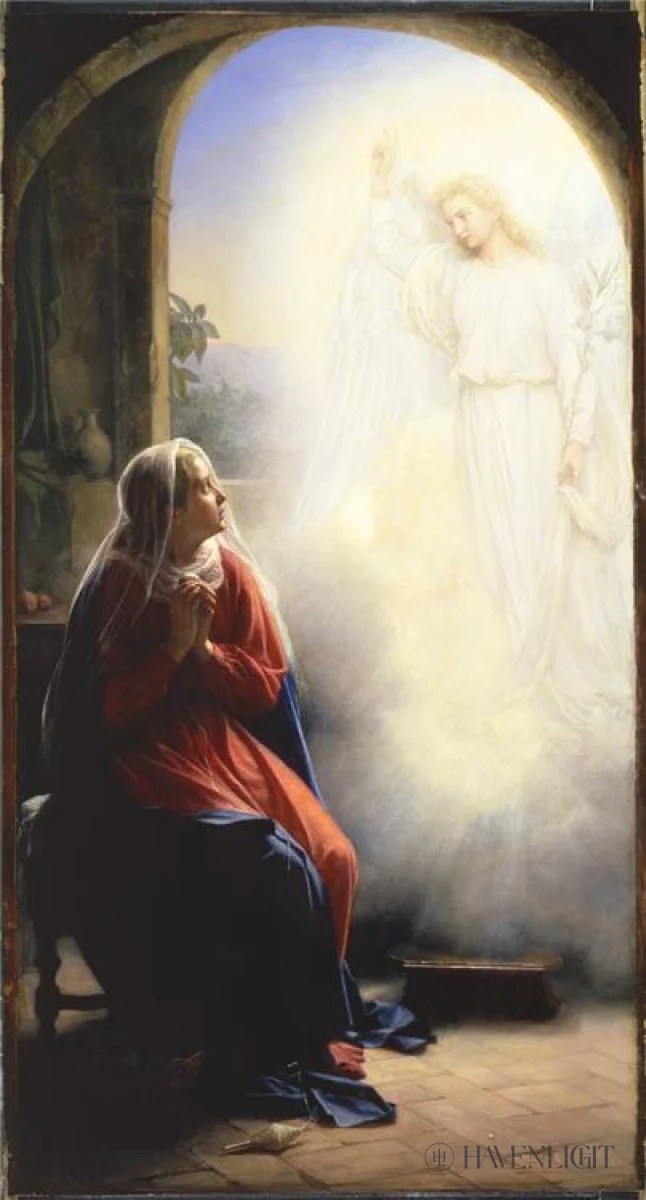
Under the influence of the Holy Spirit, St. Luke (who wrote his Gospel in Greek) documented the Archangel Gabriel’s words to Mary for posterity. St. Luke states that Gabriel referred to the Blessed Virgin Mary (Luke 1:28). Chaire, kecharitōmenē, ho kyrios meta sou! (Hail, “Full of Grace,” the Lord is with you!) The word that Luke uses—kecharitōmenē—is used nowhere else in the Scriptures or in any other Greek literature. It is a one-of-a-kind word for a one-of-a-kind person. No one else in human history is kecharitōmenē. I want to look carefully at what is clearly a very important word. The root is “charis,” which is translated as “grace,” or “gift,” and sometimes “favor.” But the root is a passive verb form, so it is more like being “graced, gifted, favored.” But it’s also present perfect, so it’s “having been graced, gifted, favored.” But also, because of the unique Greek tense that English doesn’t have, it denotes a completed action, the effects of which still continue in the present. It’s an enduring past action. Mary is from her beginning and forever one whose unique essence and disposition is to be perfectly filled with grace. The bible uses the Greek phrase “pleres charitos” (“plena gratia”) which literally means “full of grace” in some other places, such as St. Stephen at his martyrdom. But Luke didn’t use pleres charitos to refer to Mary. Pleres charitos is an adjective—it describes St. Stephen. But kecharitōmenē is a noun. It is a person who is, was, has been, and is being graced, as fundamental to the way of their existence.
What the Archangel Gabriel wants to communicate to Mary (and to us) in the word kecharitōmenē is that Mary has a unique name, a unique title, a unique role, and that she—though human—is a unique being in salvation history. Mary is she whose very name, whose very title, whose very person is to actively, perpetually receive grace in anticipation of, and in honor of, her role as Mother of God Incarnate, Jesus. That’s one reason why using “full of grace” does not go far enough. It is remarkable—in fact it is of utmost importance—that kecharitōmenē is clearly used by the angel Gabriel—the messenger of the most High God—as a proper noun, as Mary’s heavenly name. Kecharitōmenē is who Mary is, what Mary is, and not only what she has. She is the Kecharitōmenē,because of that “singular privilege and grace granted by God, in view of the merits of Jesus Christ, the Savior of the human race,” as Piux IX put it in the dogmatic definition.
That “singular privilege” requires a “singular word,” and Mary has such a word. Mary receives her heavenly name from the angel, which she then reveals as her identity to St. Bernadette. And what is revealed at the Annunciation, “Hail, kecharitōmēne,” is confirmed by Mary herself, at Lourdes. With great humility and grace she accepts the title bestowed on her by God through Gabriel, then later affirmed by the Church, identifying herself: “I am the Immaculate Conception.”




 The Snarky Vicar